
Why Is Interior Liturgical Architecture So Poor?

  • Thread starter Thread starter Exorcist
  • Start date Start date
Status
Not open for further replies.
Have you every read Pope Benedict’s “The Spirit of the Liturgy”?

If not, I think you should. It outlines what the CHurch is trying to accomplish during the Liturgy, and really, none of it involves actually seeing what is going on.

The Liturgy is about interior participation, how we listen to the Word spoke, the lessons of the Homily and the offering of one’s self as a Sacrifice along with the Sacrifice of the Altar offered by the priest.

The long, straight, narrow naves which you object to correspond to the procession of the Church Militant towards the Heavenly promise made visible in the Sanctuary.

One of the great charataristics of the Gothic Cathedrals of Europe was the tremendous vertically of the architecture, it draws the eyes upwards to Heaven and reinforces the transcendant nature of the Mass.

So I think the elements of architecture that you are proposing that the Church emphasize are not really the one’s the Church itself ( as witnessed by Pope Benedict’s book) chooses to stress,.

Or, as I tell my 5 year old when she complains that she can’t see when she kneels down for the Consecration “You are supposed to look with the eyes of your heart, that is where the REAL excitement is happening” 🙂

And full disclosure, I’ve got my first degree in Engineering, the second one is a BA in Art History - Ecclesial Architecture 😃
I’m sorry you missed my main point – “churches should be primarily designed to best facilitate the faithful’s exposure (of all five senses) to the sacrifice taking place atop the altar.”

Anything else is simply an excuse for poor design or limited budgets.
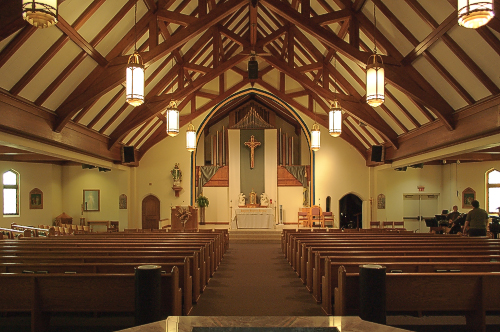
 
I’m sorry you missed my main point – “churches should be primarily designed to best facilitate the faithful’s exposure (of all five senses) to the sacrifice taking place atop the altar.”

No, I got your main point, and it is incorrect.

There is no need for the people to ‘see’ what is happening on the altar, at least with their eyes.

Rather, the architecture should emphasize the drawing of the people towards the Heavenly reality modeled in the sanctuary.

Take a look at Eastern Catholic Churches. The consecration and elevation happen behind an iconostasis and is visible only via two doors. The Mysteries are visually hidden from the people and that is by design. It creates a longing, a sense of desire.

flickr.com/photos/www-grkat-net/1107212779/

We are not yet in Heaven, but on a journey towards it. That was the nature of the ‘procession’ that Pope Benedict outlined in “The Spirit of the Liturgy”

Read that book. Church architecture should exist to reinforce the theology of the Liturgy. Your main point does not accomplish that.

The focus should be on the interior senses, what we see with the eyes of Faith, not the exterior ones.
 
My local parish was built in the early 90s and is in “the round.” No kneelers, either. The acoustics are good, and you can see from most seats (it’s large), but overall it just doesn’t feel quite like the Mass I grew up with. Looking back, my drifting away from the church coincided with the building of this parish, and the introduction of liturgical dancers, doing away with confirmation names and altar girls in yucky brown albs.
 
I asked a priest friend what he thought of church “x”'s plain appearance. He told me that it wasn’t “plain” but rather “noble simplicity” I respectfully disagreed with him. I told him it looked like junk to me. 😃
 
No, I got your main point, and it is incorrect.

There is no need for the people to ‘see’ what is happening on the altar, at least with their eyes.

Rather, the architecture should emphasize the drawing of the people towards the Heavenly reality modeled in the sanctuary.

Take a look at Eastern Catholic Churches. The consecration and elevation happen behind an iconostasis and is visible only via two doors. The Mysteries are visually hidden from the people and that is by design. It creates a longing, a sense of desire.

We are not yet in Heaven, but on a journey towards it. That was the nature of the ‘procession’ that Pope Benedict outlined in “The Spirit of the Liturgy”

Read that book. Church architecture should exist to reinforce the theology of the Liturgy. Your main point does not accomplish that.

The focus should be on the interior senses, what we see with the eyes of Faith, not the exterior ones.
Actually it’s your opinions that are incorrect – or rather excuses for poorly designed church structures.

Once more, “churches should be primarily designed to best facilitate the faithful’s exposure (of all five senses) to the sacrifice taking place atop the altar.” All the rest is secondary or less…
 
My local parish was built in the early 90s and is in “the round.” No kneelers, either. The acoustics are good, and you can see from most seats (it’s large), but overall it just doesn’t feel quite like the Mass I grew up with. Looking back, my drifting away from the church coincided with the building of this parish, and the introduction of liturgical dancers, doing away with confirmation names and altar girls in yucky brown albs.
That might well be the case, but that doesn’t mean it’s necessarily a bad thing.

The other variables you mention are not a function of church architecture.
 
Actually it’s your opinions that are incorrect – or rather excuses for poorly designed church structures.

Once more, “churches should be primarily designed to best facilitate the faithful’s exposure (of all five senses) to the sacrifice taking place atop the altar.” All the rest is secondary or less…
You keep posting the same sentence, “churches should be primarily designed to best facilitate the faithful’s exposure (of all five senses) to the sacrifice taking place atop the altar.” as if it is a fact stated by the Church herself. You are fine to say someone else’s statement is an opinion, but to declare your own statement as fact is just as disingenuous.

My local Parish’s sanctuary is a more modern design, with shorter aisles and extra ones added on each side for viewability, but to me, it feels more like an amateur theater than a place where the sacrifice on Calvary is being re-presented at times. This is due not to the design itself, but to by the minimalist and more community, people centered approach to the liturgy.


Contrast the above image with this one of my personal parish for the TLM.

https://sphotos-a.xx.fbcdn.net/hphotos-ash4/183996_185077444891131_933449_n.jpg

Now, this whole time you’ve been saying that all five senses need to be stimulated in some way to be effective. I fail to see how a church that centers on merely the visual aspect and emphasizing a more seemingly ‘communal’ design is more effective than a traditionally designed church.

In fact, I would argue that the church in the second picture is more effective at your five senses thing, as that church actually employs incense on a regular basis, is painted to be visually appealing, is marked by a clear reredos on where the altar is, allows for kneeling before the altar, touching the altar rail which is made of the same material as the altar, underscoring the sacrifice of the cross, and how when we go to communion during mass, how we have participated in this sacrifice…there are many ways that the church in the second picture invokes the senses that the first just does not.

Merely being close to the altar in a semicircle doesn’t automatically fulfill all five senses. In fact, it could be argued that it’s not always the ideal form of a visual expression!

Sacrosanctum Concillium states that the church has no monopoly or ownership of any style. This is true. But it also states that the architecture, art, and celebration of the liturgy should first and foremost point towards God, not man. I fail to see how your reasons given have shown that modern architecture supersedes the traits in gothic or romanesque churches on these points or quite frankly, even is equal at stimulating the faithful.
 
You keep posting the same sentence, “churches should be primarily designed to best facilitate the faithful’s exposure (of all five senses) to the sacrifice taking place atop the altar.” as if it is a fact stated by the Church herself. You are fine to say someone else’s statement is an opinion, but to declare your own statement as fact is just as disingenuous.

My local Parish’s sanctuary is a more modern design, with shorter aisles and extra ones added on each side for viewability, but to me, it feels more like an amateur theater than a place where the sacrifice on Calvary is being re-presented at times. This is due not to the design itself, but to by the minimalist and more community, people centered approach to the liturgy.

http://farm7.static.flickr.com/6196/6148799207_7ce669700d_o.jpg

Contrast the above image with this one of my personal parish for the TLM.

https://sphotos-a.xx.fbcdn.net/hphotos-ash4/183996_185077444891131_933449_n.jpg

Now, this whole time you’ve been saying that all five senses need to be stimulated in some way to be effective. I fail to see how a church that centers on merely the visual aspect and emphasizing a more seemingly ‘communal’ design is more effective than a traditionally designed church.

In fact, I would argue that the church in the second picture is more effective at your five senses thing, as that church actually employs incense on a regular basis, is painted to be visually appealing, is marked by a clear reredos on where the altar is, allows for kneeling before the altar, touching the altar rail which is made of the same material as the altar, underscoring the sacrifice of the cross, and how when we go to communion during mass, how we have participated in this sacrifice…there are many ways that the church in the second picture invokes the senses that the first just does not.

Merely being close to the altar in a semicircle doesn’t automatically fulfill all five senses. In fact, it could be argued that it’s not always the ideal form of a visual expression!

Sacrosanctum Concillium states that the church has no monopoly or ownership of any style. This is true. But it also states that the architecture, art, and celebration of the liturgy should first and foremost point towards God, not man. I fail to see how your reasons given have shown that modern architecture supersedes the traits in gothic or romanesque churches on these points or quite frankly, even is equal at stimulating the faithful.
👍 Enjoyed your post.🙂
 
It is happy circumstance this thread came up when it did. Last night I attended a Veterans Day vespers in a small town in a small church. It was a musical celebration with a massed choir, brass, and bagpipes.

This church was designed in a very traditional shape, high ceiling, narrow nave from the modern materials the small parrrish could afford. Their was no stained glass or carved stone. In fact it was made or cinder block and glass bricks.

But the shape was of a mideaval monastery like a fortrress surrounding a central courtyard. The church was one side, the parsh hall one side. Offices and chapel for week day Masses, and meeting rooms making up the other two sides.

The small 15 rank Casavant Freres organ filled the church with sound holding it’s own against the brass, and 5 pipers.

I intend to make the trip every year.
 
You keep posting the same sentence, “churches should be primarily designed to best facilitate the faithful’s exposure (of all five senses) to the sacrifice taking place atop the altar.” as if it is a fact stated by the Church herself. You are fine to say someone else’s statement is an opinion, but to declare your own statement as fact is just as disingenuous…
Fair enough. Let’s break this down. What is the primary reason we attend Mass? It’s not to pray. It’s not for fellowship or to hear the word of the Lord proclaimed. It’s not even to receive holy communion. It’s to be present at Calvary as Jesus Christ is offered to His Father for our sins so that the grace flowing from that monumental event graces those in attendance.

You disagree with that fact?

In any event it logically follows that “churches should be primarily designed to best facilitate the faithful’s exposure (of all five senses) to the sacrifice taking place atop the altar.”

Further, good architecture puts the Mass (more specifically the sacrifice) and not its own details as the central focus. Some churches are architecturally noisy inside and seem to do everything they can to pull one’s focus away from the altar. That’s poor design.

There is very little difference between the two churches you posted. One has a lot more bric-a-brac than the other. Both are very conventional designs – with all the shortcoming that come along with such designs.
 
Fair enough. Let’s break this down. What is the primary reason we attend Mass? It’s not to pray. It’s not for fellowship or to hear the word of the Lord proclaimed. It’s not even to receive holy communion. It’s to be present at Calvary as Jesus Christ is offered to His Father for our sins so that the grace flowing from that monumental event graces those in attendance.

You disagree with that fact?

In any event it logically follows that "churches should be primarily designed to best facilitate the faithful’s exposure (of all five senses) to the sacrifice taking place atop the altar."

Further, good architecture puts the Mass (more specifically the sacrifice) and not its own details as the central focus. Some churches are architecturally noisy inside and seem to do everything they can to pull one’s focus away from the altar. That’s poor design.

There is very little difference between the two churches you posted. One has a lot more bric-a-brac than the other. Both are very conventional designs – with all the shortcoming that come along with such designs.
I disagree in one respect. We are not merely there to be present, or even to be present and cognizant of the sacrifice of the mass. We are there to assist Christ in the manner God has prescribed through his bride, the church. Our assistance bares some similarities to that offered by the faithful of the old covenant in Solomon’s time, where there was a barrier between the people and the high priest who was in the holy of holies.

I do not mention this to say that there needs to be a visual barrier between the altar and the nave. Instead I wish to point out that the offering of a perfect, most holy sacrifice relies not on the faithful at all-It relies on the priest, validly ordained, who is present with the faithful spiritually, and all the angels and saints, as Christ is made present in the sacrifice and offers himself for our sins to the father.

It is indeed highly encouraged that the faithful be present, that they be participating, that they are able to see the high altar. I’ll even agree that a church’s design should take into account laity assisting at the mass, and best facilitating the graces they can receive. But this is still not the Church’s primary goal in its construction. It is mightily important yes, but not primary.

The primary importance (as I see it) in Church design is creating as best a suitable temple for God, where sacrifice can be offered to him in dignity. The accidents of location, size, visibility, etc. are of secondary importance when compared to this. If we compromise the design for participatory reasons, we’ve already lost what a church is about in the first place: a suitable place for the sacrifice of our Lord himself.

One last thought: a friend told me how he usually stopped in an adoration chapel to pray. He went before work on a winter morning during a snowstorm, and found a priest and an altar server celebrating mass, all alone. He decided to stay, and afterwords asked the priest why he still had mass when there was such a bad snow storm. Wouldn’t he know that no one would be there?

The priest replied that He wasn’t alone, and that it was for all those who couldn’t or were not there that he offered mass.
 
I disagree in one respect.
“…primary reason…”
We are not merely there to be present, or even to be present and cognizant of the sacrifice of the mass. We are there to assist Christ in the manner God has prescribed through his bride, the church. Our assistance bares some similarities to that offered by the faithful of the old covenant in Solomon’s time, where there was a barrier between the people and the high priest who was in the holy of holies.

I do not mention this to say that there needs to be a visual barrier between the altar and the nave. Instead I wish to point out that the offering of a perfect, most holy sacrifice relies not on the faithful at all-It relies on the priest, validly ordained, who is present with the faithful spiritually, and all the angels and saints, as Christ is made present in the sacrifice and offers himself for our sins to the father.

It is indeed highly encouraged that the faithful be present, that they be participating, that they are able to see the high altar. I’ll even agree that a church’s design should take into account laity assisting at the mass, and best facilitating the graces they can receive. But this is still not the Church’s primary goal in its construction. It is mightily important yes, but not primary.

The primary importance (as I see it) in Church design is creating as best a suitable temple for God, where sacrifice can be offered to him in dignity. The accidents of location, size, visibility, etc. are of secondary importance when compared to this. If we compromise the design for participatory reasons, we’ve already lost what a church is about in the first place: a suitable place for the sacrifice of our Lord himself.

One last thought: a friend told me how he usually stopped in an adoration chapel to pray. He went before work on a winter morning during a snowstorm, and found a priest and an altar server celebrating mass, all alone. He decided to stay, and afterwords asked the priest why he still had mass when there was such a bad snow storm. Wouldn’t he know that no one would be there?

The priest replied that He wasn’t alone, and that it was for all those who couldn’t or were not there that he offered mass.
 
Status
Not open for further replies.
Back
Top