Why is the Eastern Orthodox Church false?

  • Thread starter Thread starter John214
  • Start date Start date
Status
Not open for further replies.
1)It has been mentioned that the 28th Canon of the Council of Chalcedon explicitly stated that the reason that Rome had it’s place was based on its imperial authority. Granted Rome rejected this, does it not show that at least the majority idea (within the East at the least) was that Rome’s primacy was based on this? Keep in mind this was in the 450s and that over 500 bishops attended.
There were only 192 signatories to canon 28,and most of them were based in or around Constantinople.

From this article by Mark Bonocore: bringyou.to/apologetics/a35.htm

< In the same way, upon concluding their synod, the Council fathers write to Pope Leo, saying…

You are set as an interpreter to all of the voice of blessed Peter, and to all you impart the blessings of that Faith. – Chalcedon to Pope Leo, Ep 98

For if where two or three are gathered together in His name He has said that there He is in the midst of them, must He not have been much more particularly present with 520 priests, who preferred the spread of knowledge concerning Him …Of whom you were Chief, as Head to the members, showing your good will. – Chalcedon to Pope Leo (Repletum est Gaudio), November 451

Besides all this, he (Dioscorus) extended his fury even against him who had been charged with the custody of the vine by the Savior. We refer to Your Holiness. – Chalcedon to Pope Leo, Ep 98

You have often extended your Apostolic radiance even to the Church of Constantinople. – Chalcedon to Pope Leo, Ep 98

Knowing that every success of the children rebounds to the parents, we therefore beg you to honor our decision by your assent, and as we have yielded agreement to the Head in noble things, so may the Head also fulfill what is fitting for the children. – Chalcedon to Pope Leo, Ep 98

So, the Council of Chalcedon clearly recognized Pope Leo as the successor of Peter and the Head of the Church. However, the Council did have one problem. One of its canons, Canon 28, had given Constantinople primacy in the East. The Canon read:

“…we do also enact and decree the same things concerning the privileges of the most holy Church of Constantinople, which is New Rome. For the Fathers rightly granted privileges to the throne of old Rome, because it was the royal city. And the one hundred fifty most religious Bishops gave equal privileges to the most holy throne of New Rome, justly judging that the city is honored with the Sovereignty and the Senate and enjoys equal privileges with the old imperial Rome…” (Canon 28, Chalcedon)

However, Pope Leo refused to agree to this canon; and employing a kind of “line item veto,” ordered it struck from the Council documents. In this, Bishop Anatolius of Constantinople writes to Pope Leo, apologizing and explaining how the canon came to be, saying …

As for those things which the universal Council of Chalcedon recently ordained in favor of the church of Constantinople, let Your Holiness be sure that there was no fault in me, who from my youth have always loved peace and quiet, keeping myself in humility. It was the most reverend clergy of the church of Constantinople who were eager about it, and they were equally supported by the most reverend priests of those parts, who agreed about it. Even so, the whole force of confirmation of the acts was reserved for the authority of Your Blessedness. Therefore, let Your Holiness know for certain that I did nothing to further the matter, knowing always that I held myself bound to avoid the lusts of pride and covetousness. – Patriarch Anatolius of Constantinople to Pope Leo, Ep 132 (on the subject of canon 28 of Chalcedon).

So, the matter was settled; and, for the next 6 centuries, all Eastern churches speak of only 27 canons of Chalcedon – the 28th Canon being rendered null and void by Rome’s “line item veto.” This is supported by all the Greek historians, such as Theodore the Lector (writing in 551 AD), John Skolastikas (writing in 550 AD), Dionysius Exegius (also around 550 AD); and by Roman Popes like Pope St. Gelasius (c. 495) and Pope Symmachus (c. 500) – all of whom speak of only 27 Canons of Chalcedon. >

See also this thread: forums.catholic-questions.org/showthread.php?t=208250&highlight=canon+28+proves+old+rome
 
From Luke Rivington’s The Byzantine Plot:
mwt.net/~lnpalm/byzantin.htm

< Of the two ‘greater sees’ Alexandria was vacant, and Antioch was occupied by a partisan of Anatolins, who owed to him his irregular elevation, which had been pardoned by Rome only (as Leo said) ‘for the sake of peace.’ [6]

Constantinople, therefore, had nothing to fear from these. She only needed a lack of scrupulous fairness on her own part to enable her to press the matter to a successful issue under these favourable circumstances. But further, she could count upon at least the silence of another leading prelate, viz. Juvenal of Jerusalem, who had himself just gained the object of his ambition for the last twenty years in the compromise by which he had wrested three provinces from Antioch. He at any rate was not in a position to complain of any illicit stretch of jurisdiction on the part of another. And Juvenal and Anatolius had a further bond in that both had come under the influence of Dioscorus and coquetted with Eutychianism. Then the Bishop of Heraclea, the Primate of Thrace, was absent, and he was very closely concerned in the project that Constantinople had before her of extending her actual jurisdiction as well as securing the semblance of synodical sanction for titular precedence. This primate was represented by Lucian, who was so friendly to Anatolius that he was sent by him to Rome on this very matter. Ephesus, again, of supreme importance, as one of the exarchies to be robbed of its autonomy, was vacant, Bassian and Stephen having been deposed. Thalassius of Csesarea was there, but did not subscribe. The Illyrians were not there, not even Thessalonia, neither was Ancyra, Corinth, Nicomedia, Cos, or Iconium, all of them important centres. In fact, the little knot of bishops whom Constantinople gathered round herself by various means could not by any stretch of language be called a representative ecclesiastical body. Moreover they had no leave from Rome to discuss the question now forced upon the bishops by Constantinople; it was no part of the council’s programme. It was simply a plot against the Church’s order, with hardly a name that would command the confidence of the Church except Eusebius of Dorylium. >

< On the following day the Papal legates demanded an explanation of what had been done in their absence. They had absented themselves on the technical ground that after the definition of faith had been drawn up, and the matter of the lapsed bishops dealt with, their commission ended. But it turned out that they had also received orders from Rome to oppose any attempt at altering the relations of bishops on the ground of the civil status of their sees. Leo was already well aware of the ambitious projects of Constantinople. >

< In spite, however, of the legates’ protest the bishops voted the canon.

The matter could not, of course, stand there. Comparatively speaking, as we have seen, they were but a handful of bishops [14], most of them of sees grouped round Constantinople, and their leaders far from enjoying the esteem of the Catholic world. Their canon was the work ‘rather of Greek sophists than of Fathers of the Church.’ [15] They had adroitly tacked on their new claim over three large metropolitanates (which by the Nicene Council had been left autonomous) to the third canon of Constantinople, so that the new and old parts read like one, in which, as Canon Bright remarks, they were more ‘astute than candid.’ It was not true, as they asserted, that the Fathers (if the Nicene Fathers were meant) ‘gave’ her (patriarchal [16]) privileges to the See of Rome; they only recognised what was already ancient. It was not true that what the Nicene Fathers recognised as ancient custom was due to the secular position of the See of Rome. Her privileges were settled by herself as See or St. Peter. It was not true that the Fathers of Constantinople had bestowed anything in the way of jurisdiction, but merely the second rank in the way of honorary precedence. It was not true that Constantinople had any right over Pontus, Thrace, and Asia Minor. The bishops, moreover, enunciated a principle, which had its natural sequel in the present subservience of the Greek schism to the Czar on the one hand and to the Sultan on the other [17]. It so mixed up the movements of the Church and the State as to secularise the former and ensconce the latter in the position of the real determinant of the Church’s jurisdiction. No wonder that only about 150 bishops out of the original 600 could be induced to sign [Note: Rivington made an error here. The correct number is 192 signatories.], and that St. Leo could fearlessly call it an ‘extorted subscription,’ even after some few at the session had denied that they were compelled to subscribe. St. Leo knew that his legates were right in their estimate of the kind of influence that had been brought to bear upon these subservient bishops. >
 
Just decided to peek my head in here one last time 'fore Pascha…
So, the matter was settled; and, for the next 6 centuries, all Eastern churches speak of only 27 canons of Chalcedon – the 28th Canon being rendered null and void by Rome’s “line item veto.” This is supported by all the Greek historians, such as Theodore the Lector (writing in 551 AD), John Skolastikas (writing in 550 AD), Dionysius Exegius (also around 550 AD); and by Roman Popes like Pope St. Gelasius (c. 495) and Pope Symmachus (c. 500) – all of whom speak of only 27 Canons of Chalcedon.
The above, which you cited, is from Mark Bonocore’s apologetics website–hardly a scholarly source. This claim is frequently repeated, with absolutely no substantiation. Rather than not speaking of 28 canons 'til at least 1051 AD (a claim which I find dubious), “for the next six centuries” is actually a misunderstanding that should read “until the sixth century,” which is more accurate. Even a pro-Catholic polemical website somewhat backs me up on this:

ancientpapacy.org/articles/chalcedon.htm

There are also some outright misrepresentations in this claim. For example, I’m 90% sure that canon 28 was incorporated into Justinian’s Corpus iuris civilis (which enacted the Chalcedonian canons into law) in 554 A.D. I also know for a fact that canon 36 of the Quinsext Council of 692 A.D. specifically confirmed Chalcedon canon 28 into the canon law of the Eastern Church. (You can look up Quinsext 36 on newadvent, as a matter of fact.)

Thus, I’m going to call BS on this one until it’s backed up. Substantiate with primary sources, please, and please make sure to double-check your facts in the future. It muddies the debate and makes you look bad, particularly since the real facts of the matter prove that, for all his bloviation, Leo basically got ignored in short order–which supports the Orthodox argument that the papacy claimed authority it neither truly possessed nor was able to exercise (St. Anatolius’ humble, deferential, peacemaking, and thoroughly Christian letter notwithstanding).

Pax. 🙂

EDIT: Schaff also remarks:

The papal annulling does not appear to have been of much force, for Leo himself confesses, in a letter written about a year later to the Empress Pulcheria (Ep. cxvi.), that the Illyrian bishops had since the council subscribed the xxviiith canon.

And it should also be remembered that Rome herself gave tacit ratification to Canon 28 when she approved the Seventh Ecumenical Council, which ratified the Quinsext canons, which had ratified Chalcedon 28. This also helps explain why Rome tacitly accorded Constantinople second place at the Ignatian and Photian councils of the late ninth century.
 
The above, which you cited, is from Mark Bonocore’s apologetics website–hardly a scholarly source. This claim is frequently repeated, with absolutely no substantiation. Rather than not speaking of 28 canons 'til at least 1051 AD (a claim which I find dubious), “for the next six centuries” is actually a misunderstanding that should read “until the sixth century,” which is more accurate. Even a pro-Catholic polemical website somewhat backs me up on this:

ancientpapacy.org/articles/chalcedon.htm

The article says: “For example, the early sixth century historian Theodore Lector speaks of twenty-seven canons of Chalcedon. John Scholasticus, the mid-sixth century patriarch of Constantinople, did not include canon 28 in his collection of canons. Numerous Latin collections give only twenty-seven canons of Chalcedon as well.”

Who in the 6th century regarded canon 28 as legitimate,and why?
Were they of the orthodox faith or were they Monophysites? or bishops who valued Byzantine nationalism over communion with Rome,the fount of orthodoxy?

There are also some outright misrepresentations in this claim. For example, I’m 90% sure that canon 28 was incorporated into Justinian’s Corpus iuris civilis (which enacted the Chalcedonian canons into law) in 554 A.D.

Yes,Justinian was inclined toward Monophysitism. Most of the Emporers were not concerned with orthodoxy. They were more concerned with having a theological concensus among the Eastern bishops,so that there would be a stable “One Church,one Empire”.

catholic-legate.com/dialogues/canon6.html

< Also, even though Byzantines like Justinian did, as I said, “dust off” Chalcedon to use as a political bargaining chip, this SAME Emperor Justinian also writes to the Pope, saying …

“Yielding honor to the Apostolic See and to Your Holiness, and honoring your Holiness, as one ought to honor a father, we have hastened to subject all the priests of the whole Eastern district, and to unite them to the See of your Holiness, for we do not allow of any point, however manifest and indisputable it be, which relates to the state of the churches, not being brought to the cognizance of your Holiness, since you are the Head of all the holy churches.” (Justinian Epist. ad. Pap. Joan. ii. Cod. Justin. lib. I. tit. 1).

And, even after Justinian, we see that faithful and devout Byzantines simply did not take Canon 28 of Chalcedon seriously. For example, St. Maximos the Confessor (c. 650 A.D.) writes of the Apostolic See of Rome:

“How much more in the case of the clergy and church of the Romans, which from old until now presides over all the churches which are under the sun? Having surely received this canonically, as well as from councils and the apostles, as from the princes of the latter (Peter & Paul), and being numbered in their company, she is subject to no writings or issues in synodical documents, on account of the eminence of her pontificate …even as in all these things all are equally subject to her (the Church of Rome) according to sacerodotal law. And so when, without fear, but with all holy and becoming confidence, those ministers (the popes) are of the truly firm and immovable rock, that is of the most great and Apostolic Church of Rome.” (Maximus, in J.B. Mansi, ed. Amplissima Collectio Conciliorum, vol. 10)

Remember, this is a Byzantine speaking; and he applies the authority of Rome to Matt 16:18-19, not to its being the original capital of the Empire. >

I also know for a fact that canon 36 of the Quinsext Council of 692A.D. specifically confirmed Chalcedon canon 28 into the canon law of the Eastern Church. (You can look up Quinsext 36 on newadvent, as a matter of fact.)

That canon,also,was never recognized by Rome. The councils did not have the final say on their decisions. The pope did.

newadvent.org/cathen/04311b.htm

< In fact, the West never recognized the 102 disciplinary canons of this council, in large measure reaffirmations of earlier canons. Most of the new canons exhibit an inimical attitude towards Churches not in disciplinary accord with Constantinople, especially the Western Churches. Their customs are anathematized and “every little detail of difference is remembered to be condemned” (Fortescue). >

< In the matter of celibacy the Greek prelates are not content to let the Roman Church follow its own discipline, but insist on making a rule (for the whole Church) that all clerics except bishops may continue in wedlock, while they excommunicate anyone who tries to separate a priest or deacon from his wife, and any cleric who leaves his wife because he is ordained (can. iii, vi, xii, xiii, xlviii).

< Dr. Fortescue rightly says (op. cit. below, p. 96) that intolerance of all other customs with the wish to make the whole Christian world conform to its own local practices has always been and still is a characteristic note of the Byzantine Church. >
 
Very interesting,

And thanks for peeking in one last time before Pascha, please come back at the end of Pascha as well.

Thank you also anthony for addressing the first question. At least now we have one Catholic opinion on it (though I hope for more later) in the mean time, we still have three other questions for the Catholic side which have yet to recieve an answer, if any would be so willing to contribute, it would be much appreciated!

God Bless All!

John
 
I will try to make these responses brief and uncontentious as possible (save for one) so you can get to your studies. If you or anybody else has a question about a particular portion, feel free to let me know.
Alexandria was represented at Chalcedon.
Not by their patriarch. And they didn’t accept the acts.
I’ll admit one can make a fairly decent argument based on the fact that the Copts were not explicitly anathematized at Chalcedon, but history suggests they were.
There is no such thing as implicit anathema, and it is doubful today more than ever:

The confusions and schisms that occurred between their [Oriental Orthodox] Churches in the later centuries, they realize today, in no way affect or touch the substance of their faith, since these arose only because of differences in terminology and culture and in the various formulae adopted by different theological schools to express the same matter. Accordingly, we find today no real basis for the sad divisions and schisms that subsequently arose between us concerning the doctrine of Incarnation. In words and life we confess the true doctrine concerning Christ our Lord, notwithstanding the differences in interpretation of such a doctrine which arose at the time of the Council of Chalcedon. Common Declaration of Pope John Paul II and
Hh Mar Ignatius Zakka I Iwas, Paragraph 3. prounione.urbe.it/dia-int/oo-rc_syrindia/doc/i_oo-rc_syrindia_1984.html
The thing is, you seem to be suggesting Orthodoxy necessitates an open invitation not only to those whose orthodoxy is in dispute, but even to those who have already been authoritatively confirmed as heretical.
The OO were not deemed by that council to be heretical. Even if they were, apparently an authoritative confirmation isn’t one that involves Alexandria. Pentarchy?
Whereas “the Pope decides it’s ecumenical” is not arbitrary? 😛
You are correct that just because the Pope is more easily a sign of unity, that alone isn’t enough. There must be some historical basis for his authority. I’ve given evidence here: forums.catholic-questions.org/showpost.php?p=3605641&postcount=206
This was eventually the understanding that developed. Even from your Catholic perspective, you’ll note that, pre-Schism, the bishop of Rome did not declare any council Ecumenical that did not have the participation of the Pentarchy.
Post hoc ergo propter hoc, and it is not my understanding, and it doesn’t explain Constantinople IV.
And that raises another question. If papal supremacy was a dogmatic portion of the “faith which has been believed everywhere, always, by all,” then how did the Arian controversy roil up so powerfully? Why didn’t the Pope simply wave a hand, excommunicate Arius, and then watch as every pious bishop in Christendom lined up behind him?
Because he doesn’t have magic powers, he has a charism, just like you attribute to a plenary council. Neither did they simply wave their hands.
Not at all. Christ is with the Church–and only the Church–until the end of the aeon. As such, the Truth will always win out.
I agree, yet every street corner Protestant and Evangelical has some reason (good or bad, mostly bad) for why they’ve got it and we don’t. It’s all about how we know it’s the truth.
With all due respect, you are massively incorrect. How could a council possibly be ecumenical, representing the universal and primordial Faith, without the voices of the holiest, most ancient, and most honoured Churches?
I am not incorrect at all. It would be a calamity today amongst the Orthodox if only these four Patriarchs met with the Bishop of Rome and tried to enforce a binding decision upon them. That is why it has never happened. I would enjoy debating you about this further, but it can wait until things are wrapped up on your end.
 
He does say what I want to hear: that the Pope explicitly approved the council, and disavowed the 869 council as a latrocinium . . . .
This is the one I can’t ignore:

“It [council of 879] annulled the Council of 869 as a fraud; it readopted the Nicene Creed with an anathema against the Filioque, and all other changes by addition or omission, and it closed with a eulogy on the unrivalled virtues and learning of Photius. To the Greek acts was afterwards added a (pretended) letter of Pope John VIII. to Photius, declaring the Filioque to be an addition which is rejected by the church of Rome, and a blasphemy which must be abolished calmly and by, degrees.” ccel.org/s/schaff/history/4_ch05.htm

Schaff does NOT claim that Pope John approved Photius’ council. He goes even further claiming that the proceedings were misrepresented to Pope John. I QUOTED all of this to you here: forums.catholic-questions.org/showpost.php?p=3601997&postcount=187

Here’s what you originally wrote:
Oh, come now. You really wanna hash things out? What about the real Constantinople IV of 879, which Dvornik (Catholic) and Schaff (Protestant), among others, assert was ratified by Pope John VIII.
You are simply incorrect. Then when you realize your error you say this:
I submit to you that these sources are of greater weight and authority than Schaff and Carroll.
. . .
Schaff is over a century old. Still generally reliable, but increasingly dated in the face of tremendous advances in modern scholarship.
So now others are more reliable than Schaff, even though you used his credentials twice to back up your erroneous claim that he asserts Pope John both approved and ratified council 879. As a factual matter, Schaff does not say what you claim he does; he says the opposite. You cited him as an authority twice when you believed he advanced your position, then impugned his scholarship when you realized it didn’t. That is disingenous.
It is my understanding that Dvornik, in a seminal work on the subject, has decisively established John’s purported subsequent excommunication of Photius as utterly spurious. There appears to be growing scholarly consensus on this issue.
There are differing schools of thought on whether there was a second Photian schism.
Near as I can determine, the only purported way in which John was misled was that his legates omitted his assertion of absolute papal supremacy in bringing the papal opinion to the attention of the synod. All sources indicate that, in spite of this, John accepted the acts of the synod.
I believe you know that all sources do not indicate this. Perhaps you misspoke.
If Pope John VIII did indeed ratify the councils of 879-80, and did not subsequently excommunicate Photius, what are the implications to the Catholic position, in your eyes?
The excommunication of Photius is unimportant, only whether John VIII was in fact accurately informed of the proceedings, and whether he accepted them.
The problem is not one of authority but of enumeration. There is not an Orthodox Christian in existence who does not consider the acts of the Photian and Palamite Synods as binding, correct, and true.
Their consideration of them as such does not make them so; not even under your own criteria that you set forth previously.
Technically correct, but low attendance (particularly of the extraordinary dimensions of the 869 council) raises questions of how ecumenical the synod really is, and to what degree it actually acts as representative of the whole Church.
Under your criteria, it does not matter. Remember the pentarcy.
Your speculation is nice, but it’s not a question that needs addressing unless you provide some indication that the Pentarchy received spurious representation at an ecumenical council.
That is all you’ve given me thus far on Constantinople IV. I have read Fr. Dragas’ articles before, but I refuse to waste my time reading something that has the word “Romanism” in its title. Life is too short.
There is no canon 30 of Chalcedon.
Tanner, who you previously cited as an authority, disagrees with you:

In the ancient Greek collections, canons 29 and 30 are also attributed to the council:
· canon 29 is an extract from the minutes of the 19th session; and
· canon 30 is an extract from the minutes of the 4th session. piar.hu/councils/ecum04.htm
 
Real quick-like:

Anthony:
  1. My point: contrary to Bonocore’s ridiculous statement re: “six centuries” passing before we have any rejection of canon 28, we see it was completely ignored by Illyria, Justinian, and Trullo, along with Rome’s tacit acceptance by giving Constantinople second place in 869 and 879. In short, despite Leo’s grand papal claims, even he himself admits his inability to get the Church to listen when he speaks. The point stands.
  2. Could you provide primary source documentation that the papacy authoritatively refused to ratify the Seventh Ecumenical Council’s incorporation of the Trullan Canons? I can’t seem to find any definitive statements. Note the call of the question. I know Rome rejected Trullo. I want to know if and how Rome rejected Nicea II’s incorporation of Trullo (since, as we know, under Rome a council may be ratified as ecumenical ex post, e.g. Constantinople I).
tdgesq:
  1. As you know, a given bishop’s physical participation is unnecessary as long as he’s represented by some alternate means. In addition, Dioscorus was present at Chalcedon and was permitted to make his case, though he was ultimately deposed and refused a vote in the proceedings. This is a rabbit trail. Can you provide a single historical or scholarly source that argues the Pentarchy was not truly represented at Chalcedon?
1a. It doesn’t matter whether they accepted the acts, since the requirement is representation or ratification, and they clearly got representation.

1b. There’s a good argument they did accept the acts, at least on the episcopal level, since after Dioscorus’ deposition he was replaced by the Chalcedonian, Proterius.
  1. By “implicit anathema” I mean: if one is not named in the anathema (e.g., “anathema to Arius!”), one is anathematized when one elects belief or action that has been anathematized. Chalcedon anathematized those who refused to accept the Tome. The Copts did just that, and were pretty vigorous about calling the Tome a Nestorian work and excommunicating its author. They’re also incontrovertibly and unequivocally under the anathema of the Sixth Ecumenical Council for their anathematized liturgical interpolation into the Trisagion.
  2. I am not committing post hoc ergo propter hoc. I am merely arguing the evidence may be viewed either way.
3a. There is not a scrap of evidence pre-Nicea I that an ecumenical council was even a normative ecclesial procedure, much less that its validity revolved around papal ratification. The precise concept of an ecumenical council was a concept that necessarily evolved after they already existed. As such, I hope we can agree that the specific requirements for ecumenicity are “up for grabs” to the strongest historical claim.

3b. As to Constantinople 869, the only detailed account with actual mention of the Pentarchical legates is in Abbé Guettée’s The Papacy. Admittedly, it’s not my favourite source, but there seems to be no polemicism with the facts here (I cross-checked the main points). The initial Pentarchical representation consisted in

the three Papal legates, Ignatius, Thomas, Bishop of Tyre, self-styled representative of the Patriarch of Antioch, and the priest Elias, calling himself the representative of the Bishop of Jerusalem.

Alexandria did not show up until the ninth session, and the Patriarch later disavowed the legitimacy of his envoy in a letter to the Emperor. Guettée states the legates from Antioch and Jerusalem were false, but he doesn’t go into detail, although he implies (“without an opportunity of communicating with the Patriarchs themselves”) that the patriarchs hadn’t signed off on their respective legates. He also reiterates several times that the Emperor refused to grant the pro-Photian bishops leave to defend themselves or Photius (element of duress?).
  1. The “pretended letter” is not the only measure by which John VIII demonstrably assented to 879. Perhaps he initially assented to the council based on misinformation, but he did assent. Read Schaff more closely to see that, while he believes the letter to be spurious, yet he does believe that John assented, then changed his mind:
But when the pope’s eyes were opened, he sent the bishop Marinus to Constantinople… After his return Pope John VIII. solemnly pronounced the anathema on Photius.

4a. The above, however, is unreliable in face of modern scholarship. Alexander Vasiliev, yet ANOTHER preeminent historian of Eastern Christianity, agrees with all the other preeminent modern historians specializing in the subject:

Basil and Photius refused to yield in any of these points and even went so far as to arrest the legate. It was formerly believed that when news of this act of defiance reached John VIII he anathematized Photius in a solemn ceremony… Recent investigations by Amann, Dvornik, and Grumel, however, have shown that the second schism of Photius never existed, and that neither John VIII or any of his successors anathematized Photius.

If John accepted Photius’ reinstatement–thus implicitly annulling the acts of 869–and subsequently remained in communion with Photius, then where do the Catholics get off calling 879 “pseudosynodus Photina,” and calling 869 the Eighth Ecumenical Council? It just doesn’t square up.
  1. It hurts your case to argue the ancient Greek sources list 30 canons, after it’s been argued all the ancient Greek sources only list 27 canons in deference to papal authority. 😃 Which is it? Did the Greeks accept 27 canons in deference to the Pope, or did they accept 30 canons, which by numerical necessity includes canon 28? 😉
In any event, whether one numbers “canon 30” as a canon or an extract from the minutes of the council, it’s a semantic difference that doesn’t affect the simple point I made: Alexandria was represented at Chalcedon.

Christos Anesti!
 
  1. As you know, a given bishop’s physical participation is unnecessary as long as he’s represented by some alternate means. In addition, Dioscorus was present at Chalcedon and was permitted to make his case, though he was ultimately deposed and refused a vote in the proceedings. This is a rabbit trail. Can you provide a single historical or scholarly source that argues the Pentarchy was not truly represented at Chalcedon?
Yes. I just gave it to you in the last post. If you want to ignore canon 30, that’s your business, but don’t complain you weren’t given a source. Apparently your definition of “participation” includes when the bishops claim they don’t have representative power and the council itself agrees. Here it is one more time for you:

The most eminent and illustrious officials and the exalted assembly declared: Since the most reverend bishops of Egypt have up to now put off subscribing to the letter of the most holy Archbishop Leo, not because they are in opposition to the catholic faith, but because they claim that it is customary in the Egyptian diocese not to do such things in contravention of the will and ordinance of their archbishop, and because they consider they should be given until the ordination of the future bishop of the great city of Alexandria, we think it reasonable and humane that, retaining their present rank in the imperial city, they should be granted a moratorium until such time as an archbishop of the great city of Alexandria is ordained.

If you want to call that “participation,” then you are going to have a difficult time explaining how the Council of Florence lacked “participation,” when numerous eastern legates after voting claimed they had to hold another synod with their bishops to confirm their decision.
1a. It doesn’t matter whether they accepted the acts, since the requirement is representation or ratification, and they clearly got representation.
When I see people use the word “clearly,” it inevitably signals to me that it isn’t clear at all. That is the case here. Maybe I should just deal with it this way - give me the early historical sources that define what is required by “participation” of the pentarchy.

So how many people have to ratify it? Is it a majority of the pentarchy players? So if it’s three against two the ayes have it kind of thing. Do you have any early (pre-Nicene, heck even Nicene) support for that proposition? I told you early on that your problem here is going to be the arbitrariness of your criteria.
1b. There’s a good argument they did accept the acts, at least on the episcopal level, since after Dioscorus’ deposition he was replaced by the Chalcedonian, Proterius.
So then the other council members can depose the Patriarch who disagrees with the council, appoint a new one and then have unanimous consent. So it’s another majority wins rule. Prescinding for a moment from the question of historical support, do the Orthodox believe that the OO no longer have valid apostolic orders, or did they just lose their “Alexandrian” status within the pentarchy?
  1. By “implicit anathema” I mean: if one is not named in the anathema (e.g., “anathema to Arius!”), one is anathematized when one elects belief or action that has been anathematized.
Then you have a very different understanding of it than I. My understanding is that anathema is a juridical process that must be followed in order for a person to be anathematized. The references to anathemas pertaining to specific heresies denote beliefs for which a person can be subjected to the process of anathema. That’s my recollection anyway. But let us assume they were “implicitly anathematized.” Now they lose their status in the pentrarchy, or do the lose apostolic orders altogether?
  1. I am not committing post hoc ergo propter hoc. I am merely arguing the evidence may be viewed either way.
Great, so you aren’t arguing any causal connection between ratification by the Pope and the participation of the pentarchy.
3a. There is not a scrap of evidence pre-Nicea I that an ecumenical council was even a normative ecclesial procedure . . . .
Yes indeed. You are absolutely correct. And there is more than a scrap of evidence pre-Nicene that the Bishop of Rome was already exercising his authority pursuant to Matthew 16:18 to unilaterally define doctrine.
, much less that its validity revolved around papal ratification. The precise concept of an ecumenical council was a concept that necessarily evolved after they already existed.
Well, look again: forums.catholic-questions.org/showpost.php?p=3605641&postcount=206

Necessarily evolved sounds like a euphemism for you don’t have any evidence. Then again, the Catholics do believe in development of doctrine.
As such, I hope we can agree that the specific requirements for ecumenicity are “up for grabs” to the strongest historical claim.
Absolutely.
 
Read Schaff more closely to see that, while he believes the letter to be spurious, yet he does believe that John assented, then changed his mind:
But when the pope’s eyes were opened, he sent the bishop Marinus to Constantinople… After his return Pope John VIII. solemnly pronounced the anathema on Photius.
It grows wearisome having to spar with you on factual matters that can easily be verified or disproved, like what Schaff says. How in the world you see this as even coming close to what you claim - Schaff admits Pope John assented (previously you used the words “approved” and “ratified”) the Photius council is mind-boggling.
4a. The above, however, is unreliable in face of modern scholarship. Alexander Vasiliev, yet ANOTHER preeminent historian of Eastern Christianity, agrees with all the other preeminent modern historians specializing in the subject:
Good grief! Schaff is unreliable, but he does say that Pope John “assented, approved, ratified” the council, so he’s right on that one. Even though the plain language of the document makes no such assertion.
Basil and Photius refused to yield in any of these points and even went so far as to arrest the legate. It was formerly believed that when news of this act of defiance reached John VIII he anathematized Photius in a solemn ceremony… Recent investigations by Amann, Dvornik, and Grumel, however, have shown that the second schism of Photius never existed, and that neither John VIII or any of his successors anathematized Photius.
They don’t claim he was anathematized, they claim he was excommunicated. Furthermore, as I stated in my last post, his excommunication has little to nothing to do with whether Pope John ratified the council. If Photius was excommunicated, you’d tell me that Pope John just changed his mind, and likely cite to Schaff again. :o
  1. It hurts your case to argue the ancient Greek sources list 30 canons, after it’s been argued all the ancient Greek sources only list 27 canons in deference to papal authority. 😃 Which is it? Did the Greeks accept 27 canons in deference to the Pope, or did they accept 30 canons, which by numerical necessity includes canon 28? 😉
It weakens a case I never made? The straw man is alive and well today! If you are talking about Bonocore, then I believe his claim is that it is the later translations where they were lacking, but I don’t really know. Whether the canons are actually numbered, I don’t know. All I know is that is how your expert Tanner characterizes them, except he does use some different language for canon 28:

“What is usually called canon 28 (on the honour to be accorded the see of Constantinople) is in fact a resolution passed by the council at the 16th session. It was rejected by the Roman legates.”

By the way, your man Tanner does appear to back up much of what Bonocore says:

Because of canon 28, which the Roman legates had opposed, the emperor Marcian and Anatolius, patriarch of Constantinople, sought approval for the council from the pope. This is clear from a letter of Anatolius which tries to defend the canon, and especially from a letter of Marcian which explicitly requests confirmation. Because heretics were misinterpreting his withholding approval, the pope ratified the doctrinal decrees on 21 March 453, but rejected canon 28 since it ran counter to the canons of Nicaea and to the privileges of particular churches.

Constantinople requested ratification, and the Pope refused. Ecumenical or no?
In any event, whether one numbers “canon 30” as a canon or an extract from the minutes of the council, it’s a semantic difference that doesn’t affect the simple point I made: Alexandria was represented at Chalcedon.
Your theory on how Alexandria was “represented” at Chalcedon raises more questions than it answers. At some point you are going to have to back up theory with some historical evidence. Otherwise it’s arbitrary. The bishops attending claim they don’t have authority without their archbishop, so the council in canon 30 gives them leave to seek permission from him. Then he refuses to ratify the council. Then the council replaces the former patriarch with another one that you claim now accedes to all the rights of the see of Alexandria. And so now we have representation by the pentarchy all of which, by the way, aren’t required to ratify the proceedings, just a majority of them. All interesting theory, but that is all it is at this point.
 
Wow !!! the pages moving quick.
CHRIST IS RISEN, INDEED HE IS RISEN… AL MASSIH KAM, HAKKAN KAM †††
40.png
Evlogitos:
I shall never consent to give in, merely because somebody is very much elated at receiving a letter from men. Even if it had come down from heaven itself, but he does not agree with the sound doctrine of the faith,
I dont understand is that how the RCs credit their claim of Authority or discredit other’s claim against theirs without seeing how much they destort the context.

What we see in above, One of the Greatest Fathers of the Church saying that you should obey the"sound doctrine of the faith" so your obedience in essence is to the sound doctrine of the faith and not to the Person or his office…in another word if ,in this perticular topic, the pope does not have a sound doctrine of faith he is not valid regardless of his office. so obedience is to the sound Apostolic Teaching and not to the office.
40.png
anthony022071:
The Pope had the authority to “bind and loosen”.
So does all the Bishops and those whom they appoint.
40.png
anthony022071:
The ultimate authority and point of reference for orthodoxy in the Church was not tradition any more than it was scripture. It was the Chair of Peter
WOW!!! but,yes we know a good RC must follow the teaching of his church, but lets take a look at this above quote.

1 Corinthians 11:2 Now (A)I praise you because you (B)remember me in everything and (C)hold firmly to the traditions, just as I delivered them to you.

Also…2 Thessalonians 3:6 Now we command you, brethren, (A)in the name of our Lord Jesus Christ, that you (B)keep away from every brother who leads an (C)unruly life and not according to (D)the tradition which you received from us
And…
Colossians 1:23 if indeed ***you continue in the faith firmly ***(BG)established and steadfast, and not moved away from the (BH)hope of the gospel that you have heard,

Without the Tradition you have absolutly nothing at all even if you place the Tradition first with a second to it, then you wont even have the “Primacy of Authority” nor would you have the “chair of Peter” as it is defined by your church neither and mostly the Holy Bible.
Tradition means what had been handed down to us “from the beginning by all and everywhere” Tradition is the “life of the Church” shall I remind you that your church base her claim concerning the “Primacy of Authority” from the book of Matthew.
And not to mention that one of the wrong things in your church that they saparated the Tradition from the scritpures as it is listed in the Catechism of the RCC.
The scriptures IS part of the Tradition as the Bible said in the Epistle of Paul to the thess.>>>" Thessalonians 2:15 So then, brethren, (A)stand firm and (B)hold to the traditions which you were taught, whether (C)by word of mouth<<<(this what your church calls Tradition plus whatever goes under it such as the Imma. Conc.,Puga., Indulg.and the magisterium also the Pope is another part that it is equal to the Tradition according to the CCC) or (D)by letter<<<(Scripture) from us "
So as you see Scriptures is not something else it is Part of the Tradition and Any Bishop whether he is Pope or Patriarch or whomever, if he is not in line with the Tradition in another word “follow” the Tradition=(the sound doctrine of the faith), he is not valid, because his teaching is of “men” (as listed by Basil in the above quote) and not of GOD."…And we also thank God continually because, when you received the word of God, which you heard from us, you accepted it not as the word of men, but as it actually is, the word of God, which is at work in you who believe. 1 Thessalonians 2:13-15
40.png
anthony022071:
Basil wrote to Pope Damasus:

“It is these [heretics] that we implore your diligence to denounce publicly to all the churches of the East. . . . I am constrained to mention them by name, in order that you may yourselves recognize those who are stirring up disturbance here, and may make them known to our Churches. . . . You, however, have all the more credit with the people, in proportion to the distance that separates your home from theirs, besides the fact that you are gifted with God’s grace to help those who are distresses."
and then later you asked…
Why would Basil appeal to the pope to denounce the heretics publicly to all the churches in the East,and to examine the condition of the church of Caesarea and correct the unruly there unless the pope really did have universal jurisdiction over the whole Church?]
I still dont see where is the Primacy of Authority here as it is defined by the RCC???

And then you ask “why would Basil appeal to the Pope"maybe because of the following from above quote??? >>>…“It is these [heretics] that we implore your diligence to denounce publicly to all the churches of the East. . . . I am constrained…and then he said also"in proportion to the distance that separates your home from theirs” <<< explains it all …and if the Pope has the Primacy of Authority then “WHY” should Basil “implore” the Pope, isnt that what he should do in the first place if he was as your claim is???, but he is not and from the words of Basil he seems(the pope) to be hesitent to interfere, but basil kind of remind him of the distance that separates your home from theirs, and that he (Basil) is “CONSTRAINED”.

All there is in here, is nothing but a"Primacy of Honor" if anything at all, or the First among equal, exactly as the Orthodox Church always said.
It is still Pascha day, I will reply on later time, Evlogitos my brother is CHRIST I like your replies GBU and your work††† and CHRIST IS RISEN
 
Now to tdgesq

lets correct for you some of the wording before procceding.
40.png
tdgesq:
The OO were not deemed by that council to be heretical. Even if they were, apparently an authoritative confirmation isn’t one that involves Alexandria. Pentarchy?
This term Oriental Orthodox did not exist at the time of the Council, they were Orthodox Just as was the Church of Rome also an Orthodox Church, besides the OO didnt break from the (Eastern Orthodox) Churches but from all the Orthodox Churches at that time and again Rome was part of the Orthodox Church. No sentences nor issues were directed at the Churches mentioned( Oreintal Orthodox)as they are known now nor against any church, issues and accusation were directed at some Patriarchs bishops or whomever was a subject, but not against their Churches, so the sentences were passed on individuals not churches.
And as I mentioned before a bishop or a Patriarch has NO SAY NOR HE CAN VOTE in the E. Council if there is a disapute with another Bishop, actually both bishops cannot vote and they must have somebody to represent them, they can attend the Council but they cannot speak except to answer the Council questions.
As was the case with Arius in the first E.C. where Eusebius by an order of the Emperor had to represent Arius.
Now if you read the acts of that Council you will find that the Bishops or the attendees of that council objected that the legates of Pope Leo should be allowed to be seated among the rest but they should be seated with the representitives of Discorus according to the E.Council rules ,however the senate whom they governed the Council ruled in favor of the Popes legates not to mention also that Pope Leo had gained the Emperor on his side, if you just read the acts all this would become very obvious to the reader, you would also find many things such the tome of Pope Leo that even though the Bishops accepted it but yet they went aside and they issued one of their own that it is a slightly diffrent , how diffrent? it is almost a copy of the one whom they condemned (Discorus) …reading all this it became so clear that the Emperor had some “wishes” and he wanted them to be done.
 
40.png
tdgesq:
You are correct that just because the Pope is more easily a sign of unity, that alone isn’t enough. There must be some historical basis for his authority. I’ve given evidence here: forums.catholic-questions.org/showpost…&postcount=206
After reviewing those historical evidence let us compare them with the following starting with the confession of Peter:

One Catholic scholar Abbé Guettée says “The truth confessed by St. Peter is, therefore, the foundation of the Church, and no promise was made to his person, nor, consequently, to his subjective faith.”Abbé Guettée, “The Papacy: Its Historic Origin and Primitive Relations with the Eastern Churches”

Cyprian added to this in saying “Rock is the unity of faith, not the person Peter”.
De Catholicae Ecclesia Unitate, cap. 4-5 quoted ibid, p28. Note that St. Cyprian re-occurs a number of times as one of the so-called ‘champions’ of Papal Primac

St. Cyprian says ”For neither did Peter, whom first the Lord chose, when Paul disputed with him afterwards about the circumcision, claim anything to himself insolently, nor arrogantly assume anything, so as to say that he held
primacy, and that he out to be obeyed to novices and those lately come.” Epistle LXX concerning the baptism of Heretics quoted in Whelton, p34

Augustine: “Therefore Peter is so called from the rock; not the rock from Peter; as Christ is not called Christ from the Christian, but the Christian from Christ. Therefore, He saith, ‘Thou art Peter; and upon this Rock’ which thou hast confessed, upon this Rock which thou hast acknowledged saying, ‘Thou art the Christ, the Son of the living God, will I build My Church:’ that is upon Myself, the Son of the living God, ‘will I build My Church.’ I will build thee upon Myself, not Myself upon thee. For men who wish to be built upon men, said, ‘I am of Paul: and I of Appollos; and I of Cephas,’ (1Cor. 1:12) who is Peter, but upon the Rock, said ‘But I am of Christ. “And when the Apostle Paul ascertained that he was chosen, and Christ despised, he said, ‘Is Christ divided’? Was Paul crucified for you? Or were ye baptized in the name of Paul’? (1Cor 1:13) And, as not in the name of Paul, so neither in the name of Peter; but in the name of Christ: that Peter might be built upon the Rock, not the Rock upon Peter.”Sermon XXVI Matt. XIV, 25, quoted Ibid, pp31-32

Augustine once more.“He had not the primacy over the disciples (in discipulos) but among the disciples (in disipulis). His primacy among the disciples was the same as that of Stephen among the deacons.”Sermon 10 on Peter and Paul, quoted at Ibid, p.33.

Augustine said “See what praises follow this faith. ‘Thou art Peter, and upon this rock I will build this Church. What meaneth, ’Upon this rock I will build My Church’? Upon this faith; upon this that has been said, ‘Thou art the Christ the Son of the Living God. Upon this rock,’ saith He, ‘I will build My Church”.
Homily X on John V. 1-3 quoted in Whelton, pp27-8

The Shepherd of Hermas: deals with the analogy of ‘the Rock’ in relationship to Jesus. “First of all, sir,” I said, “explain this to me: What is the meaning of the rock and the gate?” “This rock,” he answered, “and this gate are the Son of God.”
“The Shepherd of Hermas” Chapter XII

Gregory of Nyssa: ”These men (i.e., Peter, James, & John) are the foundations of the Church, and the pillars and mainstays of truth. They are the perpetual founts of salvation, from whom the copious waters of divine doctrine flow.

Hilary of Poitiers: “This faith is that which is the foundation of the Church; through this faith the gates of hell cannot prevail against her. This is the faith which has the keys of the kingdom of heaven. Whatsoever this faith shall have loosed or bound on earth shall be loosed or bound in heaven…The very reason why he is blessed is that he confessed the Son of God. This is the Father’s revelation, this the foundation of the Church, this the assurance of her permanence. Hence has she the keys of the kingdom of heaven, hence judgment in heaven and judgment on earth…Thus our one immovable foundation, our one blissful rock of faith, is the confession from Peter’s mouth, Thou art the Son of the living God”
Hilary of Poitiers “On The Trinity, Book VI.37” quoted at Philip Schaff and Henry Wace, “Nicene and Post-Nicene Fathers” (Grand Rapids: Eerdmans, 1955)

St. Jerome: What did other people understand the ‘rock’ to mean? “Christ is the Rock Who granted to His apostles that they should be called rock. God has founded His Church on this Rock, and it is from this Rock that Peter has been named. 6th Book on Matthew, quoted in Whelton, p32.

Ambrosiaster
(Verse 20). ‘Built upon the foundation of the apostles and prophets, Christ Jesus himself being the cornerstone.’ The above puts together New and Old Testaments. For the apostles proclaimed what the prophets said would be, although Paul says to the Corinthians: ‘God placed the apostles first, the prophets second’ (1 Cor. 12.28 ). But this refers to other prophets, for in 1 Cor. Paul writes about ecclesiastical orders; here he is concerned with the foundation of the Church. The prophets prepared, the apostles laid the foundations. Wherefore the Lord says to Peter: ‘Upon this rock I shall build my Church,’ that is, upon this confession of the catholic faith I shall establish the faithful in life Commentary on Ephesians, M.P.L., Vol. 17, Col. 380. quotes from Ambrosiaster, and Aphraates

Saint John Chrysostom: “The keys of the heavens, that whatever you shall bind on earth shall be bound in heaven” - Homily 54, 2-3.

Saint Augustine: "This refers to the keys about which it is said “whatever you loose on earth shall be loosed in heaven” - Sermon 3, 8

Saint Jerome: “Elsewhere the same is attributed to all the apostles, and they all receive the keys of the kingdom of heaven, and the strength of the church depends on them all alike” - Epistle 146, 1
 
40.png
tdgesq:
Yes indeed. You are absolutely correct. And there is more than a scrap of evidence pre-Nicene that the Bishop of Rome was already exercising his authority pursuant to Matthew 16:18 to unilaterally define doctrine.
Answered this already
"“What is usually called canon 28 (on the honour to be accorded the see of Constantinople) is in fact a resolution passed by the council at the 16th session. It was rejected by the Roman legates.”

To shed some more lights on this 28th canon from more historical views
…The Imperial Commissioners made it quite clear that to the Roman Church might be conceded precedence and chief honors, as befitted so ancient and distinguished a Church, but no more. Leo regarded this as opposing his claim and tried to get the Churches of Alexandria and Antioch to object, but in vain. The Canon was afterwards further ratified by the Council in Trullo (A.D. 692). (Denny, 450, 754, pp. 210, 382.)

I aslo believe is that the arguement is about Papal Authority so let us again look at this particular Canon law since both churches obied by and there is no dispute in it…besides it is older then the 28th canon:
Sixth(6) canon of the first Ecumenical council…Speaks about the Authority of the Bishops

Ancient Epitome of Canon VI.
Sixth(6) canon of the first Ecumenical council: The Bishop of Alexandria shall have jurisdiction over Egypt, Libya, and Pentapolis. As also the Roman bishop over those subject to Rome. So, too, the Bishop of Antioch and the rest over those who are under them. If any be a bishop contrary to the judgment of the Metropolitan, let him be no bishop. Provided it be in accordance with the canons by the suffrage of the majority, if three object, their objection shall be of no force.

Maybe this one doesnt mention Constantinople however it should be more then sufficient to proove that from the earliest time considering also what I have posted in the above that there was no Primacy of Authority over the whole Church by one Bishop
let me throw another canon here, Second canon of the second Ecumenical council: concerning the Bishops Authority…

Second canon of the second Ecumenical council: 2) Bishops must not leave their own diocese and go over to churches beyond its boundaries; but, on the contrary, in accordance with the Canons…

well how about another canon
Second Ecumenical Council
3.
third canon
Let the Bishop of Constantinople, however, have the priorities of honor after the Bishop of Rome, because of its being New Rome.


hhhmmmm this one sounds fimiliar let us compare it with the 28th canon, remember that this 3rd canon was accepted by Rome and the 28th canon only defined it more clearly.
… And this is in keeping with the fact that the Fathers naturally enough granted the priorities to the throne of Old Rome on account of her being the imperial capital. And motivated by the same object and aim the one hundred and fifty most God-beloved Bishops have accorded the like priorities to the most holy throne of New Rome, with good reason deeming that the city which is the seat of an empire, and of a senate, and is equal to old imperial Rome in respect of other privileges and priorities, should be magnified also as she is in respect of ecclesiastical affairs, as coming next after her, or as being second to her. And it is arranged so that only the Metropolitans of the Pontic, Asian, and Thracian dioceses shall be ordained by the most holy throne of the most holy Church of Constantinople aforesaid…
I will continue another time got to go for now GBU all †††
 
I don’t believe the orthodox church is false and neither do I believe the Roman church is false. I think there history is founded in the same beliefs, but the egos of men have brought about division. Hopefully the reunification of the churches is in the future since talks have opened up last fall about reunification:

“Vatican joins historic talks to end 950-year rift with Orthodox church” - The Times (London)​

November 28, 2007

Ruth Gledhill, Religion Correspondent and Paul Bompard in Rome

(November 16, 2007 - The Times) The Roman Catholic and Orthodox churches took tentative steps towards healing their 950-year rift yesterday by drafting a joint document that acknowledges the primacy of the Pope.

The 46-paragraph “Ravenna Document”, written by a special commission of Catholic and Orthodox officials, envisages a reunified church in which the Pope could be the most senior patriarch among the various Orthodox churches. [snip]

  1. *]This is the 1st among equals argument. Popes have never agreed to this for themselves. As then Cardinal Ratzinger (now Benedict XVI) pointed out (link was provided)
    *]“Commissions” don’t speak for anybody, they have no authority, they discuss.
    Therefore, while provocative issues are always on the table, I would suggest not putting TOO much emphasis on what commissions discuss.
 
the Orthodox Church never said that the Bishop of Rome does not occupy the First rank among the bishops and that was still so untill the schism in 1054ad
Ignatios,

Popes have never accepted this terminology 1st among equals for themselves. The patriarchal system introduced in the East advanced this notion. I gave the Vatican link
40.png
Ignatios:
Cyprian also said :"…This unity firmly should we hold and maintain, especially we bishops**,** presiding in the church*,* in order that we may approve the episcopate itself to be one and undivided. Let no one deceive the brotherhood by falsehood; no one corrupt the truth of our faith by a faithless treachery. The episcopate is one; it is a whole in which each enjoys full possession***.***"
And again: Here are Cyprian’s words at the opening of the Council: (Mansi, i. 951, quoted by Denny, Papalism, 581, p. 282.)"…“None of us setteth himself up as a Bishop of Bishops, or by tyrannical terror forces his colleagues to a necessity of obeying, inasmuch as every bishop, in the free use of his liberty and power, has the right of forming his own judgment, and can no more be judged by another than he can himself judge another.”, there is too much to list in here I suggest to read all about Cyprian and the councils of Carthage.
The council of Carthage is a local council. And Cyprian is correct, no bishop at that council can judge another bishop.
40.png
Ignatios:
enough has been said concerning this in the previous pages, if you choose to see the Orange as an Apple …
If Irenaeus didn’t say Rome but instead said Constantinople (which didn’t exist at his time) or Alexandria, or Antioch, or Jerusalem, you know that the Orthodox would have his quotes on the equivalent of speed dial when talking about the primacy of Constantinople, or Antioch, or Alexandria, or Jerusalem whichever the case would be. Now you know that’s true… correct?

But that would need to be coupled with a history of other quotes from the 1st century to the 21st century as well. Rome can show that, the others can NOT.
40.png
Ignatios:
Rome held the presidency over what or whom? the whole Church? first I gnatius doesnt say that Rome held the presidency over any other Church and he doesnt say the word “over” accept when he said that Rome “presides over Love” not over the whole Churches, [snip]
Ignatius wrote to 6 Churches. If they all preside why does he only say Rome presides? Why didn’t he say that of any other?
40.png
Ignatios:
And then we can clearly see from Ignatius’s writting that the presidency of Rome over the whole Church did not exist for if it did this where we see it, if we just read on his letter to the Romans chapter nine:"…Chapter IX(9).-Pray for the Church in Syria.
Remember in your prayers the Church in Syria,which now has God for its shepherd, instead of me. Jesus Christ alone will oversee it, and your love [will also regard it].
You forgot to finish the quote (what’s in red)

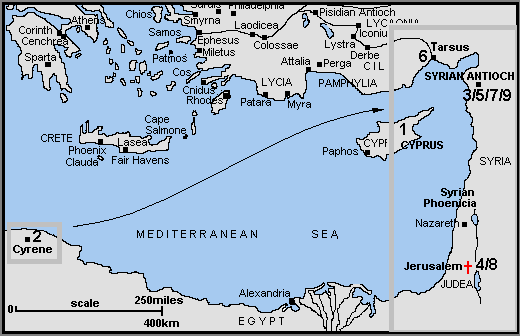
This map shows geography & distances we’re talking about. Ignatius writes to 6 Churches. Why does Ignatius say Rome holds the presidency?


40.png
Ignatios:
and let me throw one more thing from history to you but remmeber that there is a lot more then this to refute your claims from history, Eusebius, Church History (Book III) Chapter 36. Ignatius and His Epistles."…10. These things he wrote from the above-mentioned city to the churches referred to. And when he had left Smyrna he wrote again from Troas to the Philadelphians and to the church of Smyrna; and particularly to Polycarp, who presided over the latter church. And since he knew him well as an apostolic man, he commended to him, like a true and good shepherd, the flock at Antioch, and besought him to care diligently for it. "…hhhmmm wasnt that suppose to be the role of the bishop of Rome , if he existed or at least if he had supremacy as the RCC claims today??? I have to go now I will answer the rest later on maybe after our Pascha=Passover(Easter) is Over.
Ignatius also asks Rome (see in red above)
 
steve b:
Popes have never accepted this terminology 1st among equals for themselves. The patriarchal system introduced in the East advanced this notion. I gave the Vatican link
steve, Please pay heed to what has been said, i wasnt saying whether the Popes accepted that terminology or not what I said was a respond to what had been implied and my answer to that was …“the Orthodox Church never said that the Bishop of Rome does not occupy the First rank among the bishops and that was still so untill the schism in 1054ad.” Now whether the Popes accepted this or not is another issue.
but to comment on whether the Popes accepted or not let us look again at the Second Ecumenical Council,third canon and see whether the Popes accepted that or not.

third Canon: Let the Bishop of Constantinople, however, have the priorities of honor after the Bishop of Rome, because of its being New Rome.
As far as I know from records and documents from both sides Orthodox and Catholic that there is no issues with this canon and both accepted it and signed to it.
The council of Carthage is a local council. And Cyprian is correct, no bishop at that council can judge another bishop
The Council of Carthage was a Local council, yes, you are right on this one.
However this very council was held because “…Stephen I, bishop of Rome, attempted to exert authority over other churches on the basis of succession from Peter. He attempted by letters to overrule the decision of a council of African bishops concerning the baptism of heretics. In response, the Africans held a larger council of 87 bishops which upheld the previous council and rejected Stephen’s decrees. This was the Seventh Council of Carthage in 258.”
So you assumed that Cyprian told that to the bishops “at that council” then you gave an opinion based on a wrong assumption. So what Cyprian said it was directed to the Bishop of Rome.
Please you must read before you answer.
If Irenaeus didn’t say Rome but instead said Constantinople (which didn’t exist at his time) or Alexandria, or Antioch, or Jerusalem, you know that the Orthodox would have his quotes on the equivalent of speed dial when talking about the primacy of Constantinople, or Antioch, or Alexandria, or Jerusalem whichever the case would be. Now you know that’s true… correct?
Wrong…I am an Antiochian from the Antiochian land itself and If my Patriarch got up one day and said that he is the Head of the Church, be sure I would fly there the next day and I can also assure you that there would be a million faithfull like myself pulling him down the streets by his beard, shouting ANAXIOS=not worthy, for CHRIST alone is the Head of the Church just as our father Saint Ignatius said to the Romans, and I can also assure you that we wont accept any bishop Patriarch or a pope over our Patriarch except CHRIST. Also the Holy See of Antioch “THE FIRST THRONE OF PETER” has all the elements to make claims rightfully to “THE Successor of Peter” but we dont simply because it is wrong to seek headship over the whole CHURCH which is belong only to CHRIST as the Bible said.
But that would need to be coupled with a history of other quotes from the 1st century to the 21st century as well. Rome can show that, the others can NOT.
.

steve I dont mean any insult, but you need to do some extensive study on those matters before you get into them. It seems that your knoweldge in these matters is not sufficient enough to carry you through.
Ignatius wrote to 6 Churches. If they all preside why does he only say Rome presides? Why didn’t he say that of any other?
He didnt only say “Rome presides” this what they call quoting things out of context, If he did then maybe you somewhat have a debatable case, here is what he said…" the Church which presides in the place of the region of the Romans".
It is abvious, he confined the presidency of Rome to the “Region of the Romans”.

He didnt say that to another Church maybe as some historical sources said that there was more then one church in Rome and/or the suburbs of that area, but if he didnt say that to the others, it wouldnt mean that they are under Rome, why is it you RCs always try to stretch anything that you come across and do the impossible for the sake of presidency. I really wonder why is presidency is sooo important to you?
 
…continued
You forgot to finish the quote (what’s in red)
Stoped at the ","next time I will make sure to add this one.:rolleyes: anything else would you like me to add???
This map shows geography & distances we’re talking about. Ignatius writes to 6 Churches. Why does Ignatius say Rome holds the presidency?
…Scroll back up
Originally Posted by Ignatios
and let me throw one more thing from history to you but remmeber that there is a lot more then this to refute your claims from history, Eusebius, Church History (Book III) Chapter 36. Ignatius and His Epistles."…10. These things he wrote from the above-mentioned city to the churches referred to. And when he had left Smyrna he wrote again from Troas to the Philadelphians and to the church of Smyrna; and particularly to Polycarp, who presided over the latter church. And since he knew him well as an apostolic man, he commended to him, like a true and good shepherd, the flock at Antioch, and besought him to care diligently for it. "…hhhmmm wasnt that suppose to be the role of the bishop of Rome , if he existed or at least if he had supremacy as the RCC claims today??? I have to go now I will answer the rest later on maybe after our Pascha=Passover(Easter) is Over.
Ignatius also asks Rome (see in red above)
Ignatius asked Rome for their prayers, the text is clear!!! and Ignatius didnt ask Polycarp the Text said that he"he commended to him"…“the flock at Antioch, and besought him to care diligently for it.
Remember in your prayers the Church in Syria,which now has God for its shepherd, instead of me. Jesus Christ alone will oversee it, and your love [will also regard it[/COLOR]].
Now look at this "RED"text and read it again and then tell me where do you see a question there??? he is telling them that your “LOVE” will also regard it, why because as christians that what we suppose to do even to our enemies, and Rome was well known and still does to this day with her charity works they and still have the largest resources, Charity does not mean presidency nor is it Primacy neither does it mean honor and defenitly not “AUTHORITY” if thats what you are driving to.
 
Hey everyone,

Ignatios, Steve B, and tdgesq, interesting posts. I thought I might contribute a little.

I was checking out the New Advent, Catholic Encyclopedia, regarding Papal infallibility and Ecumenical Councils, to see just what the Catholic position was on these subjects. And I had a question.

The New Advent website states that regarding an Ecumenical council:
  1. The right to summon an ecumenical council belongs properly to the pope alone, though by his express or presumed consent given ante or post factum, the summons may be issued, as in the case of most of the early councils, in the name of the civil authority. For ecumenicity in the adequate sense all the bishops of the world in communion with the Holy See should be summoned, but it is not required that all or even a majority should be present.
  2. As regards the conduct of the deliberations, the right of presidency, of course, belongs to the pope or his representative; while as regards the decisions arrived at unanimity is not required.
  3. Finally, papal approbation is required to give ecumenical value and authority to conciliar decrees, and this must be subsequent to conciliar action, unless the pope, by his personal presence and conscience, has already given his official ratification (for details see GENERAL COUNCILS).
newadvent.org/cathen/07790a.htm

Okay, This is all fine and good, but the problem I see is that I do not see the value in an “ecumenical” council if this definition is true, other than perhaps to make other bishops feel like they are important (but in no way would they be, or at least I cannot see how).

Suppose 1000 Bishops were called to an ecumenical council, 50 actually came, and only 2 agreed with the Pope. By the definition above this would still be an “ecumencial” council and the Pope’s side would win. I honestly cannot see the difference between this and the Pope’s speaking “ex cathedra”. I also see very little point in having an ecumenical council with the above definition, it seems much more efficient to simply have the Pope speak ex cathedra to decide manners of doctrine.

What is your thoughts on this?
 
Status
Not open for further replies.
Back
Top