Will the Real (Insert Place Here) Please Stand Up?

  • Thread starter Thread starter patrick457
  • Start date Start date
Status
Not open for further replies.
Is there any way to recreate his footsteps to lead you to a possible distance which might point a direction. If he was scourged and imprisoned overnight they might lead him out before dawn but he falls when there is a crowd, so maybe daybreak in the city, walking slowly with help at 6:30 am. So if he died at the 6th hour and was alive on the cross for 3 hours and if we say the 6th hour is 6 hours after sunrise then he died at 12:30 pm and was crucified at 9:00 am. So that would leave 2 and a half hours between the prison and the crucifixion. Maybe walk a mile at most given all delays and preparations and very slow progress. So about 3 miles from the temple to the mount of olives. Injured and falling and carrying a cross a lot less than 1 mile per hour. He might have walked in that state for a mile or half mile or less.
The problem is, you really can’t recreate Jesus’ footsteps in this, because - if we’re going to be precise - we don’t know where virtually all of the places involved (the high priest’s house, the Praetorium, Golgotha) exactly are.

It’s highly likely that Caiaphas’ house was somewhere in the Upper City (which was where the rich people and the priests in Jerusalem lived), but we’re not if the traditional location pointed as his house is the exact one (it’s in the correct general area though). As for the Praetorium, a medieval tradition connected it with the Antonia Fortress north of the Temple, but more modern scholars increasingly think that it’s actually in Herod’s Palace in the Upper City (which is actually closer to the traditional location of Golgotha). The current Via Dolorosa route was only invented during the Middle Ages, and as for Golgotha … well, we’re talking about that right now. 😉

Oh, and Jesus died at the ninth hour (3 PM). According to the synoptics, the sun became dark at the sixth hour (midday). Mark (15:25) claims that Jesus was crucified at the third hour (9 AM), but in John (19:14), Jesus was still at the Praetorium at about the sixth hour.
 
The problem is, you really can’t recreate Jesus’ footsteps in this, because - if we’re going to be precise - we don’t know where virtually all of the places involved (the high priest’s house, the Praetorium, Golgotha) exactly are.

It’s highly likely that Caiaphas’ house was somewhere in the Upper City (which was where the rich people and the priests in Jerusalem lived), but we’re not if the traditional location pointed as his house is the exact one (it’s in the correct general area though). As for the Praetorium, a medieval tradition connected it with the Antonia Fortress north of the Temple, but more modern scholars increasingly think that it’s actually in Herod’s Palace in the Upper City (which is actually closer to the traditional location of Golgotha). The current Via Dolorosa route was only invented during the Middle Ages, and as for Golgotha … well, we’re talking about that right now. 😉

Oh, and Jesus died at the ninth hour (3 PM). According to the synoptics, the sun became dark at the sixth hour (midday). Mark (15:25) claims that Jesus was crucified at the third hour (9 AM), but in John (19:14), Jesus was still at the Praetorium at about the sixth hour.
I see, very interesting. If Jerusalem was anything like Rome then the rich folk would live on a hill-top near to the markets or ‘shopping mall’, presumably for some convenience, security, the views, get away from the worst of the heat, noise, crowds, etc.
I suppose locate a hill, locate the main market and you’d find the wealthy houses. Maybe.
I thought it became dark just when he died not 3 hours before?
 
I thought it became dark just when he died not 3 hours before?
“And when the sixth hour had come, there was darkness over the whole land until the ninth hour. And at the ninth hour Jesus cried with a loud voice, ‘Eloi, Eloi, lema sabachthani?’” (Mark 15:34) It was a three-hour darkness, lasting from midday until “the ninth hour,” 3 PM, the time of the ‘evening’ sacrifice.

I think those Jesus movies where they basically skip any indication of the duration of the darkness is to blame for all this. (Yeah, like this one here.) Seriously, in many of those movies Jesus seems to only last for like, a few minutes on the cross at the most (for pacing reasons obviously). I mean, He died pretty quickly for a crucifixion victim - He was only alive for three to six hours; crucifixion was designed to keep people alive and suffering for as long as possible, and many crucifixion victims lasted for a day or two at the very least - but not that quickly.

But hey, I guess it’s much more dramatic to show those clouds rolling in - and it’s almost always - in other words, around 70-80% of the time - clouds in film that’s being shown - just when Jesus’ vital signs start to fade. 🤷
 
Gordon’s Calvary-Garden Tomb

This is pretty much the alternative to the Church of the Holy Sepulchre nowadays.

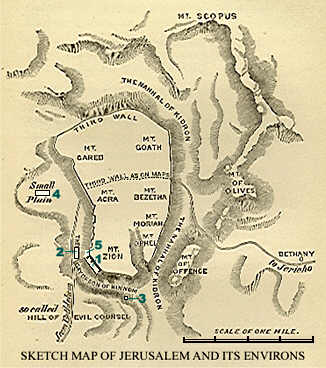
Ever since the 17th-18th century, more people have begun to express their dissatisfaction with the traditional site, first and foremost because it is now currently within the city walls - whereas it is clear from the NT that Golgotha was outside the city. Most of these people were Protestants who did not have any territorial claims at the Church of the Holy Sepulchre and who felt that the traditional site is too cluttered with
Lots of interesting points, but frankly I don’t put any credence in any of the supposedly identified sites of Gospel events, except for the Temple itself. Most date only to medieval times, and there is no reason to believe those folks had any more idea where things were than we do. And, as you point out, practicalities and financial decisions have had an influence on the identification of these locations.
 
Lots of interesting points, but frankly I don’t put any credence in any of the supposedly identified sites of Gospel events, except for the Temple itself. Most date only to medieval times, and there is no reason to believe those folks had any more idea where things were than we do. And, as you point out, practicalities and financial decisions have had an influence on the identification of these locations.
And even then, some people even dispute whether the Temple really was in the location where the Dome of the Rock stands today. 🤷
 
Continuing about the Garden Tomb:

One factor that convinced Gordon that Gordon’s Calvary or ‘Skull Hill’ was the biblical Golgotha was his personal, rather peculiar kind of typological/mystical reading of the Bible - which critics would count as an argument against this site. I already mentioned his rather literal reading of Leviticus 1:10-11 (“If his gift for a burnt offering is from the flock, from the sheep or goats, he shall bring a male without blemish, and he shall kill it on the north side of the altar before the LORD…”) as implying that Jesus must have been crucified to the north of Jerusalem - because hey, aren’t these lambs a type of Jesus?

Gordon also thought that various land formations in Jerusalem actually represented a skeleton lying sideways: ‘Skull Hill’ and the Garden Tomb was the skull (obviously), the land between ‘Skull Hill’ and the Temple Mount was the “sides” (Gordon appealed to his reading of Psalm 48:2: “Beautiful for situation, the joy of the whole earth, is mount Zion, on the sides of the north…”), and the Temple Mount was the pelvis. The foot of this imaginary skeleton was around the Pool of Siloam.


These speculative identifications were published posthumously in 1885, after Gordon’s ‘last stand’ at Khartoum. As noted earlier, Gordon’s claims gained fame and publicity, not so much for any scientific validity but because of Gordon’s compelling personality, his heroically tragic death, and his fame in contemporary British society. In other words, the site became popular because here was a popular guy endorsing this, so it must be true. 😉 It’s pretty much like actors who appear in adverts: their fame help sells the product.

Critics would say that the weakness of Gordon’s theory is precisely because Gordon seemed to be over-reliant on his emotions and personal interpretations of Scripture rather than sound research. (Gordon’s own religious consciousness was apparently so intense it almost bordered into spiritual hallucination. In fact, he went to Jerusalem during a period of unemployment prompted by his religious beliefs.)
 
I quote at length from ‘The Garden Tomb: Was Jesus Buried Here?’ by Gabriel Barkay (pp. 27-36 of this PDF booklet by the Biblical Archaeology Society, The Burial of Jesus).

A long and extremely bitter dispute concerning the authenticity of the site followed Gordon’s identification of the hill as Golgotha and the consequent identification of the cave in its western escarpment as Jesus’ tomb. The authenticity of the tomb was supported mainly by Protestants. It was attacked mainly by Catholics, who held to the traditional identification of Jesus’ tomb within the Church of the Holy Sepulchre. The dispute was conducted in scores of articles in a number of journals. Most of these articles have a theological and apologetic, rather than a scientific bent. None concerning the cave, nor any useful analysis of the archaeology of the site.

…]

In 1904, Karl Beckholt, who was serving as Danish consul in Jerusalem and as warden of the Garden Tomb, conducted a small excavation in the yard of the Garden Tomb. He found some objects, which were published 20 years later by a Jerusalem scholar and Anglican clergyman named James Edward Hanauer. This 1924 publication renewed the bitter dispute about the location of the authentic tomb of Jesus. The opposing positions were summarized in a sharply worded article written from the Catholic point of view by Louis-Hugues Vincent, one of the Dominican scholars at the École Biblique. Father Vincent, a leading scholar on the archaeology and history of Jerusalem, defended the position that the Garden Tomb cave was of the Byzantine period. He entitled his article “The Garden Tomb—History of a Myth.”

In 1955, the Garden Tomb Association sponsored a small excavation in the garden area. Unfortunately, nothing is known about this dig; it was never published.

The dispute over the authenticity of the Garden Tomb was again summarized in 1975 in a book entitled The Search for the Authentic Tomb of Jesus by W. S. McBirnie, who advocates the Garden Tomb’s authenticity. McBirnie’s book, however, is not based on any archaeological information, nor is the author knowledgeable about the history of the area in ancient times.

Thus, almost all published articles dealing with the Garden Tomb from its discovery through 1975 have been polemical, written to prove certain theological presuppositions. Except for the first article by Conrad Schick, who reported the actual discovery of the cave, there has been no objective, factual and archaeological discussion of the Garden Tomb.

To understand why this is so, we need to look at the historical situation in the late 19th century. The growing western interest in the ancient Near East, the Holy Land and Jerusalem brought hordes of visitors and pilgrims who took a new and often critical approach to the traditional holy sites. More and more Protestants came to Jerusalem, and they began to question the authenticity of the holy sepulcher. Located as it is in the midst of a densely built-up area of the Old City, the Church of the Holy Sepulchre did not seem to the Protestants to be a suitable place, outside the city, as Jewish law required, where Jewish dead would have been buried in the early Roman period. The traditional site of the sepulcher within the church was in those days dark, dismal and frequently filthy. It was crowded with priests, monks and pilgrims, mainly from Eastern countries, who often bickered with each other over rights to light candles and to hold ceremonies in various parts of the church. The Protestant newcomers did not feel at home here and could not imagine that this site could be the authentic burial place of Jesus. In this frame of mind, they welcomed any suggestion locating Jesus’ tomb in a place that would better fit the tastes of Protestant Westerners, especially because the Protestants were wholly without any proprietary share in the Church of the Holy Sepulchre, which was divided among the Greek Orthodox, Roman Catholic, Armenian and Coptic Churches.

The earliest recorded tradition about Jesus’ burial in the Holy Sepulchre is about three centuries after the Crucifixion. The New Testament itself gives no clue whatever as to the location of Golgotha and the tomb of Jesus. The name Golgotha has not been preserved in any form in any written source in antiquity, either Jewish or non-Jewish. It is not attested in geographical names in or around Jerusalem. This was enough to lead many wishful Protestants to reject the authenticity of the Church of the Holy Sepulchre.

On the other hand, there was never any sound scientific basis for locating the tomb of Jesus in the area of the Garden Tomb. The identification of the Garden Tomb as the tomb of Jesus thus reflects the psychology and atmosphere of late 19th-century Jerusalem, rather than any new evidence—scientific, textual or archaeological.
 
(Please Note: This uploaded content is no longer available.)

[do you happen to know if that little hill on the right has a name?]

…please continue…
 
It looks like a cemetery… place of the skull!
Yes, there are a lot of tombs on the Kidron Valley and the Mount of Olives. (At the same time, you have to remember that many of those tombs are of later date.) But seriously, as I pointed out, we don’t even know why Golgotha was called ‘Skull-place’. Besides, this wasn’t the only place in Jerusalem back then that had tombs in it. The only real requirement for tombs back then is that they had to be outside the city, some distance away from the city walls. Jerusalem was really surrounded by tombs and cemeteries, especially on the north, south and eastern sides (and a few on the west as well).
 
Here we go:

The Church of the Holy Sepulchre


Out of the three sites we’re discussing here, the Church of the Holy Sepulchre is the oldest (and, for about a millennium and a half, pretty much the only) contender.

Our first possible reference to this site comes from a sermon by the 2nd century bishop of Sardis, Melito, entitled On the Passover/Pascha (Peri Pascha).

Pay attention, all families of the nations, and observe! An extraordinary murder has taken place in the center of Jerusalem, in the city devoted to God’s law, in the city of the Hebrews, in the city of the prophets, in the city thought of as just. And who has been murdered? And who is the murderer? I am ashamed to give the answer, but give it I must. For if this murder had taken place at night, or if he had been slain in a desert place, it would be well to keep silent; but it was in the middle of the main street, even in the center of the city, while all were looking on, that the unjust murder of this just person took place.

We know from the gospels that in Jesus’ day, Golgotha was outside Jerusalem. (Something corroborated by Jewish custom: as I noted earlier, tombs were required to be some distance away from the city walls, because corpses and tombs are unclean.) But here we have Melito saying that Jesus was crucified “in the middle of the main street (plateia - the city square or main avenue in a given city), in the center of the city.” It’s clear from these references in his sermon that Melito believed that a site that was at that point in the middle of the city of Jerusalem was the place where Jesus died.

After the failed revolt of Simon bar Kokhba against the Romans (AD 132-136), the emperor Hadrian kicked the Jews out of Jerusalem and, in order to remove any memory of the city’s Jewishness, renamed it Aelia Capitolina and turned it into a pagan city. In fact, it was Hadrian who renamed Judaea into Syria Palaestina. (From this point on, whenever we’re referring to pagan Jerusalem (2nd-4th century), I’ll call it Aelia.)

During that time, a temple to the goddess Aphrodite/Venus was built on the site where the Church of the Holy Sepulchre now stands. (A statue of Jupiter - a favorite god of Hadrian - stood on the site where the tomb of Jesus supposedly was, and a statue of Venus stood atop the so-called Rock of Calvary.) Later Christian historians like Eusebius are quick to claim that the temple was built here because Hadrian also wanted to blot out the memory of Jesus’ burial place (which was supposedly already a holy site for the Christians of Jerusalem by that time), but for all we know, the choice of location could have just had a more mundane reason behind it.

This temple was located on the junction of Aelia’s main north-south road (cardo maximus) with one of the two main east-west roads (aka decumanus) and directly adjacent to the forum; the forum itself was, as is traditional in Roman towns, at the junction of the cardo maximus with the (other) main east-west road. The location fits in with Melito’s description of Jesus’ place of execution being “in the middle of the plateia” - a colonnaded avenue, which in a Roman city could only mean the main street.


The area of Golgotha, c. 150-325 AD, from Joan Taylor’s Golgotha: A Reconsideration of the Evidence for the Sites of Jesus’ Crucifixion and Burial
 
(Continued)

A second early reference to Golgotha comes from Eusebius’ Onomasticon (aka On the Place-Names in the Holy Scripture), a kind of gazetteer listing places mentioned in the Bible. Written late in the 3rd century or early in the 4th (we know it’s rather early because of its sparse references to Christianity and complete absence of remarks on Constantine’s buildings in the Holy Land), before Constantine built his basilica on the site of the temple of Venus, this is what the entry for ‘Golgotha’ reads:

Golgotha, “place of the skull,” in which Christ was crucified. And up to this day it is shown in Aelia to the north (literally, ‘on the north side’ or ‘near/by the northern parts’) of Mount Sion.

This suggests that the site of the crucifixion - which is what is specifically mentioned by Eusebius - was near the northern parts of what is called today “Mount Zion,” i.e. the (South-)Western Hill, which quite fits the location of the Church of Holy Sepulchre.


Quoting from Joan Taylor’s article (linked in the last post):

This tends to suggest that the site of the crucifixion — which is what is specifically mentioned by Eusebius — was near the northern parts of “Mount Zion.” Today, Mount Zion is identified outside the southern wall of the city. However, strictly speaking, geographically Mount Zion is the whole of the south-western hill, the “summit” being just south of the present Citadel, where the ground height is 773 m (2536 ft) above sea level. The summit of current Mount Zion is 765 m (2510 ft) above sea level. The southwestern hill was the location of the legionary camp of Aelia, which was relocated to Eilat some time in the reign of Diocletian. It is fairly clear that this camp was generally thought to be outside Aelia; the geometrical street-plan of the city did not apply here. Aelia proper began just north of the camp, i.e. north of greater Mount Zion (Biddle 1994:100). The Bordeaux Pilgrim of AD 333 describes Mount Zion as this greater area, possibly divided by a wall. The pilgrim goes out of Jerusalem and sees the pool of Siloam “beside the wall” (Itin. 592) and then climbs up Mount Zion from there and then goes “inside Sion, within the wall” to see David’s palace, the area of the present Citadel. The pilgrim then passes through “the wall of Zion towards the Gate of Neapolis”; which walls are being referred to is not clear, but these are probably remains of the first wall. The pilgrim may have passed through old Gennath Gate, if it still remained in use. At some point, the extent of Mount Zion shrunk. Some clue as to the extent of Mount Zion in the Byzantine period is given by Eucherius, in the fifth century, who writes that

it is on the south, and over looks the city like a citadel. The greater part of the city lies on the flat tip of a hill which is lower than this Mount. Mount Sion is covered on the northern flank with dwellings for clergy and monks, and its summit, which is level, is occupied by monks’ cells round the church which is said to have been founded by the apostles in honor of the place of the Lord’s resurrection, because it was there they were filled by the Spirit once promised by the Lord… Mount Sion … is approached by rising ground stretching north.

This description fits with modern understanding of the extent of Mount Zion. A wall that separated out “Mount Zion” proper from the city was built approximately where the present wall runs, possibly some time in the early Byzantine period. Eucherius writes in the fifth century that a lengthy wall “now embraces Mount Sion, though this was once just outside.” This wall would have enclosed the south side of Mount Zion.

If Mount Zion is considered to have included the legionary camp, however, Eusebius’ identification of the site of Jesus’ crucifixion matches what we have already adduced from the evidence. At the end of the third century, the site of the crucifixion could well have been described as being in Aelia, right beside the northern parts of Mount Zion.​
 
(Continued)

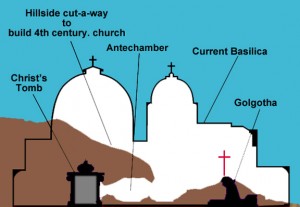
In 325-6, Constantine had the temple of Venus demolished and the soil which had provided a flat surface for the temple removed. During the course of the excavation, a tomb was found underneath where the statue of Jupiter once stood; this was immediately hailed as the genuine tomb of Jesus. Constantine then had the tomb encased in a shrine, which was then housed in a basilica: the Church of the Anastasis (Resurrection). Here’s Eusebius describing the event in his Life of Constantine:

http://members.bib-arch.org/bswb_graphics/BSBA/26/06/BSBA260602410L.jpg
The Church of the Holy Sepulchre in the 4th century.

http://www.imj.org.il/images/exhibitions/christinity/P1_holy2.jpg
Reconstruction of what the Aedicule (the shrine housing the tomb believed to be that of Jesus) would have looked like back then.

AFTER these things, the pious emperor addressed himself to another work truly worthy of record, in the province of Palestine. What then was this work? He judged it incumbent on him to render the blessed locality of our Saviour’s resurrection an object of attraction and veneration to all. He issued immediate injunctions, therefore, for the erection in that spot of a house of prayer: and this he did, not on the mere natural impulse of his own mind, but being moved in spirit by the Saviour himself.

For it had been in time past the endeavor of impious men (or rather let me say of the whole race of evil spirits through their means), to consign to the darkness of oblivion that divine monument of immortality to which the radiant angel had descended from heaven, and rolled away the stone for those who still had stony hearts, and who supposed that the living One still lay among the dead; and had declared glad tidings to the women also, and removed their stony-hearted unbelief by the conviction that he whom they sought was alive.

This sacred cave, then, certain impious and godless persons had thought to remove entirely from the eyes of men, supposing in their folly that thus they should be able effectually to obscure the truth. Accordingly they brought a quantity of earth from a distance with much labor, and covered the entire spot; then, having raised this to a moderate height, they paved it with stone, concealing the holy cave beneath this massive mound. Then, as though their purpose had been effectually accomplished, they prepare on this foundation a truly dreadful sepulchre of souls, by building a gloomy shrine of lifeless idols to the impure spirit whom they call Venus, and offering detestable oblations therein on profane and accursed altars. … T]hese devices of impious and wicked men against the truth had prevailed for a long time, nor had any one of the governors, or military commanders, or even of the emperors themselves ever yet appeared, with ability to abolish these daring impieties, save only that one who enjoyed the favor of the King of kings.

And now, acting as he did under the guidance of the divine Spirit, …] gave orders that the place should be thoroughly purified, thinking that the parts which had been most polluted by the enemy ought to receive special tokens, through his means, of the greatness of the divine favor. As soon, then, as his commands were issued, these engines of deceit were cast down from their proud eminence to the very ground, and the dwelling-places of error, with the statues and the evil spirits which they represented, were overthrown and utterly destroyed.

Nor did the emperor’s zeal stop here; but he gave further orders that the materials of what was thus destroyed, both stone and timber, should be removed and thrown as far from the spot as possible; and this command also was speedily executed. The emperor, however, was not satisfied with having proceeded thus far: once more, fired with holy ardor, he directed that the ground itself should be dug up to a considerable depth, and the soil which had been polluted by the foul impurities of demon worship transported to a far distant place.

This also was accomplished without delay. But as soon as the original surface of the ground, beneath the covering of earth, appeared, immediately, and contrary to all expectation, the venerable and hollowed monument of our Saviour’s resurrection was discovered. Then indeed did this most holy cave present a faithful similitude of his return to life, in that, after lying buried in darkness, it again emerged to light, and afforded to all who came to witness the sight, a clear and visible proof of the wonders of which that spot had once been the scene, a testimony to the resurrection of the Saviour clearer than any voice could give.

 
(Continued)

Before Constantine and before Hadrian, what was the site like?

From the Iron Age onwards (8th-7th century BC-1st century BC), the site where the CoHS now stands functioned as a limestone (meleke, aka ‘Jerusalem stone’) quarry outside the city, which provided building stone for buildings in the city. The area, originally the slope of a hill (Mount Gareb), was substantially cut away by the quarrying. During the OT period, the city proper was originally quite some distance away from the quarry, lying to the southwest. The city however eventually expanded, first to the west before it came north toward the quarry.


http://www.christusrex.org/www1/jhs/THS-qua2.jpg

The site was finally abandoned in the 1st century BC when the good quality stone ran out, at which time the quarry was likely filled over (one area of the quarry was actually over 40 feet deep) with soil mixed with stone flakes from the ancient quarry. (That, or the soil just built up naturally in the area.) The area then apparently functioned as a garden or orchard for cereals, fig, carob, and olive trees. Around this time, the area may have also become a mini-cemetery. This was not surprising, first because of the bedrock left exposed around the quarry, and second, because there was lots of available space in the area. (The western side of Jerusalem was not exactly a prime spot for burials, since the air could bring the stench of the tombs toward the city; we do have a few examples of tombs to the west of Jerusalem, but as mentioned earlier most other tombs and graveyards were located to the north, east or south, with the north and south being the more favored areas.)

http://www.wingsofeaglesct.com/LIFE_OF_JESUS/JESUS_LIFE_PIX/church_holy_sep_tombs_ancient.jpg

We have at least four surviving tombs within the church now (not counting the one in the Aedicule) - it’s possible more once existed. The more famous one is the so-called Tomb of Joseph of Arimathea, a tomb of the kokhim type. (A kokh or a loculus is a narrow shaft or niche running perpendicularly back from the tomb’s stone wall. Bodies or ossuaries - bone boxes - were placed in these niches. Kokh tombs were common from the 3rd century BC up to the 1st century AD.)

During the time of Jesus, rock-hewn family burial caves could either be of the kokhim type or the bench type, or a combination of the two. The basic design of these rock-cut tombs consists of a square or rectangular room - just barely tall enough for a person to be able to stand upright - with benches on three sides of the chamber, leaving a pit in the middle, and a low, narrow doorway which could be closed with a blocking stone (either disc-shaped or - more commonly - square, plug-shape) or simply walled over with mud brick and stones. Three of the four walls of the burial cave (the entrance wall excepted) would have one to three narrow kokhim or loculi running perpendicularly back from the chamber wall on it. These niches in turn could also be walled up or sealed by blocking stones. Slightly later, in some Jerusalem tombs you see another type of shelf: the arcosolia, which has [bibleplaces.com/images12/Tomb-of-Kings-arcosolium,-tb100803385-bibleplaces.jpg"]a bench-like aperture](") (arcosolium) with an arched ceiling hewn into the length of the wall.

This area (judging by the presence of the tombs) would have outside the city walls until the building of Jerusalem’s ‘third wall’ starting from the time of Herod Agrippa (AD 41-44), enclosing it within the city walls. The tombs would have been emptied when the area was included within the city, but the garden probably remained.
 
(Continued)

And now for the pros and the cons:

Pros

The greatest argument for the Church of the Holy Sepulchre is essentially the ancient tradition that lies behind it. As noted, even before Constantine built a church in the area, you have a possible reference to the traditional site as early as Melito in the 2nd century. The claim made by some writers of the time that the Christians of Jerusalem had venerated and passed down the location of Golgotha could very well be authentic - or at least, have an air of verisimilitude. Not to mention, the area as it was in the 1st century does kind of fit the descriptions in the gospels: it was outside the city and yet still close enough to it, there was a garden in the area, and there are tombs. Even it’s not the actual site, it’s still pretty darn close.

Cons

The greatest argument against the Church of the Holy Sepulchre would be, again, tradition. Critics point out that Hadrian expelled the Jews out of Jerusalem in AD 135-6, during the aftermath of Bar Kokhba’s rebellion, an order which would have included Jewish Christians. Decades earlier, many Jewish Christians in Jerusalem are also said to have moved away from the city just before the city fell to the Romans in AD 70. The fact that Jewish Christians moved away from Jerusalem to settle elsewhere during these two rebellions is actually the reason why Jerusalem, the ‘mother Church’, no longer occupied an important position in later Christianity - its position and importance being overtaken by gentile sees like Rome or Antioch or Alexandria.

So the critics would question: how can we be sure that this early tradition surrounding the Church of the Holy Sepulchre - if it really is early - is authentic? What if this idea ultimately derived from the gentile Christians who settled in Jerusalem/Aelia later, who would have had no more clue about the location of Jesus’ crucifixion and burial than we do now? In other words, they think that there is a sort of disconnect between the Jewish Christians who lived in the city earlier and the gentile Christians who lived in it later. Who knows if the Jewish Christians passed down their local traditions to the gentile settlers, or if there were still any Jewish Christians left to pass them down? Critics would argue, maybe they didn’t, and maybe there aren’t.

This is now me talking.

It’s true that there are many scholars today who think that there was no continuity between the earlier Jewish Christian community of Jerusalem and the later gentile Christians of Aelia Capitolina. They argue that some information recorded in the works of authors like Eusebius - say, of Jewish Christians fleeing Jerusalem before AD 70 and returning to it later - were just inventions designed to give the two communities an air of continuity. But ironically, while rejecting those elements, they uncritically accept the inference in Eusebius that the later Church in Aelia was ‘completely’ gentile. That itself, we can argue, is a questionable premise: it’s too neat to be historical. What if Eusebius was oversimplifying things here, and the process was actually more complex? What if some of these ‘gentiles’ were actually Jewish Christians who simply quit identifying themselves as ‘Jewish’?

Nevertheless, it would be going too far to imagine that there was an absolute break between the ‘Jewish’ Jerusalem church before the war and the ‘Gentile’ one that followed it. We do not need to assume that all the Jewish-Christians packed their bags and fled, leaving an empty space for entirely alien Christians from other places to step into. If there had been friendly contacts between the church of Jerusalem and other Palestinian churches prior to the Revolt, then it is very likely that efforts were made to maintain the continuity of traditions and customs, even though the personnel of the church may have changed. Moreover, we do not need to assume that all the members of the church fled. They need only have declared themselves no longer Jews to stay. If it is probable that during the middle of the second century many ethnically Jewish Christians were abandoning the praxis of Mosaic law, and thereby becoming ‘Gentile’, then it is very possible indeed that certain members of the Jerusalem church dropped Jewish praxis after the Revolt and thereby stayed in their ancestral city. It would have been a very tempting option. After persecution by Bar Kochba and his supporters, they may have felt unease at being still linked with Judaism, and it would have been natural if members of the church began to think of themselves as quite separate from other Jews, having more in common with the universal church, which had largely abandoned Judaism. It may be significant that there is no legend of a ‘flight from Jerusalem’ after the Bar Kochba Revolt, only one which tells of a flight to Pella after the Jewish War, in AD 70 …] At any rate, we can surely imagine that at least one or two members of the church abandoned Jewish praxis, declared themselves no longer Jews, stayed in the city, and passed on the traditions of the church to new members from outside. The transition from ‘Jewish’ to ‘Gentile’ church may have been as smooth as it appears to have been elsewhere. Those who did not wish to forsake Mosaic law would have had to go to Caesarea, or other places; perhaps even to the Bashan.
 
Now, even if the CoHS is in the correct area/region, there is still uncertainty as to whether the tomb in the Aedicule was really the tomb where Jesus was laid in (as mentioned, there were other tombs in the area) and whether the Rock of Calvary was really the exact spot where the cross stood.

Some scholars argue that the Rock of Calvary could not have been the place where the crosses of Jesus and the two criminals stood. The main reason for this is because this column of rock in its present shape is really too steep to climb and its top too narrow to have adequate space for three crosses. (This is of course assuming that it was already in this state during the time of Jesus. We can’t exclude the possibility that this outcrop was cut into shape later.)

Instead, they look to some other spot within the same general area, but they don’t agree on the specific location. Archaeologist Joan Taylor, in her article Golgotha: A Reconsideration of the Evidence for the Sites of Jesus’ Crucifixion and Burial, proposes that Jesus and the two men were crucified somewhere further down south, closer to the city walls (and thus beyond the confines of the church), while another archaeologist, Shimon Gibson, instead proposes that the actual spot where Jesus’ cross stood was actually enshrined on the apse of the western end of the basilica or the Martyrium.

Both of them agree that later generations of Christians (4th century and afterwards) had only forgotten this exact spot (for one, because it was either buried beneath the basilica or on the streets) and confused the next prominent landmark in the area - the finger of rock in the courtyard just outside the basilica - to be the site of the crucifixion itself, because by the time the basilica was built, a cross was placed on top of this rock. Later Christians, in their idea, seem to have confused the cross as a marker denoting the exact spot where the cross of Jesus stood.

http://members.bib-arch.org/bswb_graphics/BSBA/26/06/BSBA260602410.jpg
In Shimon Gibson’s proposal, the spot where Jesus was crucified would have actually been inside the church, where the apse of the basilica was (somewhere near the modern Greek Orthodox Katholikon) rather than on the Rock of Calvary itself.


Joan Taylor thinks meanwhile that the actual spot was further down south, beyond the basilica’s confines, closer to where the street and the city gate would have been in the 1st century. (Somewhere inside that area circled in red.)
 
Now what exactly was the Rock of Calvary?

Some archaeologists think that maybe, this outcrop was a leftover of the quarrying process. The workers in the quarry - who were mainly looking for the prized limestonemeleke - left the rock alone because this particular rock was of inferior quality, and because this rock was flawed.

In a place within the Church of the Holy Sepulchre known as the Chapel of Adam, there’s this window in the sanctuary where you can see a crack in the rock. Popular tradition claims that this crack was caused by the earthquake during Jesus’ crucifixion; the blood of Jesus seeped through this crack and touched the remains of Adam (who was supposed to have been buried right underneath this outcrop). But at the same time, there might be a more mundane explanation for this crack: it was either caused by quarry workmen who attempted to chisel the stone out or it was an original flaw in the rock. Either way, the crack would have rendered it useless for making blocks. That was why the outcrop was left standing.

http://churchoftheholysepulchre.net...hoto-gallery/Rock of Calvary in Jerusalem.jpg

Another theory proposed by a few archaeologists is that this rock might have originally been a nefesh, a freestanding memorial monument that marked the graves of affluent and/or important persons, which were usually under or near the monument. Given that the area was originally a cemetery-slash-garden, proponents think it’s not unlikely that the rock was once a monument for one of the tombs that originally existed in this area. This theory, however, needs more study before we can propose it with confidence.


The so-called Tomb of Absalom (Yad Avsalom) in the Mount of Olives. Despite the name, this is actually a 1st-century AD Jewish nefesh for a wealthy family buried in the nearby (and similarly-misnamed) Cave of Jehoshaphat. This particular example shows the common construction of such monuments: a pyramid or a cone surmounting a cube-shaped base. The bottom cube was hewn out of the bedrock of the Mount of Olives, while the top part was built out of ashlars.
 
Mount Zion

The name ‘Zion’ was applied at different times to three different hills Jerusalem now sits on.

2 Samuel 5:7 records ‘Zion’ as the name of a Jebusite fortress that was conquered by King David and which he turned into the ‘City of David’ (Ir David). This stronghold was on the lower part of ancient Jerusalem’s Eastern Hill.

And the king and his men went to Jerusalem against the Jebusites, the inhabitants of the land, who said to David, “You will not come in here, but the blind and the lame will ward you off”—thinking, “David cannot come in here.” Nevertheless, David took the stronghold of Zion, that is, the city of David. And David said on that day, “Whoever would strike the Jebusites, let him get up the water shaft to attack ‘the lame and the blind,’ who are hated by David’s soul.” Therefore it is said, “The blind and the lame shall not come into the house.” And David lived in the stronghold and called it the city of David. And David built the city all around from the Millo inward. And David became greater and greater, for the LORD, the God of hosts, was with him.

http://members.bib-arch.org/bswb_graphics/BSBA/11/06/BSBA110603400L.jpg
Jerusalem as it would have looked like during the time of Solomon (10th Century BC)

After the Jebusite city was conquered by the Israelites, it expanded northward towards the uppermost part of the Eastern Hill. This highest part - also known as ‘Mount Moriah’ - became the site of Solomon’s Temple. During the reign of Hezekiah, the city expanded further westward, enclosing a previously unwalled suburb in what is now the Old City of Jerusalem, west of the Temple Mount. The Judahites later begin to poetically apply the name ‘Zion’ to the Temple Mount or even to Jerusalem as a whole: you can see this usage in the Psalms and in the later parts of Isaiah (60:14), as well as in 1 Maccabees (4:37, 60: 5:54; 7:33).

In Judah God is known;
his name is great in Israel.
His abode has been established in Salem,
his dwelling place in Zion.
There he broke the flashing arrows,
the shield, the sword, and the weapons of war. Selah (Psalm 76:1-2)


Finally, the name Zion settled to what is called the Western Hill, which is much more higher and broader than the Eastern Hill and thus seemed the worthier location for the by-then forgotten palace of David. We don’t know exactly when the name shift occurred (some authors think Josephus in the 1st century already applies the name ‘Zion’ to the Western Hill), although it was most certainly in place by the Byzantine period (cf. Eusebius). It is the Western Hill that is still called ‘Mount Zion’ today.
 
Status
Not open for further replies.
Back
Top