(Continued)
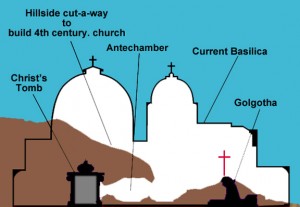
In 325-6, Constantine had the temple of Venus demolished and the soil which had provided a flat surface for the temple removed. During the course of the excavation, a tomb was found underneath where the statue of Jupiter once stood; this was immediately hailed as the genuine tomb of Jesus. Constantine then had the tomb encased in a shrine, which was then housed in a basilica: the Church of the Anastasis (Resurrection). Here’s Eusebius describing the event in his
Life of Constantine:
http://members.bib-arch.org/bswb_graphics/BSBA/26/06/BSBA260602410L.jpg
The Church of the Holy Sepulchre in the 4th century.
http://www.imj.org.il/images/exhibitions/christinity/P1_holy2.jpg
Reconstruction of what the
Aedicule (the shrine housing the tomb believed to be that of Jesus) would have looked like back then.
AFTER these things, the pious emperor addressed himself to another work truly worthy of record, in the province of Palestine. What then was this work? He judged it incumbent on him to render the blessed locality of our Saviour’s resurrection an object of attraction and veneration to all. He issued immediate injunctions, therefore, for the erection in that spot of a house of prayer: and this he did, not on the mere natural impulse of his own mind, but being moved in spirit by the Saviour himself.
For it had been in time past the endeavor of impious men (or rather let me say of the whole race of evil spirits through their means), to consign to the darkness of oblivion that divine monument of immortality to which the radiant angel had descended from heaven, and rolled away the stone for those who still had stony hearts, and who supposed that the living One still lay among the dead; and had declared glad tidings to the women also, and removed their stony-hearted unbelief by the conviction that he whom they sought was alive.
This sacred cave, then, certain impious and godless persons had thought to remove entirely from the eyes of men, supposing in their folly that thus they should be able effectually to obscure the truth. Accordingly they brought a quantity of earth from a distance with much labor, and covered the entire spot; then, having raised this to a moderate height, they paved it with stone, concealing the holy cave beneath this massive mound. Then, as though their purpose had been effectually accomplished, they prepare on this foundation a truly dreadful sepulchre of souls, by building a gloomy shrine of lifeless idols to the impure spirit whom they call Venus, and offering detestable oblations therein on profane and accursed altars. … T]hese devices of impious and wicked men against the truth had prevailed for a long time, nor had any one of the governors, or military commanders, or even of the emperors themselves ever yet appeared, with ability to abolish these daring impieties, save only that one who enjoyed the favor of the King of kings.
And now, acting as he did under the guidance of the divine Spirit, …] gave orders that the place should be thoroughly purified, thinking that the parts which had been most polluted by the enemy ought to receive special tokens, through his means, of the greatness of the divine favor. As soon, then, as his commands were issued, these engines of deceit were cast down from their proud eminence to the very ground, and the dwelling-places of error, with the statues and the evil spirits which they represented, were overthrown and utterly destroyed.
Nor did the emperor’s zeal stop here; but he gave further orders that the materials of what was thus destroyed, both stone and timber, should be removed and thrown as far from the spot as possible; and this command also was speedily executed. The emperor, however, was not satisfied with having proceeded thus far: once more, fired with holy ardor, he directed that the ground itself should be dug up to a considerable depth, and the soil which had been polluted by the foul impurities of demon worship transported to a far distant place.
This also was accomplished without delay. But as soon as the original surface of the ground, beneath the covering of earth, appeared, immediately, and contrary to all expectation, the venerable and hollowed monument of our Saviour’s resurrection was discovered. Then indeed did this most holy cave present a faithful similitude of his return to life, in that, after lying buried in darkness, it again emerged to light, and afforded to all who came to witness the sight, a clear and visible proof of the wonders of which that spot had once been the scene, a testimony to the resurrection of the Saviour clearer than any voice could give.