Will there be EC in America in 40 years?

  • Thread starter Thread starter Madaglan
  • Start date Start date
Status
Not open for further replies.
Yes, to which I added the 10000 for the new Exarchy. The numbers for 2010, are here:

cnewa.org/source-images/Roberson-eastcath-statistics/eastcatholic-stat10.pdf
That’s what I thought. The trouble with that is they do not use consistent criteria. For example, in Brazil they apparently use the state-sponsored census numbers, whereas in the US they apparently use registered parishioners. it seems to me that those numbers aren’t worth the paper they’re printed on (or the bandwidth & disk space they occupy).
 
That’s what I thought. The trouble with that is they do not use consistent criteria. For example, in Brazil they apparently use the state-sponsored census numbers, whereas in the US they apparently use registered parishioners. it seems to me that those numbers aren’t worth the paper they’re printed on (or the bandwidth & disk space they occupy).
Of course it is natural that the membership numbers will have a different value to each person.
 
The USA and Canada have a combined population of over 2.1 million people of Ukrainian (I’m guessing Ruthenians are included) ancestry. Based on the total membership of all applicable Eastern Churches, I’d say that leaves a sizeable number left as a potential evangelism target.
 
The USA and Canada have a combined population of over 2.1 million people of Ukrainian (I’m guessing Ruthenians are included) ancestry. Based on the total membership of all applicable Eastern Churches, I’d say that leaves a sizeable number left as a potential evangelism target.
Thats not a lot of people. Thats not even the population of Metro Vancouver. Plus given that they are dispersed over a wide area.

The current numbers of Ukrainian Catholics in Canada have about 5000 as the number of active Ukrainian Catholics in the entire Eparchy of New Westminster (British Columbia). Thats less than the number of people some of the larger Roman Catholic parishes have in the same region.
 
The USA and Canada have a combined population of over 2.1 million people of Ukrainian (I’m guessing Ruthenians are included) ancestry. Based on the total membership of all applicable Eastern Churches, I’d say that leaves a sizeable number left as a potential evangelism target.
From my experience ethnicity has practically no appeal. It’s not like people carry a special DNA code for church…Almost no one wants to get “back to the roots”, most families who have forgotten the old ways are not loooking back with regret… … and the church should probably not make any appeal on that basis.

Sure, there will be some who are curious, and some will want to experience the “old fashioned Easter” Grandma used to talk about from when she was a little girl, at least once, but they won’t join Great-Grandpa’s church just because it was Great-Grandpa’s church.

Eastern Christian spirituality is a great gift to the modern world, there is so much potential good in it. it is an antidote for a lot of what ails this society of ours. It must be shared. If the invited guests will not come to the banquet go out into the street and find those who will.
 
Eastern Christian spirituality is a great gift to the modern world, there is so much potential good in it. it is an antidote for a lot of what ails this society of ours. It must be shared. If the invited guests will not come to the banquet go out into the street and find those who will.
AMEN!

Its what we should do, share this faith to the world. I believe a lot of people will benefit from it.
 
Yes, I don’t understand the ethnic thing at all because I was brought up Roman Catholic and I love the Byzantine Rite. In fact, I have a friend who swtiched from the Latin Rite to the Byzantine Rite.

I’ve been to a Melkite Liturgy and several other Eastern Catholic Liturgy’s but it is the Byzantine Liturgy that really stirs my soul. I have always loved the Eastern part of our Church and I think it is the ethnicity that attracts me to it as well. The spirituality too. If there was an Eastern Catholic Church that were closer to me I would be attending it now.🙂
It’s funny, but for all the times I’ve heard the online stories of traditional RC’s coming into EC churches and offending people, I’ve seldom seen the one’s where it was OICWR crowd offending the cradle EC’s (and I know it happens) with disparaging comments about the church’s ethnic flavor being too strong. Sometimes you just have to ask the question, if ethnic parishes are such a bad thing, how can you explain the success of the very ethnic Greek Orthodox churches, who often put on bigger and better festivals-carnivals than the much larger nearby RC parish.
 
I think the Eastern Catholic Churches in America could definitely benefit from something along the lines of Catholics Come Home. Maybe that would scare a few people who have a different vision of what the EC Churches should look like, but keep in mind, those people you want to write off, are the sons and daughters, grandsons and granddaughters of the people who have kept the parishes alive, and to them, those fallen away persons are most dear.
 
I think the Eastern Catholic Churches in America could definitely benefit from something along the lines of Catholics Come Home. Maybe that would scare a few people who have a different vision of what the EC Churches should look like, but keep in mind, those people you want to write off, are the sons and daughters, grandsons and granddaughters of the people who have kept the parishes alive, and to them, those fallen away persons are most dear.
I don’t disagree with you, honestly. I have made the argument myself with real people I have met.

But as a basis for evangelization I would say it is a non-starter at best, and lends itself to the charge of phyletism.

Personally, I have met a few (very few, as it turns out) people who encountered the EC and afterward discovered that they had ancestry in the tradition. It makes the discovery doubly-sweet and heartwarming. 🙂

But the tradition has to be acknowledged on it’s own terms first. People who approach from the perspective of “this is what my people are supposed to do” are adopting the wrong attitude (and weaker reasoning), and we should not encourage that.

Believe me, this is as serious a concern among Orthodox as it is for EC.

We need to quit trying to regather the tribes and aggressively approach any and all, (but most especially the non-Christian, unchurched and the atheists among us).

If we took the mandate seriously we would not be closing parish structures in the old neighborhoods, they would sing with many voices.
 
Hesychios
There's alot of people out there pct wise in the EC Churches, who just like there RC counterparts, were baptized, catechised etc and then at around the age of 18 decided attending church was a bunch of nonsense or at least not in the top 100 things to do on a Sunday. If these people, who in many instances are returning to the RC Church decades later, there's no reason they shouldn't be returning to the EC Churches as well.
 
Maybe it is time for EC to return to it’s true Mother Church!!
The Eastern Catholic Churches in Central Europa deny that they ever belonged to the separated Byzantine Church. They claim that their ancestors migrated beyond the Byzantine influence before the schism, and kept their Liturgy, customs (married priests) and faith including the faith in the primacy of the Patriarch of Rome. In the time of the union they had to accept only the doctrine of the Purgatory, they were allowed to keep their Liturgy and customs.

I know very little about the other Eastern Catholic Churches, but guess that the influence of the Byzantine empire and Church ceased in their territory also before the schism, so they never were part of Byzantine church in schism.

We all shall understand that the schism was not about the faith and doctrine, but a political rivalry, extended to the level of the religion.
 
Hesychios
Code:
                                      There's alot of people out there pct wise in the EC Churches, who just like there RC counterparts, were baptized, catechised etc and then at around the age of 18 decided attending church was a bunch of nonsense or at least not in the top 100 things to do on a Sunday. If these people, who in many instances are returning to the RC Church decades later, there's no reason they shouldn't be returning to the EC Churches as well.
But the proportion is hugely different. There are over 1 billion Roman Catholics. There are only a few million Eastern Catholics. Even if all these lukewarm Eastern Catholics were to return to full devotion to the faith, we’d still be tiny in comparison to the RC parishes. The Ukrainian Church has 5 million members. I think the Archdiocese of Manila has more members than the entire Ukrainian Church. Add to that the fact that the Ukrainian Catholics are dispersed around the world. As I mentioned earlier, only 5000 in our Eparchy. Hard to sustain parishes with such a low number of parishioners. Aside from trying to get Ukrainians back, I think the Church should read out to former Catholics who’ve gone to Protestant churches. Perhaps the change of praxis and the style of Liturgy may make them think about Catholicism once again.
 
The Eastern Catholic Churches in Central Europa deny that they ever belonged to the separated Byzantine Church. …
This is theoretically possible in places like Czech Republic and western Slovakia, some parts of Hungary and southern Poland.

The presence of Byzantine rite Christians in those areas is well attested from before the schism, it being the original missionary working area of Ss Cyril and Methodios.

However, the process of Latinization and absorption was in full swing in those areas for hundreds of years, which is why those people are mostly Latin today. Many of the present day ECC in those areas are actually descended from people who migrated from other areas (like Ukrainians in Czech Republic) and could be expected to have some Orthodox ancestors.
 
Personally, I have met a few (very few, as it turns out) people who encountered the EC and afterward discovered that they had ancestry in the tradition. It makes the discovery doubly-sweet and heartwarming. 🙂
I have very good reason to suspect such… My great grandfather emigrated from Poland in 1908, and spoke something much more slavic than polish; further, he emigrated with several icons, according to my grandfather, who inherited one of them, a Bohorodicen; the other two were Czestachowa and a Pantocrator, all with silver over all but the faces and halos. My grandfather’s “Polish” was readily intelligible save for word endings, and I studied Russian, not Polish; the ethnic poles of his second wife’s kinfolk was not. (My grandmother died before my parents met. His second wife was the one I grew up with as “Grandma”.)

Further, my grandfather confided that his dad had complained about how different the mass was back in the 1920’s… under the Trent liturgy… and after seeing the byzantine, said that he finally knew what his father had been talking about.

So, in looking at it, it is likely that my great grandfather was Ukrainian Catholic or Ruthenian Catholic in the old country, and latinized upon arrival…
 
I have very good reason to suspect such… My great grandfather emigrated from Poland in 1908, and spoke something much more slavic than polish; further, he emigrated with several icons, according to my grandfather, who inherited one of them, a Bohorodicen; the other two were Czestachowa and a Pantocrator, all with silver over all but the faces and halos. My grandfather’s “Polish” was readily intelligible save for word endings, and I studied Russian, not Polish; the ethnic poles of his second wife’s kinfolk was not. (My grandmother died before my parents met. His second wife was the one I grew up with as “Grandma”.)

Further, my grandfather confided that his dad had complained about how different the mass was back in the 1920’s… under the Trent liturgy… and after seeing the byzantine, said that he finally knew what his father had been talking about.

So, in looking at it, it is likely that my great grandfather was Ukrainian Catholic or Ruthenian Catholic in the old country, and latinized upon arrival…
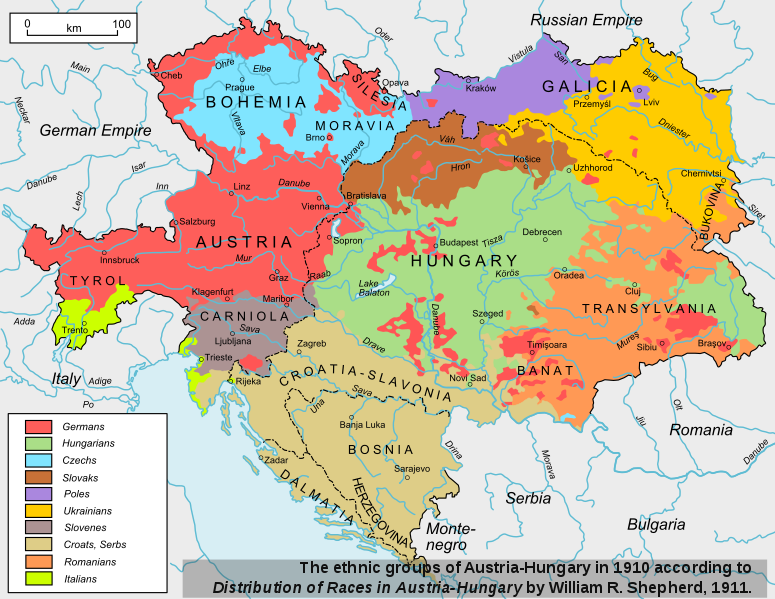
Do you know where he lived? The borders changed there and at the time of the map below (1910) Poland was split between Austria, Prussia, and Russia. In 1908 he might have spoken one of several (Rusyn) languages in the Austria-Hungry area used by these people:

Boyko (Subcarpatihan Voivodeship of today’s Poland)
Lemko (S.E. of today’s Poland Poland)
Volynian (in Chelm, of today’s PolandPoland)
Upper Sannian (San river valley)

The purple area was under Austrian influence:

 
The Eastern Catholic Churches in Central Europa deny that they ever belonged to the separated Byzantine Church. They claim that their ancestors migrated beyond the Byzantine influence before the schism, and kept their Liturgy, customs (married priests) and faith including the faith in the primacy of the Patriarch of Rome. In the time of the union they had to accept only the doctrine of the Purgatory, they were allowed to keep their Liturgy and customs.

I know very little about the other Eastern Catholic Churches, but guess that the influence of the Byzantine empire and Church ceased in their territory also before the schism, so they never were part of Byzantine church in schism.

We all shall understand that the schism was not about the faith and doctrine, but a political rivalry, extended to the level of the religion.
I don’t quite understand this. What do you mean the Eastern Catholics in Central Europa say they separated before the schism? What difference would that make?
 
Do you know where he lived? The borders changed there and at the time of the map below (1910) Poland was split between Austria, Prussia, and Russia. In 1908 he might have spoken one of several (Rusyn) languages in the Austria-Hungry area used by these people:

Boyko (Subcarpatihan Voivodeship of today’s Poland)
Lemko (S.E. of today’s Poland Poland)
Volynian (in Chelm, of today’s PolandPoland)
Upper Sannian (San river valley)

The purple area was under Austrian influence:

http://upload.wikimedia.org/wikiped...hnic.svg/775px-Austria_Hungary_ethnic.svg.png
Hi Vico:

I was looking at your map. It never even dawned on me that Austrians and Germans were Catholic and Orthodox. My husband has family from Greece, Germany, Austria, and Scottland. I always presumed the Greek part was Greek Orthodox but I never thought about the other countries. Do you happen to know the predominant religons in Germany, Austria in around 1881-1910? I’m just curious. He is a Methodist convert to the Catholic faith and his family has no idea of their religious background so it would be interesting to know what the people of his country of origin originally were.

Thanks and Many blessings.
 
Do you know where he lived? The borders changed there and at the time of the map below (1910) Poland was split between Austria, Prussia, and Russia. In 1908 he might have spoken one of several (Rusyn) languages in the Austria-Hungry area used by these people:
He emigrated in 1905, under polish citizenship, via Krakow, then returned and brought the family over in 1908. I know from the photos that they did not live in Krakow; one of them is from the trip to Krakow.

I am told he avoided discussing the old country.
 
He emigrated in 1905, under polish citizenship, via Krakow, then returned and brought the family over in 1908. I know from the photos that they did not live in Krakow; one of them is from the trip to Krakow.

I am told he avoided discussing the old country.
He was probably a Rusin like Pope John Paul II’s mother.

Galicia was part of the Austrian kingdom at that time. My grandparents came from the region of Tarnow, closer to Krakow than any other big city. They were definitely Polish though.

Galicia was once inhabited by Celts, but they were either adsorbed or expelled by the White Croats, a Slavic people who are likely the ancestors of all the Poles and Ukrainians in Galicia, from east of L’viv to west of Krakow.

The people of “Little Poland” were originally evangelized when the area was part of the Moravian kingdom, into the Byzantine rite. Later the newly evangelized (by Saint Adalbert) kingdom of Poland expanded to include the area and suppressed the Byzantine rite in southern Poland (and anywhere else it had spread by then) but the Rusyn were border people and probably were able to escape the consolidation.

(Please Note: This uploaded content is no longer available.)
 
Status
Not open for further replies.
Back
Top