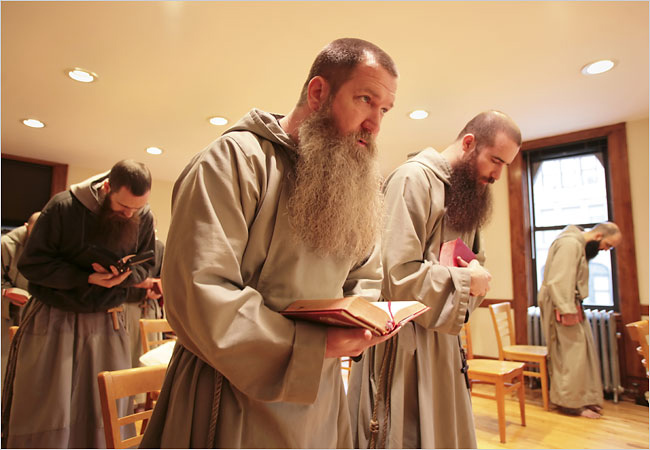
Would you wear this habit?

  • Thread starter Thread starter JReducation
  • Start date Start date
Status
Not open for further replies.
Let me offer an apology for derailing the thread with my reply about veiling/headcovering. As has been said many times, there are enough of those hotly debated veil threads in the archives to last a decade. So I will get back on track to assist the this thread in staying open.

I do like to see Sisters in traditional habits, but understand practicality and culture need to be considered when determining the apparel of any religious order.
 
Let me offer an apology for derailing the thread with my reply about veiling/headcovering. As has been said many times, there are enough of those hotly debated veil threads in the archives to last a decade. Let us get back in track so the thread can remain open.

I do like to see Sisters in traditional habits, but I understand practicality and culture need to be considered when determining the apparel of any religious order.
My apologies as well.

Just out of curiosity…do you have a particular order that you find has attractive habits?
 
My apologies as well.

Just out of curiosity…do you have a particular order that you find has attractive habits?
Augustinian Sisters Servants of Jesus and Mary- simple, mid-calf dress (gray/white) with sleeves that vary based on season/climate (long to slightly above elbow) and modified head covering. Practical, simple, and easy to identify as a Sister.
 
Brother Jay, I know this is off topic but I have been curious about why some Franciscan brother sport long beards? Is it the man thing or is there another reason?

I confess to having the urge to rid the world of beards.😊
:ehh:
 
Brother Jay, I know this is off topic but I have been curious about why some Franciscan brother sport long beards? Is it the man thing or is there another reason?

I confess to having the urge to rid the world of beards.😊
Actually, the beard has nothing to do with masculinity. This notion came into existence with homophobia. In fact, the Americans were ordered to shave sometime in the 1950s to avoid being confused with Bic nics (sp?)

The beard actually comes from the OT. Many communities maintained it, because it is required in the OT: Camaldolese, Little Brothers of the Poor, most Franciscans, Discalced Carmelites and all of the Eastern Catholics. You’re not even supposed to trim it or shape it.


Franciscans of the Renewal

https://encrypted-tbn2.gstatic.com/...yIIRTIXv9EiSw5Bnt_eU41VrkmaIzJsmWg5TpynuNOeY-
Franciscans of Life

(Please Note: This uploaded content is no longer available.)
Franciscans of the Primitive Observance


Capuchin Franciscans

http://www.carmelitehermits.org/images/Camaldolese/09pics 007.jpg
Camaldolese Benedictines
 
My favorite female habits are those of the Dominican sisters over in Nashville. They’re gorgeous, yet simple.

As a man, I can’t say I would ever want to wear the habit of a female religious! LOL!
http://godzdogz.op.org/uploaded_images/Coffee-753320.jpg
You don’t know many Dominicans, do you? 😃
Obviously they are not conducive to all types of work, and should be adjusted accordingly, but I have yet to see a ministry that would require the complete abandonment of a habit all together.
Oh, but some founders felt strongly about that.

St. William Chaminade founder of the Brothers of Mary prohibited any kind of distinctive garb, even a collar. The priests and brothers were to look like secular teachers.

Bl. Mother Teresa founder of the Missionary Brothers of Charity, prohibited any kind of distinctive garb for her male missionaries. They are to dress as the poor man in India, even those in America and Europe.

http://4.bp.blogspot.com/-nRuyGL9B95I/TgcgZldS8kI/AAAAAAAAAG8/zsx501KCMV0/s1600/IMG_0498.JPG
EXCELLENT! Someone brought this up!
Mother Teresa readily stressed the importance of the habit to her sisters!
She chose a sari style that was representative of a consecrated woman. It would be easily recognizable in the Indian culture to assume that a MC was an unmarried, consecrated virgin. Much the way most Westerners react when we see a woman in religious garb (tunic and veil). Mother Teresa recognized the need to be accessible to the culture, but at the same time, set apart as a visible witness to the internal sacrifices and charism of their vows.
I’m not sure where you got this. This was not what she said. We have to be careful. The Missionaries of Charity have put out an entire collection of statements that allegedly Mother made, which she never made. Their last general chapter made it a rule to prohibit the dissemination of these statements by the sisters, brothers and laity. They take this very seriously and they get very offended when we who are not Missionaries of Charity speak about Mother and quote her without checking with them first. I was blasted by them once for this. And I was actually quoting her correctly. Go figure. I’ll never quote her again, not within hearing distance of one of their sisters. :nope:

I was told that she chose the white because it was easy to maintain. The blue stripes were perfect, because they honored the Blessed Mother and the Trinity. It was a coincidence that she found this sari already made. She did not design it.

I was also told that originally, her hair was exposed. When she went to train in nursing with the Medical Mission Sisters, they encouraged her to wear a cap to cover her hair to protect her from lice. That’s how they come to wear a cap under the sari. It’s like a surgical cap.

The sari became well known in those areas where they served, not because it was identifiably Catholic or religious, because they were many sisters. It became obvious that it was a uniform. They also wear a cross on the shoulder. I was told that by their sisters.

They deny that it was intended to be a distinctive religious habit; rather, it became so as they grew in numbers. According to the sisters, the reason for the sari and not a European habit was Christ’s revelation that he wanted an Indian congregation.

The sisters also deny that Mother was a nun. They are very careful to explain that she had been a nun when she was with the Order of Loretto. Upon being dispensed from the Order of Loretto and incorporated into the Society of the Missionaries of Charity that she founded, she was demoted from a nun to a sister. Therefore, consecrated virginity does not enter into the picture. Sisters do not have to be virgins. Virginity is required by some, not all, orders of nuns, never by sisters.

This is not to say that Mother was not a virgin. It’s just that when they make their vows, they do not use the rite for the consecration of virgins. They use the rite for religious consecration. Only some groups of women use this rite.

Going back to the OP, their habit is quite comfortable and very practical. It’s easy to maintain too. It’s cool in the summer and warm in the winter.

 
I’m not sure where you got this. This was not what she said. We have to be careful. The Missionaries of Charity have put out an entire collection of statements that allegedly Mother made, which she never made. Their last general chapter made it a rule to prohibit the dissemination of these statements by the sisters, brothers and laity. They take this very seriously and they get very offended when we who are not Missionaries of Charity speak about Mother and quote her without checking with them first. I was blasted by them once for this. And I was actually quoting her correctly. Go figure. I’ll never quote her again, not within hearing distance of one of their sisters. :nope:

I was told that she chose the white because it was easy to maintain. The blue stripes were perfect, because they honored the Blessed Mother and the Trinity. It was a coincidence that she found this sari already made. She did not design it.

I was also told that originally, her hair was exposed. When she went to train in nursing with the Medical Mission Sisters, they encouraged her to wear a cap to cover her hair to protect her from lice. That’s how they come to wear a cap under the sari. It’s like a surgical cap.

The sari became well known in those areas where they served, not because it was identifiably Catholic or religious, because they were many sisters. It became obvious that it was a uniform. They also wear a cross on the shoulder. I was told that by their sisters.

They deny that it was intended to be a distinctive religious habit; rather, it became so as they grew in numbers. According to the sisters, the reason for the sari and not a European habit was Christ’s revelation that he wanted an Indian congregation.

The sisters also deny that Mother was a nun. They are very careful to explain that she had been a nun when she was with the Order of Loretto. Upon being dispensed from the Order of Loretto and incorporated into the Society of the Missionaries of Charity that she founded, she was demoted from a nun to a sister. Therefore, consecrated virginity does not enter into the picture. Sisters do not have to be virgins. Virginity is required by some, not all, orders of nuns, never by sisters.

This is not to say that Mother was not a virgin. It’s just that when they make their vows, they do not use the rite for the consecration of virgins. They use the rite for religious consecration. Only some groups of women use this rite.

Going back to the OP, their habit is quite comfortable and very practical. It’s easy to maintain too. It’s cool in the summer and warm in the winter.
I was only going off the two biographies I read of Mother.
I didn’t mean that she intended it as a symbol of virginity. That was just the custom for the style that she chose. It didn’t have much to do with their vows or consecration as it did with the general mindset that these women were not married, and did not plan on being married.

The story (as recounted in the biographies) does affirm what you said however. Upon leaving Loreto, she went into the market to find some suitable Indian attire. She found her Sari and purchased two, because it was the cheapest the vendor sold. It was only later that she realized the significance of the blue borders and it’s relation to the Holy Trinity.
 
I love seeing nuns in habits. When I was in elementary school our principal was a nun and she wore a uniform I guess, it didn’t look like other nuns habits to me, although she did wear the veil. She would wear a white collared shirt tucked into a navy blue, straight, knee length skirt, and she always wore plain white sneakers with crazy shoelaces. There’s a convent in the Bronx connected to St. Anthony de Padua church and I love to just walk by and watch the nuns garden and do laundry (they hang their habits outside to dry as long as the weather permits). There’s a certain elegance in the simplicity of many habits.🙂
 
Hint: most of the women are clean shaven. 😃
:rotfl::rotfl::rotfl:

I have a photograph of a Franciscan on my desk. I love him very much. He is an inspiration to me. He reminds me to persevere when I get weak.


Happy New Year Brother.

-Tim-
 
I was only going off the two biographies I read of Mother.
I didn’t mean that she intended it as a symbol of virginity. That was just the custom for the style that she chose. It didn’t have much to do with their vows or consecration as it did with the general mindset that these women were not married, and did not plan on being married.

The story (as recounted in the biographies) does affirm what you said however. Upon leaving Loreto, she went into the market to find some suitable Indian attire. She found her Sari and purchased two, because it was the cheapest the vendor sold. It was only later that she realized the significance of the blue borders and it’s relation to the Holy Trinity.
The story of the sari is a very simple story. I think that the sisters and brothers of the Missionaries of Charity want to make sure that these stories are correctly transmitted, because Mother’s story has been found to be one of heroic faith and virtue. They don’t want it tainted with myth. Nothing can unravel a canonization process faster than mythology.

The Missionaries of Charity remind me very much of Franciscans. They are passionate about their founder. Mother is not just the founder, she is truly the matriarch of this family, just as we revere Francis as the Seraphic Father or the Holy Father, which we often call him. Though this now confusing when we refer to Pope Francis as the Holy Father. The passion that these men and women feel for Mother is admirable. I make sure that when I’m around them I say very little, lest I make a mistake and get an earful. They have no qualms about giving you a tongue lashing either. LOL
I love seeing nuns in habits. When I was in elementary school our principal was a nun and she wore a uniform I guess, it didn’t look like other nuns habits to me, although she did wear the veil. She would wear a white collared shirt tucked into a navy blue, straight, knee length skirt, and she always wore plain white sneakers with crazy shoelaces. There’s a convent in the Bronx connected to St. Anthony de Padua church and I love to just walk by and watch the nuns garden and do laundry (they hang their habits outside to dry as long as the weather permits). There’s a certain elegance in the simplicity of many habits.🙂
Now that is funny. Watching the clothes line is not something that I would have ever think to do. I’m trying to think if we ever hung our clothes in a place that could be seen from the outside. I don’t think so. By the time that I entered religious life, we had dryers. There was very little that you hung up. We did hang up the tunics, because they were wool. To avoid shrinking it was better to hang them up on a clothes hanger. Today, they are a blend. They go right into the dryer. It almost took an Act of Parliament to change from wool to a blend.
 
Again, I think we need to separate the nuns from the sisters.
From the website Brother JR refered, only a few are nuns, most are sisters.

I think why the sisters clothes were so varied was because they try hard to be distinctive from different congregation (or forced to be distinctive). Thus the whole variation in veils, sometimes to the point of being ridiculous.
If they must wear a habit, I wonder why don’t they just pick one older habit and modified the color just to make them distinctive (or add your congregation emblem sewn on their clothes to differentiate them).

I like the Filippini sisters’ clothes from the website. They are simple, a bit distinctive, but easily blend with their surroundings and comfortable for their work.
 
This was actually done by sisters that had an order of nuns to emulate, such as the Carmelite, Franciscans, Dominicans, Benedictines and Augustinian Sisters. These families had nuns before they had sisters. The sisters took the nuns’ habits and modified them. You won’t see much difference between a Dominican nun and a Dominican sister. Those who are familiar with the Dominican family could tell the difference by looking at the veils. The habit itself is the same. This was also true of the other communities that I mentioned above.

Those communities that had no point of reference, such as the Sisters of Mercy, I’m not sure where they got their inspiration. What was interesting was that even in 20th century America, they were founding new communities, but adopting old habits. For example, St. Katherine Drexel founded a Franciscan community, but used the habit of the Sisters of Mercy. She added a scapular and the Franciscan cord. That was the only difference. You would think that in the 20th century, she would have thought of something more contemporary.

Another community founded in 20th century America was the Missionary Servants of the Blessed Trinity. They dressed in very American clothes.

http://www.stshrine.org/oldsite/History/images/ThreeFoundersObverse.jpg

They never wore a veil, nor did they ever wear floor length skirts.

(Please Note: This uploaded content is no longer available.)

I once had to chuckle to hear someone say that they should put on a veil and long skirts. When I showed the person the photos of their origins, the individual just “hurrumphed out of the room.” 🤷
 
I had absolutely NO idea this was so complicated! I have really learned a lot from this discussion. Thanks to everyone for the interesting questions and answers.
 
I had absolutely NO idea this was so complicated! I have really learned a lot from this discussion. Thanks to everyone for the interesting questions and answers.
It’s a very complex issue. While there is a place for the habit, there has to be a place for common sense. It can’t all be nostalgia. What was practical once upon a time, may no longer be practical. Then there is another reality. Maybe something was not practical, but there were no other alternatives either. Today there are alternatives. In deciding on a habit, a community has to consider several factors:
  1. The will of the founder
  2. Its own traditions
  3. The purpose of its habit (why did the founder choose a habit?)
  4. It’s work
  5. It’s financial resources
  6. Climate
  7. Availability of materials
  8. Cost and time involved in maintenance
  9. Local culture
  10. Particular law
I like to think that those of us who wear a habit certainly want to make a statement to the world. However, I also believe that we want to choose the statement. If an additional message is sent, we hope that it will be a good one. But we want to make sure that our intent is made clear.

I can speak best about Franciscans. When we wear our habit, we want the lay faithful to think of St. Francis, his love for the Gospel, his discipleship. Hopefully, those who think will be moved to live the Gospel as he did.

We’re not too concerned about people identifying us. That would be a secondary message. It’s not intended, but we don’t mind, because it’s neutral. Actually, the habit makes it harder to identify us, because we all look alike. It’s easy for any of us to disappear into the crowd of habits rather than be singled out.
 
Thank you for the information on beards. I just hope any lady afflicted with facial hair is allowed to join an order which permits shaving.
 
I’m trying hard to remember. There was a saint who was not admitted to the Franciscans because he could not grow a beard. He ended up becoming a Redemptorist. Could it have been St. Gerard?

If you think that this is strict, try joining some of the cloistered orders. I some cloistered orders, singing is more important than the habit. If you can’t sing, you don’t have a vocation to the order. I believe that the Carthusians are one of them.

Speaking of habits, that’s a nice habit. It’s very simple and practical.

Here is another company that makes habits. Check out these prices.

glenfont.com/MensHabits.html

If you want to give a gift to a friar or a monk, now you know what to give him, a new habit. :yup:

This is our work habit. It’s made of denim, but it leans more to the grey than to blue. The best is very expensive. I think it’s about $40.00. We just wear a shorter chord. Can’t afford the belt.

View attachment 19005
 
As a young lady discerning a vocation to the Discalced Carmelites, I’m finding this conversation very interesting.

🙂
 
Status
Not open for further replies.
Back
Top