W
weller2
Guest
The data tells a different story:If you look at gasoline, for example, that’s not true.
Actually, adjusted for inflation, the price of gasoline is about what it was in 1918. A little less, actually. Since then, it has been pretty much between $2.00 and $4.00/gallon again, adjusted for inflation. When we think about what things cost to buy or produce, we always need to consider what inflation does to them.

It’s rather interesting that crude was at (inflation-adjusted) $20/bbl for 100 years, which would hint at it being the equilibrium price. The price has then shot up during the first oil crisis, and never really returned to the equilibrium level – which strongly suggests that the market is now production limited, not consumption limited.
NB it’s possible that you are saying the truth, as gasoline might have actually gotten cheaper w.r.t. crude due to advances in processing. However, the primal energy source is crude, not gasoline – conversely, it’s the inflation-adjusted price of crude that matters.
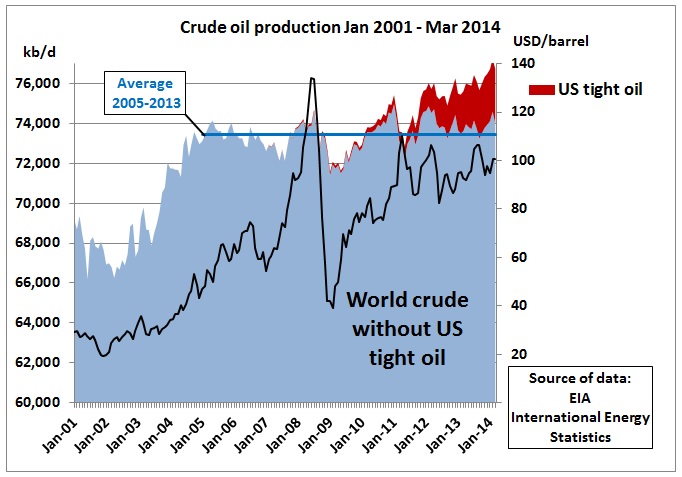
As you can see in the following graph, world production of crude has stayed flat since 2004, and all the increase in production in production comes from US shale:There have been ups and downs, but development of petroleum resources in the U.S. might cause one of the “down” moves, again, adjusted for inflation. And that’s despite OPEC.
The problem is, production from US shale is predicted to stop growing in 2016:
There’s also another alarming indicator, if youignore such predictions. As the US shale is supposedly profitable, then you should see increased profits of the energy companies. However, it seems that they are taking debt instead:The two major forecasting agencies, Washington’s EIA and Paris’ IEA, are both more pessimistic than is generally known for they both foresee US shale oil production leveling off as soon as 2016. The reason for this is that drillers will simply run out of new places to drill and frack new wells. While new techniques of extracting more oil from a well are possible, there is need to look closely at the costs of these techniques vs. the potential payoff.
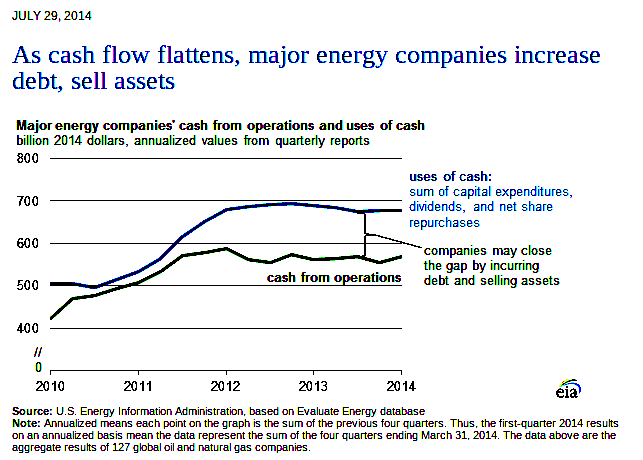
What it looks like is that US shale oil is being subsidized with credit – i.e. due to large upfront investment required, it is being sold below cost. This will work as long as energy companies can roll over debts by opening new wells – however, the amount of new wells is finite.
Also, last month the Rockefeller family sold its shares in the oil business. Their official line is that it’s because they want to go “green”, but the truth is probably that their analysts are competent enough to see what is going on.
Yes, we still have a lot of oil, but it’s $200/bbl oil.