WSJ: Whatever Happened to Global Warming?

  • Thread starter Thread starter Theo520
  • Start date Start date
Status
Not open for further replies.
The entire point of this article was about how all of that observation hasn’t panned out how it was predicted to. We’re not denying the science, only the conclusions.

This has nothing to do with politics, and I have no fear of green technologies. This is about whether or not the fear and regulations associated with the whole notion of global warming are warranted or appropriate. I am a firm believer in science when it is appropriately applied. I personally do not believe that the presented evidence supports the conclusions that have been drawn by those in favor of global warming. I am perfectly willing to append that opinion should further evidence warrant it, but as it stands I’ve seen nothing that does. To further qualify this, I have studied evidence from both sides, and have watched presentations which gave arguments and evidence from both sides in a fair and unbiased way. One of my wife’s professors once did a presentation that was nothing but gathered data, no conclusions or opinions given. In the end of all of that, I have arrived at the informed opinion which I have previously stated. Namely: Man-made global warming is not the severe threat that it has been made to appear. We should continue to try to find less damaging methods of energy generation and transportation, but not because the world’s going to end if we don’t. We should do so because it is our call to be good stewards, and finding ways to do less damage is always good.
Several points:
  1. Thanks for focusing this reply on potential scientific criticisms, not who gets funded and the like.
  2. It would be helpful to stick to claims the climate science community is actually stating in assessments…e.g., not “…but not because the world’s going to end if we don’t.” No one thinks that.
  3. The foundation of anthropogenic global warming is atmospheric radiative transfer. It is this that needs to be refuted, not the general performance of a particular model over 20 years (at simulating ENSO for example).
  4. Climate modelers do not make predictions about the future, they make projections. Even a perfect model will not be correct at some aspect of what we see in reality if it is not being forced properly or initialized incorrectly, etc. Secondly, one can, for example, make claims that “smoking tends to cause lung cancer.” An observation of a smoker who does not develop lung cancer does not falsify this hypothesis. Similarly, if we observe a planet behaving in ways that do not seem to accord with Kepler’s law, this does not mean the foundations of planetary motion are wrong…it may be that an undetected planet is modifying the orbit, that once accounted for, allows the theory to “work.”
The hiatus can result from any number of auxiliary hypotheses that have nothing to do with the long-term global warming forecast, much of which has been discussed in the literature. I have already argued in previous threads that one needs to look at longer periods of time on temperature, sea ice, etc (climate is more than just one number or one metric), multiple diagnostics of the climate system, and think about how to put it into an appropriate long-term context. Theo has stated several times now that " claim x does not pass the scientific method" (whatever that means) but this not been put forth as a defensible formulation of falsifiability. Instead, the focus has been on a single metric of the climate system of just a short period of time, and with categorical claims about the scientific method that do not agree with the current literature on the topic.
  1. You should post reasons you disagree with the science, perhaps from the talk you heard.
 
Several points:
  1. Thanks for focusing this reply on potential scientific criticisms, not who gets funded and the like.
No problem, supporting or refuting global warming is the job of the data, not of the people collecting it.
  1. It would be helpful to stick to claims the climate science community is actually stating in assessments…e.g., not “…but not because the world’s going to end if we don’t.” No one thinks that.
I was being colorful, but okay: I disagree with the specific assertion that the Sea Levels are going to raise dramatically as a direct result of man-made climate change. This is only one of the assertions I disagree with, but it’s one that I’ve heard repeated often.
  1. The foundation of anthropogenic global warming is atmospheric radiative transfer. It is this that needs to be refuted, not the general performance of a particular model over 20 years (at simulating ENSO for example).
That is one foundation of it, and I’m not claiming that it -needs- to be refuted. What I’m claiming is that the predictions being trumpeted are not supported by the data that’s been gathered, which is what the article is claiming.
  1. Climate modelers do not make predictions about the future, they make projections. Even a perfect model will not be correct at some aspect of what we see in reality if it is not being forced properly or initialized incorrectly, etc. Secondly, one can, for example, make claims that “smoking tends to cause lung cancer.” An observation of a smoker who does not develop lung cancer does not falsify this hypothesis. Similarly, if we observe a planet behaving in ways that do not seem to accord with Kepler’s law, this does not mean the foundations of planetary motion are wrong…it may be that an undetected planet is modifying the orbit, that once accounted for, allows the theory to “work.”
A matter of semantics, but I’ll give that one to you. I agree that individual instances of deviance from a set of laws do not negate the laws, and generally point to a misunderstood or unaccounted for variable. The article is not looking to use a single variation to discount it though, it is pointing out that as the results have not been similar to the projections, the supporters have been “moving the goal post” while not modifying their rhetoric or their dire predictions.
The hiatus can result from any number of auxiliary hypotheses that have nothing to do with the long-term global warming forecast, much of which has been discussed in the literature. I have already argued in previous threads that one needs to look at longer periods of time on temperature, sea ice, etc (climate is more than just one number or one metric), multiple diagnostics of the climate system, and think about how to put it into an appropriate long-term context. Theo has stated several times now that " claim x does not pass the scientific method" (whatever that means) but this not been put forth as a defensible formulation of falsifiability. Instead, the focus has been on a single metric of the climate system of just a short period of time, and with categorical claims about the scientific method that do not agree with the current literature on the topic.
I would argue that 15 years is not a short amount of time given the timelines that have been put forth. If you’re claiming that we will see significant change in thirty or forty years, and we go fifteen years without any change, that’s a significant block of your projected timeline where nothing has been happening. This would suggest that your projections or models are wrong somewhere, which is what the article is saying.
  1. You should post reasons you disagree with the science, perhaps from the talk you heard.
It’s not that I disagree with the science. The science is the science, it is a collection of data used to draw conclusions; there is nothing to agree or disagree with, it is simply a series of observations. What I disagree with are the conclusions that are being drawn. Based on the historical cycles of heating and cooling in the world, I do not believe that one cycle that is (arguably) seeing a slightly above-average rate of heating (or, more specifically, an above average rate of exiting an ice-age) warrants the reaction we’ve seen in regards to the issue.
 
  1. It would be helpful to stick to claims the climate science community is actually stating in assessments…e.g., not “…but not because the world’s going to end if we don’t.” No one thinks that.
Actually, I think this is incorrect. Certainly no scientist thinks that. But the effect of politicized scare-mongering by non-scientists means that there are almost certainly a large number of man-on-the-street people out there who think that life will not be sustainable on this planet by, say, the end of this century (or possibly a lot sooner) if MMGW is not addressed.

Someone (I forget who) once pointed out that it is interesting that the whole MMGW political posturing accelerated quickly at almost the same time that the Berlin Wall came down. People are easier to manipulate if you have the possibility of a man-made armageddon to scare and shame them with. Once the nuclear threat dissipated, they needed something else.

Now I’m all in favor of reasonable green measures. I recycle, use cloth bags at the store, and have only one each incandescent and halogen light bulbs in my apartment. I work at home, so I drive very seldom. And so on. But these kinds of decisions should be made out of an understanding of the real situation and a respect for God’s creation, not from a place of fear of a bogeyman.

–Jen
 
No problem, supporting or refuting global warming is the job of the data, not of the people collecting it.

I was being colorful, but okay: I disagree with the specific assertion that the Sea Levels are going to raise dramatically as a direct result of man-made climate change. This is only one of the assertions I disagree with, but it’s one that I’ve heard repeated often.

That is one foundation of it, and I’m not claiming that it -needs- to be refuted. What I’m claiming is that the predictions being trumpeted are not supported by the data that’s been gathered, which is what the article is claiming.

A matter of semantics, but I’ll give that one to you. I agree that individual instances of deviance from a set of laws do not negate the laws, and generally point to a misunderstood or unaccounted for variable. The article is not looking to use a single variation to discount it though, it is pointing out that as the results have not been similar to the projections, the supporters have been “moving the goal post” while not modifying their rhetoric or their dire predictions.

I would argue that 15 years is not a short amount of time given the timelines that have been put forth. If you’re claiming that we will see significant change in thirty or forty years, and we go fifteen years without any change, that’s a significant block of your projected timeline where nothing has been happening. This would suggest that your projections or models are wrong somewhere, which is what the article is saying.

It’s not that I disagree with the science. The science is the science, it is a collection of data used to draw conclusions; there is nothing to agree or disagree with, it is simply a series of observations. What I disagree with are the conclusions that are being drawn. Based on the historical cycles of heating and cooling in the world, I do not believe that one cycle that is (arguably) seeing a slightly above-average rate of heating (or, more specifically, an above average rate of exiting an ice-age) warrants the reaction we’ve seen in regards to the issue.
It’s not that I disagree with the science. The science is the science, it is a collection of data used to draw conclusions; there is nothing to agree or disagree with, it is simply a series of observations. What I disagree with are the conclusions that are being drawn. Based on the historical cycles of heating and cooling in the world, I do not believe that one cycle that is seeing a slightly above-average rate of heating (or, more specifically, an above average rate of exiting an ice-age) warrants the reaction we’ve seen in regards to the issue.
“Data” is just a collection of numbers. No one just publishes thousands of numbers and says the science is done. The whole issue (or “the science”) is the interpretation, the development of the theory, and how we make sense of it. The marriage of observations, theory, modeling, etc has been synthesized in a number of reports (e.g., here, here, in reports from the National Academies, etc). Appropriate time horizons over which the signal of anthropogenic global warming is expected to emerge from natural variability (e.g., from 1950-present) is all part of the story (first link, chapter 10). How past climates fit into the picture is part of the story (chapter 5). How the ‘hiatus’ fits into the picture is part of the story. I focus on studies of past climate myself. There are number of core claims at the heart of what is being claimed, and whether or not models are perfect at representing short-term variability is not one of them. In fact, it is demonstrated in these discussions (and in a linked image from my last post) that the collection of cmip5 models may be at the high or low end of observations for any given 15-year segment of time, but the 60+ year trend is as we expect.

…in fact, when you account for what internal variability has done, in addition to what external forcings (volcanoes, the Sun, etc) have done after the cmip5 historical model experiments were finished, and potential gaps in observations, then observed climate change in the surface temperature record is very much explainable. Moreover, since the planet is still receiving more energy than it is shedding to space, we know it must warm more, irregardless of whether the deep ocean slows the rate of infrared emission to space. There are always technical issues to explain, but the big-picture issue of relevance to what we communicate to policymakers hasn’t.

Whether or not this is all “bad” or how you view melting sea ice, drought, sea level, etc as a priority, is a value judgment. I don’t tend to debate value judgments very much, but part of this has implications for how a rational society makes objective risk decisions. Your values are likely to differ from mine and others. It also leads to the final sentence in this piece.

"“Don’t undermine the science just because you don’t like the economics. That’s a dangerous slope, because the problem of course is you’re not undermining just that, you’re undermining the basis of rational decision-making in society.”
 
Chris,
Please stop relying on your ‘denier’ strawman to make an argument. Comments follow your bullets.
Several points:
  1. Thanks for focusing this reply on potential scientific criticisms, not who gets funded and the like.
Depending on the topic, it may be relevant to introduce who is someones benefactor. bias is a proven risk in science.
  1. It would be helpful to stick to claims the climate science community is actually stating in assessments…e.g., not “…but not because the world’s going to end if we don’t.” No one thinks that.
The projections with sensational headlines are out there for all to see. They were backed by ‘science’ yet have not come true. Here’s one from 2009 for example:
melting ice will trigger wave of natural disasters.
Scientists warn of earthquakes, avalanches and volcanic eruptions as the atmosphere heats up and geology is altered. Even Britain could face being struck by tsunamis – “Not only are the oceans and atmosphere conspiring against us, bringing baking temperatures, more powerful storms and floods, but the crust beneath our feet seems likely to join in too,” – Professor Bill McGuire, director of the Benfield Hazard Research Centre, at University College London, – The Guardian, Sep 2009.
  1. The foundation of anthropogenic global warming is atmospheric radiative transfer. It is this that needs to be refuted, not the general performance of a particular model over 20 years (at simulating ENSO for example).
Please stop projecting your strawman. No one is denying there is likely an anthropogenic signal. The question is how much. It’s dishonest of you to present it as an ALL OR NOTHING decision.
  1. Climate modelers do not make predictions about the future, they make projections. Even a perfect model will not be correct at some aspect of what we see in reality if it is not being forced properly or initialized incorrectly, etc.
Call it what you will but whether the projections matched measurement is a statistical problem. The models have failed the scientific method with a high degree of confidence.
Secondly, one can, for example, make claims that “smoking tends to cause lung cancer.” An observation of a smoker who does not develop lung cancer does not falsify this hypothesis. Similarly, if we observe a planet behaving in ways that do not seem to accord with Kepler’s law, this does not mean the foundations of planetary motion are wrong…it may be that an undetected planet is modifying the orbit, that once accounted for, allows the theory to “work.”
Your smoking example would be relevant if we were explaining why one specific location did not match projection. Since we are looking at global cancer rates, or global temperature means, the isolated example is irrelevant and we can test the hypothesis.

If the model on planetary motion was wrong because it missed including a planet, it still failed the scientific method and must be reformulated. You don’t cling to the erroneous output of the discredited model.
The hiatus can result from any number of auxiliary hypotheses that have nothing to do with the long-term global warming forecast, much of which has been discussed in the literature.
I look forward to the new models that incorporate these ‘missing planets’ so to speak. However, it’s premature of you to assume they will have “* nothing to do with the long-term global warming forecast*”.
Theo has stated several times now that " claim x does not pass the scientific method" (whatever that means) but this not been put forth as a defensible formulation of falsifiability. Instead, the focus has been on a single metric of the climate system of just a short period of time, and with categorical claims about the scientific method that do not agree with the current literature on the topic.
The OP here from WSJ showed where the IPCC acknowledged our current hiatus of >15 yrs would negate the projections of their models.
  1. You should post reasons you disagree with the science, perhaps from the talk you heard.
Nobody disagrees with the elemental physics, that’s just your strawman at work.
 
Code:
The projections with sensational headlines are out there for all to see. They were backed by ‘science’ yet have not come true. Here’s one from 2009 for example:
That is just an example of why packaging science for the common man to read in the media is not always a good thing. The media chooses to sensationalize things not the scientists and no one said any of those things would happen tomorrow. Such plausible scenarios are used to illustrate the fact that abusing the Earth has long term consequences some of which, such as the alarming rate of desertification in China, can be observed today.
 
Chris,

Call it what you will but whether the projections matched measurement is a statistical problem. The models have failed the scientific method with a high degree of confidence.
You can’t claim a hammer doesn’t work when it doesn’t cut wood correctly. The models are not designed for matching up the timing of short-term variability. This is not possible due to chaos theory.
Your smoking example would be relevant if we were explaining why one specific location did not match projection. Since we are looking at global cancer rates, or global temperature means, the isolated example is irrelevant and we can test the hypothesis.
Even for a global population, a substantial portion of the bell curve of smokers will not get lung cancer, just as (for climate) various 15-year realizations of internal variability can generate hiatus-like periods amidst a forced trend. Numerous models do this but may not be synchronized with nature, nor do we expect/need them to be. Observations themselves are just one realization of an ensemble. We do not have a statistical representation of 100 different planet Earth’s that took different realizations, just one. The fact we are looking at “global means” in temperature is irrelevant.

In any case, the question is not whether models are ‘wrong’ (trivially, any model is wrong) but whether they exhibit skill to forced responses. The other point here is that the idea of ‘falsification’ is not useful in this context or countless others, which is why you should abandon it. We can’t agree on philosophy though so the discussion of models is currently pointless.
If the model on planetary motion was wrong because it missed including a planet, it still failed the scientific method and must be reformulated. You don’t cling to the erroneous output of the discredited model.
No, even a perfect model will be wrong if given wrong (name removed by moderator)ut. Alternatively, if we told a model that the Earth received 20% more sunlight than it actually receives and it matched observations perfectly, then it would be “right” for completely nonsensical reasons-- and thus wrong! So it is with climate, and the case with the hiatus too. In fact, the disagreement between models and observations can lead to the development of new hypotheses that test the veracity of your model (as was the case with Neptune’s discovery in our solar system), and similarly stratifying models by ENSO and using updated forcing estimates results in closure between obs and the cmip5 ensemble spread.

Incorrect models still have substantial use in science (Newton’s laws). Clinging to them can still be useful when their limitations are recognized, and where they still do work, not systematically denied.
I look forward to the new models that incorporate these ‘missing planets’ so to speak. However, it’s premature of you to assume they will have “* nothing to do with the long-term global warming forecast*”.
See e.g., Kosaka and Xie (2013), Risbey et al (2014), Schmidt et al (2014), Huber and Knutti (2014), etc
 
You can’t claim a hammer doesn’t work when it doesn’t cut wood correctly. The models are not designed for matching up the timing of short-term variability. This is not possible due to chaos theory.
The IPCC models have failed to meet their own specification, silly. They said they were a hammer but couldn’t pound a nail.
Even for a global population, a substantial portion of the bell curve of smokers will not get lung cancer, just as (for climate) various 15-year realizations of internal variability can generate hiatus-like periods amidst a forced trend. Numerous models do this but may not be synchronized with nature, nor do we expect/need them to be. Observations themselves are just one realization of an ensemble. We do not have a statistical representation of 100 different planet Earth’s that took different realizations, just one. The fact we are looking at “global means” in temperature is irrelevant.
Stop pretending statistics doesn’t matter. The models made their predictions with identified confidence levels and standard deviations. You now seem to argue they should have professed less certainty. That’s called back pedaling son.
No, even a perfect model will be wrong if given wrong (name removed by moderator)ut. Alternatively, if we told a model that the Earth received 20% more sunlight than it actually receives and it matched observations perfectly, then it would be “right” for completely nonsensical reasons-- and thus wrong! So it is with climate, and the case with the hiatus too. In fact, the disagreement between models and observations can lead to the development of new hypotheses that test the veracity of your model (as was the case with Neptune’s discovery in our solar system), and similarly stratifying models by ENSO and using updated forcing estimates results in closure between obs and the cmip5 ensemble spread.
What is this rubbish? The models were designed around the (name removed by moderator)ut. Instead of propping them up, just admit they need major redesign.
Incorrect models still have substantial use in science (Newton’s laws). Clinging to them can still be useful when their limitations are recognized, and where they still do work, not systematically denied.
Newton’s laws pass the scientific method for given criteria with 99.9999% certainty

Perhaps one of the Harmonic Models will come out to prove itself. Too bad they don’t match IPCC projections
 
The IPCC models have failed to meet their own specification, silly. They said they were a hammer but couldn’t pound a nail.

You have already been shown to be wrong on all major points here. As the next El Nino develops, hanging on tightly to the already rather well explained hiatus will not be tenable anymore. GMST trends will continue to rise in the decadal statistics. Referencing irrelevant WUWT graphs are not an escape…

This sentence shows the epidemiological double-standard: “Newton’s laws pass the scientific method for given criteria with 99.9999% certainty.”

No, Newton’s laws are wrong and by your logic should be thrown out and never thought about again. Climate models reproduce the observed hiatus “for given criteria” as well (using updated radiative forcings, proper evolution of the Pacific state) and exhibit very good agreement in the GMST trend for the long-term statistics, yet you categorically dismiss them despite numerous referenced papers showing that this is not a suitable interpretation. The CMIP5 ensemble spread are not prediction bounds. This is a complex subject, a non-trivial obs-model comparison, and numerous papers show your position to be scientifically unsupported. I have already referenced at least four of them but many others exist.

Sorry, but I cannot continue dialogue with you anymore. Both of our positions have been outlined sufficiently.
 
You have already been shown to be wrong on all major points here, as many of the above references show. As the next El Nino develops, hanging on tightly to the already rather well explained hiatus will not be tenable anymore. GMST trends will continue to rise in the decadal statistics. Referencing irrelevant WUWT graphs are not an escape…

Sorry, but I cannot continue dialogue with you anymore.
Sorry charlie,
I’ve responded to your posts completely, paragraph by paragraph, with specifics.
The best you’ve done is reply with spurious insults and ad hominem deflections without addressing the issues I raise.

I’ve never implied the hiatus is permanent, just that it negates the IPCC models.

No comment on the harmonic model? 😛
 
Listen to the Holy Father when it comes to faith and morals and to climate scientists when it comes to climate change. To do otherwise is foolish.

Turn off Fox News and right-wing talk radio and pick up a papal encyclical on Catholic Social Teaching or a peer reviewed paper on climate change. You might learn something.
 
Sometimes we must reestablish perspective on an issue.

I affirm there is complete consensus among the scientific community that CO2 is a greenhouse gas. The basic physics are not in dispute.

However, there is no scientific consensus on how much it impacts our climate system.
Since the estimates in play are between 1.5 to at least 9 for CO2 sensitivity, we have no scientific consensus on AWG where it really matters.
http://www.skepticalscience.com/pics/RoeBaker.jpg

In contrast, consider how scientists agree on the exact constant for Gravity at sea level, and how it changes with any elevation.
en.wikipedia.org/wiki/Gravity_of_Earth
That is a true consensus among scientists.
 
The IPCC models have failed to meet their own specification, silly… The models made their predictions with identified confidence levels and standard deviations.
You have made claims like this several times. What is the most recent IPCC model prediction that has definitely failed its own confidence specification, and how did you learn that it had failed? Did you look at the IPCC reports themselves where they admitted as much? Or did someone unaffiliated with the IPCC tell you the models have failed and you just believed them?
 
Sometimes we must reestablish perspective on an issue.

I affirm there is complete consensus among the scientific community that CO2 is a greenhouse gas. The basic physics are not in dispute.

However, there is no scientific consensus on how much it impacts our climate system.
Since the estimates in play are between 1.5 to at least 9 for CO2 sensitivity, we have no scientific consensus on AWG where it really matters.
http://www.skepticalscience.com/pics/RoeBaker.jpg

In contrast, consider how scientists agree on the exact constant for Gravity at sea level, and how it changes with any elevation.
en.wikipedia.org/wiki/Gravity_of_Earth
That is a true consensus among scientists.
This is not surprising in the least, and proves nothing, either for or against GW theory. The gravitational constant can be determined by a very short experiment under controlled conditions. Climate sensitivity to the doubling of CO2 requires experiments that are neither fast nor under controlled conditions. So naturally the confidence band for the value of this parameter is going to be many times wider than for the gravitational constant. Nevertheless usefull conclusions can be drawn from this distribution by taking the stated confidence band into consideration when drawing the conclusions.
 
Sheesh! Now the WSJ folks are the new climate experts. What’s next?
 
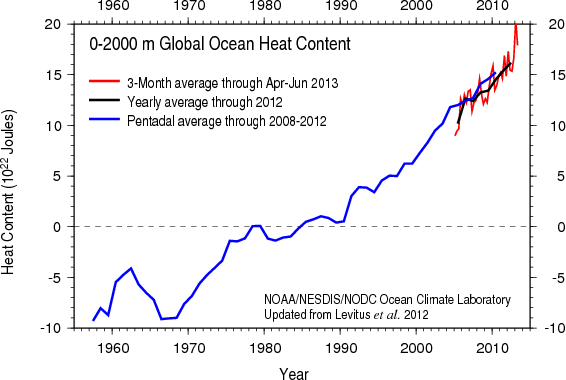
The scientists back in 2008 did not know to what extent the deeper oceans would be taking up the warming. Note that the temps they are referring to are lower atmosphere + land temps.

Science is an ongoing progressing process. They freely admit there are known knowns, known unknowns, and unknown unknowns. This was a case of the latter. They just didn’t expect it. They also didn’t expect the Antarctic ice sheets to break up as quickly as they did. They didn’t expect GW would increase Rossby waves (nor’easters). There have been many surprises along the way re climate science. And that’s the nature of science, esp when it is focused on such a complex, whole earth system.

However, that WSJ article is completely wrong, bogus, deceptive, meaning to deceive the not so well informed public – which doesn’t have the time or does not want to read the scientific literature. A public that would rather stick its head in the sand than face and deal with the truth.

When they say global (as in global climate change), they mean global – the earth’s energy imbalance or total heat content, which includes not only atmospheric, land, and surface ocean temps (as reflected in those stats they more commonly use), but also deeper ocean temps. I know this because back in those years (before 2008) I was trying to raise the issue of carbon release (mainly methane, which is 23 times more powerful than CO2) from melting clathrates (hydrates or molecular ice cages) on the oceans floors leading to spiraling of the warming, and they told me not to worry, that wouldn’t happen for a very long time since the ocean floors were very cold and would not be warming up for many centuries (implying we’d solve the AGW problem well before then, and it would never happen).

As long as they thought those deeper ocean temps were stable (a constant), they did not feel they needed to include them in the equation, and the data they have on them doesn’t go back as far as lower atmospheric temps, but it does go back far enough to show a good portion of the warming has gone into the deeper oceans. As the atmosphere only holds about 2% of the total heat content and the oceans store about 90% of the additional heat, this is a huge factor that needs to be included in any discussion of global warming. Atmospheric temps (while important) are only one indicator among many, and relying solely on them as the WSJ people suggest we do is missing the big picture. See realclimate.org/index.php/archives/2013/09/what-ocean-heating-reveals-about-global-warming/


Actually this is not a good situation – the excess heat from the enhanced greenhouse effect going into the deeper oceans rather than the atmosphere. As mentioned, if the deep oceans warm up fast enough, then a huge amount of methane could be released to the atmosphere causing greater warming, causing greater melting and CH4 release, and greater warming – sort of a shotgun effect (and scientists do claim that “shotgun” is more fully loaded than during past great warmings, such as the PETM, when it was also discharged. See en.wikipedia.org/wiki/Clathrate_gun_hypothesis

Now, I’m not a climate scientist, so what I’m going to do next (which you all can do) is write to a climate scientist I know – a specialist on GHGs, including CH4 – and ask him about what this more rapid warming of the deeper oceans may mean for vast clathrate melting and methane release (I haven’t contacted him in years, since this greater ocean heat uptake has been discovered). He is very conservative in his ideas about this vast methane release and continues to insist CO2 from burning fossil fuels is the main factor. But I’d like to see what he has to say now.
 
Code:
That is just an example of why packaging science for the common man to read in the media is not always a good thing. The media chooses to sensationalize things not the scientists and no one said any of those things would happen tomorrow. Such plausible scenarios are used to illustrate the fact that abusing the Earth has long term consequences some of which, such as the alarming rate of desertification in China, can be observed today.
Unfortunately, as one meteorologist noted in a interview some years ago “Many of the people talking about ‘global warming’ are not scientists”.

I would further add that some of the actual scientists may not be qualified to make such assessments, and only do so for their own personal gain or that of relative or close friend.

This concept is now, I’m sorry to say, a part of our culture is really just a lot of excuse-making.
 
Status
Not open for further replies.
Back
Top