J
JReducation
Guest
It has to be a genuine virgin wool. It’s usually a blend so that it does not have to be ironed. But wool must be the dominant fiber. It must be 60" wide. The color cannot have any hint of red. Some browns have a hint of burgundy to it.What on earth kind of fabric are they using?
We have the same fabric, but it is ash grey. It cannot bee charcoal. The rest is the same.
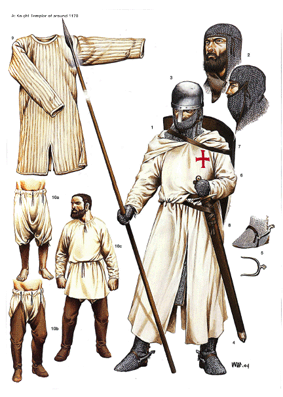
The labor is the most expensive part. It’s a difficult piece of garment to sew. It has many layers and hidden compartments. It has six pockets that you cannot see. If you have a caperone, there is another pocket in it that is hidden in the seams. We don’t have a caperone, so we don’t have that 7th pocket. The pockets are different sizes and different shapes for very specific uses. Of course, since the sleeves and the tunic are so long, you’re talking about very long seams. It must be sewn as one peace from the tip of your hem up to your knuckles. It’s not like the sleeves on an alb, which are added on after they are made. Our sleeves are laid out flat and open along side the open tunic. You sew from the bottom to the top and around the under arm to the knuckles. BTW, the tunic cannot be two pieces, a front and back, like a shirt. It is one piece. There cannot be a seam on the shoulders.
This style of sewing was how they did it in the 13th century and we still preserve it. Many parts of the habit must be done by hand.
Fraternally,
Br. JR, FFV