1950 "The year of the assumption"

  • Thread starter Thread starter myfavoritmartin
  • Start date Start date
Status
Not open for further replies.
You could make this same silly argument with the Trinity and the Council of Nicea and subsequent councils.

Your error is that just because something is defined at some point, it does not mean that it was not believed previously. Or that it’s not true.
And protestantism for that matter:D
 
You could make this same silly argument with the Trinity and the Council of Nicea and subsequent councils.

Your error is that just because something is defined at some point, it does not mean that it was not believed previously. Or that it’s not true.
You have to look at History. The Assumption has been a belief since the earliest days of the Church. All the Pope did was affirm something that had been believed all along. The same can not be said for all the “doctrines” pulled out of thin air when Protestanism was created. Doctrines that no one had beleived for the first 1500 years of the Churchs existence and has no badis in Scripture were suddenly foisted on the public as the TRUTH. Unfortunatlely a lot of people were misled and left the One True Church

When you see Protestsants hammering Catholics over the Assumption you just have to wonder if they really know the history of their own faith.
 
Cool, we’re agreed that we should reject doctrines that weren’t held by the early Christians. Good.
Agreed – “early Christians” can certainly be defined as at least those living no later than about 200AD.
That wraps it up for all those man-made traditions from the mid-1500’s onward, such as sola scriptura, once-saved-always-saved, withholding baptism from infants … 👍
Well, eternal security (“once saved, always saved”) is actually a Biblical doctrine, and thus would have been believed by the early church.

Scripture alone as a definer of faith (“sola scriptura”) is clearly wrong in that the holy spirit works within us to bring us to a closer understanding of the truth. However, just because scripture cannot be said to be absolutely the only source of information about our faith doesn’t mean that you can say that other sources are valid – you’d have to prove that validity first.

“Withholding baptism from infants” – that’s just a clever rhetorical way of rearranging the statement as to shift the burden of proof. However, I would point out that Christian baptism has it’s origins in Jewish ritual – this ritual was a ceremonial baptism in the Mikvah, which would signify one’s decision to follow a particular way of teaching. This ritual, as far as I know, was not permitted to children. Additionally, the baptism of scripture required one to first profess faith in Jesus as savior (this is undisputable). An infant simply cannot do that, and thus, doesn’t meet biblical criteria for baptism. I would thus argue that baptism of infants would be the teaching not adhered to by early Christians. The restoring of that teaching during the reformation is hardly a man-made tradition.

In any case, what about the hundreds of man-made traditions the Catholic church has instituted since the early Christian church? The weekly celebration of the last supper, the canonization of “saints”, the confession of sins to an ordained priest, the rosary and similar instruments of penance, and so forth.
While we’re at it, we can get rid of the Trinity, too.
As the trinity is unbiblical, I agree. Discussion of trinitarianism is better done in another thread, however.
If he had been on a desert island from September 1950, to Oct. 31 1950, he would not have any obligation to believe it; on November 2, when he got back to civilisation, & heard of the definition that happened the day before, he would have the obligation - unless he had serious reasons to think his information was not trustworthy; at which point, he would be obliged to do his best to find out the facts. 🙂
And if someone denies this “truth” now, they are anathema or something, right? However, in 1949, obviously this was not the case. What’s the difference? Would anyone dare to argue that the truthfulness of belief in the assumption of Mary actually changed in that time period? I surely wouldn’t (I believe it was false, and still is). I doubt you would either (you’d argue that it was true even before the church dogmatized it).

The difference then is merely that the Catholic church uttered some words that caused this to become “official” policy. It didn’t change the righteousness of the policy, nor the righteousness of the believer. Instead, it places its claim to power upon the responsibility to follow the Roman church. This responsibility, however, is unproven.
You could make this same silly argument with the Trinity and the Council of Nicea and subsequent councils.
Sure you could – and should. There’s a difference between understanding more about the truth, and changing dogma. Hypothetically – if the concept of Jesus divinity was doubted at some point in church history, would that mean that Jesus actually wasn’t divine, or that belief in that divinity wasn’t required in order for salvation to be obtained?
Your error is that just because something is defined at some point, it does not mean that it was not believed previously. Or that it’s not true.
I agree. However, the dogmatic assertion that “the Catholic church doesn’t change it’s teachings” doesn’t mean it’s true either.
You have to look at History. The Assumption has been a belief since the earliest days of the Church.
Was it unanimous among the early fathers? I highly doubt it. Regardless, there have been lunatics who have believed all sorts of nonsense throughout history – this doesn’t mean it’s right.
 
All the Pope did was affirm something that had been believed all along.
But was it believed by all? If it was, there was no reason to define it. If it wasn’t, how do we know that the pope got it right, aside from having faith in him?
The same can not be said for all the “doctrines” pulled out of thin air when Protestanism was created. Doctrines that no one had beleived for the first 1500 years of the Churchs existence and has no badis in Scripture were suddenly foisted on the public as the TRUTH. Unfortunatlely a lot of people were misled and left the One True Church
Yes, because as we all know, everyone that was any form of Christian was a Roman Catholic for the first 1500 years following Christ’s death. The Orthodox and other schismatic churches don’t actually exist, and didn’t split away from the Roman church on the basis of differing doctrinal beliefs. 😉
When you see Protestsants hammering Catholics over the Assumption you just have to wonder if they really know the history of their own faith.
Actually, I wonder if you know the real history of your faith.

In short – stop assuming protestants intentionally have decided to invent dogma that is different from the Catholic Church. Open your eyes, and actually try to see things as we see them.
 
PC Master;2356755In short – stop assuming protestants intentionally have decided to invent dogma that is different from the Catholic Church. Open your eyes said:
Problem is it took you 1500 years to see them. I cant imagine God allowing his Church to be in Grevious error for 1500 eyars Can you?
 
I agree. However, the dogmatic assertion that “the Catholic church doesn’t change it’s teachings” doesn’t mean it’s true either.

Was it unanimous among the early fathers? I highly doubt it. Regardless, there have been lunatics who have believed all sorts of nonsense throughout history – this doesn’t mean it’s right.
Can you provide us links of Church fathers denying the Assumption. Can you tell us which teachings the Church changed? Can you tell us why God waited so long to reveal the truth to Luther et al? Can there be 30,000 different versions of the Truth?
 
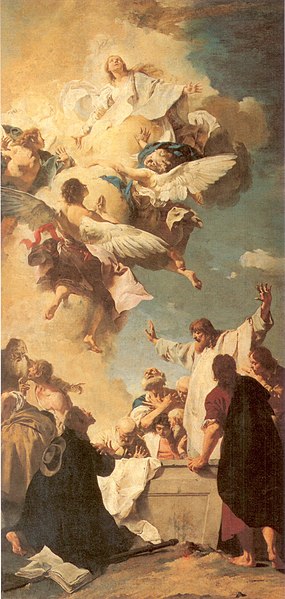
This is an obvious forgery since it purports to have been painted in 1735, Of course we know there was no beleif in the assumption until 1950


Assumption of Mary Painting by Giovanni Battista Piazzetta, 1735 Paris, Musee du Louvre
 
I think the important question here is:

What happened to Moses and his body?

Wellllll, according to Jewish tradition, you get certain answers that aren’t in the Bible. Stuff that sounds awfully like the story of Mary’s Assumption – or Elijah’s and Enoch’s, for that matter.

And according to eyewitnesses, Moses was running around in his own body when he stopped by during the Transfiguration, just like his buddy Elijah.

Which would seem to verify this tradition that wasn’t in the Bible. This tradition that everybody believed, but the rabbis and priests didn’t feel the need to codify and openly proclaim. Of course, since everybody knew it and nobody was running around denying it, there was no need for them to say what people had to believe about Moses’ fate.
 
Hi, All
Here are some verses I believe are relevant to Mary and what the Church believes through Tradition and scripture.

Gensis. 3:15, I shall put enmity between you and the Woman, and betweeen your offspring and hers; it will bruise your head and you will strike its heel.

John. 2: 4-5, Jesus said, 'Woman, what do you want from me ?
My hour has not come yet. His mother said to the servants do whatever he tells you.

John. 19: 26–27, Seeing his mother and the disciple that he loved
standing near her, Jesus said tohis mother, ’ Woman, this is your son, ’ then to the disciple he said, ’ this is your mother. 'From that hour the disciple took her into his home.

Rev. 12: 17, Then the dragon was enraged with the Woman and went away to make war on the rest of the children [the saints] who obey God’s commandments.

Some connections maybe ?
Peace, OneNow1
 
Estesbob, Those are magnifent paintings of the Assumption you have posted. Took my breath away. I’ve never been to Italy so it was so nice of you to post those famous paintings.

What an incredible amount of love for Our Blessed Mother those painters had. If only everyone shared that same feeling.
 
, "Let them search the scriptures. They will not find Mary’s death; they will not find whether she died or did not die; they will not find whether she was buried or was not buried. More than that: John journeyed to Asia, yet nowhere do we read that he took the holy Virgin with him. Rather, Scripture is absolutely silent [on Mary’s earthly end] because of the extraordinary nature of the prodigy, in order not to shock the minds of men. . . . Neither do I maintain stoutly that she died. . .

Epiphanius - A.D. 377
 
I read your links. I would point out, however, that the amount of time spent out of the Catholic church isn’t a contributing factor to how I perceive your knowledge. I know Baptists who have been in church for more than 60 years, and still don’t even know the basics.

However, please feel free to show me some non-Catholic sources you’ve read to show you that history proves the Catholic church’s views.
 
I read your links. I would point out, however, that the amount of time spent out of the Catholic church isn’t a contributing factor to how I perceive your knowledge. I know Baptists who have been in church for more than 60 years, and still don’t even know the basics.

However, please feel free to show me some non-Catholic sources you’ve read to show you that history proves the Catholic church’s views.
First off, it’s weird that we Catholics would have to look for non-Catholic sources. Do Catholics have to look to non-Catholics to corroborate the Trinity?

Anyway, you might take a look at the Eastern Orthodox. Sure, they’re probably torqued that the Pope defined the binding dogma, but in essence they probably believe it.

Okay, found an Eastern Orthodox link on the Differences Between Catholics and Orthodox. Number 9 refers to Mary:
ocf.org/OrthodoxPage/reading/ortho_cath.html

Receiving the Holy Spirit once more at Pentecost, she was able to die without sin. Because of her special role in the Divine Plan (“economy” or “dispensation”), she was taken into the heavens, body and soul. She now sits at the foot of her Son, making intercession for all those who implore her mercy. The Orthodox Church honors the miracle of her “assumption” with a feast on 15 August; likewise, the followers of the Pope.
This utterly destroys the notion that the Assumption is a mere Papal invention of the 1900’s.

So, then. Are you and Myfavoritmartin now ready to convert to the Holy Catholic Faith?
 
DEAR MYFAVORITEMARTIN,

The Catholic Church holds that we are JUSTIFIED THROUGH faith with works, but we are SAVED BY grace alone. I assume you believe you are saved by grace alone, and justified through faith alone?
I’m sorry if we implied that we thought you believed in salvation by faith and not grace alone. Sorry.

PC Master,
Agreed – “early Christians” can certainly be defined as at least those living no later than about 200AD.
I decline! The Early Church Fathers’ writings stretch into the 8th century.
Well, eternal security (“once saved, always saved”) is actually a Biblical doctrine, and thus would have been believed by the early church.
Quote the Early Church Fathers showing that the majority of the early Church interpreted Scripture to say that one can have eternal secuirity on earth that they are saved.

Please, look at these verses and see if you can honestly tell me that they teach OSAS/eternal security and salvation in an instant, not a process.

(I have added boldface)

Matthew 7:21
Not every one who says to me, `Lord, Lord,’ shall enter the kingdom of heaven, but he who does the will of my Father who is in heaven.

Matthew 24:13
But he who endures to the end will be saved.

One who has eternal security has no need to endure. He has already been saved…no?

Romans 11:22
Note then the kindness and the severity of God: severity toward those who have fallen, but God’s kindness to you, provided you continue in his kindness; otherwise you too will be cut off.

This implies that there are those who have fallen. Eternal security? No. It also says that those who CONTINUE in His kindness will have kindness. Those who don’t CONTINUE will be cut off. Eternal security? No.

Philippians 2:12
Therefore, my beloved, as you have always obeyed, so now, not only as in my presence but much more in my absence, **work out **your own salvation with fear and trembling

If you are saved at once and are always saved…why would you have to work it out. Working it out seems to denote process. It denotes more than an instant.

1 Corinthians 9:26-27
Well, I do not run aimlessly, I do not box as one beating the air; but I pommel my body and subdue it, lest after preaching to others I myself should be disqualified.

Paul subdues his body because he doesn’t want to not live up to his preaching. If he doesn’t live up to his teaching, he will be DISQUALIFIED.

1 Corinthians 10:11-12
Now these things happened to them as a warning, but they were written down for our instruction, upon whom the end of the ages has come. Therefore let any one who thinks that he stands take heed lest he fall.

Those who are “born-again saved” think they will be standing at the end of the ages, yet they still need to take heed LEST HE FALL. This says that people can fall.

Galatians 5:4
You are severed from Christ, you who would be justified by the law; you have fallen away from grace.

One can fall away from grace. Eternal security? No.

2 Timothy 2:11-13
The saying is sure: If we have died with him, we shall also live with him; if we endure, we shall also reign with him; if we deny him, he also will deny us; if we are faithless, he remains faithful – for he cannot deny himself.

If we need to endure to reign with Him, doesn’t that mean that we have to continue to be with Him? This shows that one is not saved in an instance then with eternal security. It says that you NEED to endure to reign with Him. If you don’t, you will deny him.

Hebrews 6:4-6
For it is** impossible to restore **again to repentance those who have once been enlightened, who have tasted the heavenly gift, and have become partakers of the Holy Spirit, and have tasted the goodness of the word of God and the powers of the age to come, if they then commit apostasy, since they crucify the Son of God on their own account and hold him up to contempt.

So those who have been enlightened by the taste of the heavenly gift and the word of God and have been partakers of the Spirit can commit apostasy. Eternal security for those who are “saved”?(if being a partaker of the Spirit, isn’t the definition of the so called “born again” Christian I don’t know what is) No.

Hebrews 10:26-27
For if we sin deliberately after receiving the knowledge of the truth, there no longer remains a sacrifice for sins, but a fearful prospect of judgment, and **a fury of fire **which will consume the adversaries.

So those who have received the knowledge of truth have the ability to lose a sacrifice for sins. Those who have received the knowledge of truth could be consumed by a fury of fire and judgement. Eternal security? No.

Continued on next post…

 
Status
Not open for further replies.
Back
Top