Ask A Buddhist II

  • Thread starter Thread starter notself
  • Start date Start date
Status
Not open for further replies.
What happens is that when one dies, one is reborn into a place that corresponds to a very particular mental state that occurs as part of the process of dying, and this mental state is affected by one’s deeds in life. If they are born into a woeful destination (that is, as a hungry ghost, an animal. or as a being in hell) then you must wait there for a period of time before you die again. Then, your next birth will be determined in the same way, but will likely be based on actions from prior lifetimes. Eventually, the person may be reborn as a human being again. The person may have certain tenancies from previous lifetimes, but it is ultimately that person’s free will what to do. A person with evil inclinations can overcome them through a charitable and humble heart, and a person with good inclinations can be overcome with greed and selfishness as well.
But how can they be reborn as a human being again if you reject a soul? Are you saying the same exact body? Also I have read you can be reborn into something other then a human being is this true?

Again how? Without a soul? A soul is denied in Buddhsim, rejected! So how is this possible?
 
Yes, and Thomas Merton as well, and the Desert Fathers. I understand that there is a very strong non-theistic tradition even in historical Catholicism, and a number of Catholic (as well as of course Muslim and Jewish) scholars and mystics have discussed the issue of not using the label “God” because it allows us to make our own presumptions about what that is.

Karen Armstrong’s “The History of God” explores some fascinating history in this area. Worth a read if you haven’t.

Yes, it sounded that way to me as well.

I thought I’d share a bit of my own experience with “prayer” and meditation since I think there was an earlier question about that. (Just for reference, my own practice is currently an hour a day – with intensive retreats when I have the time which is rare right now – but has been at times more and often much less over the last dozen or so years.)

People tend to think of meditation as a very “empty” experience, and indeed it can be that way. That sort of “what am I doing here? Why am I bothering?” feeling. But clarity-emptiness-compassion is very different from some kind of zoned-out un-caring state. It takes a great deal of practice and commitment, and yes, mostly trust and faith, to even have an inkling about how this works, let alone to experience it with any kind of certainty or stability. I have had only the slightest glimpses of that, most of the time it is fleeting, ephemeral and involves a kind of constant struggling with one’s own confusion and doubt. This is not to be discouraging, not at all! But just to point out that all serious engagement with spiritual matters requires some kind of effort, resolve and renunciation.

On the other hand, sometimes even in every day experience, we do meet with an experience of sudden grace. And as Rinnie posted, we can find ways to work very directly and immediately to generate selflessness and compassion:

Reading about the Christian experience of struggle and redemption, I think that both of these aspects of prayer are a common, shared experience!

Most of the meditation I have done has been the kind of thing that most people associate with Buddhist practice – sitting still and working with letting thoughts and conceptions go. But as I began to get more and more into the more esoteric aspects of the Tibetan Buddhist tradition, I find myself in a position that is even more like what a traditional concept of prayer would look like – much to my chagrin and surprise! (While these involve “secret” or “hidden” teachings, there are many public sources where you can read about them, so I feel okay about sharing that aspect of my practice here.)

For example, the practice of Guru Yoga involves directing one’s mind at a particular deity that is seen as a manifestation of Buddha. I’ll never forget when my practice instructor gave me these instructions, and she said, “then you pray for these things” [that I be relieved of ego-clinging, see the world as it is, and so on.] I remember asking…

“Really? Like actually, you know, pray?”
“Yes, like you’re really asking a divine being that really has the power to give you these things to give them to you.”

That has been a real challenge for me as a very western, “rational”, “scientific” person. It has involved giving up a lot of what I thought about myself and even what I thought Buddhism was really about…

People will say that the difference between this kind of prayer and judeo-christian forms is that we “know” that the deity is actually imaginary, and that we’re really praying to nothing but our own awakened set of mind. But I sometimes wonder if that isn’t sort of a distinction without a real difference.
See thats where I never get a straight answer. Buddhism denys a particular deity. We as Catholic tell your straight up. Its GOd Almighty creator of heaven and earth we pray to.

I mean from what I have come to understand here, its not Buddha, we all agree they do not pray to him as a god. But what I am getting the deity is yourself. Unless of course it is my total misunderstanding.:confused:
 
I feel energy expanding from my heart out to the world. I don’t feel a god or divine being. God is just a word to me.
This interests me because according to the theological linguistics of Eastern Orthodox/Eastern Catholic mysticism, there is of course the “Essence/Energy” distinction which stems from the Greek Fathers, Saint Maximos the Confessor, the Athonite masters and achieved its classical formulation in the “Triads” by Saint Gregory Palamas durin the 14th century and the great debacle between the monks of Mount Athos and Barlaam during the 1330s.

According to this Palamite understanding of union with God, the Creator is both “Essence” - which is unknowable and imperceptible - and “Energy”.

We thus become divinised - reach the state of theosis - through union with and participation in the Uncreated Divine Energies.

The Orthodox also recognize “natural, created energy”.

I’ll dwell more on this tommorrow evening but here is a little piece from the Triads:
“…There are three realities in God, namely substance [essence], energy, and a Trinity of divine hypostases. Since it has been shown above that those deemed worthy of union with God so as to become one spirit with him…are not united to God in substance, and since all theologians bear witness in their statements to the fact that God is imparticipable in substance and the hypostatic union happens to be predicated of the Word and God-man alone, it follows that those deemed worthy of union with God are united to God in energy and that the spirit whereby he who clings to God is one with God is called and is indeed the uncreated energy of the Spirit and not the substance of God, even though Barlaam…may disagree…”
***- Saint Gregory Palamas (1296-1359), Athonite monk & Orthodox/Catholic mystic ***
The uncreated energies of God are eternal, for the eternal is beyond time and duration. And what is beyond time and duration is divine, uncreated. The Energies are immanent throughout the universe and within all things, creatures and people. One becomes aware of their existence through the quieting of the mind in contemplation so as to achieve apatheia (passionless tranquility) and unite with the Energy.

From the Greek Orthodox website of America:
The divine energies are “within everything and outside everything.” All creation is the manifestation of God’s energies. Vladimir Lossky says in the Mystical Theology of the Eastern Church: “These divine rays penetrate the whole created universe and are the cause of its existence.” The uncreated Light and the knowledge of God in Orthodox tradition “illuminates every man that cometh into this world.” It is the same light that the apostles saw on Mount Tabor that penetrates all of creation and transforms it, creating it anew. A modern ascetic says in the Undistorted Image: “Uncreated Light is divine energy. Contemplation of Uncreated Light begets, first and foremost, an all absorbing feeling of the living God - an immaterial feeling of the immaterial, an intuitive, not a rational perception - which transports man with irrestible force into another world, but so warily that he neither realizes when it happens nor knows whether he is in or out of the body.” This is not a sentimental or emotional feeling or romantic fantasy. It is experience of the divine uncreated Light described by the neptic Fathers. Again, in the words of the same ascetic: “This supramental sensation of the Living God (which is experienced in contemplation) is accompanied by a vision of light, of light essentially different from physical light. Man himself abides in light because, assimilated to the Light which he contemplates, and spiritualized by it, he then neither sees nor feels his own material being or the materiality of the world.”
 
This interests me because according to the theological linguistics of Eastern Orthodox/Eastern Catholic mysticism, there is of course the “Essence/Energy” distinction which stems from the Greek Fathers, Saint Maximos the Confessor, the Athonite masters and achieved its classical formulation in the “Triads” by Saint Gregory Palamas durin the 14th century and the great debacle between the monks of Mount Athos and Barlaam during the 1330s.

According to this Palamite understanding of union with God, the Creator is both “Essence” - which is unknowable and imperceptible - and “Energy”.

We thus become divinised - reach the state of theosis - through union with and participation in the Uncreated Divine Energies.

The Orthodox also recognize “natural, created energy”.

I’ll dwell more on this tommorrow evening but here is a little piece from the Triads:

The uncreated energies of God are eternal, for the eternal is beyond time and duration. And what is beyond time and duration is divine, uncreated. The Energies are immanent throughout the universe and within all things, creatures and people. One becomes aware of their existence through the quieting of the mind in contemplation so as to achieve apatheia (passionless tranquility) and unite with the Energy.

From the Greek Orthodox website of America:
Wow! Just Wow!
 
When I recite a sutta like Metta or the one to Hungry Ghosts, I feel warmth of heart. I feel energy expanding from my heart out to the world. I don’t feel a god or divine being. God is just a word to me.

People who have been caught up in greed, gossip, anger…those who have led less than exemplary lives but have done nothing seriously unskillful go to the realm of Hungry Ghosts.
This seems to be based on an entirely emotional understanding of spirituality and faith. Also a somewhat atheistic worldview.

As rinnie asks, how can you be reborn into another life without a soul? Or as a spirit creature?

Why are those who lead less than exemplary lives any less deserving of mercy than anyone else?
They deserve justice…but also mercy.

This idea is a nihilistic and sad outlook on life. It negates the point of charity, mercy or any other good works.
 
The spiritual writer whom he recommends, LaGrange, is best known for his magnum opus “The Three Ages of the Interior Life”, in which he propounded the thesis that infused contemplation and the resulting mystical life are in the normal way of holiness of Christian perfection. This influenced the section entitled “Chapter V: The Universal Call to Holiness in the Church” in the Second Vatican Council’s Dogmatic Constitution on the Church, Lumen Gentium and its call for all Catholics, whether monastic, clerical or lay, to contemplate. He is thought to be the greatest Catholic Thomist of the 20th century and I have read portions of that wonderful book before.

The reforms implemented by the Second Vatican Council (ie the Universal Call to Holiness/Contemplation and collegiality), are still in the process of being implemented by the Church. Blessed Pope John Paul II was particularly committed to the Universal Call to Holiness which is why he beatified and canonized so many people from all walks of life during his pontificate.

A good description of infused contemplation (in a mystical itinerary of 9 levels):
Fascinating. Where can I get some descriptions of these nine levels? It would be interesting to compare them with the stages of Buddhist meditation.
 
It leads to that inner “warmth” and feeling in the chest that the western Catholic mystic Richard Rolle spoke of so eloquently in my earlier post; then to light (nimita?) and then potentially to some kind of extra-sensory perception where place is transcended and one feels connected to reality and other people on a higher level beyond sense.
From a Buddhist point of view, the description of a mystical experience presented in the pilgrim’s progress is spot on. The experience of the “warmth” in the heart was the arising of Piti (rapture) that can come up before the experience of Jhana, and the appearance of light without visible cause is a classic description of the Nimita that comes up at the pre-Jhanic state called Upacara-Samadhi (Access concentration) in which the mental hindrances have been temporarily abandoned, and a Nimita appears.

It mentions also the apperance of the ability to see things far away. The Buddhist texts also list this as a possible effect of meditation, although it is seen as being very foolish to use meditation primarily to attain these as most people can’t get these spontaneously, but have to engage in meditation that is focused exclusively on developing concentration to do so, which isn’t a type of meditation that directly is helpful in moving towards Nibbana.

Also, the technique of repeating the two halves of the prayer on the in-breath and the out-breath resembles several Buddhist techniques. In one technique, one counts the in and out breaths, counting up to five, then six, then to seven, etc… up to ten and then repeating. In another technique, one repeats one half of a short phrase on the in breath and the other on the out breath. The traditional example of this is the word Buddho.

These are just preperatory techniques designed to deal with distraction, however, and the focus is not on the words, but on the breath. These methods are abandoned when one’s distractions are under enough control to go without them.
 
I agree, but individual experience only goes so far.

The Buddha knew and experienced stuff that people who take refuge in the Buddha have to trust or accept on faith. Like the idea that one can experience past-lives, you just have to trust that the Buddha was speaking rightly about that until you yourself can actually do that.
But the teachings that are initially accepted on faith are confirmed by experience. The teaching of past lives for example is eventually understood through understanding the nature of reality.
 
And in Christ there is not emptiness but love, mercy & the fullness of truth! 👍
In many of the sects that teach Shunyata, this universal emptiness is actually identified with the Buddha nature, the Bodhicitta, and ultimate truth itself, so you aren’t disagreeing as much as you think you are 😉
 
Continuing:

There are a number of yajnas in Brahmanism, ranging from common rituals (cf. the Agnihotra, the daily offering of milk to Agni at sunrise and sunset) to high-end special ceremonies, many of which could be performed (or rather, sponsored) only by a person of status. Here are three examples of the latter.

As mentioned before early Vedism also performed animal sacrifice: the most famous one is the Ashvamedha, the horse sacrifice which could only be conducted by a raja. In this ritual, a horse was consecrated, and, accompanied by the king’s kin and other warriors, was allowed to roam where it would for a year (or half-year). Anyone who should stop the horse is ritually cursed (a dog was slaughtered to symbolize this before the horse was set free), and wherever it trod, the sovereignty of its master must be proclaimed - hence, if it went into neighbouring provinces hostile to the sacrificer, they must be subjugated. Meanwhile an uninterrupted series of rituals would be conducted in the sacrificer’s home.

At the end of the year, the returning horse, along with other animals, are bound onto stakes and then ritually slaughtered, and the chief queen then has to copulate (or mimic copulation) with the dead horse, while the other queens ritually utter obscenities. The next day, the horse’s flesh is cut up, roasted and then offered to the gods by fire. (Again note the ritual cooking of the meat before burning it as a holocaust.) At the conclusion of the sacrifice, the priests who performed the ritual are then rewarded with a part of the booty won during the wandering of the horse.

Another is the Purushamedha (“human sacrifice”), which resembles the Ashvamedha in many respects, in that people from all classes and of all descriptions were tied to the stake and offered to Prajapati, the ‘lord of creatures’ and the Vedic god of procreation and life. While the Shatapatha Brahmana implies that the ritual was symbolic (since it presupposes that the victims are to be released unharmed), many scholars theorize that human sacrifice did occur at an early stage before being disavowed on ethical grounds.

Finally, there is the Atiratra Agnicayana, the ‘overnight piling of Agni (fire[place])’, a grand-scale ritual which takes twelve days to perform and which involves a huge falcon-shaped altar, the uttaravedi (‘northern altar’ - complementing the three regular altars at the east, south, and west) made out of 10,800 bricks and animal sacrifice. The original purpose of the ritual is unclear, but the immediate practical purpose of the ritual is apparently to build up for the sacrificer an immortal body that is permanently beyond the reach of impermanence, suffering, and death.
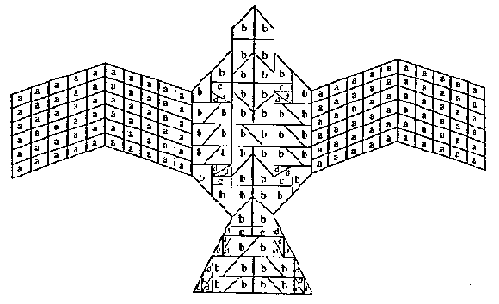

A diagram of the uttaravedi.


The necessary implements for the ritual along with a model of the uttaravedi.


The uttaravedi inside the specially-built temporary ritual enclosure.


The whole enclosure being destroyed by fire at the conclusion of the ritual.

The Agnicayana is unique since it is one of the few Vedic rituals still being performed today. Performance of the ceremony was abandoned in most circles after the post-Vedic period (6th century BC); although there have been attempts at revival, the ritual was widely held to have been extinct by the 11th century.

Then in 1975, the Indologist Frits Staal happened to come upon an Agnicayana conducted performed in Kerala by Nambudiri Brahmins following the Shrauta tradition (a minority Hindu tradition which places more emphasis on the performance of rituals rather than having a set of beliefs, and thus continues to hold the Vedic rituals of old), who have kept the tradition alive for 3000 years. The Nambudiris of that time were concerned that the ritual was threatened by extinction (the last performance was in 1956), so in exchange for a financial participation of the scholars towards the cost of the ritual, they agreed that the performance should be filmed and recorded for posterity. This became the documentary having a set of beliefs, and thus continues to hold the Vedic rituals of old) at Kerala, who kept the tradition alive for 3000 years. The Nambudiris were concerned that the ritual was threatened by extinction (the last performance was in 1956), so in exchange for a financial participation of the scholars towards the cost of the ritual, they agreed that the performance should be filmed and recorded for posterity. This became the documentary Altar of Fire.

I have linked to a preview available on Youtube. In it you can see the preparations for the ritual proper: the construction of utensils (altars, pots, mud bricks, frames for the bricks, etc.) as well as the ritual enclosure which represents the sacrificer’s house for the duration of the ceremony - which is then set on fire upon finishing.

Efforts to bring the ritual to people’s attention were successful, and there have been further public performances since then. Note that in these modern Agnicayanas the obligatory goat sacrifice is performed symbolically using an effigy due to legal and ethical concerns.

P.S. In case you’re wondering, the use of murti (statues or portraits of deities; ‘idols’) was foreign to the ancient Indo-Aryans, which religion was aniconic.

 
What does giving words to an aspiration change? Or do for you? Where is it getting divine help? You are on your own, alone, left alone in your own darkness do you not agree?
It changes the heart. Turning towards universal goodwill and compassion weakens the defilement of ill-will and stinginess, and develops in their stead a heart of universal love. It is part of a change in one’s character. It sounds a far cry away from despairing alone in darkness to me.
 
Buddha claimed he experience past lives. Where is his proof? Who ever testifed to his truth that he claims to have. That is something we should all think about.
The core statements of the Buddhist religion are not historical ones, but doctrinal ones. If you were to try to write up some sort of Buddhist creed, you would find that its statements wouldn’t demand belief in specific historical events, but rather would be entirely statements which remain confirmable by a person living in modern times through their own meditative practice (Assuming they get far enough)
 
You can get a feel for how the Vedic people viewed sacrifice in the legend of the sacrifice of Purusha, the primeval man, recounted in a famous hymn known as the Purusha Sukta. (cf. Rigveda, 10.90; Samaveda, 6.4; Atharvaveda, 19.6; Yajurveda, 31.1-6) In it, sacrifice is literally what created the universe.

A THOUSAND heads hath Purusa, a thousand eyes, a thousand feet.
On every side pervading earth he fills a space ten fingers wide.
This Purusa is all that yet hath been and all that is to be;
The Lord of Immortality which waxes greater still by food.
So mighty is his greatness; yea, greater than this is Purusa.
All creatures are one-fourth of him, three-fourths eternal life in heaven.
With three-fourths Purusa went up: one-fourth of him again was here.
Thence he strode out to every side over what eats not and what eats.
From him Viraj was born; again Purusa from Viraj was born.
As soon as he was born he spread eastward and westward o’er the earth.
When Gods prepared the sacrifice with Purusa as their offering,
Its oil was spring, the holy gift was autumn; summer was the wood.
They balmed as victim on the grass Purusa born in earliest time.
With him the Deities and all Sidhyas and Rsis sacrificed.
From that great general sacrifice the dripping fat was gathered up.
He formed the creatures of-the air, and animals both wild and tame.
From that great general sacrifice Rcas and Sama-hymns were born:
Therefrom were spells and charms produced; the Yajus had its birth from it.
From it were horses born, from it all cattle with two rows of teeth:
From it were generated kine, from it the goats and sheep were born.
When they divided Purusa how many portions did they make?
What do they call his mouth, his arms? What do they call his thighs and feet?
The Brahman was his mouth, of both his arms was the Rajanya made.
His thighs became the Vaisya, from his feet the Sudra was produced.
The Moon was gendered from his mind, and from his eye the Sun had birth;
Indra and Agni from his mouth were born, and Vayu from his breath.
Forth from his navel came mid-air, the sky was fashioned from his head,
Earth from his feet, and from his ear the regions. Thus they formed the worlds.
Seven fencing-sticks had he, thrice seven layers of fuel were prepared,
When the Gods, offering sacrifice, bound, as their victim, Purusa.
Gods, sacrificing, sacrificed the victim these were the earliest holy ordinances.
The Mighty Ones attained the height of heaven, there where the Sidhyas, Gods of old, are dwelling.
 
But how can they be reborn as a human being again if you reject a soul? Are you saying the same exact body? Also I have read you can be reborn into something other then a human being is this true?

Again how? Without a soul? A soul is denied in Buddhsim, rejected! So how is this possible?
The reason why you are having difficulty understanding it is because you are thinking of rebirth in the same way that the Greeks, the Jains, and the Hindus thought about it (i.e. as reincarnation, or transmigration). They thought of rebirth as being that when the body decays and the soul is freed from the body, it goes somewhere else and takes on a new body. This is not what Buddhism teaches.

Buddhism instead teaches that the mind is a continuous process of mental events, and that this process continues after death. Rebirth is not the soul taking on a new body, but is the continuation of a process.
 
This idea is a nihilistic and sad outlook on life. It negates the point of charity, mercy or any other good works.
How so? What do you mean by Nihilism, and how does a belief in Kamma and rebirth negate charity and mercy? These things are seen as being objectively good, and therefore things which should be done.
 
We now go to Shramana.

Alongside Vedic Brahmanism existed a group of individual, experiential and free-form independent traditions known in Sanskrit as shramana (Pali: samana). The main characteristic of these traditions were their opposition to established Brahmanism and its emphasis on ritual and rote, and with it the rejection of the Vedas which brahmans hold in high esteem.

Many of these movements were composed of wandering ascetics (parivrajaka) who have separated themselves from normal society in pursuit of spiritual enlightenment. However, not all ‘heterodox’ shramanic movements were ascetic in nature: some (like the Charvaka school) had a materialistic viewpoint, in that they preached a worldly existence and carried denunciation of brahmanical orthodoxy to the extreme.
 
We now go to Shramana.

Alongside Vedic Brahmanism existed a group of individual, experiential and free-form independent traditions known in Sanskrit as shramana (Pali: samana). The main characteristic of these traditions were their opposition to established Brahmanism and its emphasis on ritual and rote, and with it the rejection of the Vedas which brahmans hold in high esteem.

Many of these movements were composed of wandering ascetics (parivrajaka) who have separated themselves from normal society in pursuit of spiritual enlightenment. However, not all ‘heterodox’ shramanic movements were ascetic in nature: some (like the Charvaka school) had a materialistic viewpoint, in that they preached a worldly existence and carried denunciation of brahmanical orthodoxy to the extreme.
Can you give us a time line for the Vedic period. For example when did the wandering ascetics first start to have influence and gather followers? There were many groups with famous leaders at the time of the Buddha. These ascetics were supported by the laypeople and still are today. When did this movement begin?
 
The reason why you are having difficulty understanding it is because you are thinking of rebirth in the same way that the Greeks, the Jains, and the Hindus thought about it (i.e. as reincarnation, or transmigration). They thought of rebirth as being that when the body decays and the soul is freed from the body, it goes somewhere else and takes on a new body. This is not what Buddhism teaches.

Buddhism instead teaches that the mind is a continuous process of mental events, and that this process continues after death. Rebirth is not the soul taking on a new body, but is the continuation of a process.
The following is from a rather long and complex essay called The Fundamentals of Buddhism by Nyanatiloka Mahathera. The essay is actually a small online book in a PDF file, here is the link. accesstoinsight.org/lib/authors/nyanatiloka/wheel394.html#ch3

I have only quoted parts of the section on bhavanga-sota for the sake of brevity.
The term bhavanga-sota, is identical with what the modern psychologists, such as Jung, etc., call the soul, or the unconscious, thereby not meaning, of course, the eternal soul-entity of Christian teaching but an ever-changing subconscious process. This subconscious life-stream is the necessary condition of all life. In it, all impressions and experiences are stored up, or better said, appear as a multiple process of past images, or memory pictures, which however, as such, are hidden to full consciousness, but which, especially in dreams, cross the threshold of consciousness and make themselves fully conscious….
Thus this subconscious life-stream, or bhavanga-sota, can be called the precipitate of all our former actions and experiences, which must have been going on since time immemorial and must continue for still immeasurable periods of time to come. Therefore what constitutes the true and innermost nature of man, or any other being, is this subconscious life-stream, of which we do not know whence it came and whither it will go. As Heraclitus says: “We never enter the same stream. We are identical with it, and we are not.” Just so it is said in the Milindapañha: “na ca so, na ca añño; neither is it the same, nor is it another (that is reborn).” All life, be it corporeal, conscious or subconscious, is a flowing, a continual process of becoming, change and transformation. No persistent element is there to be discovered in this process. Hence there is no permanent ego, or personality, to be found, but merely these transitory phenomena….
Thus a real understanding of the Buddha’s doctrine of kamma and rebirth is possible only to one who has caught a glimpse of the egoless nature, or anattata, and of the conditionality, or idappaccayata, of all phenomena of existence. Therefore it is said in the Visuddhimagga (Chap. XIX):
Everywhere, in all the realms of existence, the noble disciple sees only mental and corporeal phenomena kept going through the concatenation of causes and effects. No producer of the volitional act or kamma does he see apart from the kamma, no recipient of the kamma-result apart from the result. And he is well aware that wise men are using merely conventional language, when, with regard to a kammical act, they speak of a doer, or with regard to a kamma-result, they speak of the recipient of the result
.
As one can see from the above, bhavanga-sota is a process at the most basic level. In this sense it is a not a noun, ground, but a verb, processing. When one through meditation reaches the level of this subtle processing one understands what the Buddha is teaching regarding impermanence, not-self, cause and result, and the process of rebirth.
 
Can you give us a time line for the Vedic period. For example when did the wandering ascetics first start to have influence and gather followers? There were many groups with famous leaders at the time of the Buddha. These ascetics were supported by the laypeople and still are today. When did this movement begin?
Generally speaking, the Vedic period is considered to begin with the arrival of the Indo-Aryan tribes (jana) at north and northwest India and the composition of the hymns of the Rigveda, which is generally dated to 1700 to 1100 BC (the early Vedic period). At this time, Indo-Aryan culture was still pastoral and nomadic in nature. Their arrival was contemporaneous with the decline of the Indus Valley civilization (a phase known as Late Harappan) and possibly precipitated the beginning of the Iron Age in India.

The transition from the early to the later Vedic period (around 1000 BC) was marked by the emergence of sedentary agriculture as the dominant economic activity and a corresponding decline in the significance of cattle rearing: people increasingly looked upon land as wealth. The successful cattle raids that had marked earlier Aryan life was no longer the most desirable attribute of Aryan chiefs; more esteem was attached in skilfully managing the incorporation of different clans into larger political groupings (janapada). Out of these processes came the sixteen great kingdoms and republics known as the mahajanapadas around the 6th century BC.

There are some problems with pinning a date to shramanic traditions, in part because with the exception of Jainism and Buddhism, all the others (like Charvaka or Ajivika) have died out without any surviving first-hand information (most of what we know about them comes from other sources, which are often hostile). There is a theory that shramana and its ideas might have had roots from the native Harappan (Indus Valley) culture, and some people have postulated about certain connections between it and some traditions (usually Jainism, on the basis of iconography), but all that we can say for sure is that several movements are likely to have already existed even before the 6th century BC.
 
And another good point is for some reason people deny taking refuge in Buddha. Wonder why? …In the Christian faith we are up front and tell you we take refuge in Christ. That is the whole being of our faith.
Hmm…I wonder where that is coming from. Maybe we don’t talk about these things much, because it’s almost an assumption.

The very first set of vows that one takes as a Buddhist are Refuge Vows. That’s what distinguishes a “Buddhist” from a “non-Buddhist”. I mean, I guess a lot of people say that they are “Buddhists” because they resonate with the teachings, but that wouldn’t be accurate.

Refuge is at the core of every Buddhist practice, including the so-called “advanced” Tantric practices. For example, I take the Refuge Vow every day as the first part of my practice. It’s an extraordinary, beautiful practice. Zen practitioners take refuge as part of the morning chants. All buddhist traditions have something similar.

If you’re a practicing Buddhist, you have by definition given up any other hope of salvation. That is why for example many people argue that – even if it would work from a Christian perspective, which I assume it wouldn’t – it would be impossible for a Christian to be a Buddhist, because there would be another hope of salvation that someone had taken.

Actually, we take refuge in three things: The Buddha, or actual enlightened mind, The Sangha, or community of Boddhisatvas and fellow practitioners, and the Dharma, or teachings.
Here is another thing, they knew, or believe they knew that Buddha experienced past lives, but the truth is how could he? Where is his proof? He did just what he claimed. Thousands have testified he did indeed die, rise again, and took away death for us. Who ever testifed to his truth that he claims to have. That is something we should all think about.
It actually doesn’t really matter, because the important thing about the Buddha was not his past lives but the fact that despite his noble upbringing and all of the merit he had gained in past lives, he was an ordinary human being. That is why we take the Buddha as example rather than worshipping him. While there may be other Buddha’s in the past, present and future, the historical figure that we call “The Buddha” is dead and will remain that way.

Having been through previous lives wasn’t a credential, because the prevailing view was that everyone had also been reborn. That was just the primary world view at the time. In fact, as Bakmoon says, Buddhism teaches a very different kind of rebirth than what the Hindu’s believed. And it’s important to point out that rebirth is not generally not regarded as good news; it’s actually sort of bad news, because it means that all of the karmic patterns that you haven’t resolved will continue. The Boddhisatvas take rebirth not because they want to, but out of generosity and compassion.

I hope that helps clarify things somewhat…thank you for the honesty and directness of your questions.
 
Status
Not open for further replies.
Back
Top