Continuing:
There are a number of
yajnas in Brahmanism, ranging from common rituals (cf. the
Agnihotra, the daily offering of milk to Agni at sunrise and sunset) to high-end special ceremonies, many of which could be performed (or rather, sponsored) only by a person of status. Here are three examples of the latter.
As mentioned before early Vedism also performed animal sacrifice: the most famous one is the
Ashvamedha, the horse sacrifice which could only be conducted by a
raja. In this ritual, a horse was consecrated, and, accompanied by the king’s kin and other warriors, was allowed to roam where it would for a year (or half-year). Anyone who should stop the horse is ritually cursed (a dog was slaughtered to symbolize this before the horse was set free), and wherever it trod, the sovereignty of its master must be proclaimed - hence, if it went into neighbouring provinces hostile to the sacrificer, they must be subjugated. Meanwhile an uninterrupted series of rituals would be conducted in the sacrificer’s home.
At the end of the year, the returning horse, along with other animals, are bound onto stakes and then ritually slaughtered, and the chief queen then has to copulate (or mimic copulation) with the dead horse, while the other queens ritually utter obscenities. The next day, the horse’s flesh is cut up, roasted and then offered to the gods by fire. (Again note the ritual cooking of the meat before burning it as a holocaust.) At the conclusion of the sacrifice, the priests who performed the ritual are then rewarded with a part of the booty won during the wandering of the horse.
Another is the
Purushamedha (“human sacrifice”), which resembles the
Ashvamedha in many respects, in that people from all classes and of all descriptions were tied to the stake and offered to Prajapati, the ‘lord of creatures’ and the Vedic god of procreation and life. While the Shatapatha Brahmana implies that the ritual was symbolic (since it presupposes that the victims are to be released unharmed), many scholars theorize that human sacrifice did occur at an early stage before being disavowed on ethical grounds.
Finally, there is the
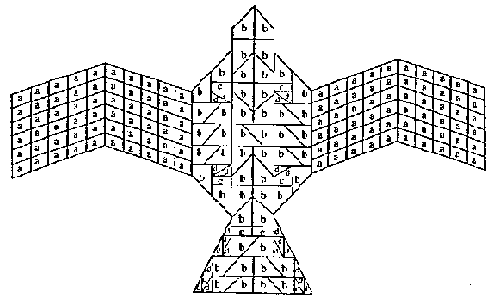
Atiratra Agnicayana, the ‘overnight piling of Agni (fire[place])’, a grand-scale ritual which takes twelve days to perform and which involves a huge falcon-shaped altar, the
uttaravedi (‘northern altar’ - complementing the three regular altars at the east, south, and west) made out of 10,800 bricks and animal sacrifice. The original purpose of the ritual is unclear, but the immediate practical purpose of the ritual is apparently to build up for the sacrificer an immortal body that is permanently beyond the reach of impermanence, suffering, and death.
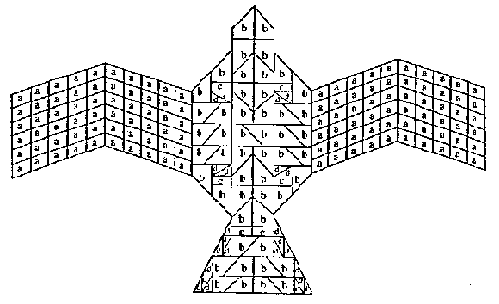
A diagram of the
uttaravedi.

The necessary implements for the ritual along with a model of the
uttaravedi.

The
uttaravedi inside the specially-built temporary ritual enclosure.

The whole enclosure being destroyed by fire at the conclusion of the ritual.
The
Agnicayana is unique since it is one of the few Vedic rituals still being performed today. Performance of the ceremony was abandoned in most circles after the post-Vedic period (6th century BC); although there have been attempts at revival, the ritual was widely held to have been extinct by the 11th century.
Then in 1975, the Indologist Frits Staal happened to come upon an
Agnicayana conducted performed in Kerala by Nambudiri Brahmins following the Shrauta tradition (a minority Hindu tradition which places more emphasis on the performance of rituals rather than having a set of beliefs, and thus continues to hold the Vedic rituals of old), who have kept the tradition alive for 3000 years. The Nambudiris of that time were concerned that the ritual was threatened by extinction (the last performance was in 1956), so in exchange for a financial participation of the scholars towards the cost of the ritual, they agreed that the performance should be filmed and recorded for posterity. This became the documentary having a set of beliefs, and thus continues to hold the Vedic rituals of old) at Kerala, who kept the tradition alive for 3000 years. The Nambudiris were concerned that the ritual was threatened by extinction (the last performance was in 1956), so in exchange for a financial participation of the scholars towards the cost of the ritual, they agreed that the performance should be filmed and recorded for posterity. This became the documentary
Altar of Fire.
I have linked to a preview available on Youtube. In it you can see the preparations for the ritual proper: the construction of utensils (altars, pots, mud bricks, frames for the bricks, etc.) as well as the ritual enclosure which represents the sacrificer’s house for the duration of the ceremony - which is then set on fire upon finishing.
Efforts to bring the ritual to people’s attention were successful, and there have been further public performances since then. Note that in these modern
Agnicayanas the obligatory goat sacrifice is performed symbolically using an effigy due to legal and ethical concerns.
P.S. In case you’re wondering, the use of
murti (statues or portraits of deities; ‘idols’) was foreign to the ancient Indo-Aryans, which religion was aniconic.