"If it can be shown that the Scotch-Irish bishops or pastors maintained a parity of rank and authority from their conversion until the twelfth century, then St. Patrick and Columba were both Scotch-Irish Presbyterians, notwithstanding the effort of some historians to claim them for the Church of Rome.
An Céli Dé
We need no further evidence that they were
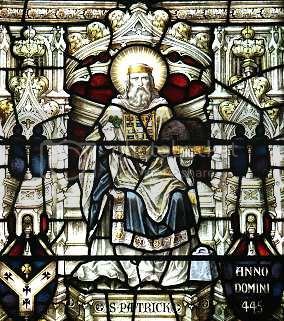
Culdees than the fact that when St. Patrick left Scotland, about A.D. 425, he began preaching and organizing Culdee Churches in Ireland. Archbishop Usher says: “We read in ‘Nennius’ that at the beginning St. Patrick founded three hundred and sixty-five Churches, and ordained three hundred and sixty-five bishops and three thousand presbyters or elders.” That is to say, one bishop or pastor and about eight elders for each Church, which is Presbyterianism pure and simple. Thus it is evident from Usher and others that as Patrick ordained one bishop for each Church, they were Presbyterian and not prelatic bishops.
It is, however, probable that before the death of St. Patrick he was induced, as some say, to accept the office of diocesan Bishop of Armagh. But there is nothing positive on this subject, for we have proof, as already stated, that he was organizing Culdee Churches up to his departure to Rome, A.D. 453, if he was ever in Rome at all.
“Alden’s Manifold Cyclopedia,” in speaking of St. Patrick, says: “The story that he went to France, where he became a monk, first at Tours, afterward in the celebrated monastery of Lérins, and that he went, A.D. 431, to Rome, whence he was sent by Pope Celestine to preach in Ireland, is entirely without evidence, although long the received account. Much obscurity has arisen from confusing two other men of the name “Patrician” with this saint. One of these, under the name “Palladius,” was sent by Pope Celestine, as bishop, to Ireland, A.D. 431. St. Patrick’s mission, on which he entered probably about A.D. 425, was eminently successful.”
It is probable that St. Patrick, before his death, in some way fraternized with the Church of Rome, in carrying on their mission work in Ireland, or else Catholic Ireland would never have accepted him after death as their patron saint.

An Céli Dé
We learn that Columba left Ireland A.D. 564, and established a Culdee college on Iona. Thus, then, if Columba and St. Patrick had any connection whatever with the Church of Rome during their missionary labors, why did they not preach the doctrines and polity of that Church, instead of teaching Presbyterianism, as is shown by Bishop Stillingfleet, when he says: “Some whole nations seem to have been without any bishops at all. So if we may believe the great antiquarians of the Church of Scotland, that Church was governed by their
‘Culdei,’ as they called their presbyters, without any bishop over them.”
In the year 650 the Prelate of Rome again renewed his effort to bring the Culdees into his fold. Finally, in the year 1150, by the aid of the secular power, popery was established in Ireland and Scotland. Culdeeism, however, was not overpowered until 1297, when the Culdees of St. Andrews were suppressed.
McLauchlin, an able historian, says: “It requires but little acquaintance with Scottish history to observe that the principles of the old Culdee Church
never were eradicated; that during the reign of the Roman Church in the kingdom they continued to exist, exhibiting themselves occasionally in such outbreaks as the letter to King Robert Bruce and his nobles to Pope John, on the uprising of the Lollards of Kyle, and finally culminated in the events of the Scottish Reformation.”
(SOURCE: Proceedings of the Fourth Congress at Atlanta, GA., April 28 to May 1 1892, The Scotch-Irish America – Who are they? And what are they, by Dr A. Given, Louisville, Kentucky)
"This church and the civilization introduced by the Romans were swept away by the Picts and Saxons, and the members, called Culdees, were compelled to hide in the wilderness of Wales, Scotland, Ireland, and the small islands between Great Britain and Ireland; chiefly in Anglesey and Iona, where they preserved their Apostolic institutions, which were modeled after the most ancient Christian church, which, it is well known, was the secret or Masonic form. (SOURCE: The Mysteries of Britain: Secret Rites and Traditions of Ancient Britain Restored: 1905)
The Culdees of York were among the guardians of the Masonic tradition in the tenth century, and the Old Charges tell us that an assembly of Masons was held at York during the reign of King Athelstan, when a reorganization of the Craft took place. (SOURCE: A New Encyclopaedia of Freemasonry (Ars Magna Latomorum) and of Cognate Instituted Mysteries: Their Rites, Literature, and History, Arthur Edward Waite: 1921)



