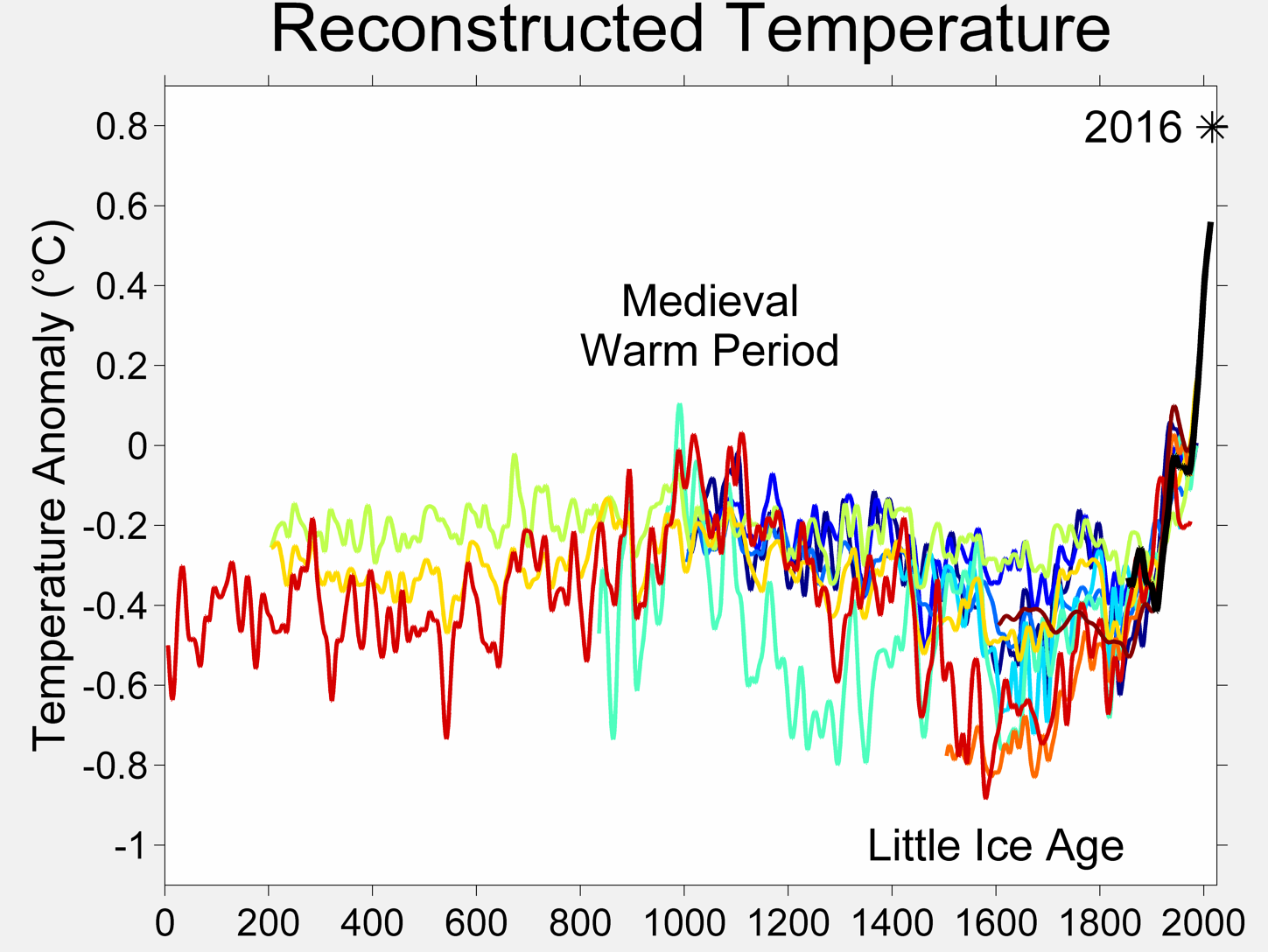
Mann himself has said his work is not that important, that GW was already well established before he did his work.
Apparently the mistake he made was not mentioning in the cover image that the chart was a splicing of the proxy data with the more recent instrumental data – tho he did cite that in the body of his work.
Also, another interesting tidbit is that the instrumental data since the 1960s actually showed greater warming than the more recent proxy tree-ring data, that the proxy failed after the 1960s to reflect temperature.
I’m thinking that is because while warming in general helps the trees, giving them bigger rings, the type of warming due to the GH effect, in which the nights are warming faster than the days, is actually harmful to plants (and people).
]
I would think a person would have to know a lot more about trees, particularly the trees used for the proxy information, than people studying tree rings likely do.
A lot of things make for bigger or smaller tree rings, and one would have to know a lot of history, and very intimately, to know the causes of differences. An unusually wet year, for example, can cause narrow rings just as an extraordinarily dry one can, because, in some places at least, high moisture in the summer can greatly influence the population of leaf pests, reducing photosynthesis. But it’s not always true because those pests tend to have population cycles, possibly influenced by their own diseases and predators, sort of like the rabbit/coyote cycle.
But, given similar soils, the biggest influences on tree growth are the age of the tree, depending on the kind of tree it is, and root space. A fire, for example, can first retard tree growth, then enhance it. Contrary to popular belief, regular fires usually don’t burn the trees, but they can be stressful initially. Clearing understory by fire, though, will enhance growth of established trees if they’re not too old. If fire is an annual event (which Indians used to ensure) then the effect would depend on other conditions, such as floor burden and moisture content, even the time of year the fire occurred. And fire, of course, greatly influences pest levels for a time.
Animal populations can inhibit or encourage growth, depending on the nature of the animals and their patterns of behavior. In a hot, sunny summer, for example, hoofed animals will spend a lot more time under trees than in a cooler, cloudier summer, and they do it in patterns that are not always obvious to us. Sometimes they will congregate in what seems like an inferior place, but there might be a subtle prevailing updraft that brings lower, cooler, air or just air movement itself. The differences can be big enough to affect animal weight gain dramatically. Animal congregation under trees tends to inhibit growth initially because of compaction. But later on, it can encourage growth due to eventual infiltration of animal waste down to the roots after a spring of ground heaving. And one large dead animal left to rot under a tree can influence growth a lot.
I have long been intrigued by one of the explanations of the excellence of the Stradivarius. One theory is that the Little Ice Age caused the tree or trees from which it was made to grow very slowly, resulting in tighter, harder rings than usual due to cold. And it might be true, though I understand that theory is contested. But it could simply be that herders didn’t take their animals into those areas as much due to the cold or season lengths.
Oddly, and kind of subtly, the height of branches can affect growth. If one pays attention, one can see that trees with wide, low, fairly dense branches affect ground temperature more than trees whose branches begin much higher. A subtle thing, but the ground constantly emanates heat and even tree branches in the winter can “encapsulate” it to a degree, depending on how they’re positioned. The same is true of moisture.
There are so many conditions and events that can affect tree growth, even over a wide area, that I really am skeptical of peoples’ analyses of the meaning of tree rings. Maybe they know all the details they need to know from the history and controlled for them all, but I’m somewhat doubtful that they do or even can.