Catholic laity doesn't get to decide what form of Mass will be celebrated

  • Thread starter Thread starter marthaferretti
  • Start date Start date
Status
Not open for further replies.
Being of the age where I grew up with the Mass said in Latin …

… Most of the people of my generation, and even my Mother’s, who continued to attend Mass liked the Mass in the vernacular, even though the change was abrupt and confusing. They really don’t want to go back to Latin–and this is pretty much universal in most parishes. … they just prefer the Mass be said in their own language, and they enjoy the active participation and dialogue and singing and audible prayers.
Similar age bracket here and I won’t say much except that one has to remember that this isn’t strictly about language. Personally, I always and everywhere prefer the use of our ancient and venerable liturgical languages. But, whether Mass is in Latin, English, French, or whatever tongue, the fact is that the Novus Ordo is vastly different in principle from the Usus Antiquior.
 
Similar age bracket here and I won’t say much except that one has to remember that this isn’t strictly about language. Personally, I always and everywhere prefer the use of our ancient and venerable liturgical languages. But, whether Mass is in Latin, English, French, or whatever tongue, the fact is that the Novus Ordo is vastly different in principle from the Usus Antiquior.
No it isn’t strictly about language, I realize that, but to the average Catholic in the pew in the 60’s it was, and that is how it is remembered. That and the priest started to face the people, and they could hear the prayers. To someone like my Mother, who is 85, that is what it is about. She could care less about the principle or other debates concerning the horizontal vs vertical dimensions and other things people are discussing. The Mass is now in English, she understands things, and she likes it. This forum does not reflect the average Catholic of that era or this era.
 
Being of the age where I grew up with the Mass said in Latin until my early adulthood, I think there is some truth to that. To us, it was just Mass, and mostly routine. If we had a Missal (not everyone did–many in my parish could not afford them, or there might be one Missal per family, if you were lucky you got one as a gift), we spent a lot of time paging through it and trying to follow the Latin along in English. Mass was also said much faster–the big complaint I heard from many people was that the New Mass was too long at around an hour. Low Mass on Sunday usually took about a half-hour to 40 min, in one parish I attended there was a priest who said it in 20 min. His Mass was very popular. Many people did not participate much, there was a lot of Rosary-saying and private devotion going on. More people may have attended Mass, but I don’t think there was much in the way of engagement.

I am not exaggerating or being facetious here. There was a reason for the change. Many Catholics went to Church out of duty, as is claimed they do today, although I think mostly people today who go want to be there (except perhaps for some teenagers and very young children). People really did not understnd the Liturgy. Scripture teaching was minimal, most Catholics did not read the Bible, although we weren’t forbidden to. After Vatican II, people somehow got the impression (and it did not come from the Council) that it was no longer a mortal sin to miss Mass on Sunday. One’s conscience was what largely determined the gravity of a sin, and people quit going, just like they quit observing the Friday abstinence. Most of the people of my generation, and even my Mother’s, who continued to attend Mass liked the Mass in the vernacular, even though the change was abrupt and confusing. They really don’t want to go back to Latin–and this is pretty much universal in most parishes. I don’t find that people are so much hostile to the EF, (although some are, but then there are some that only attend the EF that are hostile to the OF --it pretty much balances)–they just prefer the Mass be said in their own language, and they enjoy the active participation and dialogue and singing and audible prayers.

I think that there is a lot of romanticization of the period before Vat II and the Latin Mass, esp. by those who did not live then, and to them it is something new. Outside of this forum and other forums where people are really into their faith, the average Catholic in the average parish likes the vernacular and would be upset to return to the Latin. I think that if there was an attempt to seriously return to it, the average Catholic would have a very difficult time accepting it and it would be much worse than the original change. The danger is, that people took it for granted before, and eventually they would again. People are people. They might appreciate it’s beauty now, but for the most part they had lost that appreciation by the time of the Council.

I am sure that there are some here who would disagree with what I have written, but this is my observation, having actually lived before the Council. Most people do not want to return to the Latin Mass, and not out of hostility. They are ok with others preferring it and having it available for them, but they do not want it to be the norm. And they have the right to feel that way without being accused of being hostile. Not agreeing does not equal outright hostility.
Thank you.

This is quite an eye opener.

Like I’ve stated before I do not like the low masses where you can’t hear anything.

However, I do like the missa cantata and I do like that people are able to respond audibly at different parts of the EF mass. I think the EF is moving in a nice direction.
 
No it isn’t strictly about language, I realize that, but to the average Catholic in the pew in the 60’s it was, and that is how it is remembered. That and the priest started to face the people, and they could hear the prayers. To someone like my Mother, who is 85, that is what it is about. She could care less about the principle or other debates concerning the horizontal vs vertical dimensions and other things people are discussing. The Mass is now in English, she understands things, and she likes it. This forum does not reflect the average Catholic of that era or this era.
In most cases the people can hear the priest because he started using a mic. In my Eastern parish, the priest and bishop do not use a mic and yet they are heard perfectly clear. Although I do recognize that some churches are rather large. But for most neighborhood parishes, a priest can project his voice just fine and be heard clearly even if he’s facing ad orientem.
 
As a matter of fact, the pastor told me that when he announced that he was going to introduce a weekly TLM, 1/2 of the parishoners left the meeting.
probably the same bunch that heads straight for the door after receiving :cool:
 
probably the same bunch that heads straight for the door after receiving :cool:
You mean like the group that would do so before the OF was introduced - those who did so in the 1950’s and the 1960"s before the introduction of the vernacular?
 
You mean like the group that would do so before the OF was introduced - those who did so in the 1950’s and the 1960"s before the introduction of the vernacular?
Closely related to the men for whom the sermon was an opportunity to step outside for a smoke?
 
Pray for them, don’t talk about them. It’s too much like gossip and also resembles a group judging the rest. Only one can see in hearts…
 
Pray for them, don’t talk about them. It’s too much like gossip and also resembles a group judging the rest. Only one can see in hearts…
Who’s judging? We’re simply relating the reality of the pre-Vatican II period which we lived and which those who weren’t there tend to romanticize.
 
Similar age bracket here and I won’t say much except that one has to remember that this isn’t strictly about language. Personally, I always and everywhere prefer the use of our ancient and venerable liturgical languages. But, whether Mass is in Latin, English, French, or whatever tongue, the fact is that the Novus Ordo is vastly different in principle from the Usus Antiquior.
Yes. 10 people out of 1000 prefer the ancient liturgical language. This is all right, and this is why our Pope declared that any priest is free to celebrate the mass according to the usus antiquior.

The problem is if this extremely small group want to force their preference on others, and with the false believe that they are the ones who know good and evil declare the the Mass of All Ages, the Mass of the Universal Church is vastly different principle from the usus antiquior. They pull down the mass which is supernatural to their worldly level.
 
=marthaferretti;7945479]Here are two recent quotes from participants on these forums in regards to their thoughts on the level of interest of the laity in assisting at the TLM.
“Those who call themselves traditionalist are a small but vocal group. In most any parish if you ask about going back to the TLM the response is no. Most strongly from those who grew up with that mass and do not want to see it’s return. The Church is allowing the TLM as an alternative for those who do want to use that mass to worship, there is little chance that it will become mainstream.”
"What I hate, what I REALLY hate are the misguided folks that are attempting to reimpose Latin on the Church. Thankfully, they are a very tiny minority, and their influence is miniscule at best. (No I don’t really hate any of you.)
The VAST majority of those advocating a return to Latin were not even alive before Vatican II. They have no memory of a Latin Mass, they just know that it is beautiful (and it is), and can not see that part of its appeal is because it is NOT the norm.
It would be a whole different thing if every Mass, every day, was in Latin again. The vast majority of Catholics in this world would revolt (and rightfully so)."
Well now let me see if I understand this logic?

According to a PEW Report of 1970 to 2006 these stastics tell an interestering story:

1970

Number of Catholic who "regularrly fulfilled their grave duty for Sunday Mass and Holy Day of Obligation Mass =73%

The Number of Catholics who went to the Sacrament of Confession at least Once per Year was 63%

In 2006 the Mass attendence had droped to below 25%
And the Confession requirement to about 10%

***Was the Novous Ordo the ONLY reason… NO!

Was it a highly signifiant cause … YES!

Latin REMAINS THE INTERNATIONAL language of the RCC. Because the MAss is FOR US [our benefit] BUT about God: “In Him, With Him and Through Him” the FOCUS MUST [in an absolute sense] return to God-CENTERED WORSHIP, and get away from the “we ARE THEE Church” centered worship intorduced by the N.O. Mass.***

God Bless,
Pat
 
Yes. 10 people out of 1000 prefer the ancient liturgical language. This is all right, and this is why our Pope declared that any priest is free to celebrate the mass according to the usus antiquior.

The problem is if this extremely small group want to force their preference on others, and with the false believe that they are the ones who know good and evil declare the the Mass of All Ages, the Mass of the Universal Church is vastly different principle from the usus antiquior. They pull down the mass which is supernatural to their worldly level.
:yawn:
 
Since the masses celebrating the usus antiquior has an attendance less than 200 with one or two masses at a weekend at a location, and the new rite an average attendance of over 300 in an average 4 or more masses at a location, the logic says that the new form saved Catholics instead of rawing the away.

The reason for the diminishing attendance was the ban of God and moral from the schools, the public worship of the sex, greed and power, the almost complete lack of the religion in the public media and the total secularization. The new form of Mass, bringing the mass closer to the people helped to keep 25% of the people.
1970

Number of Catholic who "regularrly fulfilled their grave duty for Sunday Mass and Holy Day of Obligation Mass =73%

The Number of Catholics who went to the Sacrament of Confession at least Once per Year was 63%

In 2006 the Mass attendence had droped to below 25%
And the Confession requirement to about 10%

Was the Novous Ordo the ONLY reason… NO!

Was it a highly signifiant cause … YES!
 
I’m glad there is choice now between the OF and the EF.

I was born post Vatican council (1975) So I’ve always had the OF in English with greater or lesser degree of Latin language heritage.

Perhaps my whole approach to spirituality could have been very different liturgically if I’d only been born even a decade earlier (1962 form).

Anyway, scince 2007 the current Pope has given more green lights in the CC to retain a form of TLM, now that it will never again be the OF, that anyone who wishes for whatever reason can be enriched by its Theology, Spirituality, the Catholicness of the Latin language that in any country where the local/ vulgar tongue is different I can still enjoy God’s presence:highprayer: with incence and railings at the altar &c.

This doesn’t seem any worse to me than the Charismatic renewal and Spirituality brought out during the last 30 years. Their wish to speak in tongues in private prayer groups is sanctioned by the CC.

At the end of the day, I think my response to the OP would be the laity does get to say what goes on around them, people vote with their feet.
 
=marthaferretti;7945479]1970
Correlation does not equal causation which is something any student learns in the most basic of statistics or research methods courses. I can show you stats that suggest that increasing ice cream sales lead to higher crime rates in Chicago.

The real truth is that society as a whole is far more secular than it was 50 years ago. Christian participation in general has been declining on a steady pace during the time you mentioned and catholics have faired pretty much the same as protestants. In fact some studies such as the one who’s graphs I am linking below (performed by Georgetown University), show that we are fairing much better in terms of keeping those raised the faith as they become adults.
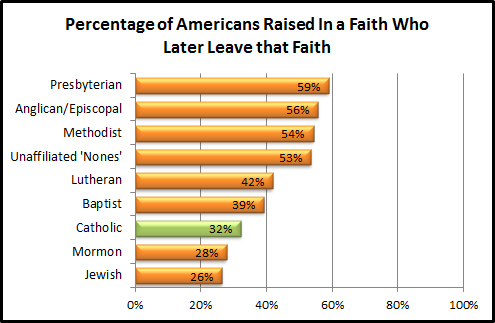


Furthermore, Eastern Catholics and the Orthodox church all regularly lament declining attendance at mass and participation in the sacrament of reconciliation. In fact, according to Metropolitan Hilarion of Volokhalamsk, Russia, only 1% of the 65% or so of ethnic Russians claiming to be ‘Orthodox’ are in any way affected in their daily lives by the Orthodox Church. They have not changed their services the last time I checked so why are they losing attendance if Latin and the NO mass are the problem?

In fact, while other Christians have reported continuing declines over the last 10 years or so, Mass attendance has stabilized.


Bottom line, things are not quite as bleak as you make them out to be. Are they good? Definitely not. We need to evangelize and draw wayward catholics back and seek out the conversion of our protestant brethren.

However, your statement that the NO Mass is a direct cause of declining Mass attendance or that holding Mass in the vernacular language has anything to do with it ts inaccurate and highly misleading.

In fact, TIME was reporting on declining numbers of Catholics and all people calling themselves Christian as far back as 1970. LINK

 
I just attended a catechetical conference at which the keynote speaker’s entire message was to not despair because of the “Myth of secularization”. He based his message on the fact that a majority of respondents to surveys over a course of 30+ years identified themselves as Catholics rather than ‘no religion’. My question, “What does it mean to identify yourself as Catholic in a survey if you never set foot inside a church?”
 
I just attended a catechetical conference at which the keynote speaker’s entire message was to not despair because of the “Myth of secularization”. He based his message on the fact that a majority of respondents to surveys over a course of 30+ years identified themselves as Catholics rather than ‘no religion’. My question, “What does it mean to identify yourself as Catholic in a survey if you never set foot inside a church?”
The issue is not new to the Church;it goes clear back to Constantine, if not farther back.

I don’t know about the myth - maybe she is related to the mythuth and the mythter. But secularization is a reality whether that speaker chose to see what is in plain view or not, and while we are not as good as Europe at secularization, the US certainly is giving it the old college try.

It is no new phenomenon that people identify themselves as Catholic and rarely set foot inside the door - let alone the confessional. The joke about bred, fed, wed and dead as too often applied to citizens of Italy has a much broader application.

In the late 1950’s at the peak of church attendance (which started falling off then, not after Vatican 2) the rate was something like 70% or maybe 72% attending Mass on a regular basis. Complacency, laziness, lack of cathechesis, lack of firm belief, and any number of other issues lead to people calling themselves Catholic but showing little or nothing to substantiate it. Nothing new; just more of them.

And as an aside, the mainline Protestant groups have seen the same fall-off over the same approximate time, so blaming it all (or even in large part) on Vatican 2 ignores the facts.
 
PJM;7949300:
Correlation does not equal causation which is something any student learns in the most basic of statistics or research methods courses. I can show you stats that suggest that increasing ice cream sales lead to higher crime rates in Chicago.

The real truth is that society as a whole is far more secular than it was 50 years ago. Christian participation in general has been declining on a steady pace during the time you mentioned and catholics have faired pretty much the same as protestants. In fact some studies such as the one who’s graphs I am linking below (performed by Georgetown University), show that we are fairing much better in terms of keeping those raised the faith as they become adults.

http://cara.georgetown.edu/staff/webpages/myth1e.jpg
Furthermore, Eastern Catholics and the Orthodox church all regularly lament declining attendance at mass and participation in the sacrament of reconciliation. In fact, according to Metropolitan Hilarion of Volokhalamsk, Russia, only 1% of the 65% or so of ethnic Russians claiming to be ‘Orthodox’ are in any way affected in their daily lives by the Orthodox Church. They have not changed their services the last time I checked so why are they losing attendance if Latin and the NO mass are the problem?

In fact, while other Christians have reported continuing declines over the last 10 years or so, Mass attendance has stabilized.

http://cara.georgetown.edu/CARAServices/ccp.jpg

Bottom line, things are not quite as bleak as you make them out to be. Are they good? Definitely not. We need to evangelize and draw wayward catholics back and seek out the conversion of our protestant brethren.

However, your statement that the NO Mass is a direct cause of declining Mass attendance or that holding Mass in the vernacular language has anything to do with it ts inaccurate and highly misleading.

In fact, TIME was reporting on declining numbers of Catholics and all people calling themselves Christian as far back as 1970. LINKAnd in fact, if you look further at the Georgetown research, you will note that the highest rate of attendance at Mass by age group is the group born well before Vatican 2. I always find it borderline hysterical when I see unsubstantiated quotes about people leaving in droves when the vernacular Mass started.
 
10 people out of 1000 prefer the ancient liturgical language.
With this constant undermining of and attacking on the Latin language, how can we have any kind of intelligent discussion on Catholic theology and Mass, which is Latin-based? Doesn’t being the official language of the Catholic Church, which claims over 1.3 billion members, have any meaning? That’s more people than speak Mandarin. Well over 2 billion claim to be Christians and how many read or hear even a little Christian Latin, (or even Greek), which goes all the way back to Christ? Compared with other major religions of the world and how many worship in a non-vernacular, something’s not right here.

Of course, people prefer a language (Duh!) which they are taught at a young age. So why aren’t we ALSO teaching our Catholic kids Latin at such an age, instead of complaining that we don’t understand Latin? Did the Reformers set the rules for the rest of us?

youtube.com/watch?v=HZHRCuEjpbA&feature=related

And that’s all I’m going to say on this thread.
 
Status
Not open for further replies.
Back
Top