Catholic responses to Blake Ostler (Mormon apologist)?

  • Thread starter Thread starter truthseeker32
  • Start date Start date
Status
Not open for further replies.
I deeply apologize if it came out insulting…it was not my intent…i was just shocked/surprised.

I just wanted to see pics of the Gs…and I did not read the stories…sorry for this as well.

Regarding the Scapulars…yes, many wear them but is not required. And nobody checks on us…that is all.
I think it is natural to want to see what others believe, and how they express their belief. I didn’t think you we’re trying to be insulting.
 
He had a false idea of God, as you do. 😃 And exclaimed in the same manner as you are. The misrepresentation is in the idea that expressing the loss of a false God, indicates He didn’t accept the truth about God, or that his false idea about God indicates something truthful about your false idea of God. It doesn’t. You think Serapion was mocking God, as you do. He wasn’t.

It is difficult to let go of false god(s), we see it here, with every Mormon post about deity.
Yesterday while driving, I had my radio on scan and I heard a man say something about God. I pressed the button to listen. It was an LDS station and the man was saying that we need to think about God…that we can know him…he is like us…he is knowable…

I immediately thought about Tom and this conversation. Until he is willing to see God from a non-Mormon perspective it seems there is nothing more to say. 🤷
 
Yesterday while driving, I had my radio on scan and I heard a man say something about God. I pressed the button to listen. It was an LDS station and the man was saying that we need to think about God…that we can know him…he is like us…he is knowable…

I immediately thought about Tom and this conversation. Until he is willing to see God from a non-Mormon perspective it seems there is nothing more to say. 🤷
I think he thinks that is what he is doing. But as we’ve discussed in other threads, the Mormon-think hangs on. It has a grip.
 
Perhaps, Tom, we would do better to start with love, and its meaning.

From Deus Caritas Est

Love now becomes concern and care for the other. No longer is it self-seeking, a sinking in the intoxication of happiness; instead it seeks the good of the beloved: it becomes renunciation and it is ready, and even willing, for sacrifice.

This is the loving relationship we have with God. It isn’t self-seeking, which I am seeing in your way of viewing communication with God.

Christ is our beloved, and we are His. It is not a self-seeking love, out for our own happiness, and we don’t view Jesus as self-seeking, that is loving us for self gratification. We already know that Jesus loves us, we don’t need a constant self-assurance, rooted in doubt of God or of self. God’s love is an unchanging constant.

We renounce ourselves for Him, our beloved, and as I already pointed out, the Cross is the evidence of His renunciation for us. His love is perfect, ours is not.

If you then go to Spe Salvi, and the section on prayer, you’ll find this:

“*Saint Augustine, in a homily on the First Letter of John, describes very beautifully the intimate relationship between prayer and hope. He defines prayer as an exercise of desire. Man was created for greatness—for God himself; he was created to be filled by God. But his heart is too small for the greatness to which it is destined. It must be stretched. “By delaying [his gift], God strengthens our desire; through desire he enlarges our soul and by expanding it he increases its capacity [for receiving him]”. Augustine refers to Saint Paul, who speaks of himself as straining forward to the things that are to come (cf. Phil 3:13). He then uses a very beautiful image to describe this process of enlargement and preparation of the human heart. “Suppose that God wishes to fill you with honey [a symbol of God’s tenderness and goodness]; but if you are full of vinegar, where will you put the honey?” The vessel, that is your heart, must first be enlarged and then cleansed, freed from the vinegar and its taste. This requires hard work and is painful, but in this way alone do we become suited to that for which we are destined[26]. Even if Augustine speaks directly only of our capacity for God, it is nevertheless clear that through this effort by which we are freed from vinegar and the taste of vinegar, not only are we made free for God, but we also become open to others. It is only by becoming children of God, that we can be with our common Father. To pray is not to step outside history and withdraw to our own private corner of happiness. When we pray properly we undergo a process of inner purification which opens us up to God and thus to our fellow human beings as well. In prayer we must learn what we can truly ask of God—what is worthy of God. We must learn that we cannot pray against others. We must learn that we cannot ask for the superficial and comfortable things that we desire at this moment—that meagre, misplaced hope that leads us away from God. We must learn to purify our desires and our hopes. We must free ourselves from the hidden lies with which we deceive ourselves. God sees through them, and when we come before God, we too are forced to recognize them. “But who can discern his errors? Clear me from hidden faults” prays the Psalmist (Ps 19:12 [18:13]). Failure to recognize my guilt, the illusion of my innocence, does not justify me and does not save me, because I am culpable for the numbness of my conscience and my incapacity to recognize the evil in me for what it is. If God does not exist, perhaps I have to seek refuge in these lies, because there is no one who can forgive me; no one who is the true criterion. Yet my encounter with God awakens my conscience in such a way that it no longer aims at self-justification, and is no longer a mere reflection of me and those of my contemporaries who shape my thinking, but it becomes a capacity for listening to the Good itself.”
*

We are called to step outside of self centricity and center ourselves on God. That is the life of a Christian, not self-fulfilment built on an idea that God can only hear me if/when He is changed by me.
 
Because Rory helped and you reminded me, here is a council’s statement:
“First, then, the holy Roman church, founded on the words of our Lord and Saviour, firmly believes, professes and preaches one true God, almighty, immutable and eternal, Father, Son and holy Spirit; one in essence, three in persons.”
-----Council of Florence, Ecumenical XVII, Session 11, 4 Feb., 1442, (EWTN website)
Yes, like I said The Catholic Church, like St. James, says that God is immutable, but does not define or explain what the Church means by the word immutable. I think the fact we believe God created would indicated that the Catholic Church does not share your God is a rock definition; therefore your Post #18 does not reflect the teaching of the Catholic Church. It reflects an invention in your own mind.
It seems that most people here do not have any concern over this issue. I do not completely understand that, but it sure seems to be the case.
Because we know God loves us and hears our prayers. Losing sleep over the lack of definition of a word seems like a waste of time. Maybe it is only worthwhile for someone who needs an axe to beat the Catholic Church with.
Let me try this parallel.
Wearing garments does not disturb me in the least (and I do not care to talk more about it BTW), but trying to use thoughts from Weinandy to align worshiping an impassible God instead of a passible God does. To the extent that Weinandy deals with and dulls this issue it will still be a mark against me being Catholic IMO.
Again, it is your problem invented by you, not the Catholic Church; therefore the Catholic Church cannot solve it for you. And immutable and impassible are not synonyms.
Now, the origins of the BOA does disturb me some. So I can sympathize (unlike the impassible God BTW ) with Catholics and former-Mormons who have no desire to pick up the concerns they would have for the BOA. Perhaps you can think of your Mormon issue that creates the most stress for you. It is quite unlikely that I have not already thought about this and few of them bother me.
Again, the “I’ve heard it before illusion of answers” defense doesn’t hold any water with me. Science has shown the B0fA to not be what Joseph Smith claimed it to be.
Why would I pick up an impassible God theology when I have a passible God who interacts with me regularly?
There is only one God and the God you interact with is impassible.
Code:
And the other parallel I have already drawn it the two papyri theory as an explanation of the BOA.  I doubt many non-LDS find that so convincing that the issue becomes unimportant.  Rory’s answer (and I love Rory) & Robyn’s answer (and it was nice) do not address this as well as Weinandy or Gavrilyuk IMO.  And I think Weinandy and Gavrilyuk present God as less worship worthy than God in LDS thought (at least as it is outlined by Blake Ostler).
I prefer to worship the God of all creation. You make the god invented by Joseph Smith to be just a regular guy; like Adam. I reject that because it is irrational.
I would rather worship the real God who is the modalistic monstor that is presented in the mis-characterizations of the Trinity, then the false God who meets with my personal approval.
Yes, I think you are looking for a god that meets your personal approval; see your Post #76. You know the immutable God is not a rock, you want a Father that will jump up and play with you at your command instead of continuing to love you while he finishes watching the game.
Code:
But God as presented by Ostler verses the God of the councils has the added benefit IMO that He is in better alignment with the Bible.  He is in better alignment with how I experience God in my life.  So, I think it more likely that God’s true characteristics are closer to those presented by Ostler within a LDS framework than those presented by the councils of the Catholic Church.
Yes, I am familiar with Mormon eisegesis. For example:
I find it likely they used “immutable” in a way similar to Aquinas and other Catholic thinkers.

 
I think he thinks that is what he is doing. But as we’ve discussed in other threads, the Mormon-think hangs on. It has a grip.
Agreed.
When one has been or is fully entrenched in LDS thought, it’s hard to do, for one, you dont see how much of it is Mormon thought.
 
Agreed.
When one has been or is fully entrenched in LDS thought, it’s hard to do, for one, you dont see how much of it is Mormon thought.
Yes, that is true.

However, I know that I tried to start from square one with him - defining the nature of God from a Jewish and Christian perspective - and he completely ignored it.

I think at this point, he is just trying to promote LDS thought in an effort to place doubt in the minds of Catholics here at CAF.
 
Yes, that is true.

However, I know that I tried to start from square one with him - defining the nature of God from a Jewish and Christian perspective - and he completely ignored it.

I think at this point, he is just trying to promote LDS thought in an effort to place doubt in the minds of Catholics here at CAF.
Very probable.
 
I think he thinks that is what he is doing. But as we’ve discussed in other threads, the Mormon-think hangs on. It has a grip.
Like I have said before, he is purposely ignoring any efforts to separate Mormon and Christian thought. I think he is asking questions in a veiled attempt at proselytizing,
 
I think at this point, he is just trying to promote LDS thought in an effort to place doubt in the minds of Catholics here at CAF.
I don’t see any promoting of LDS thought. I honestly believe it can’t be promoted be because it is irrational, so attacking the Catholic Church is the only thing to do.
 
Like I have said before, he is purposely ignoring any efforts to separate Mormon and Christian thought. I think he is asking questions in a veiled attempt at proselytizing,
Also very probable.
 
I don’t see any promoting of LDS thought. I honestly believe it can’t be promoted be because it is irrational, so attacking the Catholic Church is the only thing to do.
While I agree LDS thought is hard to promote, Tom does give it a good try in post #17:

I have read about everything I can get my hands on from Ostler. The strength of his arguments has pulled me from positions I previously held.
I think his toughest critique of Catholic thought comes in his second book Exploring Mormon Thought: Problems of Theism and the Love of God.


and post #18

*I cannot make it work (and this is not JUST an axe I hit the Catholic Church with, but a reason that I think Catholicism doesn’t work at least in its most prevalent thought traditions. That God really loves me is much more important than that He is unchanging, immutable, impassible, …).

And if you think the above is easy to understand and want more (much harder to understand by my lights – I only think I get it), I can share why God cannot create ex nihilo men who have “libertarian free will.” This comes from a Catholic philosopher and from Ostler (their conclusions are the same their arguments are almost the same). I could believe in the Calvinistic God that MUST exist if God created ex nihilo and we do not have LFW, but He is not the God who loves in the sense that the real God is.*

I feel it is a veiled attempt at promoting Mormonism, in a round-about sort of way.
Certainly, Mormons do not believe in ex nihilo and by throwing Calvin in there, it makes it seem that many Christians struggle with this question.

Anyway, just the way I see it. 🙂
 
While I agree LDS thought is hard to promote, Tom does give it a good try in post #17:

I have read about everything I can get my hands on from Ostler. The strength of his arguments has pulled me from positions I previously held.
I think his toughest critique of Catholic thought comes in his second book Exploring Mormon Thought: Problems of Theism and the Love of God.


and post #18

*I cannot make it work (and this is not JUST an axe I hit the Catholic Church with, but a reason that I think Catholicism doesn’t work at least in its most prevalent thought traditions. That God really loves me is much more important than that He is unchanging, immutable, impassible, …).

And if you think the above is easy to understand and want more (much harder to understand by my lights – I only think I get it), I can share why God cannot create ex nihilo men who have “libertarian free will.” This comes from a Catholic philosopher and from Ostler (their conclusions are the same their arguments are almost the same). I could believe in the Calvinistic God that MUST exist if God created ex nihilo and we do not have LFW, but He is not the God who loves in the sense that the real God is.*

I feel it is a veiled attempt at promoting Mormonism, in a round-about sort of way.
Certainly, Mormons do not believe in ex nihilo and by throwing Calvin in there, it makes it seem that many Christians struggle with this question.

Anyway, just the way I see it. 🙂
I saw both posts as questioning/attacking the Catholic Church, not the promotion of anything.

I wanted to say attacking Catholic belief but what he attacked we don’t believe.

I’ve only known one Mormon on here that tried to promote and argue for Mormon beliefs and he is gone now.
 
Mormonism is founded on attacking Christianity first, and then inserting itself as the “answer” to its attack. Starting with Smith who claimed all Christian churches are false, but what he was promoting is the answer to what is false.

Same thing, different day.
 
I pretty poor explanation of the two papyri theory. “Things Disappear,” stands in for a famous and well documented fire that was believed to have destroyed ALL of the papyri until some (or all) was found.
There is much more to recommend it, but I think it rather lacking myself so I will content myself with this comment.
There is much written by LDS apologist and anyone who wants to know should seek it from them not from someone who presents it as it has been presented above.

I linked to Weinandy because he offers the BEST defense of God’s impassibility I have found. Perhaps I should not have done this.
Charity, TOm
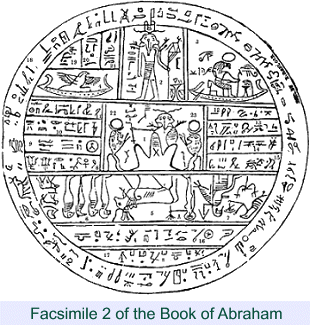
Tom, the particular thing, this:


that Smith claimed to translate is printed in your Book of Abraham, with the associated mistranslation right there with it.

The apologetics claim, what is printed in your Book of Abraham isn’t what Smith translated, but comes from something that doesn’t exist. Who cares how you think it disappeared? You’re making a claim from silence as you can’t produce the documents as evidence to support your claim. Everyone is just supposed to exclaim, “OH, that explains it!”, and ignore the facsimile that is actually in the book, and what it actually translates to. Sorry if that works for you.

This “it went missing” happens a lot in Mormonism, is all I’m saying.
 
Do the Mormons believe Blake Ostler is above St. Thomas Aquinas and other theologians?

With the critical thinking and invigorating search for truth in the Catholic Church, certainly somebody would have come along to point out new truths, invalidating Aquinas. But it never happened.

Actually it was Thomas Aquinas and a Dominican before him who discerned they could prove the existence of God using Aristotle’s Cause and Effect.

Do we need to return to Aristotle?

I also read that Pope Benedict said the Church extremely criticized Greek philosophers to show them their error so that Greek philosophy could be transformed into something better, more accurate and reflective of Truth.

I have not read the writings of Blake Ostler but already I doubt very much that he can trump our history of Catholic philosophers, be they of the Aristotle tradition or other.
 
Crazzeto AND RebbecaJ,
Thank you very much for the understanding words. I do appreciate that.

To Crazzeto’s concern about the internal consistency of LDS theology, I cannot recommend enough Ostler. He has been called the first systematic theologian within the LDS tradition. I am not sure that is entirely fair, but he has gone much farther than any other single LDS thinker towards defining a consistent (scripturally and internally) theology.
Charity, TOm
lol…Tom just made the best case against the LDS Church than any Non-LDS poster in the history of this board.

How sad is it when the best “thinker” toward making sense of the disaster that is LDS theology is not one of the 16 lds “prophets” (the group of wealthy white men who talk directly with the lds god). Nor has it been any of the plethora of lds “apostles”. Nor has it been any of the hundreds of “general authorities”. It is a man named Ostler who, so far, has refused to accept my challenge.

Thank you, Tom, for this.

Be Blessed
 
lol…Tom just made the best case against the LDS Church than any Non-LDS poster in the history of this board.

How sad is it when the best “thinker” toward making sense of the disaster that is LDS theology is not one of the 16 lds “prophets” (the group of wealthy white men who talk directly with the lds god). Nor has it been any of the plethora of lds “apostles”. Nor has it been any of the hundreds of “general authorities”. It is a man named Ostler who, so far, has refused to accept my challenge.

Thank you, Tom, for this.

Be Blessed
Well I think the key for me is that they are just not getting a consistent theology. While I will grant errors will tend to creep in any faith group, there should already be a core self consistent theology in place. As for who does the thinking, that should be God.

But yeah, it’s something of a concern that just now there is someone who is working out how to make mormonism seem a little more consistent.
 
lol…Tom just made the best case against the LDS Church than any Non-LDS poster in the history of this board.

How sad is it when the best “thinker” toward making sense of the disaster that is LDS theology is not one of the 16 lds “prophets” (the group of wealthy white men who talk directly with the lds god). Nor has it been any of the plethora of lds “apostles”. Nor has it been any of the hundreds of “general authorities”. It is a man named Ostler who, so far, has refused to accept my challenge.

Thank you, Tom, for this.

Be Blessed
While I have mostly only Tom to go by, it seems that Ostler’s Theology is not Mormon theology. I have also noticed in discussions trying to prove a ‘consistency’ in ‘Mormon theology,’ Mormon theology is never introduces to the discussion, and quickly (one or two posts) turns into Catholics clarifying Catholic theology.

It is by these discussions I continue in my belief that Mormonism is inconsistent with history, science and reason.
 
I deeply apologize if it came out insulting…it was not my intent…i was just shocked/surprised.
I just wanted to see pics of the Gs…and I did not read the stories…sorry for this as well.

Regarding the Scapulars…yes, many wear them but is not required. And nobody checks on us…that is all.
I was not offended, please do not feel bad.
Charity, TOm
 
Status
Not open for further replies.
Back
Top