
Chinese Bishops asked to step aside

  • Thread starter Thread starter DustThouArt
  • Start date Start date
Status
Not open for further replies.
Many secular rulers had the right to elect bishops throughout history… and yes, this was true even well after Unam Sanctam. Right here in the Americas, Mexican bishops were elected by secular authorities not so long ago…
Now to be fair, I’m not aware of a historical precedent of a non-Christian secular authority be granted this authority…
 
The Pope, of couse, whom the Bishops needs to submit to.

But as I said, it is a complicated situation, where diplomacy and negotiation may come into play. It is not an ideal situation obviously unlike with any deomcratic government where religions are really free.

Not sure what the Holy Father has in mind but if he can get some concessions from the Chinese government like being able to maintain the Vatican authority over the clergy, that would be a tremendous gain.

Probably that requires some compromises which is a difficult road ahead, like the Taiwan issue as being dispensable or the clergy making pledges to be loyal to the government. I think at the present time, priests need to have permit to preach, which is a way of controlling them of course as they have to observe its term and condition.

OTOH, the impasse between the Vatican and the Chinese government will not do anybody any good.

It is a trying time for the persecuted Christians in where ever they are.
 
“It’s possible that Rome may betray us,” said Fr Dong, a priest in Hebei province, told The Telegraph.

“If this happens, I will resign. I won’t join a Church which is controlled by the Communist Party.”

 
This topic is upsetting to me, which doesn’t happen very often.

I hope the Vatican, China, and the Chinese bishopric are able to eventually work out a solution. Obedience must be observed above anything else.
 
I certainly hope that the US never adopts what is known as the “Vietnam Model,” whereby the government first selects several priests who are acceptable to the government as bishop candidates. Then Rome selects one of those candidates. Then the government either accepts or rejects the nomination, and finally, Rome authorizes the government approved candidate to be bishop.

Making sense of the China-Vatican Agreement on the selection of Bishops
 
I certainly hope that the US never adopts what is known as the “Vietnam Model,” whereby the government first selects several priests who are acceptable to the government as bishop candidates. Then Rome selects one of those candidates. Then the government either accepts or rejects the nomination, and finally, Rome authorizes the government approved candidate to be bishop.

Making sense of the China-Vatican Agreement on the selection of Bishops
But doesn’t Austria get to veto anyone selected as pope. For example, in 1903, Prince Jan Puzyna de Kosielsko opposed the election of Mariano Rampola as Pope, and he was not chosen. Why is it all right to allow Austria to veto the election of a pope, but it is not all right for China to veto the selection of bishops?
 
Certain European princes had the right of veto in the past, but this is no longer the case.
 
No, Austria does not get to veto a papal selection. At the time of the 1903 Conclave, several Catholic monarchs, including Austria had the power to veto one candidate from consideration.

After the Austrian Cardinal attempted to exercise the veto power against him, Card. Rampolli, expressing outrage, called it “an affront to the dignity of the Sacred College.” He voluntarily removed himself from consideration.

This was after the second vote. Yet, the third vote showed Rampolli still had lost no support. The voting went on for seven votes, finally electing Cardinal Sarto, Patriarch of Venice, who took the name Pius X.

Pius X, less than 6 months after his election, eliminated the veto power of any Catholic monarch.

The story is in Wikipedia here:


In any case, there is a considerable difference between a Catholic monarch having veto power over one candidate, and an atheist Communist government having final approval power over any bishop selection.
 
Last edited:
That’s an interesting story. I learned something new. It does show use that the selection process for offices in the Church is fluid and not set in stone. The first selection was done with a roll of the dice.
 
Certain European princes had the right of veto in the past, but this is no longer the case.
If the European princes did have that right in the past, then why would it be unworkable for the leader of China to have that right today, or at least the right to veto the choice of Chinese bishops?
 
Its not unworkable… but it still doesn’t seem to be an ideal situation. In an earlier post in this thread I pointed out the historical precedent of secular princes electing bishops, but as I noted they were always Christian rulers… the added complexity here is that we are dealing with an atheistic communist government.
 
Those who had that right in the past were Catholic, not Communist, not atheist. Why would an atheist be given any say over a conclave? In any case they no longer have that right. Every pope has the right to determine the rules to govern a papal conclave.
 
That’s an interesting story. I learned something new. It does show use that the selection process for offices in the Church is fluid and not set in stone. The first selection was done with a roll of the dice.
Actually the First Pope was selected by Jesus.
 
I should have said the first selection from within the Church. For those not familiar with the incident from the first chapter of Acts on choosing a replacement for Judas.

So they put forward two men, Joseph called Barsabbas (who was also called Justus), and Matthias. 24 And they prayed and said, “You, Lord, who know the hearts of all men, show which one of these two You have chosen 25 to [v]occupy this ministry and apostleship from which Judas turned aside to go to his own place.” 26 And they [w]drew lots for them, and the lot fell [x]to Matthias; and he was [y]added to the eleven apostles.
 
I think the poster meant that the first bishop to succeed one of the 12 (Matthias who succeeded Judas) was selected by lot.
 
Yes, the main point being is there is no theologically correct way. It is a practice and one that has changed a lot through the centuries.
 
I think it’s a little more complicated than that. I’m sure this wasn’t a decision that was made lightly.

I won’t pretend to understand the situation fully, but it does seem like they are between a rock and a hard place. Do they keep moving forward with effectively two different Catholic Churches with one controlled by the Chinese government and one under the auspices of the Vatican? Or do they try to reconcile and move things in the right direction from a more unified front? Time will tell how it all works out.
There are not two Churches. There is one Church.

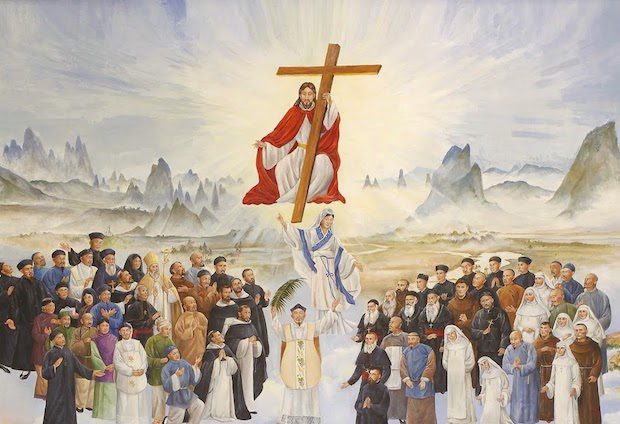
This might be the most disturbing development in the Church I’ve ever seen. We are talking about the blood of martyrs here. This dishonors them.
 
Last edited:
At one time the Church was entangled with the secular world to a much greater degree.
At the same time, that world it was entangled with was Catholic.

The Chinese government is hostile to the Catholic Church.
 
Status
Not open for further replies.
Back
Top