James K. Hoffmeier (
Ancient Israel in Sinai: The Evidence for the Authenticity of the Wilderness Tradition) will probably explain it better (footnotes not included):
The history of Canaanite/Hebrew alphabetic script has become clearer over the past century. Since this particular writing system is pertinent to the question of the origins of the Sinai covenant, it needs to be explored in some detail.
The famous inscriptions usually called Proto-Sinaitic were first noticed in Sinai at Wadi Maghara by E.H. Palmer in 1868 during his exploration of Sinai.
[1] Subsequently, in 1905, Flinders Petrie excavated the Pharaonic copper and turquoise mining site at Serabit el-Khadim. Mining at Serabit may go back to the reign of Sneferu of the Fourth Dynasty, judging from inscriptional evidence, although at nearby Wadi Maghara a relief of the Third Dynasty king Sekhemkhet is inscribed on a rock face, where he is depicted smashing the head of a local desert dweller.
[2] In his 1906 publication of his work in Sinai, Petrie offered some of the first pictures of the Proto-Sinaitic inscriptions. It is clear that at this early date, Petrie did not understand these texts, but he did recognize that there were “a definite writing system, and not merely ignorant scribbling.” In mine L, which contains one of the longest texts, Petrie discovered pottery that he dated to the reign of Thutmose III. He also pointed to a statue with Proto-Sinaitic writing on it that was associated with a shrine built by Hatshepsut, and to
a sandstone sphinx of Thutmose III that also had this peculiar script on it. Although he was not a specialist in languages, Petrie proposed a date in the
Eighteenth Dynasty for these enigmatic texts.
The publication of the Proto-Sinaitic inscriptions, along with the hieroglyphic texts at Serabit and Wadi Maghara, was handed by Petrie to a young and then little-known Egyptologist, Alan Gardiner.
[4] Not until 1955 did the full publication of the inscriptions appear, with the collaboration of T.E. Peet and Jaroslav Černý.
[5] In 1916, however, Gardiner did publish some early reflections on the texts in which he determined that the signs were alphabetic and that the language was Semitic.
[6] He demurred from Petrie’s opinion that all the Proto-Sinaitic texts were from the Eighteenth Dynasty. Gardiner suggested that some of the texts could date from the Twelfth Dynasty, because a stela of Amenemhet III contained the ox-head (aleph) sign, and the shrine of Sopdu that Petrie attributed to Hatshepsut actually originated in the Twelfth Dynasty; Gardiner thus concluded that the script dates back to the nineteenth century B.C.
[7]
William F. Albright wrote a small monograph that further investigated the Proto-Sinaitic script comparatively, with numerous examples of the script found at various tells in Canaan/Israel.
Three signs on a sherd from a Middle Bronze II-period (ca. 1800-1630 B.C.) cultic vessel discovered at Gezer, and a dagger blade from Lachish dating to the Middle Bronze III period (ca. 1600-1550 B.C.) indicate that the Semitic alphabet writing system was known in Syria-Canaan prior to the late Bronze Age.
[8] On the basis of the Levantine evidence, Albright concluded that “the Proto-Sinaitic texts, which had been rather isolated, were joined by early alphabetic scripts from Syria-Palestine, which were clearly earlier or later than the Proto-Sinaitic forms.”
[9] When he studied them alongside examples of the alphabetic scripts from Western Asia, Albright believed that an evolution of the signs could be detected, which suggested to him that the Eighteenth Dynasty date is most likely for the Sinai texts.
[10]
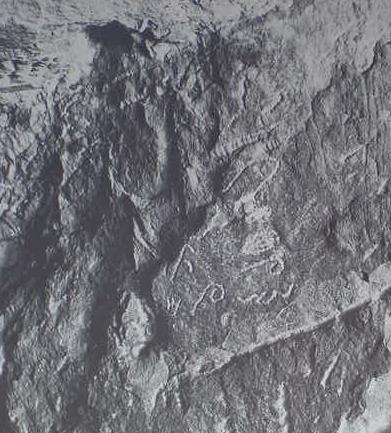
Interestingly, at Serabit el-Khadim (mine M), one of the most intriguing inscriptions was found, which reads:
‘l ‘lm, “god the eternal” (figure 33). Frank Moore Cross was the first to recognize the reading of this text, and his reading was subsequently adopted by Albright and others.
[11] This same epithet for God is also found in the Abraham narratives (אֵ֥ל עוֹלָֽם; Gen. 21:33).
Because a corpus of Middle Bronze and Late Bronze texts from Canaan, have been identified, scholars now refer to this script as Proto-Canaanite, and its evolution has been studied thoroughly by Cross.
[12] More recent study of the history of the alphabet by Joseph Naveh concurs with Cross’s views and with the dating of the Semitic-alphabetic script and the dating of the Sinai corpus to the fifteenth century.
[13] The earlier date of some of the texts found within ancient Canaan suggests that this script originated in Canaan and not Sinai, as some scholars had thought.
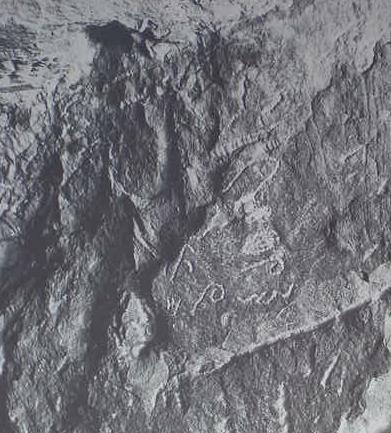
The recent discoveries by John Darnell at Wadi el-Hôl in the western desert of Egypt have revealed a collection of rock drawings and inscriptions, including a couple of early Semitic-alphabetic texts.
[14] Although they are still being studied, preliminary reports indicate that these texts may be the oldest West Semitic alphabetic writing known. The team of scholars who are examining these texts provisionally believe, based upon the orthographic comparison with Egyptian hieratic signs a date for the
[sic] these Semitic texts is from early second millennium B.C. This new evidence might indicate that the Semitic alphabetic script was actually invented in Egypt by Semites at the end of the third millennium, rather than in Canaan or Sinai, a date much earlier than Semitists have thought.
The importance of Darnell’s discovery is that the Semitic alphabet originated several centuries earlier than previously thought. Furthermore, this early date allows for additional time for this script to have developed to a level that Moses could have had a hand in recording the law at Sinai. It was noted in chapter I, § III, that some early critics of the Bible denied Moses a role in authoring the Pentateuch because they thought that writing was not sufficiently developed in his day. If we place Moses in the thirteenth century, then more a half millennium separates him from the earliest known Semitic writing.
In the seventeenth and eighteenth centuries, when firsthand knowledge of ancient scripts and writing systems was negligible, scholars might be pardoned for raising questions about their availability in the second millennium B.C. But in the intervening centuries, with the decipherment of the cuneiform scripts of Mesopotamia, Syria, and Anatolia, as well as hieroglyphic and hieratic texts in Egypt, it is recognized by all linguists that writing originated toward the end of the fourth millennium B.C., and now it appears that we can possibly place the Semitic alphabet at the very end of the third millennium B.C.
[16]
…] From Canaan to the end of the second millennium B.C., the Semitic alphabet spread to Arabia. In the 1920s
a tablet written in the Ugaritic-cuneiform script was found at Beth-Shemesh, but only recently was it shown to be written in Old South Arabian.
[25] Kenneth Kitchen, a specialist in south Arabian history, says of this find that “it reflects contact between Canaan and Saba in the field of writing at about 1200 B.C.” He adds that this discovery demonstrates that the “South-Arabian script originated as a conscious adaptation of the Late-Bronze Age Canaanite alphabetic linear script of the 13th/12th centuries B.C.”
[26] If the Sabeans from distant southern Arabia had borrowed the alphabetic script from Ugarit in the Late Bronze II period, there is no reason to deny that the Israelites could have borrowed the Canaanite alphabet during the same period.