Confusion in Genesis

  • Thread starter Thread starter YoungCatholic86
  • Start date Start date
Status
Not open for further replies.
You are right, the church does not pursue the concept of our origins based on instant creation. The church has an interest in geology, archeology , anthropology etc. which is reasonable. The study of sacred scripture is also actively sought by those seeking the truth of creation.

Do you believe in a literal Adam & Eve as the church does?
That’s a blunt and rude question.

Almost as if I asked you: Do you go to confession when you commit mortal sins?

It also feels like a set-up question and I don’t like being set up.

Do I align myself with the Church’s teaching and do I actively study the writings of our Popes and the documents and teachings of the Vatican and do I submit to them: yes.

Does that mean I believe in a literal Adam and Eve as the Church does?

Well read my post and read the church documents and the writings of Blessed John Paul II and Pope Benedict and you will know the answer.
 
You are right, the church does not pursue the concept of our origins based on instant creation. The church has an interest in geology, archeology , anthropology etc. which is reasonable. **The study of sacred scripture is also actively sought by those seeking the truth of creation. **

Do you believe in a literal Adam & Eve as the church does?
What do you mean by study? The memorization of text and the shoehorning of it into one;s beliefs, or do you mean following the teaching of Dei Verbum and using modern scholarship and the findings of archaeology and etc?

A fundamentalist belief in scripture is like de-tuning my motorbike. Not something I’m interested in doing and doesn’t make sense.
 
If your grandfather tells you a story, and years after he dies you decide to write it down and publish a book with the story he told you, would you say that the author of the story is you or your grandfather? 🤷
Another example. In Romans 16:22, we get the following: “I Tertius, who wrote this letter, greet you in the Lord.” But the letter begins with “Paul, a servant of Christ Jesus …] to all those in Rome who are loved by God and called to be saints.” So, who exactly was the ‘author’ of Romans: Tertius or Paul?
The answer to both is “Both”. But there are still a few problems with this:
  1. In the first case, we are talking abut a story that was created by a person, if that story was created by someone, the creator is the author of the created story. The redactor can be the co-author, because they can tie the story together and add or remove pieces to make it more consistent, same applies to the letter using Paul’s and Titus wordings. What about Moses? If Moses transmitted orally the historical facts that happened since before he was born until the Exodus, he was no longer the author in this case, but another person who transmits history.
  2. what language did God use to transmit the ten commandments to Moses if they didn’t have any alphabet? 🤷 at least it should be expected the hebrew people adopted God’s alphabet, but they learned their writing from who? The Phoenicians? The Phoenician alphabet was better to them than God’s?
  3. This “authorship” argument is still valid for the Apocryphal testments?
 
You are right, the church does not pursue the concept of our origins based on instant creation. The church has an interest in geology, archeology , anthropology etc. which is reasonable. The study of sacred scripture is also actively sought by those seeking the truth of creation.

Do you believe in a literal Adam & Eve as the church does?
Right. That’s exactly what drives me away from religions.
 
Do you believe in a literal Adam & Eve as the church does?
YES

Divinely inspired, St. Paul taught the connection between a real Adam and a real Jesus Who is Real God and Real Man. Take away the reality of Adam and then it becomes very easy to consider Jesus as only a man, a prophet among prophets. Naturally, I understand that the reality or Original Sin has almost disappeared.

No wonder there is confusion about the first three chapters of Genesis.:mad:
 
YES

Divinely inspired, St. Paul taught the connection between a real Adam and a real Jesus Who is Real God and Real Man. Take away the reality of Adam and then it becomes very easy to consider Jesus as only a man, a prophet among prophets. Naturally, I understand that the reality or Original Sin has almost disappeared.

No wonder there is confusion about the first three chapters of Genesis.:mad:
Let’s see… Assuming the first human couple really existed. How long ago did “Adam” and “Eve” exist? Where did they live (where is the Garden of Eden)? How was a single couple able to generate a species with so many different features (Asians still look Asians even after thousands of years, Africans still look Africans, Indians look Indians, Semites look Semites,etc)? If these questions have a plausible answer, I will believe in it.
 
By “look”, I mean “have features”. not just literal look.
 
  1. what language did God use to transmit the ten commandments to Moses if they didn’t have any alphabet? 🤷 at least it should be expected the hebrew people adopted God’s alphabet, but they learned their writing from who? The Phoenicians? The Phoenician alphabet was better to them than God’s?
Did you look at, no, read what I wrote earlier? Proto-Sinaitic, aka ‘Proto-Canaanite’ (putting it in quotes again) used by the Asiatics working in the mines at Serabit el-Khadim, as well as an instance of its possible ancestor found at Wadi el-Hol. It’s just speculation, but it’s a conceivable one.
 
Let’s see… Assuming the first human couple really existed. How long ago did “Adam” and “Eve” exist? Where did they live (where is the Garden of Eden)? How was a single couple able to generate a species with so many different features (Asians still look Asians even after thousands of years, Africans still look Africans, Indians look Indians, Semites look Semites,etc)? If these questions have a plausible answer, I will believe in it.
Adaptation capability that was present from the start.
 
Let’s see… Assuming the first human couple really existed. How long ago did “Adam” and “Eve” exist? Where did they live (where is the Garden of Eden)? How was a single couple able to generate a species with so many different features (Asians still look Asians even after thousands of years, Africans still look Africans, Indians look Indians, Semites look Semites,etc)? If these questions have a plausible answer, I will believe in it.
How long ago did Adam and Eve exist?
I have no clue. Because of the terminology and classifications of fossils used in natural science research, it is difficult to determine just when a true person began human history. There are estimates going backwards for thousands of years. For Catholics, who these people are and what they did are more important.

Where did they live?
There is no definitive Catholic doctrine on the subject even though Genesis, Chapter two speaks of rivers. The “garden” can be viewed as a sign of Adam’s friendship with God. For Catholics, this unique relationship between the Creator and the creature is more important than the geographical location.

How was a single couple able to generate a species with so many different features?
Adam and Eve were passionate lovers.:hug1: Eve could still be having children when the older ones left home. This is where genetic adaptations and changes kicked in as descendants migrated and settled in individual areas often separated from each other.
While features are distinct depending on the originating area, the functions are basically the same. For example, eyes still see regardles of shape.
 
How long ago did Adam and Eve exist?
I have no clue. Because of the terminology and classifications of fossils used in natural science research, it is difficult to determine just when a true person began human history. There are estimates going backwards for thousands of years. For Catholics, who these people are and what they did are more important.

Where did they live?
There is no definitive Catholic doctrine on the subject even though Genesis, Chapter two speaks of rivers. The “garden” can be viewed as a sign of Adam’s friendship with God. For Catholics, this unique relationship between the Creator and the creature is more important than the geographical location.

How was a single couple able to generate a species with so many different features?
Adam and Eve were passionate lovers.:hug1: Eve could still be having children when the older ones left home. This is where genetic adaptations and changes kicked in as descendants migrated and settled in individual areas often separated from each other.
While features are distinct depending on the originating area, the functions are basically the same. For example, eyes still see regardles of shape.
Yes, but see. Let’s take a look at Genesis 2: 10-14

Now a river flowed out of Eden to water the garden; and from there it divided and became four rivers. The name of the first is Pishon; it flows around the whole land of Havilah, where there is gold…] The name of the second river is Gihon; it flows around the whole land of Cush. The name of the third river is Tigris; it flows east of Assyria And the fourth river is the Euphrates.

There’s a huge deep river track running through the basin of the Persian gulf and at the north end there’s a section where apparently four rivers intersected in the past.
Genesis explains the creation of Mesopotamia, not the creation of the whole world. And if Adam and Eve were factual, the human race would have originated in the Middle East, while all evidence seems to be pointing directly to Africa.
 
How can all the human mitochondria in the world come from one person?
 
Did you look at, no, read what I wrote earlier? Proto-Sinaitic, aka ‘Proto-Canaanite’ (putting it in quotes again) used by the Asiatics working in the mines at Serabit el-Khadim, as well as an instance of its possible ancestor found at Wadi el-Hol. It’s just speculation, but it’s a conceivable one.
You may be right again. I’ll think about it.
 
James K. Hoffmeier (Ancient Israel in Sinai: The Evidence for the Authenticity of the Wilderness Tradition) will probably explain it better (footnotes not included):

The history of Canaanite/Hebrew alphabetic script has become clearer over the past century. Since this particular writing system is pertinent to the question of the origins of the Sinai covenant, it needs to be explored in some detail.
The famous inscriptions usually called Proto-Sinaitic were first noticed in Sinai at Wadi Maghara by E.H. Palmer in 1868 during his exploration of Sinai. [1] Subsequently, in 1905, Flinders Petrie excavated the Pharaonic copper and turquoise mining site at Serabit el-Khadim. Mining at Serabit may go back to the reign of Sneferu of the Fourth Dynasty, judging from inscriptional evidence, although at nearby Wadi Maghara a relief of the Third Dynasty king Sekhemkhet is inscribed on a rock face, where he is depicted smashing the head of a local desert dweller. [2] In his 1906 publication of his work in Sinai, Petrie offered some of the first pictures of the Proto-Sinaitic inscriptions. It is clear that at this early date, Petrie did not understand these texts, but he did recognize that there were “a definite writing system, and not merely ignorant scribbling.” In mine L, which contains one of the longest texts, Petrie discovered pottery that he dated to the reign of Thutmose III. He also pointed to a statue with Proto-Sinaitic writing on it that was associated with a shrine built by Hatshepsut, and to a sandstone sphinx of Thutmose III that also had this peculiar script on it. Although he was not a specialist in languages, Petrie proposed a date in the Eighteenth Dynasty for these enigmatic texts.
The publication of the Proto-Sinaitic inscriptions, along with the hieroglyphic texts at Serabit and Wadi Maghara, was handed by Petrie to a young and then little-known Egyptologist, Alan Gardiner. [4] Not until 1955 did the full publication of the inscriptions appear, with the collaboration of T.E. Peet and Jaroslav Černý. [5] In 1916, however, Gardiner did publish some early reflections on the texts in which he determined that the signs were alphabetic and that the language was Semitic. [6] He demurred from Petrie’s opinion that all the Proto-Sinaitic texts were from the Eighteenth Dynasty. Gardiner suggested that some of the texts could date from the Twelfth Dynasty, because a stela of Amenemhet III contained the ox-head (aleph) sign, and the shrine of Sopdu that Petrie attributed to Hatshepsut actually originated in the Twelfth Dynasty; Gardiner thus concluded that the script dates back to the nineteenth century B.C. [7]
William F. Albright wrote a small monograph that further investigated the Proto-Sinaitic script comparatively, with numerous examples of the script found at various tells in Canaan/Israel. Three signs on a sherd from a Middle Bronze II-period (ca. 1800-1630 B.C.) cultic vessel discovered at Gezer, and a dagger blade from Lachish dating to the Middle Bronze III period (ca. 1600-1550 B.C.) indicate that the Semitic alphabet writing system was known in Syria-Canaan prior to the late Bronze Age. [8] On the basis of the Levantine evidence, Albright concluded that “the Proto-Sinaitic texts, which had been rather isolated, were joined by early alphabetic scripts from Syria-Palestine, which were clearly earlier or later than the Proto-Sinaitic forms.” [9] When he studied them alongside examples of the alphabetic scripts from Western Asia, Albright believed that an evolution of the signs could be detected, which suggested to him that the Eighteenth Dynasty date is most likely for the Sinai texts. [10]
Interestingly, at Serabit el-Khadim (mine M), one of the most intriguing inscriptions was found, which reads: ‘l ‘lm, “god the eternal” (figure 33). Frank Moore Cross was the first to recognize the reading of this text, and his reading was subsequently adopted by Albright and others. [11] This same epithet for God is also found in the Abraham narratives (אֵ֥ל עוֹלָֽם; Gen. 21:33).
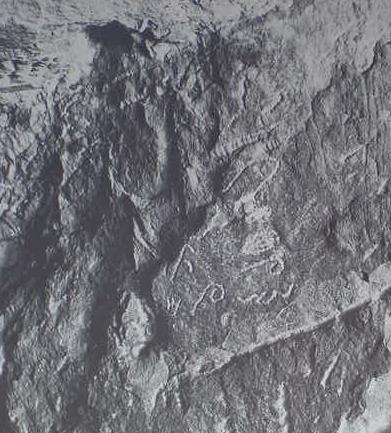


Because a corpus of Middle Bronze and Late Bronze texts from Canaan, have been identified, scholars now refer to this script as Proto-Canaanite, and its evolution has been studied thoroughly by Cross. [12] More recent study of the history of the alphabet by Joseph Naveh concurs with Cross’s views and with the dating of the Semitic-alphabetic script and the dating of the Sinai corpus to the fifteenth century. [13] The earlier date of some of the texts found within ancient Canaan suggests that this script originated in Canaan and not Sinai, as some scholars had thought.
The recent discoveries by John Darnell at Wadi el-Hôl in the western desert of Egypt have revealed a collection of rock drawings and inscriptions, including a couple of early Semitic-alphabetic texts. [14] Although they are still being studied, preliminary reports indicate that these texts may be the oldest West Semitic alphabetic writing known. The team of scholars who are examining these texts provisionally believe, based upon the orthographic comparison with Egyptian hieratic signs a date for the [sic] these Semitic texts is from early second millennium B.C. This new evidence might indicate that the Semitic alphabetic script was actually invented in Egypt by Semites at the end of the third millennium, rather than in Canaan or Sinai, a date much earlier than Semitists have thought.
The importance of Darnell’s discovery is that the Semitic alphabet originated several centuries earlier than previously thought. Furthermore, this early date allows for additional time for this script to have developed to a level that Moses could have had a hand in recording the law at Sinai. It was noted in chapter I, § III, that some early critics of the Bible denied Moses a role in authoring the Pentateuch because they thought that writing was not sufficiently developed in his day. If we place Moses in the thirteenth century, then more a half millennium separates him from the earliest known Semitic writing.
In the seventeenth and eighteenth centuries, when firsthand knowledge of ancient scripts and writing systems was negligible, scholars might be pardoned for raising questions about their availability in the second millennium B.C. But in the intervening centuries, with the decipherment of the cuneiform scripts of Mesopotamia, Syria, and Anatolia, as well as hieroglyphic and hieratic texts in Egypt, it is recognized by all linguists that writing originated toward the end of the fourth millennium B.C., and now it appears that we can possibly place the Semitic alphabet at the very end of the third millennium B.C. [16]

…] From Canaan to the end of the second millennium B.C., the Semitic alphabet spread to Arabia. In the 1920s a tablet written in the Ugaritic-cuneiform script was found at Beth-Shemesh, but only recently was it shown to be written in Old South Arabian. [25] Kenneth Kitchen, a specialist in south Arabian history, says of this find that “it reflects contact between Canaan and Saba in the field of writing at about 1200 B.C.” He adds that this discovery demonstrates that the “South-Arabian script originated as a conscious adaptation of the Late-Bronze Age Canaanite alphabetic linear script of the 13th/12th centuries B.C.” [26] If the Sabeans from distant southern Arabia had borrowed the alphabetic script from Ugarit in the Late Bronze II period, there is no reason to deny that the Israelites could have borrowed the Canaanite alphabet during the same period.

 
That’s a blunt and rude question.

Almost as if I asked you: Do you go to confession when you commit mortal sins?

It also feels like a set-up question and I don’t like being set up.

Do I align myself with the Church’s teaching and do I actively study the writings of our Popes and the documents and teachings of the Vatican and do I submit to them: yes.

Does that mean I believe in a literal Adam and Eve as the Church does?

Well read my post and read the church documents and the writings of Blessed John Paul II and Pope Benedict and you will know the answer.
Don’t get upset so quickly. There is no malice intended. The nature of debate is direct questioning. “Rude” is bit silly my friend.
 
Don’t get upset so quickly. There is no malice intended. The nature of debate is direct questioning. “Rude” is bit silly my friend.
Alright. Cool:thumbsup:

It seemed a bit like a : “so when did you stop beating your wife?” kind of question.

Yes I believe in Adam and Eve.

Science has already proved that Eve existed - we can see her lineage in our mDNA.
 
Not the one’s I was searching for but these will show probably did not originate with the Sumerians:

Sci/Tech**‘Earliest writing’ found**

The first known examples of writing may have been unearthed at an archaeological dig in Pakistan.
So-called ‘plant-like’ and ‘trident-shaped’ markings have been found on fragments of pottery dating back 5500 years.

They were found at a site called Harappa in the region where the great Harappan or Indus civilisation flourished four and a half thousand years ago.
Harappa was originally a small settlement in 3500 BC but by 2600 BC it had developed into a major urban centre.


This discovery will add to the debate about the origins of the written word.

It probably suggests that writing developed independently in at least three places - Egypt, Mesopotamia and Harappa between 3500 BC and 3100 BC.

more…
 
What do you mean by study? The memorization of text and the shoehorning of it into one;s beliefs, or do you mean following the teaching of Dei Verbum and using modern scholarship and the findings of archaeology and etc?

A fundamentalist belief in scripture is like de-tuning my motorbike. Not something I’m interested in doing and doesn’t make sense.
Why are you saying “memorization?”

I outlined many scripture verses from the NT and we were both developing reasonable questions on a previous thread but you disappeared and are now acting as if it never occurred. Catholic doctrine can be defended with scripture, right? I look at the importance of sacred scripture and I don’t embrace doctrines that the catholic church says are not permissable.
 
Status
Not open for further replies.
Back
Top