Confusion in Genesis

  • Thread starter Thread starter YoungCatholic86
  • Start date Start date
Status
Not open for further replies.
A fundamentalist reading of Scripture is not Catholic:
ewtn.com/library/CURIA/PBCINTER.HTM

The Church insists on humanity descending from one man and one woman - that is not fundamentalist interpretation, that is Church teaching.

The Church, however, does not teach that women came from man’s rib, that the creation took six days, or that evolution is a false doctrine (John Paul II described it as more than a theory) etc.
Pope John Paul II said: “more than a hypothesis.”

Go here:

scripturecatholic.com/evolution.html

And scroll down to the heading: Tradition / Church Fathers.

Peace,
Ed
 
Recently they found ancient Hebrew writing dating 3600BC is I remember. I will look for the citation.
I don’t see why this should be a problem though, but the israelites not always used the hebrew alphabet we know of, I can’t give you hard facts, but I strongly believe they used an intermediate alphabet before they developed the final hebrew, a candidate would be Proto-canaanite/proto-sinaitic. That alphabet is also an intermediate between egyptian hieroglyphs and the ** Phoenician, Hebrew, and other Canaanite** alphabets… Does that ring a bell? 🙂 And, well, Abraham was born in the City of Ur (not sure what “Ur” it was - the Babylonian Ur or some other Ur where the Chaldeans came from) but he probably was a Sumerian… 🤷
 
I don’t see why this should be a problem though, but the israelites not always used the hebrew alphabet we know of, I can’t give you hard facts, but I strongly believe they used an intermediate alphabet before they developed the final hebrew, a candidate would be Proto-canaanite/proto-sinaitic. That alphabet is also an intermediate between egyptian hieroglyphs and the ** Phoenician, Hebrew, and other Canaanite** alphabets… Does that ring a bell? 🙂 And, well, Abraham was born in the City of Ur (not sure what “Ur” it was - the Babylonian Ur or some other Ur where the Chaldeans came from) but he probably was a Sumerian… 🤷
It is thought the alphabet was Aramaic.
 
There are many stories in the Bible – for instance, parables, which are stories that Jesus ‘made up’. The stories are still true, though: they express truths about the Kingdom of God, even if the characters in them aren’t ‘real’. So, I think I would argue that Genesis is actually true – maybe parts aren’t historically accurate, but the truth of God’s revelation are in them, through and through!

Because there was a first man. That first man fell from grace. Jesus has come along, and reversed the damage done by sin; so, whether or not you call the first man “Adam”, Jesus is the counterpoint to the original sin of the original human!

Because the “actual” creation story – the one that would sound like a science lecture – doesn’t tell us everything that the Genesis creation story does. God wanted to teach us certain facts in the creation account, and the Genesis account does that. God was inspiring the telling of salvation history, not scientific history😉

What do you mean by this?
If you look at the churches listing of the parables of Jesus in the NT. They do not contain the “parable of Genesis” or the “parable of Noahs ark”.
 
Genesis as some have said can be accepted as the actual accounrt of creation by Catholics. Instant creation. The people and events are used several times in the NT gospels and epistles. Never are they explained to be symbols or representations. Wheras the actual parables of Jesus are explained to be stories, thats why they are called parables and the church does not list Genesis or other OT references as the parables of Jesus in the NT.

Can you imagine the blood of Jesus being compared to a mythological person as Abel is supposed to be? I can’t. But he is, thats why these accounts are real events. Would Jesus get so deep into telling monotheistic Jews that as a man He is God, and all the complexities that come with that, but skip over our supposed true origins? As Judge Judy would say, if it doesn’t make sense, it isn’t true."
 
Genesis as some have said can be accepted as the actual accounrt of creation by Catholics. Instant creation. The people and events are used several times in the NT gospels and epistles. Never are they explained to be symbols or representations. Wheras the actual parables of Jesus are explained to be stories, thats why they are called parables and the church does not list Genesis or other OT references as the parables of Jesus in the NT.

Can you imagine the blood of Jesus being compared to a mythological person as Abel is supposed to be? I can’t. But he is, thats why these accounts are real events. Would Jesus get so deep into telling monotheistic Jews that as a man He is God, and all the complexities that come with that, but skip over our supposed true origins? As Judge Judy would say, if it doesn’t make sense, it isn’t true."
I’m just curious. When you use the word “mythological” here, what exactly did you mean by it?
 
I’m just curious. When you use the word “mythological” here, what exactly did you mean by it?
It’s a word used by many to describe people like Noah, Cain, Abel. etc. to show they didn’t really exist. I don’t like the word much in this context but it seems to connect with those who hold the view that many of the people of the OT never actually existed. They served only as fictional characters to explain a bigger meaning or something supposedly incomprehensible to real humans.
 
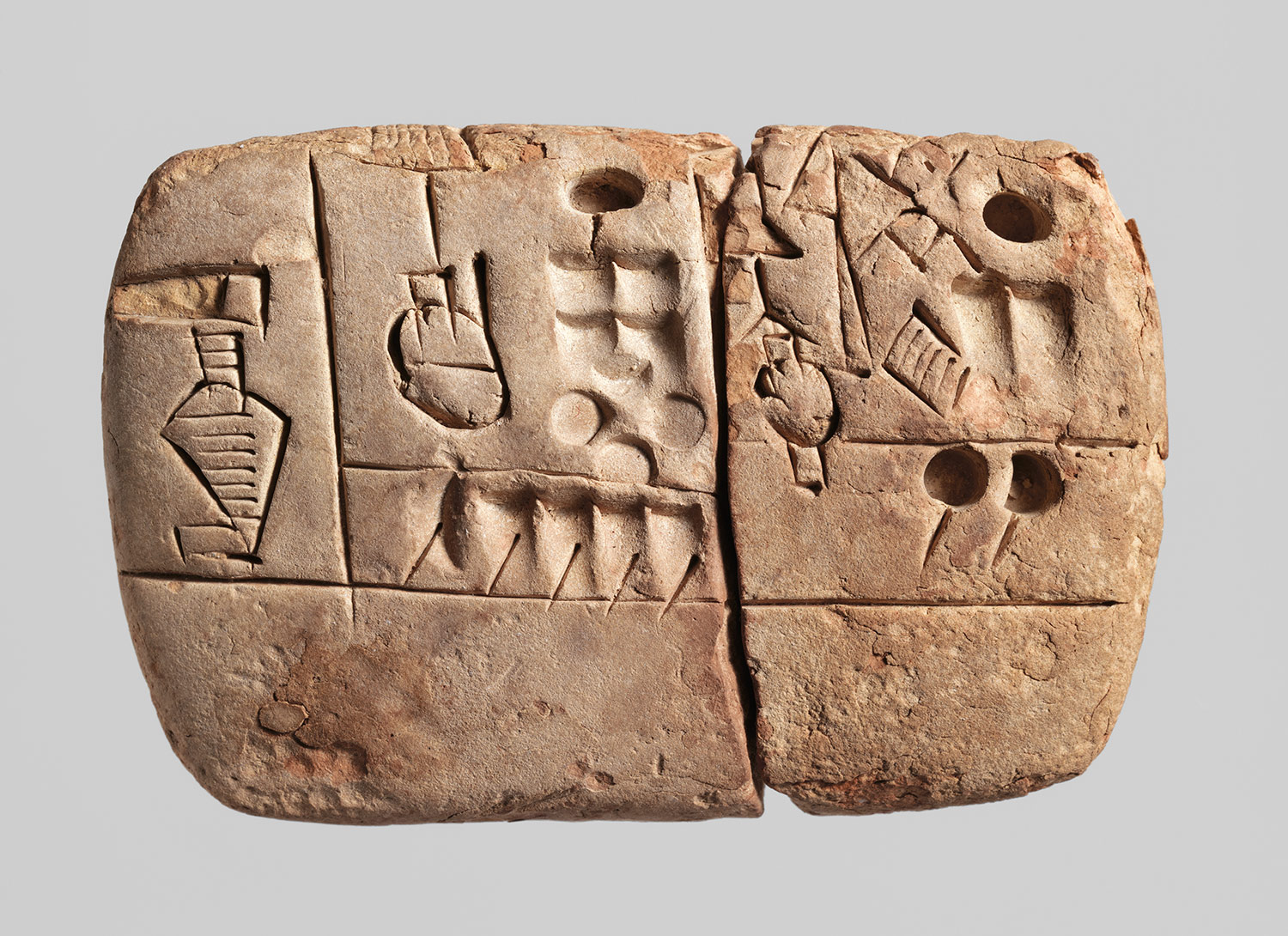
What is the earliest known date for Sumerian writing?

Hebrew writing?
The very first instance of the Sumerian script we have dates from around 3500 to 3000 BC (the so-called Proto-literate period). The first documents unequivocally written in the Sumerian language date to the 31st century, found at Jemdet Nasr (modern Iraq).


Administrative tablet, 3100-2900 BC; Jemdet Nasr period (Uruk III script)

As for Hebrew, one of the very first clear instances of the language in the archaeological record is the Gezer Calendar (10th century BC).

http://www-tc.pbs.org/wgbh/nova/bible/images/writ-04-l.jpg

There have been talks about a ceramic shard found in Khirbet Qeiyafa dating from roughly the same period being the earliest Hebrew writing yet discovered; however, given that paleo-Hebrew is just one of the different local variants of the Phoenician script used in Canaan there are still some doubts as to whether the writing really represents Hebrew at all as opposed to, say, Proto-Canaanite.

http://www.biblicalarchaeology.org/wp-content/uploads/ostracon.jpg
 
It’s a word used by many to describe people like Noah, Cain, Abel. etc. to show they didn’t really exist. I don’t like the word much in this context but it seems to connect with those who hold the view that many of the people of the OT never actually existed. They served only as fictional characters to explain a bigger meaning or something supposedly incomprehensible to real humans.
Ah, what I would like to call the ‘bastardized’ meaning of the word: as I mentioned earlier “idiotic lies only idiots would take seriously.” :cool:
 
The very first instance of the Sumerian script we have dates from around 3500 to 3000 BC (the so-called Proto-literate period). The first documents unequivocally written in the Sumerian language date to the 31st century, found at Jemdet Nasr (modern Iraq).

http://www.metmuseum.org/toah/images/h2/h2_1988.433.3.jpg
Administrative tablet, 3100-2900 BC; Jemdet Nasr period (Uruk III script)

As for Hebrew, one of the very first clear instances of the language in the archaeological record is the Gezer Calendar (10th century BC).

http://www-tc.pbs.org/wgbh/nova/bible/images/writ-04-l.jpg

There have been talks about a ceramic shard found in Khirbet Qeiyafa dating from roughly the same period being the earliest Hebrew writing yet discovered; however, given that paleo-Hebrew is just one of the different local variants of the Phoenician script used in Canaan there are still some doubts as to whether the writing really represents Hebrew at all as opposed to, say, Proto-Canaanite.

http://www.biblicalarchaeology.org/wp-content/uploads/ostracon.jpg
Couldn’t the Hebrews have been using that proto-canaanite alphabet since let’s say… the 15th B.C. century before they adopted the hebrew alphabet?
 
The evidence doesn’t demonstrate Sumerian authorship and Hebrew copying; rather, it shows that the ancient Hebrews were aware of the Sumerian mythology. Therefore, the Hebrew story was constructed in a way that teaches the inspired truth that God had in mind, while using a format that would resonate with its intended audience. This doesn’t mean “copying” in the way that you’re asserting it – that the Hebrews were simply stealing material – but rather, that their creation epic was constructed to show the superiority of their belief system over the Sumerians. When the intended audience listened to the creation epic, the correspondences would have been obvious to them, and the differences – which demonstrated the teaching points that the human author was inspired to include – would have stood out in stark relief…!
Thank you for your excellent post! I had heard this explanation many years ago.

There is always an explanation that makes perfect sense and hopefully will aid in putting to rest the doubts that some have nurtured.
 
I don’t see why this should be a problem though, but the israelites not always used the hebrew alphabet we know of, I can’t give you hard facts, but I strongly believe they used an intermediate alphabet before they developed the final hebrew, a candidate would be Proto-canaanite/proto-sinaitic. That alphabet is also an intermediate between egyptian hieroglyphs and the ** Phoenician, Hebrew, and other Canaanite** alphabets… Does that ring a bell? 🙂 And, well, Abraham was born in the City of Ur (not sure what “Ur” it was - the Babylonian Ur or some other Ur where the Chaldeans came from) but he probably was a Sumerian… 🤷
To explain it as briefly as I could.

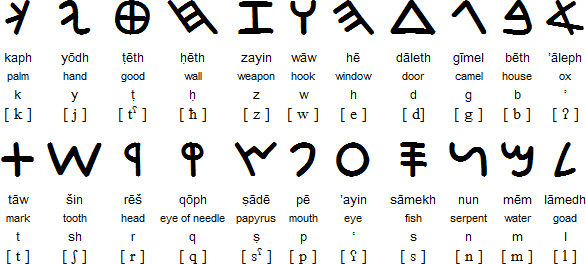
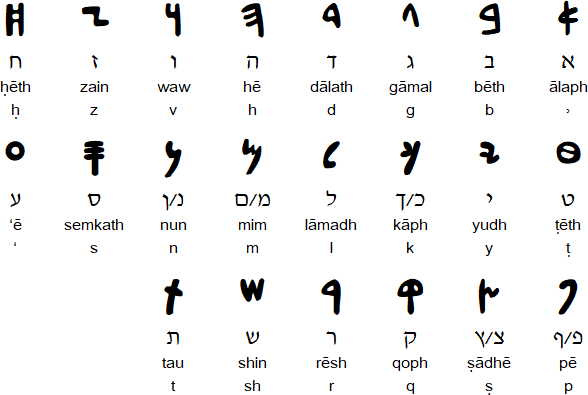
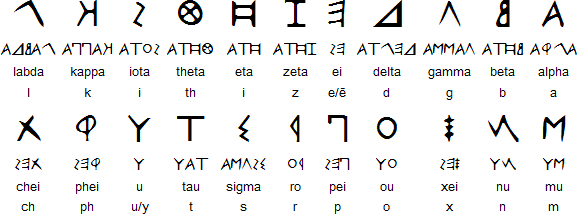
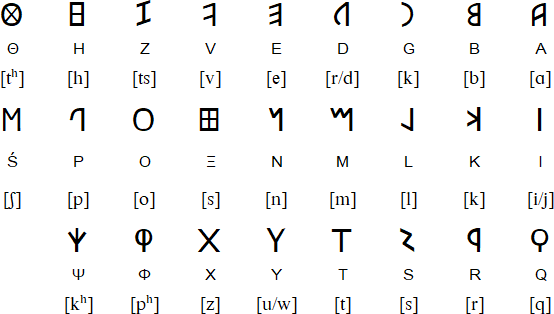
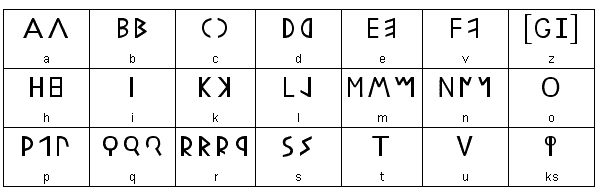
Our modern alphabet ultimately derives from the Phoenician alphabet. The reason why Phoenician became one of the most widely used writing systems is because Phoenician merchants were so influential across the Mediterranean world that their writing system was assimilated by many other cultures and evolved. Writing systems like Paleo-Hebrew (the ancestor of the Samaritan script), Aramaic (which gave us abjads like modern ‘square script’ Hebrew, Syriac, Nabataean, and Arabic), Greek, Old Italic (the ancestor of the Latin alphabet), Anatolian and Paleohispanic all started out as local variants of Phoenician.


Phoenician


Early Aramaic

http://www.typophile.com/files/hebrew-script_5538.jpg
Paleo-Hebrew (10th century BC-AD 135)

1: Gezer Calendar (10th century BC)
2: Mesha stele (Moabite; 9th century BC)
3: Siloam inscription (8th century BC)
4: 7th century BC seals
5: Early 6th century ostracon from Arad
6: 2nd century BC Leviticus fragment
7: Medieval Samaritan bookhand


Archaic Greek (Cretan)

(More comprehensive list of various archaic Greek alphabets and the evolution of Greek from Phoenician)


Archaic Etruscan


Ancient Latin (other Old Italic scripts here)

As you can see from the above, there isn’t really much difference between the different scripts.

The alphabet’s success was due in part to its phonetic nature; Phoenician was the first widely used script in which one sound was represented by one symbol, which not only allowed it to be used in multiple languages, but also allowed the common people to learn how to write. As you can infer this was highly revolutionary: the alphabet upset the long-standing status of writing systems only being learned and employed by members of the royal and religious hierarchies of society, who used writing as an instrument of power to control access to information by the larger population, thereby leading to the disintegration of many of these class divisions. Another reason factor was the maritime trading culture of Phoenician merchants, which spread the use of the script, not just in the Levant, but also into parts of North Africa and Europe.
 
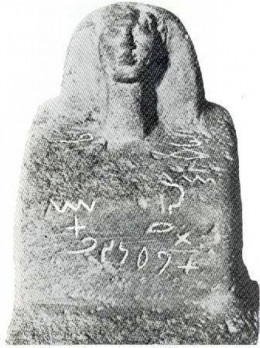
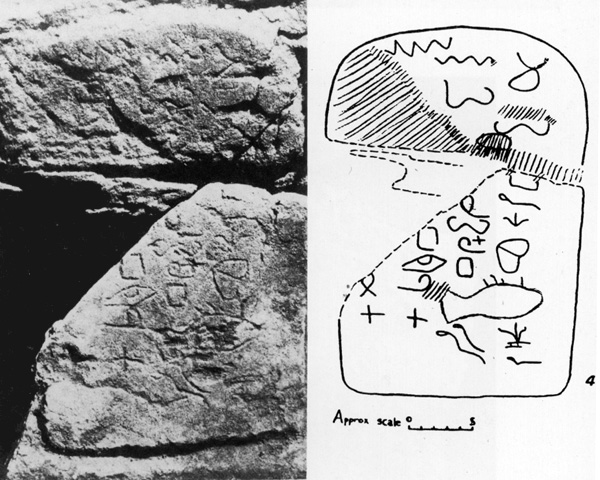
Now what about the ancestor of Phoenician? It is often thought that Phoenician is itself ultimately ultimately derived from the so-called Proto-Sinaitic script mainly attested in a very small collection of inscriptions at the turquoise mines of Serabit el-Khadim in the Sinai Peninsula. The reason for this theory is because many of the workers and officials at the mines included large numbers of so-called ‘Asiatics’, speakers of the Canaanite language that was ancestral to Phoenician and Hebrew, who had been allowed to settle the eastern Nile Delta.

According to Wikipedia:

Proto-Sinaitic is hypothesized to be an intermediate step between Egyptian hieroglyphs and the Phoenician alphabet. If this is the case, Proto-Sinaitic may be the first alphabet. According to the alphabet theory, the alphabet began with Proto-Sinaitic at the end of the Middle Bronze Age and split into the South Arabian script and the Proto-Canaanite script in the Late Bronze Age. The Proto-Canaanite script would then have evolved into Phoenician proper by 1100 BCE. [John F. Healey, *The early alphabet University of California Press, 1990, ISBN 978-0-520-07309-8, p. 18.] The theory centers on the idea that only the graphic form of the Proto-Sinaitic characters derive from Egyptian hieroglyphs, and that they were given the sound value of the first consonant of the Semitic translation of the hieroglyph. (Using a character for the first sound of its name is the acrophonic principle.) For example, the hieroglyph for pr “house” (a rectangle partially open along one side, “O1” in Gardiner’s sign list) was adopted to write Semitic /b/, after the first consonant of baytu, the Semitic word for “house”. [Goldwasser, Orly (Mar/Apr 2010). "http://www.bib-arch.org/bar/article.asp?PubID=BSBA&Volume=36&Issue=02&ArticleID=06."]How the Alphabet Was Born from Hieroglyphs”. Biblical Archaeology Review (Washington, DC: Biblical Archaeology Society) 36 (1). ISSN 0098-9444.] According to the alphabet hypothesis, the shapes of the letters would have evolved from Proto-Sinaitic forms into Phoenician forms, but the names of the letters would have remained the same.

There are also a few very short (most consisting of only a couple of letters) inscriptions in the same script found in Canaan itself, dated from around the 17th century BC, probably written by Canaanite caravaners or soldiers from Egypt. The term Proto-Canaanite is sometimes applied to instances of Proto-Sinaitic in Canaan proper, although the term is also applied to early Phoenician before some cut-off date, typically 1050 BC. The Phoenician, Hebrew, and other Canaanite dialects were largely indistinguishable before that time.


http://images2.bridgemanart.com/cgi-bin/bridgemanImage.cgi/400wm.BLP.7051040.7055475/398328.jpg

(Please Note: This uploaded content is no longer available.)
 
Couldn’t the Hebrews have been using that proto-canaanite alphabet since let’s say… the 15th B.C. century before they adopted the hebrew alphabet?
Well as I mentioned, Paleo-Hebrew is ultimately highly similar to Phoenician. And you have to remember that Hebrew and other Canaanite languages are so close that they are nigh indistinguishable; same goes for Israelite material culture, architecture and social structure when compared to their neighbors.

BTW there is also that Paleo-Hebrew inscription on 38-pound limestone boulder excavated from Tel Zayit (Zeitah).


The stone showing the carved hollow on the side opposite the inscription


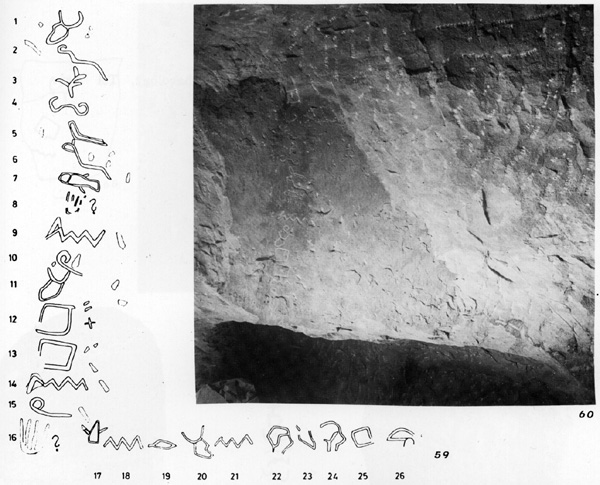
P.S. Back on Proto-Sinaitic: I think we should also mention the inscriptions found at Wadi el-Hol.

(Please Note: This uploaded content is no longer available.)

 
That said, Moses couldn’t be the author of any part of the Pentateuch, Hebrew is too young for it, and it’s easier to conclude Genesis is a corruption of Sumerian records, rather than otherwise.
 
Status
Not open for further replies.
Back
Top