Did Mary die or not?/Assumption

  • Thread starter Thread starter RileyG
  • Start date Start date
Status
Not open for further replies.
I’m not sure what the point would be. Whether Mary died or not, would not change the fact that Mary was Assumed into heaven, leaving no mortal remains. So if anything it would be an argument in favor of the Assumption. Do I understand you correctly?
I guess my point was that if there are no relics or grave then that is a point for bodily assumption before death. But again, that is speculation from the Sherlock Holmes point of view that does not consider your other points.
mdcpensive1
 
Fr. Kilian Healy wrote a book, The Assumption of Mary, several years ago and it is recently back in print. It is meticulously researched and cites many sources which claimed Mary did die. I do not want to make the argument that these are “infallible”, but only that they are “teachings”. The earliest is Origen (d. 253), then there is St. Ephrem, and St. Augustine and later St. Modestus. The belief that she died prior to the Assumption was firmly in place by the 5th century. According to Blessed John Paul II, a new belief that she did not die took root the 17th century. As to teachings in recent history we can look to our Pontiffs. It does not seem logical that Pope Pius XII, who wrote the MUN. DEUS, would have included the many statements about her death if he had not believed it. Pope Paul VI also believed and taught it. On August 15 1977, he gave a homily stating “She [Mary] died, in fact, but immediately crossed that abyss which led her to ascend to the fullness in life in the glory of God…” (from the aforementioned book). Then of course, we have the letter from John Paul II which I already posted. His letter clearly teaches that she died.

I guess I would like to see some teachings by any pope that Mary did not die. Do any such documents exist? If anyone knows of one, please provide a link.

PS. There’s no need throw around words like moronic and idiotic. All things in charity. Let’s not be clanging gongs in in our discussions.
 
I am no theologian, but I have always been taught that Mary did indeed die, and was assumed bodily into heaven after her death, and a major reason we celebrate this Feast is that it reminds us that we as Christians will also experience resurrection and glorification of our earthly bodies. It is the major example of what our hope is.

It is important to remember that although our Blessed Mother was conceived without sin and lived an immaculate life, this was because of at the power of God. She is a human as we all are, and she needed redemption as every human being ever created by God did. Her Son’s act of Redemption covered her, too, but it took place in an unique way–it occurred at the moment of her conception, which is entirely possible because God is not subject to our limitations of time and space. And it took place in that way because God needed a spotless tabernacle for His Son to be conceived in and born from. This does not mean that she could not or would not experience death–Her Son experienced death and she is not above Him. Yes, His death was necessary, but that is only because God chose to make it so. The Mother, being human in every way but sin (and not of her own innate power, but because of God) cannot be more privileged than the Son. The Son, however, is innately pure by His own power and nature, and yet He was able to experience bodily death.

The meaning of the Assumption changes significantly if we assume Mary did not experience death, in my feeble mind. Because then it becomes a feast celebrating mainly what God did for Mary, instead of also celebrating the promise of Resurrection for all mankind. Jesus promised us the Resurrection from the dead, and in raising His Mother and assuming her incorrupt body into heaven, He has given us example that His promise is real. This will happen to all of us, even though our bodies suffer corruption because of original sin, and hers did not because she had been redeemed and freed from sin at her conception. We can look to the Mother of God for realization of the promises made by Christ to all his followers.
 
Wiki. . .There is a PURPORTED grave.
Whether it is the true grave or not, why would they be looking for a grave if the early Fathers did not believe she died? Why is the icon of the Dormition always showing Mary in a tomb or a deathbed?
 
Good question :compcoff:
It is.

As I said earlier, if I am shown authentic Church teaching that explicitly states that Mary actually died, I have no problem with it whatsoever.

I am still in the process of determining whether a ‘snip’ from M.D. would be that authentic teaching because (although I thank the poster for the snip) it is only a partial extract from the entire document and, naturally, it’s an English translation from the Latin.

Again, I have no problem whatsoever in believing indeed that Mary could have chosen to die (though as we know, the wages of sin is death and she did not sin, and as we also know, there were cases of those ‘assumed’ into heaven without bodily death so there is certainly a precedent) and of course we have no ‘eyewitness’ reports that have been given the status of 'oral tradition that passes into the Deposit of Faith. I mean, the names of Mary’s parents are never mentioned in the Bible, but Sacred Tradition states their names were Anne and Joachim, and the Church instituted THOSE NAMES, AS Mary’s PARENTS, into the calendar of saints.

HOWEVER, I also have no problem with those who believe that she might not have suffered physical death --that she might have been, for example, ‘caught up’ at the EXACT point where she was about to take her last breath —because that certainly is not contradictory to any teaching. If she was about to take her last breath and then was assumed, she surely ‘completed her earthly course’, she was certainly ill to the ‘point of death’, and certainly it would APPEAR that she had died and this would explain the ‘testimony’ of those who saw her last breath, and then saw her buried and then saw an empty tomb.

Remember, GOD IS OUTSIDE OF TIME. If He took Mary to Himself at the point of her last second of existence on earth, there could be a ‘time frame’ here in the TEMPORAL WORLD where she appeared to be dead, but in heaven the ‘time’ between God’s taking her soul and body would have instantaneous.

Ever see the old musical ‘Carousel’ where the character Billy Bigelow is killed, and on going to ‘the pearly gates’ demands of the gatekeeper to see ‘the highest judge’? in the course of a few moments of dialogue he is told he can see the baby daughter whose imminent birth was the cause of his attempted robbery and death but that “She’s not so little. She’s 15 years old now”.

15 minutes in heaven was 15 years that passed on earth. So an ‘instant’ of death and assumption could have been noted in the passage of time on earth as a day, or two, or three, and yet it STILL could have been God taking her to heaven body and soul BEFORE she died. We really do not know anything about how ‘time’ passes in heaven.

So I think it is still quite reasonable to say that Mary MAY have suffered a full physical death, or she may not have, but still APPEARED to die.

Again, we really cannot know with 100% certitude that her body did fully die, or that she merely appeared to stop breathing etc., perhaps in a trance of some kind, for some period, while in heaven ‘instantly’ being assumed body and soul.

Like the old joke:

God: To me a penny is like a million dollars, and 10,000 years is like a minute.

Man: God, may I have a penny?

God: In a minute.

 
Whether it is the true grave or not, why would they be looking for a grave if the early Fathers did not believe she died? Why is the icon of the Dormition always showing Mary in a tomb or a deathbed?
Because she may have appeared to have died. (Heck, just consider the recent headlines about a newborn infant who was declared dead at birth, taken to the morgue for TWELVE HOURS, whose parents came to view her one last time and SHE STARTED TO CRY. . )

And because if she were growing older, people might (as Joseph of Arimathea had done) have started building a tomb for her when she did die, so that her bones wouldn’t be desecrated by the Romans. Probably it was planned that she would be ‘slipped in’ with some family who were not known to be Christians.

And then after she ‘disappeared’, well, the tomb was still MEANT to have her, and the oral tradition of this being the ‘grave of the Virgin’ could have been passed on quite logically.
 
I am no theologian
The following statement sure made you sound like one 😉
The meaning of the Assumption changes significantly if we assume Mary did not experience death, in my feeble mind. Because then it becomes a feast celebrating mainly what God did for Mary, instead of also celebrating the promise of Resurrection for all mankind. Jesus promised us the Resurrection from the dead, and in raising His Mother and assuming her incorrupt body into heaven, He has given us example that His promise is real. This will happen to all of us, even though our bodies suffer corruption because of original sin, and hers did not because she had been redeemed and freed from sin at her conception. We can look to the Mother of God for realization of the promises made by Christ to all his followers.
That is why I said earlier, ano no one cared, that we should examine the significance of the passing away of Mary. Every Feast we celebrate in the Church is not just a celebration of an event. Everything God did was done for a purpose. Even the turning of water into wine wasn’t just a wedding present or a random act of display of power. Every action, every event was deliberately set-up by God not only to show us His power, but also that there are symbolisms within every event that would point us to deeper truths. That goes the same for the Dormition and Assumption. Why should Mary not die? How will she get her glorified body? And Christ already conquered death, why is it wrong for the Theotokos to pass away from this life?
 
Because she may have appeared to have died. (Heck, just consider the recent headlines about a newborn infant who was declared dead at birth, taken to the morgue for TWELVE HOURS, whose parents came to view her one last time and SHE STARTED TO CRY. . )

And because if she were growing older, people might (as Joseph of Arimathea had done) have started building a tomb for her when she did die, so that her bones wouldn’t be desecrated by the Romans. Probably it was planned that she would be ‘slipped in’ with some family who were not known to be Christians.

And then after she ‘disappeared’, well, the tomb was still MEANT to have her, and the oral tradition of this being the ‘grave of the Virgin’ could have been passed on quite logically.
Can you point me to a First Millennium saint, monk, bishop, Church Father, etc. who taught that Mary did not die?
 
It is not clear at all. The entire thrust of MD is the Assumption of Mary and not her death. You should read the document properly. Its about the Assumption.
Referencing one Church Father who also believed she died before being assumed does not make it Sacred Tradition. Even that reference is to focus on the Assumption. How many early Church Fathers were there and how many said Mary died before being assumed.
MD is not about Mary’s death and it most certainly does not constitute a Church teaching that Mary died.
Catholics are free to believe Mary died or not.
Every reference from the document says she died, not just one, and some of them were liturgical statements. It mentions several times that she died, and not once does it indicate that she might not have.
 
Can you point me to a First Millennium saint, monk, bishop, Church Father, etc. who taught that Mary did not die?
Well, it’s like this.

Plenty of first millennium saints, etc. either said nobody about whether she actually died or not --IOW, they didn’t address the topic at all, which doesn’t mean that they didn’t have ideas abou ti. . .

and plenty of first millennium bishops, Church Fathers etc. taught other things which actually turned out to be not true, because they weren’t teaching infallibly. Consider Origin, and consider even St Thomas Aquinas, who is SECOND century millennium, who actually taught that Mary might have committed sin. Just because he’s a saint doesn’t mean everything he says is right.

BUT. . .

It is entirely possible. It makes theological sense.

There seems to be a lot of evidence that she did die, Again, I have no problem with believing that if the Church teaches it. More and more it seems as though this is the real deal.

This is definitely something that I will pray over and research very thoroughly.

I thank you VERY MUCH actually for bringing this to my attention. The last thing I want to do is disseminate wrong information. I want to be sure that what I believe is true really is true. Nothing matters more than the truth.
 
from Western tradition …

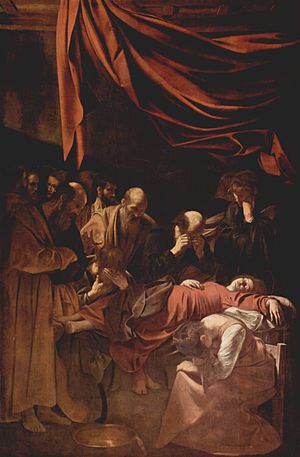
The Death of the Virgin Mary
Caravaggio (1606)

 
from Irenikon (14 Aug 2012)
Many Catholics (at least in the West) are under the impression that the Latin (Roman) Church favors the opinion that the Mother of God did not die, but was assumed at the end of her life without suffering the separation of body and soul; while the Eastern Church favors the opinion that the Blessed Virgin Mary did die, and that they refer to this death as a “dormition”. In truth, although there are certain modern westerners who (quite rashly) maintain that the Virgin did not die, the Latin tradition has generally been even stronger than that of the East in affirming that our Lady suffered death: While the East speaks of “the falling asleep (dormition) of the Theotokos”, the West has traditionally favored the more blunt “the death of the Virgin Mary”.
The Latin tradition is so strongly in favor of the doctrine that our Lady suffered death before her Assumption that this was very nearly adopted at the Second Vatican Council after being promoted especially by mariologists of the Roman school.
On the less-than-reliable web source Wikipedia (as of July 2011), we find this same confusion - as though the Latin Church was not just as strong as the East in affirming the death of the Virgin Mary: “The Orthodox Church teaches that Mary died a natural death, like any human being. …] Roman Catholic teaching holds that Mary was ‘assumed’ into heaven in bodily form. Some Catholics agree with the Orthodox that this happened after Mary’s death, while some hold that she did not experience death. Pope Pius XII, in his Apostolic constitution, Munificentissimus Deus (1950), which dogmatically defined the Assumption, left open the question.”
We shall briefly consider at least one reason as to why this confusion has crept into popular thinking. [For a discussion of whither the Blessed Mother was assumed, please consider this article, or this one.]
Dormition vs. Death

It seems that the Eastern “Dormition” tradition entails the notion of death. Certainly, the Eastern Fathers do not use dormition to deny bodily death. However, it is worth noting that the Eastern theologians generally refrain from speaking directly of “death”, but prefer the more metaphorical language of “falling asleep”. Perhaps they mean nothing different from the Latins, I do not know – What I do know is that the East does not generally speak of “The Death of the Virgin Mary”.
The West, on the other hand, has traditionally spoken first of our Lady’s death and then of her Assumption. The Latins emphasize the distinction between the two events, which the Greeks tend to collapse under the title “Dormition”. The Latins are clear: First, the Mother of God died; then, she was resurrected and assumed into heaven. Evidence of this language can be found in the Encyclical of Pius XII, excerpts of which are reproduced below.
A point of confusion: Artistic depictions in the West, Mary was alive at the Assumption
“The Assumption”, Annibale Carracci of the Western tradition

It seems that a major factor which has led to the common misconception – as though the Latin Church favors the opinion that our Lady did not die, while the East presumes that she did suffer death – is the representations of the Assumption in Western art.
When the Western artists depict the Assumption of Mary, they depict her as being alive – whereas the Byzantine iconography generally shows our Lady “sleeping” on earth while her soul is with Christ in heaven. From this fact (that the Latin art shows the Virgin alive at the Assumption), some have presumed that the Western tradition maintains that our Lady did not die, but was assumed directly. However, this is plainly not the case.
The Latin tradition (as I mentioned above) stressed more clearly the two distinct events: First, our Lady died; then, she was resurrected and assumed into heaven. Therefore, it is entirely natural that the Western depictions of the Assumption would show our Lady alive while being taken up – this does not imply that she did not die, but only that she had been raised before being assumed.
It would be incorrect to state that Mary was still alive when she was assumed; rather, the Latin tradition maintains that Mary was again restored to life when she was assumed. [This is taught by the ordinary Magisterium of the Church, which speaks of Mary’s resurrection.]
“The Dormition of the Theotokos”
in the Eastern tradition of Theophanes the Greek
In any case, it is at least a sententia certa (a certain teaching) that our Lady died before being raised and assumed into heaven. This is the clear and explicit tradition of the West and is maintained in a slightly less-clear (and more metaphorical) manner also in the East.
 
So in the East, is it believed that after she “fell asleep”, she was resurrected and then assumed into heaven?
On the third day, yes - resurrected and assumed - uncorrupted body and soul - into heaven.

The point of the article was that the tradition of the West spoke more strongly of the death than in the East, where the more metaphorical language of “falling asleep” has been long embraced.
 
On the third day, yes - resurrected and assumed - uncorrupted body and soul - into heaven.

The point of the article was that the tradition of the West spoke more strongly of the death than in the East, where the more metaphorical language of “falling asleep” has been long embraced.
Our parochial vicar at the vigil mass this evening said there is no mandated teaching and very nicely presented both views, that some believe this way, some believe that way and that you can believe either way. He seemed to lean more toward her not dying because he eluded to Elijah and said that “if he can go to heaven without dying how much more the Mother of God?” but he didn’t make a commitment. I don’t know if it’s our parish or our region/where we live but every single person I ask insists that Mary did not die. Maybe it’s a church belief, it’s a small and very religious parish. I have only been back in the faith for a little over a year. There must be substantial doubt somewhere or the Church would have made a statement on this by now.

I hold firm that she didn’t die and I will say the vigil mass was beautiful.

Dear Mother,
Pray for us.
 
Status
Not open for further replies.
Back
Top