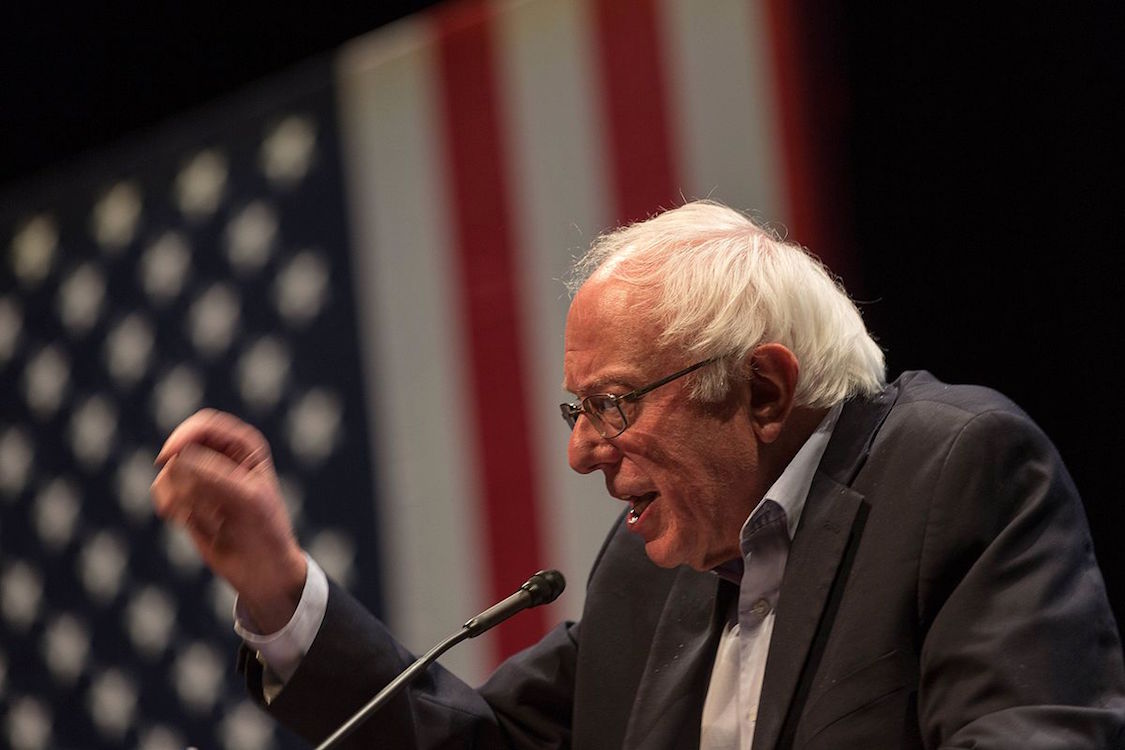
Do Democrats Know How Radical Bernie Sanders' 'Medicare For All' Plan Is?

  • Thread starter Thread starter MonteRCMS
  • Start date Start date
Status
Not open for further replies.
If an American gets shot and they don’t have insurance, will they receive the same medical care as an American who does have insurance?
Laws in most places require treatment.

However, how the bill is treated and the result on the credit of the wounded will vary substantially.
Revs up the poverty cycle
 
Last edited:
The democrats want abortions paid for under a medicare for all ;program. That means we would be paying for the slaughtyer of the innocent. And probably would be paying for “Sex” change operations…but it would also probably ration care…so grandma won’t get the care she needs…but she can have pain pill.

This is from the UK, and they have universal, single payer health care, right?


So, a patient can’t be fed food and water in the UK…if they are severely disabled, like a traumatic brain injury. They can be starved to death, no court order needed.

Medicare for all would add more $ to our debt in the USA. We don’t have as many workers due to 58 million abortions since 1973.
 
Many primary docs are switching to this model because they are simply burned out dealing with insurance companies, the government, and medical bureaucracies. They prefer to interact with patients and this allows them to do that. They also provide cheaper pricing and better care to the patients.
The article that you linked to was in no way cheaper than a traditional medical practice. My insurance company pays my provider about $55 a visit. If I had to pay cash, I could probably negotiate a rate of $75 or so. If I visited the physician four times in a year that would be a lot. The practice you linked to would charge me $780 a year. That is no way to save money.
 
Long term view: health care once took just 3 to 5% of GDP as recently as the 1960’s. We’ve gone from that to nearly 20%. Very little of that increase has actually added to our care; it has mostly gone to every party that has been able to be cronies with the government in order to financialize our care as a way of stripping us of our assets. Is it any wonder people have less money to spend on our economy when they have to spend more on health care?

Now single payer advocates claim that we will no longer have these costs on our own bottom line. But that percentage of GDP isn’t going away anytime soon, it has to be paid for from somewhere. Hence our taxes must rise in proportion to what the government would potentially have to cover. Top income tax rates in the UK go up to 50%. Plus 11% for National Insurance which is their version of our Social Security. They don’t have nearly our level of standard deductions so it’s typical for their high earners to pay 61% of their income. But the NHS still has severe cost control issues which are papered over in any discussion held by single payer advocates.
 
Depends. One would expect that there will be an increase in taxes of some kind to pay for them. It might be sellable if insurance premiums are cut at the same time.
 
The article that you linked to was in no way cheaper than a traditional medical practice. My insurance company pays my provider about $55 a visit. If I had to pay cash, I could probably negotiate a rate of $75 or so. If I visited the physician four times in a year that would be a lot. The practice you linked to would charge me $780 a year. That is no way to save money.
It doesn’t save the patients money currently because most of them keep their insurance plans to pay for hospital visits and specialty care. If they could find an insurance plan that took into account that there will be no claims ever for primary care, that would be great. Some enterprising insurance group should target a plan specifically for such patients. More on DPC from Business Insider here.
 
It doesn’t save the patients money currently because most of them keep their insurance plans to pay for hospital visits and specialty care. If they could find an insurance plan that took into account that there will be no claims ever for primary care, that would be great. Some enterprising insurance group should target a plan specifically for such patients. More on DPC from Business Insider here.
Suppose I am uninsured. In my previous example, I would pay $300 on a heavy use year. Using this woman’s practice, I would pay $780. How does that save me money? This is not a money saving device, it is a boutique healthcare plan for those who are willing to pay more for better services.
 
You think the electric bills of 10 rural people will ever cover the construction and maintenance of the lines to serve them? Of course not. You rural folks have electricity due to yet another form of collectivization that you’re unaware of…
A good deal of rural electrification was paid for by the government, but a lot of it was paid for by the consumers. The rural electric cooperatives in this part of the country all required “buying in” to the cooperative for initial capitalization.
Nowadays, of course, if you are in the country and want to build a new house or barn or well and connect to the electric line, you pay for it yourself, 100%.

It’s not as “collectivist” as some think, and never was.
 
Suppose I am uninsured. In my previous example, I would pay $300 on a heavy use year. Using this woman’s practice, I would pay $780. How does that save me money? This is not a money saving device, it is a boutique healthcare plan for those who are willing to pay more for better services.
You do have a point, but I’m not quite sure how it fits in.

I am confident that I pay less than $100 year for medical care, including what insurance pays. If I pay this doctor $780 for unlimited care, I’m going to lose money because I won’t use her care except perhaps to beat back an occasional strep infection, which isn’t even every year. If I have some really drastic condition, it will be off to the specialist with me, and he isn’t part of the $780 deal.

Her deal would be good, I guess, for someone who has a chronic condition that requires frequent checking and adjustment, but never a crisis situation, because she’s not going to deal with that.

I’m still put to wonder what costs would be like nowadays if a person was allowed to buy catastrophic coverage and just save for the routine stuff. I think for most people, it would be massively less than what Obamacare costs.

Just as an additional comment, looks like McCain is going to vote “no”, along with Murkowski and Paul. If so, that’s game over and we’re going to get killed by the cost of Obamacare in 2018.
 
Last edited:
The democrats want abortions paid for under a medicare for all ;program. That means we would be paying for the slaughtyer of the innocent. And probably would be paying for “Sex” change operations…but it would also probably ration care…so grandma won’t get the care she needs…but she can have pain pill.
My private insurance, paid for in large part by my employer, but also in part by me, also pays for abortions and sex reassignment. I don’t hear anyone saying I should not participate in the private insurance system because it pays for abortions.

Am I paying for the slaughter of the innocent? Must I and my wife and children decline to participate in this plan?
 
This is from the UK, and they have universal, single payer health care, right?

http://www.lifenews.com/2017/09/21/...bled-patients-to-death-without-a-court-order/

So, a patient can’t be fed food and water in the UK…if they are severely disabled, like a traumatic brain injury. They can be starved to death, no court order needed.
Great Britain has national health care. That’s very different from what Sanders and the co-sponsors of his bill are proposing, which is national health insurance.
 
Great Britain has national health care. That’s very different from what Sanders and the co-sponsors of his bill are proposing, which is national health insurance.
Seems like a distinction without a difference to me. If the government pays the insurance (for some) and dictates the coverages, all the insurance companies are doing is re-allocating cost to those who aren’t subsidized and administering the program.
 
Just as an additional comment, looks like McCain is going to vote “no”, along with Murkowski and Paul. If so, that’s game over and we’re going to get killed by the cost of Obamacare in 2018.
RIght. I can see McConnell just doing nothing for the next 8 days. They’ll be at least tempted to throw all kinds of money at Maine and Alaska. Watch.
 
RIght. I can see McConnell just doing nothing for the next 8 days. They’ll be at least tempted to throw all kinds of money at Maine and Alaska. Watch.
It will be tried, but I don’t think Murkowski or Collins, either one, is really a Republican. Rand Paul is just a crank, and so is McCain. So I’m not sure it will do any good to throw money at Me and Ak. Hope it works, but that’s a pretty uphill climb, no matter what.
 
Great Britain has national health care. That’s very different from what Sanders and the co-sponsors of his bill are proposing, which is national health insurance.

I bought my own health insurance. My mom found a lady that could help us navigate the marketplace. I can pay for it myself and my costs have been reasonable.

I do NOT want government health insurance. Where does it say the government must provide EVERYTHING for everyone? It doesn’t!
 
Insurance companies would in many cases not be bureaucratic. It just adds to their cost and operations load.
 
The same federal government that runs Medicaid and Medicare – both of which lose an estimated $70 billion to $110 billion in tax dollars annually to fraud – would be the sole option for your family’s health insurance.

Not surprisingly, 2/3 of Democrats said they are in favor of having the government completely take over our health insurance system – a figure that is up from 54 percent in April. This shows the growing influence that Bernie Sanders, who recently introduced a “Medicare For All” bill, continues to exert over the Democratic Party. What’s truly alarming though is that even 33 percent of Republicans polled said they support a single-payer health care system.

These results suggest that in the midst of arguing over Obamacare and the merits of the various “repeal and replace” bills, some basic truths have been forgotten.

The most important principle to understand in the debate over health care is that government-dominated systems lead to scarcity and rationing. It is why we see the same food lines and starvation in Venezuela today that we saw last century in Soviet-run countries.

In single-payer health care systems, scarcity and rationing often take the form of long wait times. The Red Cross recently declared that Great Britain, which has a single-payer system, faced a “humanitarian crisis” of hospital bed and doctor shortages. Two people recently died at a British hospital after waiting more than 30 hours in a hospital hallway for treatment.

If this situation sounds familiar, it is because the U.S. Department of Veterans Affairs Health Administration, another government-run health care system, faces a similar crisis of long wait times due to years of bureaucratic inefficiency. (Fortunately, under the leadership of President Trump and VA Secretary Shulkin, this problem is being fixed, in part by offering veterans more non-government health care provider options.)

Other times, scarcity and rationing take the form of government refusing to pay for treatments that you and your doctor think are best for your health.

In Britain’s case, the government – not the patient or doctor – has the final say on what treatments are covered. According to National Health Service Constitution for England:

Ultimately, single-payer health care suffers from the same problem that Margaret Thatcher identified as the issue with all of socialism: “Eventually you run out of other people’s money.”

In 2014, the State of Vermont tried to pass a single-payer system. The state that gave us Senator Sanders was meant to be the liberal-torchbearer that would show the nation how great a government-run system could be.

Then, reality set in.

Democratic Governor Peter Shumlin realized he would have to raise the state’s payroll tax to 11.5 percent and set premiums at nearly 10 percent of people’s income.

Three years after Vermont’s single-payer effort fell apart, California’s State Senate passed a single-payer health care bill in June of this year.

 
I can’t believe you said that. One of the criticisms of the ACA was that it favored Nebraska, due to some last minute finagling. Now we’re saying we can tolerate special funding of a couple of states just to get their vote, no matter how much it takes? It sort of defeats the purpose of the bill which is supposed to save money. Not to mention undermining the 10th Amendment. It’s not surprising McCain voted against this pork.

As for who is a Republican doesn’t really matter. Murkowski (who ran as a write-in), Paul, McCain, Collins, etc all caucus with the Republicans.
 
Last edited:
Status
Not open for further replies.
Back
Top