Food Price Riots Popping Up Around The World

  • Thread starter Thread starter ribozyme
  • Start date Start date
Status
Not open for further replies.
So what are we waiting for? We should have started building them twenty years ago, instead of assuming oil would last forever.
We have not built a nuclear reactor in more than 30 years – nor have we built a new oil refinery in that time.

In the case of nuclear power, the Federal Regulatory Commission has stated they will not issue licenses for new plants until a safe storage site for nuclear waste is available. The chosen site is Yucca Mountain in Nevada, but politicians and “environmentalists” have keept it from opening with a blizzard of lawsuits and political maneuvering (Harry Reid, the Senior Senator from Nevada, has declared it will never open.)

We have plenty of oil – in the Arctic, off the Atlantic and Pacific coasts and off the coast of Florida – and can’t drill in any of those places (although ironically, the Chinese can drill off the coast of Florida – with a license from Cuba.)
 
We have not built a nuclear reactor in more than 30 years – nor have we built a new oil refinery in that time.

In the case of nuclear power, the Federal Regulatory Commission has stated they will not issue licenses for new plants until a safe storage site for nuclear waste is available. The chosen site is Yucca Mountain in Nevada, but politicians and “environmentalists” have keept it from opening with a blizzard of lawsuits and political maneuvering (Harry Reid, the Senior Senator from Nevada, has declared it will never open.)

We have plenty of oil – in the Arctic, off the Atlantic and Pacific coasts and off the coast of Florida – and can’t drill in any of those places (although ironically, the Chinese can drill off the coast of Florida – with a license from Cuba.)
Correct. It is the obstructionism of Secular Relativist Liberalism (which is just a form of Marxism) that is causing many of the woes in today’s world. Their micromanagement via over-regulation is why we are in this mess. Only when they are eliminated from the public scene will things improve.
 
Is the United States the ONLY country on Earth that is deliberately minimizing its development of oil, natural gas and nuclear power?

Seems that the only countries failing at energy production would be those that have command economies (which tend … in many cases … to be corrupt).

But the U.S. seems to stand alone in denying itself its own natural resources and nuclear technology.
 
One thing that also has not been mentioned is that yields of crops has been improving through bio-engineering. This is and will continue to increase supplies of food being produced in the same amount of land.
I live Iiterally in the middle of a cornfield in the largest corn producing region on planet earth. Here in the midwest corn is being planted not for food but for FUEL. Greed is setting in at record pace here in Iowa and Farmers are moving away from beans to plant corn for ethanol. People are planting all the way up to fencerows becuase of the price of Corn (5 bucks a bushel) it is going to get much much worse. As our grain is being sold for ethanol you will see food prices skyrocket. Corn growers are becoming the new verion of corporate oil. 35 feet from my back deck is a 600 acres of cropland that will be planted for corn the 3rd year in a row. Crop rotation has gone out the window due to the profits in growing corn. Ethanol produced from corn is NOT the answer. Corn goes into almost EVERYTHING foodwise. Beef producers are really noticing the effects of smaller grain supplies for feed. People are turning their pastures into cropland…its getting uglier every spring. Brace yourselves for VERY high food prices. Also brace yourselves for some famine in Africa. ALOT of the grain that was going into the stomachs of hungry children in Africa is now going to go into the gas tanks of your cars.
 
So why aren’t we drilling for oil in our UNTAPPED oil-rich country like the Gulf of Mexico, California, ND, SD, ANWR, offshore of Florida (MEANWHILE Red China is digging offshore of Florida).
Because the environmentalists don’t want us to – and have been able to erect an impenetrable thicket of laws which allow them to stop all such attempts.

The same is true of nuclear power. France is about 80% nuclear, and the United States – which invented nuclear power – is only 17%. We haven’t built a nuclear reactor in this country in over 30 years.
 
Is the United States the ONLY country on Earth that is deliberately minimizing its development of oil, natural gas and nuclear power?

Seems that the only countries failing at energy production would be those that have command economies (which tend … in many cases … to be corrupt).

But the U.S. seems to stand alone in denying itself its own natural resources and nuclear technology.
That is because the Secular Relatives want to force their “victimization” on the populace as a whole. They believe they are victims, this everyone else needs to be punished and made victims. They are a dangerous lot.
 
(1) Who said anything about preemptive killing?

(2) Three times today I’d told you “abstention” and “self-control” – you’re the one who keeps mentioning contraception, not me.

snip…

God helps those who help themselves by waking up to the reality of an over-consuming human population crowding out every ecosystem on the globe. Saving remnants of the project of civilization will take a huge effort on many fronts, and population is only one of them, albeit a crucial one.
I’ve asked you for details of your plan for ZPG, and your response is “self control” and “abstention”. You know that despite previous efforts, this hasn’t worked, so I took your remarks as tongue in cheek.

Many of those who agree with you on the need for ZPG would indeed use abortion, forced sterilization, euthanasia, and infanticide to get to ZPG. And who do you pick to kill - well, the defective people of course. Survival of the fittest, after all is the name of the game. But these methods would turn off a great number of people, so the push that I’ve seen elsewhere is for artificial contraception, which as I’ve noted above actually opens the door for the other methods anyway. It leads to the culture of death described by abortion, etc. The Church teaches that this is wrong.

Funny you should mention the Titanic. Assuming the movie was correct in this respect, it shows the results of hysterical overreactions and premature decisions. The lifeboats had been lowered, but there were people in the water. Those in the boats refused to help those in the water for fear that they’d be swamped (overpopulation in the lifeboats). By the time they became non-hysterical, and decided to haul some folks out of the freezing water, those folks were dead. And at the end, the lifeboats remained half empty while hundreds died in the water.

God clearly told us to go forth and multiply. God is the author of life and death. There are some places where mankind is not supposed to rely totally on ourselves, but to humbly call on God for help. It would seem to me that this is one of those cases. And in the meantime, don’t do exactly the opposite of what God told us to do.
 
“I’ve asked you for details of your plan for ZPG, and your response is “self control” and “abstention”. You know that despite previous efforts, this hasn’t worked, so I took your remarks as tongue in cheek.”
Does that imply it could not work?
 
:rotfl: Okay…no offense, Doug50, but this chart is a joke. You can play with data quite a lot if you adjust the scales, and that is just what is done in this chart. Rather than going with an x-axis from 0 AD to 2000+AD at 200 year increments, try changing it to an 1800AD to 2000+AD axis…not so dramatic.

While there is a link between oil production and population, there is a stronger link between medical advances and population. We are living longer. Does oil help? Sure. But, it just makes your argument ridiculous to use a chart like that.
Wrong. As I said cheap energy is what created the wealth making it possible for medical advances…but you still have to eat and that is far larger in determining population capacity

If that chart that you thought was so funny is not correlated then is seems to me if you don’t believe it is then shouldn’t you attempt to disprove the hypothesis.
These are all valid arguments and they don’t share your humor:
World Nuclear Association
world-nuclear.org/education/whyu.htm
Population
Together with this increasing energy consumption, it has been possible for the world to sustain an ever increasing population. At present, however, three quarters of world energy production is consumed by the one quarter of the world’s population living in the industrialised countries.

Continuing rapid growth is foreseen in the near future, with the world’s population rising from the present 6 billion to about 8 billion over the next 25 years, and perhaps 10 billion later in the century. Most of the population growth will be in the developing countries, which is where more than three quarters of the world’s people already live.

Such a population increase will have a dramatic impact on energy demand, at least doubling it by 2050, even if the developed countries adopt more effective energy conservation policies so that their energy consumption does not increase at all over that period.

energybulletin.net/34120.html

http://www.wirralgreenparty.org/images/PC_talk_07_Jun_Slide3.JPG

paulchefurka.ca/PopulationFoodEnergy.html
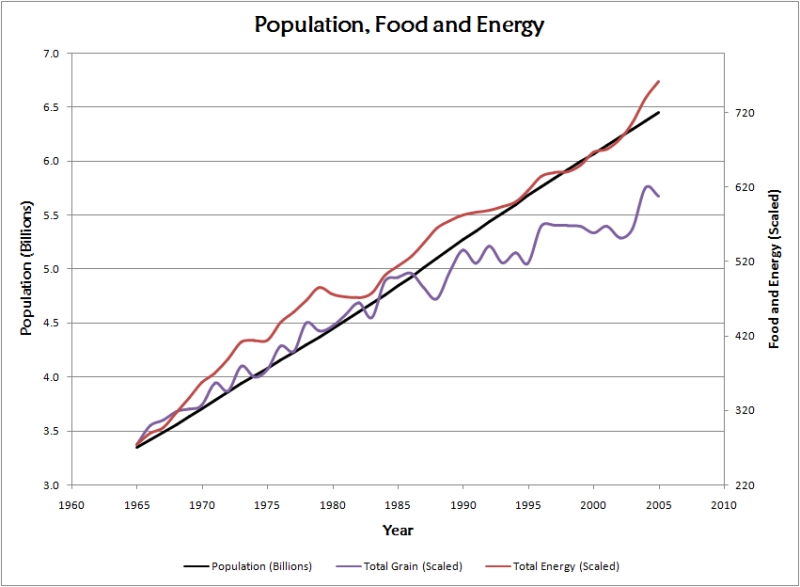
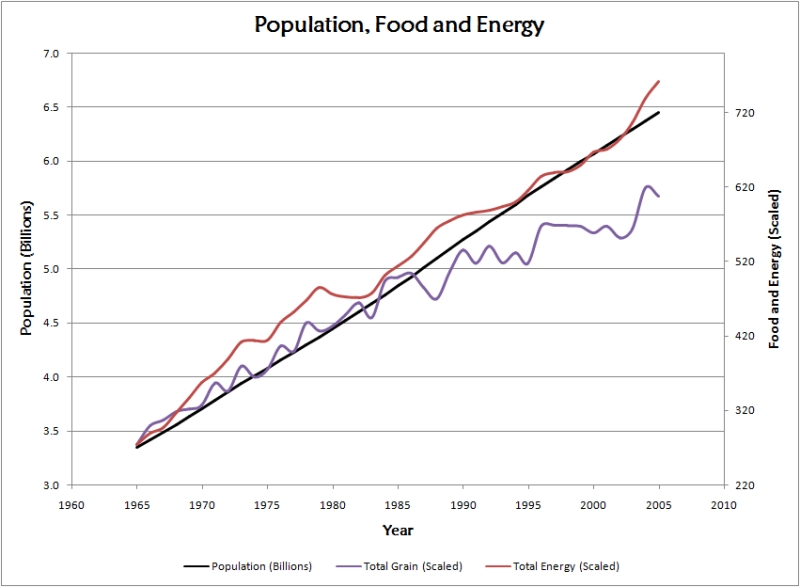
A common assumption among population analysts is that food availability is the main driver of population growth. In fact, most will go so far as to define the carrying capacity of an environment primarily in terms of the food that it offers to the population under consideration. I have two major problems with this approach to population and carrying capacity, as outlined below.

My first objection is that this approach treats carrying capacity as a variable, and the expansion of agriculture as an increase in carrying capacity. This requires a definition of carrying capacity I do not subscribe to. The definition I am most comfortable with is, “The population level that an environment can support over the long term without damaging the ecology of the environment”. An expansion of agriculture does not meet this definition because putting new land under the plow or increasing the production of existing farmland affects habitat, biodiversity, water levels and soil fertility among many environmental factors. In effect the expansion of agriculture requires that we draw on the natural capital of the environment. The repayment of this withdrawn capital does not enter the ecological equation as it should. The result is, by definition, not sustainable. In fact, the form of organized agriculture (which I have heard playfully called “totalitarian agriculture”) practiced for the last ten thousand years is by definition unsustainable, especially when you consider that virtually all of the arable land on the planet is now under cultivation. Now, my definition of carrying capacity may be too strict and may be disputed by other ecologists, but it’s the one that seems most comprehensive and reasonable to me.

My second problem is that energy is never mentioned in mainstream analyses that focus on food. **The possibility that this omission may be wrong-headed is hinted at by the well-known studies that found 7 to 10 calories of fossil fuel embedded in every calorie of food we eat. ** In fact, I have developed a strong suspicion that rising per capita energy consumption has even more to do with population increase than rising food production. To investigate this possibility I created the graph below. It shows population, grain consumption and primary energy consumption from 1965 to 2005, all scaled to allow a visual estimate of correlation.

 
:I’m not someone who thinks that oil demand will go from lots to zero, but then I don’t think we are going to run out with little or no warning either.
No, of course it won’t go from lots to zero fast. but it doesn’t need to do that for economic chaos to ensue. When gasoline reaches $7.00 or $10.00 or $15.00 per gallon (choose your break point), many people will no longer be able to afford to drive to work. When heating oil reaches 40-50% of a family’s budget, many parts of the country will no longer be habitable in winter, and no one will want to relocate there. Those who live there will simply have to walk away from their equity into the bewildering status of refugees within their own country. The cascade effect can bring down the economic house of cards without oil literally running out.
 
Many of those who agree with you on the need for ZPG would indeed use abortion, forced sterilization, euthanasia, and infanticide to get to ZPG. And who do you pick to kill - well, the defective people of course. Survival of the fittest, after all is the name of the game. But these methods would turn off a great number of people, so the push that I’ve seen elsewhere is for artificial contraception, which as I’ve noted above actually opens the door for the other methods anyway. It leads to the culture of death described by abortion, etc. The Church teaches that this is wrong…
ricmat, these are your words, not mine. You’re the one who keeps harping on abortion, sterilization, and euthanasia – I’ve never breathed a hint about this. I recommend abstention and self-control, and you sneer at it. What do you think the Roman Catholic teachers?
 
Ethanol produced from corn is NOT the answer. Corn goes into almost EVERYTHING foodwise. Beef producers are really noticing the effects of smaller grain supplies for feed. People are turning their pastures into cropland…its getting uglier every spring. Brace yourselves for VERY high food prices. Also brace yourselves for some famine in Africa. ALOT of the grain that was going into the stomachs of hungry children in Africa is now going to go into the gas tanks of your cars.
Discerning, you are quite. As the demand for food increases with growth in the world’s population, it coincides with declining global oil reserves. We will see more and more cropland given over to ethanol production. However, it would take twice the current total acreage under cultivation to fuel the current US fleet of automobiles. The would leave no room for food cultivation, much less for grazing land for cattle to produce manure to fertilize the crops in the absence of fossil-fuel based fertilizers. It’s a conundrum!

Petrus
 
No, of course it won’t go from lots to zero fast. but it doesn’t need to do that for economic chaos to ensue. When gasoline reaches $7.00 or $10.00 or $15.00 per gallon (choose your break point), many people will no longer be able to afford to drive to work. When heating oil reaches 40-50% of a family’s budget, many parts of the country will no longer be habitable in winter, and no one will want to relocate there. Those who live there will simply have to walk away from their equity into the bewildering status of refugees within their own country. The cascade effect can bring down the economic house of cards without oil literally running out.
And the 800lb gorrilla heck of it is that oil production might actually increase to the 112 million per day that CERA predicts (assuming no geopolitical issues) but the percentage of family budgets paid for energy will still rise and become more expensive.

When people read about some great discovery like deepwater Gulf or horizontal drilling in the Bakken they like to argue “see there’s lots of oil yet to be drilled.” It cost a lot of money to go after these unconventional reserves and that cost has to be passed on to the consummers.

Look at today’s economy as a simple example: Nobody is waiting in gas lines to fill up their cars but the price at the pump (for what ever reason) is still going up. And that increasing price is having a very real affect on people budget and lifestyles.

as everyone debating in this news program believes the days of cheap oil is over abc.net.au/4corners/special_eds/20060710/default_full_mac.htm
 
Wrong. As I said cheap energy is what created the wealth making it possible for medical advances…but you still have to eat and that is far larger in determining population capacity

If that chart that you thought was so funny is not correlated then is seems to me if you don’t believe it is then shouldn’t you attempt to disprove the hypothesis.
Thank you for providing charts that are over a correct time scale. That is much more appropriate and was the reason I was laughing at your previous chart.

However, you are misquoting me. I did not say there is no correlation between food/energy and population. What I said is that it doesn’t prove causation. Oil production and population track about the same. Okay…which came first, the chicken or the egg? Did the increase in oil production fuel (pardon the pun 😃 ) population growth or did population growth spur oil production?

I agree that shortage of oil will effect the economy dramatically, but I believe there are technology solutions close enough that we will still be okay. I know you may poo-poo my Hydrogen fuel cell link I provided, but if gas continues to increase in price, then it is only natural that the production and use of hydrogen fuel cells and other technologies will be accelerated to fill the gap. If motor vehicle usage of gas decreases dramatically, it will give breathing room for other petroleum-based products. Similarly, it would be wise to increase our nuclear powerplants (though coal is not in as dire straits as oil…I think…I’m no expert), so that we can decrease our fossil fuel dependence for energy production.

Will things get rough for a little while? Sure, why not? There have been rough spots throughout history. I trust in God. He has given us the tools we need to survive.
 
This is a thread about food price riots. To bring up population growth in such a thread, are you suggesting that the earth simply can not provide enough food for world’s population?
Absolutely! Population growth depends on available food. As fossil-fuel based feedstocks for artificial fertilizers decline, that fertilizer will have to be produced again by animals, as it once was. Land committed to grazing for livestock, and land committed to ethanol and biodiesel production is land taken out of cultivation for human food. Population and food are intimately related. The earth cannot support an infinite human population. What it can support is an open question, and we are conducting a grand experiment to see what the sustainable limit is. We will know when the excess population begins to be trimmed by famine, epidemics, and resource wars. I don’t know whether this is a worthy or morally justifiable experiment.

Petrus
 
ricmat, these are your words, not mine. You’re the one who keeps harping on abortion, sterilization, and euthanasia – I’ve never breathed a hint about this. I recommend abstention and self-control, and you sneer at it. What do you think the Roman Catholic teachers?
I have an underlying problem with his, ricmat’s, type of argument because it suggest, to me, a belief that humans lack self control. If that were true then the teaching of the Church on free will and abstinence would have to be false.
 
I have an underlying problem with his, ricmat’s, type of argument because it suggest, to me, a belief that humans lack self control. If that were true then the teaching of the Church on free will and abstinence would have to be false.
True. And it also tries to deflect the argument: “You’ll never convince the Muslims to have small families, so we should forget about the problem.”

Although I speak sanguinely about the Horsemen of the Apocalypse “trimming” the population that exceeds carrying capacity, consider this as black humour. I am acutely aware of how horrific this will be, and I really feel for my children. What keeps you cheerful, Doug?
 
Actually, Robert, it wasn’t oil that kicked off the population growth but rather coal.

Humans have know about wood, coal, and oil for thousands of years. From the POV of economics we moved from one energy source to the next with each being more efficient then the latter. We have no energy replacement for oil that is more efficient and therefore more cost effective, ie cheap.

You seem like a smart guy but consider Pro Rick Smalley look at the problem and couldn 't find a solution to the coming energy…challenge

Prof Rick Smalley - Our Energy Challenge
Columbia University Nanoscale Science and Engineering Center presents “Our Energy Challenge” by Nobel laureate Professor Richard Smalley of Rice University.
video.google.com/videoplay?docid=-4626573768558163231
Power point presentation Smalley is using in the above lecture
smalley.rice.edu/emplibrary/columbia20030923.pdf

One of the big problems with hydrogen has to do with storage at the pressures needed. If it’s possible to do solving that problem will have come from Fullerene research nanowerk.com/spotlight/spotid=2999.php But even then you have to consider the cost of making the hydrogen and the costs of engineering the storage. As I’ve told Al, what can be done in the lab doesn’t necessarily scale to consumers.

To use an example: NASA has plans to put a man on Mars. But to get the rocket fuel for the return trip they have plans to make the fuel using Mars’ CO2 atmosphere and hydrogen to make methane and oxygen. Can it be done? Sure but at an economic loss of energy. Here on earth we burn gasoline that goes into the atmosphere. It is theoretically possible to reverse the process and make gasoline from the carbon and hydrogen in the earth’s atmosophere. But we all know that will never happen due to the energy (name removed by moderator)ut costs…but it could, in theory, be done.
 
Actually, Robert, it wasn’t oil that kicked off the population growth but rather coal.

Humans have know about wood, coal, and oil for thousands of years. From the POV of economics we moved from one energy source to the next with each being more efficient then the latter. We have no energy replacement for oil that is more efficient and therefore more cost effective, ie cheap.

You seem like a smart guy but consider Pro Rick Smalley look at the problem and couldn 't find a solution to the coming energy…challenge

Prof Rick Smalley - Our Energy Challenge
Columbia University Nanoscale Science and Engineering Center presents “Our Energy Challenge” by Nobel laureate Professor Richard Smalley of Rice University.
video.google.com/videoplay?docid=-4626573768558163231
Power point presentation Smalley is using in the above lecture
smalley.rice.edu/emplibrary/columbia20030923.pdf

One of the big problems with hydrogen has to do with storage at the pressures needed. If it’s possible to do solving that problem will have come from Fullerene research nanowerk.com/spotlight/spotid=2999.php But even then you have to consider the cost of making the hydrogen and the costs of engineering the storage. As I’ve told Al, what can be done in the lab doesn’t necessarily scale to consumers.

To use an example: NASA has plans to put a man on Mars. But to get the rocket fuel for the return trip they have plans to make the fuel using Mars’ CO2 atmosphere and hydrogen to make methane and oxygen. Can it be done? Sure but at an economic loss of energy. Here on earth we burn gasoline that goes into the atmosphere. It is theoretically possible to reverse the process and make gasoline from the carbon and hydrogen in the earth’s atmosophere. But we all know that will never happen due to the energy (name removed by moderator)ut costs…but it could, in theory, be done.
Understood, but I am not relying on lab work or professors. My principle is a commercial company producing nanomaterials and working with manufacturers of actual consumer applications, in addition to working with and funding university studies. They already have a way to produce hydrogen relatively (to oil) cheaply.

I started to look at Prof. Smalley’s presentation, but it is from 2003. No offense, but there have been some advances in nanotechnology and energy in the last five years. His assumptions may need some updating.
 
It is certainly possible that the cost of oil right now is related more to the value of the dollar than anything else. Hard to get the value of the dollar up while the Fed is trying to avoid bank and “alternative institution” failure which would likely spread to insurance companies, brokerages, peoples’ retirement plans and doubtless more things than I even know. Certainly many more foreclosures than are now happening, with consequent, even greater, deflation in the real estate market.

The Fed could bring down oil consumption as well as prices in a hurry if it chose to do so. It apparently thinks the downside would be worse than high commodity prices.

Not being an expert, and having nothing to say about it anyway, I couldn’t argue with the Fed’s policy (softening but prolonging the landing) effectively. But it’s a choice that was made.

The U.S., at least, precludes itself from drilling in promising fields for aesthetic reasons. That’s a choice too, and, at least for now, it has been made.

The world’s population is projected to peak soon, then decline sharply, because of choices already made, not because of starvation.

So, why is population the overriding concern?
 
Status
Not open for further replies.
Back
Top