
Okay…no offense, Doug50, but this chart is a joke. You can play with data quite a lot if you adjust the scales, and that is just what is done in this chart. Rather than going with an x-axis from 0 AD to 2000+AD at 200 year increments, try changing it to an 1800AD to 2000+AD axis…not so dramatic.
While there is a link between oil production and population, there is a stronger link between medical advances and population. We are living longer. Does oil help? Sure. But, it just makes your argument ridiculous to use a chart like that.
Wrong. As I said cheap energy is what created the wealth making it possible for medical advances…but you still have to eat and that is far larger in determining population capacity
If that chart that you thought was so funny is not correlated then is seems to me if you don’t believe it is then shouldn’t you attempt to disprove the hypothesis.
These are all valid arguments and they don’t share your humor:
World Nuclear Association
world-nuclear.org/education/whyu.htm
Population
Together with this increasing energy consumption, it has been possible for the world to sustain an ever increasing population. At present, however, three quarters of world energy production is consumed by the one quarter of the world’s population living in the industrialised countries.
Continuing rapid growth is foreseen in the near future, with the world’s population rising from the present 6 billion to about 8 billion over the next 25 years, and perhaps 10 billion later in the century. Most of the population growth will be in the developing countries, which is where more than three quarters of the world’s people already live.
Such a population increase will have a dramatic impact on energy demand, at least doubling it by 2050, even if the developed countries adopt more effective energy conservation policies so that their energy consumption does not increase at all over that period.
energybulletin.net/34120.html
http://www.wirralgreenparty.org/images/PC_talk_07_Jun_Slide3.JPG
paulchefurka.ca/PopulationFoodEnergy.html
A common assumption among population analysts is that food availability is the main driver of population growth. In fact, most will go so far as to define the carrying capacity of an environment primarily in terms of the food that it offers to the population under consideration. I have two major problems with this approach to population and carrying capacity, as outlined below.
My first objection is that this approach treats carrying capacity as a variable, and the expansion of agriculture as an increase in carrying capacity. This requires a definition of carrying capacity I do not subscribe to. The definition I am most comfortable with is, “The population level that an environment can support over the long term without damaging the ecology of the environment”. An expansion of agriculture does not meet this definition because putting new land under the plow or increasing the production of existing farmland affects habitat, biodiversity, water levels and soil fertility among many environmental factors. In effect the expansion of agriculture requires that we draw on the natural capital of the environment. The repayment of this withdrawn capital does not enter the ecological equation as it should. The result is, by definition, not sustainable. In fact, the form of organized agriculture (which I have heard playfully called “totalitarian agriculture”) practiced for the last ten thousand years is by definition unsustainable, especially when you consider that virtually all of the arable land on the planet is now under cultivation. Now, my definition of carrying capacity may be too strict and may be disputed by other ecologists, but it’s the one that seems most comprehensive and reasonable to me.
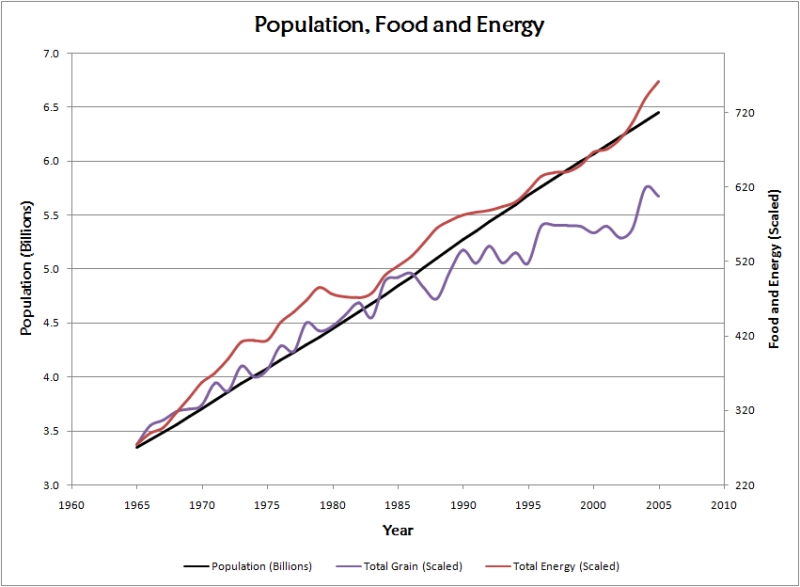
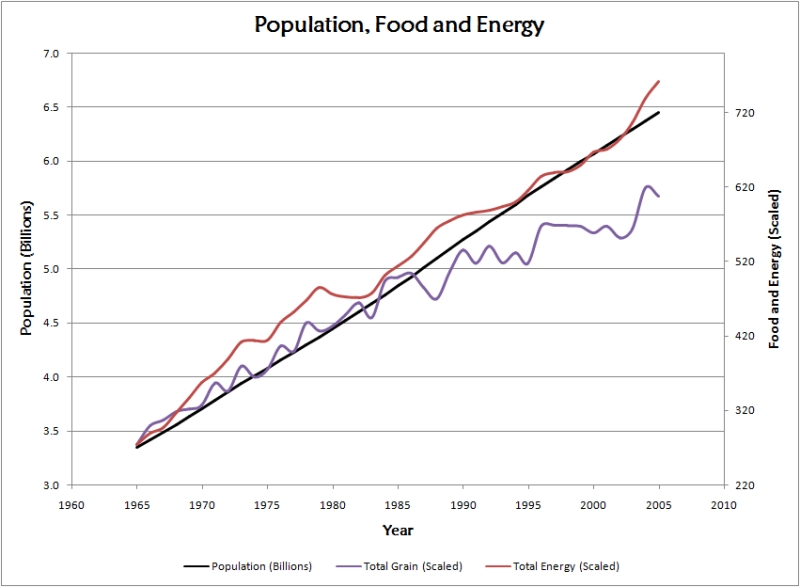
My second problem is that energy is never mentioned in mainstream analyses that focus on food. **The possibility that this omission may be wrong-headed is hinted at by the well-known studies that found 7 to 10 calories of fossil fuel embedded in every calorie of food we eat. ** In fact, I have developed a strong suspicion that rising per capita energy consumption has even more to do with population increase than rising food production. To investigate this possibility I created the graph below. It shows population, grain consumption and primary energy consumption from 1965 to 2005, all scaled to allow a visual estimate of correlation.

 ) population growth or did population growth spur oil production?