Fr Miscamble defending atomic bomb

  • Thread starter Thread starter CatholicAggie19
  • Start date Start date
Status
Not open for further replies.
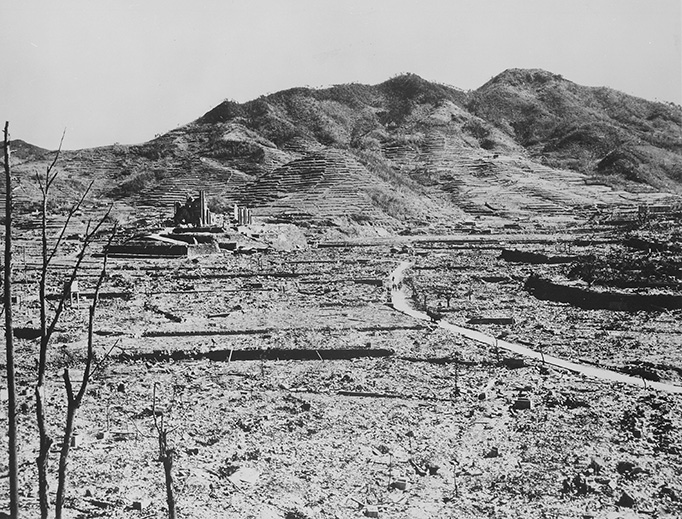
The second bomb was essential to the forcing of the surrender, as mandated by the Emperor at the 9-10 August gozen kaigen. The war faction of the controlling Saiko Senso Shido Kaigi was arguing that we could only have one of the things. It was necessary to demonstrate that we not only could do it, we could do it again. One response was “They may have a hundred of them”. We didn’t but it was nice of them to think so.
 
Yep. A lot of historical comments that could be made. But I can’t do such until someone else has posted, when I could do 3 more. Just as happy not to. Will if opportunity arises and it seems appropriate.

Historical comments, note. I do not address the RCC teaching on the morality. I have my own opinion on that, not interested in others. But history of the event is a major hobby of mine.
I was a history major, and I would love for you to continue. I have read about this issue some (other parts of the war hold more interest for me, honestly) and have read good arguments both for and against the use of the bomb. Honestly, despite the fact that some historians have pointed out that Japan had put out a few “peace feelers” about negotiating an end to the war, i doubt this would have been viable for the Allies. The terms for the Allies and the Japanese would likely be way too far apart, and many in Japan felt they could still kill enough people to make demands. Of course there is the whole unconditional surrender debate, whether it was right for the Allies to insist upon it. I am not sure Japan would have accepted a peace agreement that the Allies would view as acceptable even without forcing Japan to an unconditional surrender. And the whole time negotiations would be going on, areas in Asia and the Pacific under Japanese control would continue to deteriorate. In China alone, tens of thousands were dying per month I believe. And you do point out, even after Hiroshima, the Japanese Cabinet did not choose to give up. In fact, Hirohito himself had to break the Cabinet deadlock after Nagasaki, and even then some fanatical military officers attempted to prevent the Hirohito’s surrender recording from being broadcast!

(and I am not talking about debating this as a moral issue—we have already established that Catholic teaching does NOT allow the use of WMDs on population centers, regardless of why and that it is an intrinsic evil)
 
Last edited:
WWII has been a hobby of mine, meaning a book collecting focus, for over 60 years. The bombs/end game has been a major focus for over 25 years. Resulting, on this subject, in a collection of over 150 books and an unknown number of articles and papers, in 3 ring binders. I hate posting on it, but my best guess is that, on this forum and its predecessor incarnation, I’ve done so around 800 times. Tiring.

But I do continue (aging as I am). Not in any type of overall manifesto, but with respect to particular infelicitous historical assertions usually made by key -clicking scholars. Or with respect to expanding on other sort of posts. Comments (not corrections) on your post:

There were no peace feelers, by anyone officially able to make a peace overture, by anyone, including the 3 Japanese European embassy attempts, late before the bombs. What there had been was attempts to achieve a softer landing than a surrender would be, through some form of negotiated, settlement/treaty/armistice.Beginning with attempted contacts with the Soviet Union in Feb 1945, before the mutual non-aggression pact was announced as not to be renewed, by the Soviets, and a final, desperate attempt, late in the game, to approach the Soviets again, both in the person of the Soviet ambassador to Japan, and more pertinently, through instructions from Togo to the Japanese ambassador to the Soviet Union, Sato. This latter was the attempt that the peace faction of the Supreme Committee for the Conduct of the War (the power structure of 6 persons who held the reins. The Cabinet, while the only formal agency that could surrender, had no power to do so. Togo continually stressed the urgency of Sato’s assignment, while emphasizing it was in no way a surrender offer. It was an attempt to allow a soft landing for the defeated Japanese, through the “good offices” of the Soviets. Sato steadily stated that this idea was a non-starter. The only solution was surrender, to the terms of the Potsdam declaration. This was still going on when the first bomb fell.

The unconditional surrender discussion, and the attempt to ensure the continuity of the kokutai, the national polity/imperial Shintoism, takes more time than I’ll give it tonight. I got a book on the 32nd US Army division, on New Guinea, that I need to get back to. But you are putting your finger on salient points and looking at them in the right way. The estimated casualty range in the Pacific Theater for 1945 is between 125,000/month and over 300,000/month. And Operation ZIPPER was scheduled start in Sep, followed by OLYMPIC in Sep.Time was blood. Giangreco’s HELL TO PAY is recommended. Or Gruhl’s IMPERIAL JAPAN’S WORLD WAR II. For the attempted coup (a common form of military intrusion in Japan’s politics at the time, JAPAN’S LONGEST DAY/The Pacific War Research Society. A Japanese source.

I have no doubt this will need to be divided, for length. So I’m stopping. Two absolutely essential book recommendations: Frank/DOWNFALL and Kort/THE COLUMBIA GUIDE TO HIROSHIMA AND THE BOMB. More will follow, if needed.

I hate this topic.

Hmmm. Didn’t have to divide it.
 
Last edited:
A few years ago I saw an interview with a high-ranking Japanese military officer who said it was probably justified, because every Japanese citizen would have fought to the death, and many more lives would have been lost.

That said, I wish Truman would have dropped one in an unpopulated area somewhere near Japan, and told Emperor Hirohito that the next one would be in a populated area if Japan didn’t surrender. Maybe he showed Hirohito the film of the tests. I’d like to think he warned him somehow.
 
Last edited:
This was considered. It was rejected for a number of reasons: the thing might not work. It might hand a (rather mashed-up) uranium bomb to any Japanese wanting to get it into the hands of Prof. Yoshio Nishima.And time (which is blood) marches on.

That every Japanese would fight was the essence of the defense plan for the Home Islands, Ketsu-go. This was to be the gyokusai, the shattering of the jewels. The idea was not to defeat an invasion, but to raise the blood-level of the butchers bill, both Japanese and American, to the point where a war-weary America (and we were war-weary) would have lighter terms. For a number of reasons, that would not have happened. But after the bombs, it was quite clear that this approach, like the idea of the Soviets helping mediate a softer landing, would not be possible. There wouldn’t, the Japanese realized, be a need for an invasion. Just more of these pika-dons.
 
Last edited:
I have Giangrecos book about Downfall. At least that is the one I think I have. I have quite a few books myself, although i have only been collecting about a third of the time you have. Recently read Fire and Fury, the US Army in the Pacific. Read another book just recently about the Battle of Manila. Currently on “The Dead and Those About to Die” about the 1st Division on Omaha. The 32nd and the whole Buna-Gona campaign, the Kokoda Trail, Port Moresby are way too often forgotten. Those campaigns, like the campaigns in Burma must have been pure misery. I also think General Eichelberger is one if the most overlooked field commanders in the US Army from WWII. He and the 32nd Div had the misfortune of just being part of “MacArthur’s forces” in the papers then and history books now.
 
A few years ago I saw an interview with a high-ranking Japanese military officer who said it was probably justified, because every Japanese citizen would have fought to the death, and many more lives would have been lost.

That said, I wish Truman would have dropped one in an unpopulated area somewhere near Japan, and told Emperor Hirohito that the next one would be in a populated area if Japan didn’t surrender. Maybe he showed Hirohito the film of the tests. I’d like to think he warned him somehow.
I don’t know what was said, but the Truman did warn the Emperor. The Japanese didn’t take him seriously.
 
If it’s HELL TO PAY, and I bet it is, the 2nd edition adds a couple of chapters, but nothing essential. What Giangreco is essential about is numbers and their implications. We would have a had a difficult time mounting OLYMPIC.

Will look for FIRE AND FURY. The breaking of the Bismark Barrier is one of my weaker points, which is why THE GHOST MOUNTAIN BOYS/Campbell is waiting for me. As is Bergerud’s TOUCHED WITH FIRE. And Burma - I need to finish Slim’s DEFEAT INTO VICTORY, and the collected Stillwell papers. And I got some of Eichelberger’s books, somewhere. The naval war is usually my main reading area. Other than the end game, in August.

So much to read. Fortunately, for 60 years, I’ve bought far faster than I’ve read. WWII is not the only addiction.
 
If it’s HELL TO PAY, and I bet it is, the 2nd edition adds a couple of chapters, but nothing essential. What Giangreco is essential about is numbers and their implications. We would have a had a difficult time mounting OLYMPIC.

Will look for FIRE AND FURY. The breaking of the Bismark Barrier is one of my weaker points, which is why THE GHOST MOUNTAIN BOYS/Campbell is waiting for me. As is Bergerud’s TOUCHED WITH FIRE. And Burma - I need to finish Slim’s DEFEAT INTO VICTORY, and the collected Stillwell papers. And I got some of Eichelberger’s books, somewhere. The naval war is usually my main reading area. Other than the end game, in August.

So much to read. Fortunately, for 60 years, I’ve bought far faster than I’ve read. WWII is not the only addiction.
It is Hell to Pay. Very detailed analysis of the American invasion plans and the enormous scale of the undertaking.

I also have Frank’s “Downfall”.

To correct myself: It is “Fire and Fortitude” by John McManus and it is excellent, although looking at it on my e-reader, I don’t think finished the whole book (a problem of mine—something else catches my attention or I read the sections of the book out of order or jump between multiple books etc). It ends with the Army role in GALVANIC on Makin in November 1943. A lot about the army campaigns in the SW Pacific Theater like Buna etc.
 
The New Mexican test preceded the bombings. The Pacific tests occurred after the war.

They were not altogether caught flatfooted by the size of the detonation; they knew e.g. what sort of maneuvers were needed for the aircraft to escape.

ICZC NIKA
 
It’s an air bust vs ground burst question: air bursting a nuke spreads its blast and thermal effects over a wider area, but leaves fallout particles too light to fall back to the ground before decaying and weakens its ability to destroy heavily fortified targets. Ground bursting is highly effective against said hard targets, but launches lots of dust into the air, causing the fallout particles to fall relatively quickly, thereby exposing those downwind to lots of radiation. The bombs used on Japan were air bursted.
 
Last edited:
World War I illustrated why a negotiated peace agreement was untenable: unless Japan was utterly defeated and forced to surrender their military capabilities, they’d be out for revenge. It would have made a nuclear World War III inevitable sometime in the 1960’s, as twenty years of peace would give Japan enough time to rebuild its military and economy, including a nuclear arsenal of its own.
 
Pope Pius XII

In particular, in response to a suggestion made by Max Planck, he warned the world about the imminent dangers of atomic war and in his address to the Pontifical Academy of 1943 appealed to world leaders to act together to secure its prevention: ‘Although it is still unconceivable to take technical advantage of such an unforeseen achievement, it does break the ground for multitudes of possibilities which make the setting-up of uranium reactor no longer a utopia. It is, however, essential to prevent the process from taking place as an explosion because otherwise the consequence could be catastrophic not only in itself but for the whole Planet’. Unfortunately the United States had already passed the experimental stage and two years later the first nuclear bomb was dropped on Hiroshima. In 1948 Pius XII admitted sadly that nuclear energy had been employed for destruction and death: ‘The nuclear bomb, the most terrible weapon that the human mind has ever conceived’. The tragedy of Hiroshima made him realise that a future conflict, to which science would make its contribution, would be fatal to the world: ‘What calamities a future conflict would hold in store for mankind, if it proved impossible to stop or slow down the use of every new and sophisticated scientific invention’. His appeal then followed: ‘We should mistrust the science whose main objective is not love’. He was not just thinking of nuclear weapons, but also of the whole arsenal of sophisticated systems, from missiles to chemical, biological and conventional weapons which were the result of the use and development of scientific research. He was adamant in his views and declared: ‘Each branch of science governed by scientists worthy of the name and you in particular tends towards the realisation of love for your fellow-men’.
 
I don’t know if there is an official teaching, but I have definitely heard a number of priests say that the United States’ atom-bombing of Japan in WWII was immoral because of the disregard of innocent human life.
If you time-traveled back to the WWII era, you could probably also find a number of priests taking the opposite position.

You will find far fewer priests defending the dropping of the atomic bomb today in the post-nuclear arms race, post-Vietnam era, than back in the days when many parishes had families losing husbands and sons, often 2, 3, 4 members of same family, in the war.
 
Last edited:
Status
Not open for further replies.
Back
Top
