
You are using an out of date browser. It may not display this or other websites correctly.
You should upgrade or use an alternative browser.
You should upgrade or use an alternative browser.
- Status
- Not open for further replies.
D
Duane1966
Guest
I understand completely. Here are some quotes from a paper written by a Judaic scholar. I could not provide the link, but if you type the title of the paper you can download the paper. There are spaces between quotes. Emphasis on some words are mine. The last two quotes deal with rabbis and the Talmud.No, I don’t think you do understand. I don’t care what Jews thought hundreds of years after Christ. The issue is: What did they think before Christ came and at the time of Christ. That’s the context within which the whole Christian narrative in the Bible is laid out! The answer to that is clear from the passage cited…The oldest source we have says drawing humans was forbidden.
The whole paper is interesting.
Make yourself no graven image”: The Second Commandment and Judaism by Carl Ehrlich
**According to the description of the construction of the First (Solomonic) Temple in Jerusalem in 1 Kings 7, the Temple was decorated with a plethora of figurative images: columns topped with pomegranates; a large basin that was supported by twelve oxen; depictions of lions, oxen, cherubs, and palms; and in the Holy of Holies the Ark of the Covenant rested between two large cherubs. Solomon is criticized at least twice in the Hebrew Bible: the first time somewhat obliquely in the so-called Law of the King (Deut 17:14-20), and the second time openly on account of his foreign or exogamous marriages (1 Kgs 11:1-8). The first criticism is political, the second religious in nature. In order to accommodate his wives and their religious practices, he let shrines to their various deities be erected in Jerusalem. At no point is he criticized on account of the iconography of the temple that he built in honor of Israel’s God. The only cultic crime of which he was accused is the introduction of foreign cults into Israel.
When, however, the representational arts are no longer viewed as a religious threat, Jewish interpretations of the Second Commandment have tended to be much more liberal and accommodating. In addition, the attitudes of the general societal environment in which the Jews have found themselves have also played an oftentimes determinative role in formulating Jewish responses to representational art.
Thus, the threatened erection of a statue of the Roman emperor Caligula in the Jerusalem Temple in the first century C.E. was a cause of great concern to the Jewish leadership of the time, while the placement of a statue of the Parthian king in a third century synagogue in Nahardea was not. The reason for this difference in attitude is to be found in the fact that the statue of Caligula was meant to serve as an object of worship within the context of the imperial Roman cult. The Zoroastrian Parthians had no royal cult. The statue of the king in Nahardea was simply there to serve as a symbol of the state, in the same manner in which contemporary synagogues more often than not display the national flag in addition to the Israeli one.
Stripped of their mythological contexts, one could now walk upon the most beautiful mosaic floors in certain synagogues, which were decorated with scenes and objects of Jewish origin, as well as motifs taken from the Hellenistic-Roman world, such as zodiac signs, anthropomorphic representations of the seasons, and even the sun god Helios in his chariot. The walls of the synagogue at Dura-Europos on the Euphrates River were lavishly covered with scenes taken from the Bible. It needs to be emphasized that these were the synagogues in which the rabbis who PRODUCED the Talmud prayed
The story is told about Rav, the founder of the illustrious Talmud academy in Sura in Babylonia, that he was once a guest in a synagogue in which there was a beautifully decorated mosaic floor. Rav participated actively in the synagogue service and even read out of the Torah. Yet, when the congregation bowed down in worship, Rav remained standing. His erect attitude was attributable to the figural representations on the mosaic floor. The fact that such pictures were to be found in a synagogue DID NOT DISTURB HIM. After all, they did not keep him from praying there. Were he, however, to bow down in prayer, it could appear as if he were bowing down to the figures depicted on the floor, instead of before the invisible God. It was in order to avoid even the possible semblance of idolatry that Rav chose to remain standing. The context of his actions determined his attitude in prayer and toward the interpretation of the Second Commandment.**
T
TimothyH
Guest
Sagrada Familglia - Barcelona
sagradafamilia.cat/sf-eng/
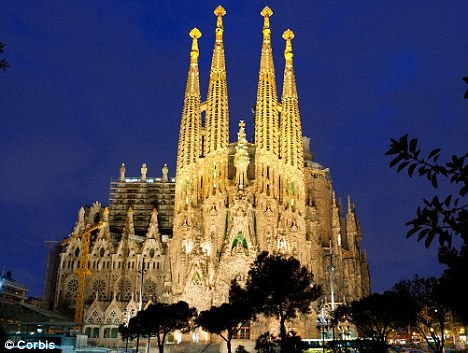
http://images.nationalgeographic.co...celona-gaudi-spain-vacation_20500_600x450.jpg

-Tim-
sagradafamilia.cat/sf-eng/

http://images.nationalgeographic.co...celona-gaudi-spain-vacation_20500_600x450.jpg

-Tim-
S
steve_b
Guest
The Jews/hebrews before Christ, would have accepted Christ when He came. See the following scripture passages. Many Jews during the time of Christ accepted Him. In the very beginning, the Church, i.e. the Catholic Church was 100% Jewish.No, I don’t think you do understand. I don’t care what Jews thought hundreds of years after Christ. The issue is: What did they think before Christ came and at the time of Christ.
As far as the OT, Think about the transfiguration .Matthew 17:1 Moses and Elijah who represented the law and the prophets of the OT, were there witnessing Jesus transfiguration along with Peter James and John. And Peter wanted to make a tent for both Moses and Elijah. In Context
j:
Once God appears in the flesh (the incarnation), we now have an image of God. Plus think about this, Peter James and John saw Moses and Elijah.That’s the context within which the whole Christian narrative in the Bible is laid out! The answer to that is clear from the passage cited…The oldest source we have says drawing humans was forbidden.
M
MarkInOregon
Guest
You don’t think that what worship and serve mean are at the heart of the issue and the commandment?I would love to discuss all of those points, but it’s going to get way off-topic. A short version of an answer is this: What does “worship” mean? What does “serve” mean? I believe the Greek version of the OT, the very same version Jesus would have had access to, shows a very different understanding of “worship” and “serve” than how the CC defines it today. I’ll leave it at that, because if I don’t, things will get way off-topic.
The peace of Christ,
Mark
M
MarkInOregon
Guest
Well how do I know that someone is not worshiping the statue of the the city founder or the great general who freed the country, or that great civil rights leader or any other figure we sing the praises of? How do we know that someone doesn’tt have all those pictures of their family because they love and worship them?I don’t disagree. I didn’t say a “church setting,” I said a “worship” setting. Worship can and does occur everywhere, not just in a church building somewhere. I too think it can occur in people’s homes and in public and that it often does. My point is that it has to do with worship, not history, science, or other aspects of human life.
The distinction you are trying to make seems arbitrary to me and not in keeping with a reading of the text. I think many people do have a tendency to “worship”, if you will, ancestors or great figures from history–just as they do money or power or…fill in the blank. I can’t see the distinction you are trying to draw between having a statue of a great saint or a great secular leader or scientist. I would say a statue of a saint has to do with history also – we admire the saint because the are great examples of people living for God, sacrificing for God. Saint Francis has much to teach us with regard to living the teachings of Christ. A Statue of St Francis is not a god–it is a representation of a human being who lived a life in the service of God. Why would a statue of St Francis be forbidden by this commandment while one of say Martin Luther King or George Washington would not? Perhaps I don’t understand the distinction you are trying to make?
The peace of Christ,
Mark
M
MarkInOregon
Guest
Lets go back to your OP. How are you defining the phrase “graven image”. By my understanding of the phrase–no Catholic church has any “graven images”. As was pointed out earlier the word translated by the KJV of the Bible as “graven image” literally means “an idol”. The statues in Catholic churches are not idols–is it your contention they are? If you acknowledge that they are not idols–then what is your objection? If you contend they are idols–on what grounds do you make such a claim? Would you be o.k. if they were molten images instead of graven images–I doubt it–so perhaps the question should be is “graven image” a good translation for us in the 21st century when perhaps it obscures the meaning of the original text?Hello Everyone,
It’s been awhile since I posted, but I am hopeful many of you will help me out with this issue.
I cannot for the life of me understand why it is considered acceptable to have graven images of God, saints, angels, etc. in church when the Bible clearly seems to indicate otherwise. I have read some Catholic apologetics on this, but not a lot. I didn’t find any of their arguments very persuasive, so I was wondering if you all could point me in the right direction on this important issue.
Thanks and God Bless!
-Justin
The peace of Christ,
Mark
T
Tomdstone
Guest
Some Eastern Churches interpret graven image as meaning 3D image and so they do not have 3D statues but 2D icons.Lets go back to your OP. How are you defining the phrase “graven image”. By my understanding of the phrase–no Catholic church has any “graven images”. As was pointed out earlier the word translated by the KJV of the Bible as “graven image” literally means “an idol”. The statues in Catholic churches are not idols–is it your contention they are? If you acknowledge that they are not idols–then what is your objection? If you contend they are idols–on what grounds do you make such a claim? Would you be o.k. if they were molten images instead of graven images–I doubt it–so perhaps the question should be is “graven image” a good translation for us in the 21st century when perhaps it obscures the meaning of the original text?
The peace of Christ,
Mark
F
Fr_of_Jazz
Guest
Let me raise some issues.Hello Everyone,
It’s been awhile since I posted, but I am hopeful many of you will help me out with this issue.
I cannot for the life of me understand why it is considered acceptable to have graven images of God, saints, angels, etc. in church when the Bible clearly seems to indicate otherwise. I have read some Catholic apologetics on this, but not a lot. I didn’t find any of their arguments very persuasive, so I was wondering if you all could point me in the right direction on this important issue.
Thanks and God Bless!
-Justin
Regarding Ex 20, perhaps we need a context alert. Verse 3 immediately preceding 20:4-5 is “You shall not have other gods besides me.” An idol was the presence of that god in pagan religious practice. Creating a idol was worshipping a god that did not exist or a demon.
In addition, those who rule out the use of images seem to be taking the command not to make idols more rigorously than the OT itself which in places commands the making of statues and the religious use of images.
Ex 25:18–20 – Two gold statues of angels were to be made to fit over the propitiatory of the ark. [Something in the heavens above.]
1 K 8:6ff – Two gold statues of angels were made to fit over the propitiatory of the ark in the temple [Something in the heavens above.]
1 Chr 28:18–19 – ditto
1 K 6:29-35 – cherubim, palm trees, and open flowers carved on the side wall of the temple [Something in the heavens above and earth below.]
2 Chr 3:7 – ditto
Ezekiel 41:17–18 – describes carved images in the idealized temple he saw in a vision. [Things in the heavens above and on the earth below.]
Num 21:8–9 – the bronze serpent - [Something on the earth below.]
Idols are of persons or things that were not real, an image is of something real.
Anything with a body can be represented in art. To represent Jesus in art is to affirm the Incarnation.
Catholics or EOCs praying before a statue or an icon are not praying to the stone or paint on wood: they are praying to Jesus (who is God and man) who is represented in the image. In the case of a saint they are reminded by the image that the saint is really with God praying for us, as the person praying asks God to hear the saint’s intercession.
So a few questions to ponder:
(1) Given that an idol (an image of a false/nonexistent god) is prohibited, what does it say about Jesus’ divinity if an image of Him is prohibited?
(2) Given that an image of a pure spirit can’t be produced, what does it say about Jesus’ humanity if He can’t be represented in art?
(3) Since we have bodies, the senses have a role in worship. The physical body of man participates as much in worship as does his soul. What does it say about the make up of man if we rule out the senses in the worship of God in and through Christ?
B
BrassAnkles
Guest
Let me raise some issues.
Regarding Ex 20, perhaps we need a context alert. Verse 3 immediately preceding 20:4-5 is “You shall not have other gods besides me.” An idol was the presence of that god in pagan religious practice. Creating a idol was worshipping a god that did not exist or a demon.
In addition, those who rule out the use of images seem to be taking the command not to make idols more rigorously than the OT itself which in places commands the making of statues and the religious use of images.
Ex 25:18–20 – Two gold statues of angels were to be made to fit over the propitiatory of the ark. [Something in the heavens above.]
1 K 8:6ff – Two gold statues of angels were made to fit over the propitiatory of the ark in the temple [Something in the heavens above.]
1 Chr 28:18–19 – ditto
1 K 6:29-35 – cherubim, palm trees, and open flowers carved on the side wall of the temple [Something in the heavens above and earth below.]
2 Chr 3:7 – ditto
Ezekiel 41:17–18 – describes carved images in the idealized temple he saw in a vision. [Things in the heavens above and on the earth below.]
Num 21:8–9 – the bronze serpent - [Something on the earth below.]
Idols are of persons or things that were not real, an image is of something real.
Anything with a body can be represented in art. To represent Jesus in art is to affirm the Incarnation.
Catholics or EOCs praying before a statue or an icon are not praying to the stone or paint on wood: they are praying to Jesus (who is God and man) who is represented in the image. In the case of a saint they are reminded by the image that the saint is really with God praying for us, as the person praying asks God to hear the saint’s intercession.
So a few questions to ponder:
(1) Given that an idol (an image of a false/nonexistent god) is prohibited, what does it say about Jesus’ divinity if an image of Him is prohibited?
(2) Given that an image of a pure spirit can’t be produced, what does it say about Jesus’ humanity if He can’t be represented in art?
(3) Since we have bodies, the senses have a role in worship. The physical body of man participates as much in worship as does his soul. What does it say about the make up of man if we rule out the senses in the worship of God in and through Christ?

R
Randy_Carson
Guest
I did. My apologies.I ignored it because it was simply a copy and pasting of the CA article I already said I read and disagreed with. I think you missed that.
:tiphat:
R
Randy_Carson
Guest
Still, the Bible Christian will argue that the prohibition is against images specifically.Let me raise some issues.
Regarding Ex 20, perhaps we need a context alert. Verse 3 immediately preceding 20:4-5 is “You shall not have other gods besides me.” An idol was the presence of that god in pagan religious practice. Creating a idol was worshipping a god that did not exist or a demon.
In addition, those who rule out the use of images seem to be taking the command not to make idols more rigorously than the OT itself which in places commands the making of statues and the religious use of images.
Ex 25:18–20 – Two gold statues of angels were to be made to fit over the propitiatory of the ark. [Something in the heavens above.]
1 K 8:6ff – Two gold statues of angels were made to fit over the propitiatory of the ark in the temple [Something in the heavens above.]
1 Chr 28:18–19 – ditto
1 K 6:29-35 – cherubim, palm trees, and open flowers carved on the side wall of the temple [Something in the heavens above and earth below.]
2 Chr 3:7 – ditto
Ezekiel 41:17–18 – describes carved images in the idealized temple he saw in a vision. [Things in the heavens above and on the earth below.]
Num 21:8–9 – the bronze serpent - [Something on the earth below.]
Idols are of persons or things that were not real, an image is of something real.
Anything with a body can be represented in art. To represent Jesus in art is to affirm the Incarnation.
Catholics or EOCs praying before a statue or an icon are not praying to the stone or paint on wood: they are praying to Jesus (who is God and man) who is represented in the image. In the case of a saint they are reminded by the image that the saint is really with God praying for us, as the person praying asks God to hear the saint’s intercession.
So a few questions to ponder:
(1) Given that an idol (an image of a false/nonexistent god) is prohibited, what does it say about Jesus’ divinity if an image of Him is prohibited?
(2) Given that an image of a pure spirit can’t be produced, what does it say about Jesus’ humanity if He can’t be represented in art?
(3) Since we have bodies, the senses have a role in worship. The physical body of man participates as much in worship as does his soul. What does it say about the make up of man if we rule out the senses in the worship of God in and through Christ?
Exodus 20:4
“You shall not make for yourself an image in the form of anything in heaven above or on the earth beneath or in the waters below.
F
Fr_of_Jazz
Guest
Yet there are the orders in the OT specifically to make images as listed in my post. Bible Christians have to deal with that. They also have to deal with the tie of idols to false gods as opposed to Jesus who is truly man and thereby capable of being represented and who is truly God and thereby not a false and imaginary god.Still, the Bible Christian will argue that the prohibition is against images specifically.
Exodus 20:4
“You shall not make for yourself an image in the form of anything in heaven above or on the earth beneath or in the waters below.
Besides it’s only a big deal to them because religious use of images is Catholic (they usually don’t know about the EOC) and that’s bad because it is Catholic which is not good because it is Catholic which is bad because it’s Catholic which is . . . .
T
TimothyH
Guest
This is really the bottom line.Yet there are the orders in the OT specifically to make images as listed in my post. Bible Christians have to deal with that. They also have to deal with the tie of idols to false gods as opposed to Jesus who is truly man and thereby capable of being represented and who is truly God and thereby not a false and imaginary god.
Besides it’s only a big deal to them because religious use of images is Catholic (they usually don’t know about the EOC) and that’s bad because it is Catholic which is not good because it is Catholic which is bad because it’s Catholic which is . . . .
-Tim-
R
Randy_Carson
Guest
Yet there are the orders in the OT specifically to make images as listed in my post. Bible Christians have to deal with that. They also have to deal with the tie of idols to false gods as opposed to Jesus who is truly man and thereby capable of being represented and who is truly God and thereby not a false and imaginary god.
Besides it’s only a big deal to them because religious use of images is Catholic (they usually don’t know about the EOC) and that’s bad because it is Catholic which is not good because it is Catholic which is bad because it’s Catholic which is . . . .
I agree with you guys…I’m just very conscious of the need for airtight defenses against Protestant attacks.This is really the bottom line.
-Tim-
A
alphomega
Guest
I can’t think of a single image or statue in our Church that isn’t of a real person that walked the earth. Even our statues have statues worshiping them (Fatima children and Mary)Hello Everyone,
It’s been awhile since I posted, but I am hopeful many of you will help me out with this issue.
I cannot for the life of me understand why it is considered acceptable to have graven images of God, saints, angels, etc. in church when the Bible clearly seems to indicate otherwise. I have read some Catholic apologetics on this, but not a lot. I didn’t find any of their arguments very persuasive, so I was wondering if you all could point me in the right direction on this important issue.
Thanks and God Bless!
-Justin
F
Fr_of_Jazz
Guest
I can’t think of a single image or statue in our Church that isn’t of a real person that walked the earth. Even our statues have statues worshiping them (Fatima children and Mary)

J
jinc1019
Guest
Hi All,
Sorry I haven’t been able to respond to the responses I have received here. I greatly appreciate them. I’ve been thinking over carefully, and I would like to admit (happily, because I believe it’s true) that my position on this topic has changed, due in large part to one or two of the arguments presented here (especially in regards to the images in the Temple built without an explicit command).
I’m still not convinced that we should have images or statues representing God himself, but I do admit that I was wrong about images in general (so long as they are not worshipped, of course).
Sorry I haven’t been able to respond to the responses I have received here. I greatly appreciate them. I’ve been thinking over carefully, and I would like to admit (happily, because I believe it’s true) that my position on this topic has changed, due in large part to one or two of the arguments presented here (especially in regards to the images in the Temple built without an explicit command).
I’m still not convinced that we should have images or statues representing God himself, but I do admit that I was wrong about images in general (so long as they are not worshipped, of course).
J
jinc1019
Guest
I don’t deny much of your argument here (assuming of course that we can agree Jews did not believe in making images of God, and I think we can).I understand completely. Here are some quotes from a paper written by a Judaic scholar. I could not provide the link, but if you type the title of the paper you can download the paper. There are spaces between quotes. Emphasis on some words are mine. The last two quotes deal with rabbis and the Talmud.
The whole paper is interesting.
Make yourself no graven image”: The Second Commandment and Judaism by Carl Ehrlich
**According to the description of the construction of the First (Solomonic) Temple in Jerusalem in 1 Kings 7, the Temple was decorated with a plethora of figurative images: columns topped with pomegranates; a large basin that was supported by twelve oxen; depictions of lions, oxen, cherubs, and palms; and in the Holy of Holies the Ark of the Covenant rested between two large cherubs. Solomon is criticized at least twice in the Hebrew Bible: the first time somewhat obliquely in the so-called Law of the King (Deut 17:14-20), and the second time openly on account of his foreign or exogamous marriages (1 Kgs 11:1-8). The first criticism is political, the second religious in nature. In order to accommodate his wives and their religious practices, he let shrines to their various deities be erected in Jerusalem. At no point is he criticized on account of the iconography of the temple that he built in honor of Israel’s God. The only cultic crime of which he was accused is the introduction of foreign cults into Israel.
When, however, the representational arts are no longer viewed as a religious threat, Jewish interpretations of the Second Commandment have tended to be much more liberal and accommodating. In addition, the attitudes of the general societal environment in which the Jews have found themselves have also played an oftentimes determinative role in formulating Jewish responses to representational art.
Thus, the threatened erection of a statue of the Roman emperor Caligula in the Jerusalem Temple in the first century C.E. was a cause of great concern to the Jewish leadership of the time, while the placement of a statue of the Parthian king in a third century synagogue in Nahardea was not. The reason for this difference in attitude is to be found in the fact that the statue of Caligula was meant to serve as an object of worship within the context of the imperial Roman cult. The Zoroastrian Parthians had no royal cult. The statue of the king in Nahardea was simply there to serve as a symbol of the state, in the same manner in which contemporary synagogues more often than not display the national flag in addition to the Israeli one.
Stripped of their mythological contexts, one could now walk upon the most beautiful mosaic floors in certain synagogues, which were decorated with scenes and objects of Jewish origin, as well as motifs taken from the Hellenistic-Roman world, such as zodiac signs, anthropomorphic representations of the seasons, and even the sun god Helios in his chariot. The walls of the synagogue at Dura-Europos on the Euphrates River were lavishly covered with scenes taken from the Bible. It needs to be emphasized that these were the synagogues in which the rabbis who PRODUCED the Talmud prayed
The story is told about Rav, the founder of the illustrious Talmud academy in Sura in Babylonia, that he was once a guest in a synagogue in which there was a beautifully decorated mosaic floor. Rav participated actively in the synagogue service and even read out of the Torah. Yet, when the congregation bowed down in worship, Rav remained standing. His erect attitude was attributable to the figural representations on the mosaic floor. The fact that such pictures were to be found in a synagogue DID NOT DISTURB HIM. After all, they did not keep him from praying there. Were he, however, to bow down in prayer, it could appear as if he were bowing down to the figures depicted on the floor, instead of before the invisible God. It was in order to avoid even the possible semblance of idolatry that Rav chose to remain standing. The context of his actions determined his attitude in prayer and toward the interpretation of the Second Commandment.**
What I would say though is this: I still believe that at the time of Christ, the norm was definitely NOT to make images of any kind in places of worship, unless commanded. However, as you point out, the “norm” was likely different before the time of Christ (at some point) and was definitely different a few hundred years after Christ, which really holds no weight in this conversation.
So the previous statements I made were partially true. At the time of Christ, images were not generally allowed unless commanded, but before Christ, there were eras that allowed for more imagery.
Either way, I agree with your overall argument that images should be allowed in Church (the exception being images that depict God, which I know we disagree about).
J
jinc1019
Guest
Just a note…Because my position on this has changed, I’m not going to respond to the various small discussions that went on earlier. It doesn’t make much sense since my primary position has changed. However, I am still open to discussing the notion that God himself should be displayed as an image in worship.
- Status
- Not open for further replies.