Lies on the part of the anti-catholic radicals - Peter the Great himself killed Greek Catholic priests with his own sword, not to mention the Imperial governemnt destroyed by force the Greek Catholic Church in central Ukraine and Belarus
Still denying that the Polish-Lithuanian commonwealth destoyed (or tried to) by force the Orthodox Church in central Ukraine and Belarus.
Peter the “Great,” in a stupor from Westoxification, did many things, including killing Orthodox. So your point was to show…?
The sound principles of Catholicism, however, were maintained and propagated by the Jesuits who, suppressed by the Holy See and exiled from the Catholic nations, found an asylum and the centre of their future revival in Russia. In 1779 Catharine II invited the Jesuits to exercise their ministry in White Russia, and in 1786 they had in Russia six colleges and 178 members. Their number increased so much that Pius VII re-established their order for Russia, where it returned to life under Father Gruber. In 1801 the society had 262 members, and 347 in 1811.
The Jesuits retained a lively gratitude for the hospitality that they had received in Russia, and worked with zeal to convert it to Catholicism.
Thanks, but no thanks.
Btw, what is the difference between the bishops who signed Brest and Metropolitan Siestrzencewicz?
The first dismemberment of Poland (1772) brought a strong body of Catholics to Russia, and Catharine II proposed to make of them a national Church, independent of Rome. Unfortunately an ambitious Polish bishop, Stanislaus Siestrzencewicz, entered into her views, and a ukase of 23 May, 1774 established the Diocese of White Russia, with its episcopal see at Mohileff, its first bishop being Siestrzencewicz, Vicar-General of Vilna. This personage is judged variously by historians. Pierling, Zalenski, and Markovitch treat him as an ambitious man who sought to become patriarch of all the Catholics in Russia, and who in his heart hated the Roman See. Godlewski on the contrary is inclined to excuse him, and to believe that the difficult conditions of Catholicism in Russia, possibly led him to adopt measures that appear to have been injurious to Catholic interests. According to Markovitch, during his long episcopate (1774-1826), Siestrzencewicz was the scourge of the Catholic Church of both rites in Russia. By her manifestos of 1779 Catharine II began the systematic destruction of the religious orders, withdrawing them from the authority of their religious superiors, and putting them under the jurisdiction of the Bishop of Mohileff. The latter in 1782 was raised to the archiepiscopal dignity, and in 1784 received the pallium from the Apostolic Legate, Mgr. Giovanni Andrea Archetti, Archbishop of Chalcedon. He assumed episcopal jurisdiction over all the Catholics of the Russian Empire, and acted as if he were independent of the Holy See.
newadvent.org/cathen/13253a.htm
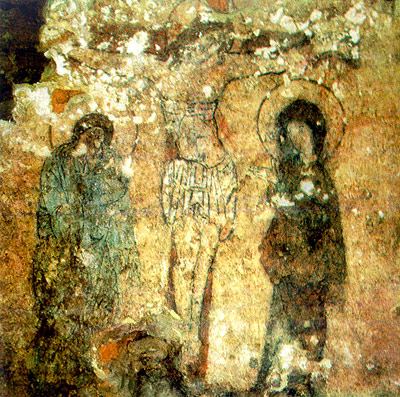
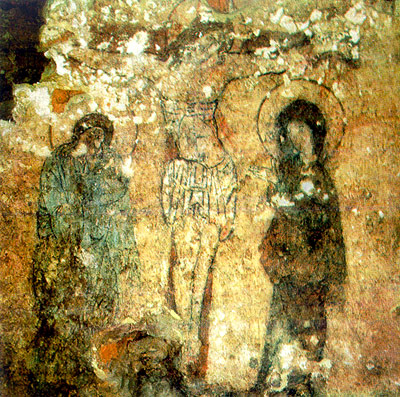
Siestrzencewicz later also took the title of primate of Lithuania, from the Mother Church of Lithuania, in whose crypt we find:
 upload.wikimedia.org/wikipedia/commons/b/b0/Fresco_in_Vilnius_Cathedral_crypt.jpg
upload.wikimedia.org/wikipedia/commons/b/b0/Fresco_in_Vilnius_Cathedral_crypt.jpg
upload.wikimedia.org/wikipedia/commons/b/b0/Fresco_in_Vilnius_Cathedral_crypt.jpg
How’d that get there?
When the time came for Jogaila to choose a wife, it became clear that he intended to marry a Christian. His Russian mother urged him to marry Sofia, daughter of Prince Dmitri of Moscow, who required him first to convert to Orthodoxy.[15] That option, however, was unlikely to halt the crusades against Lithuania by the Teutonic Order, who regarded Orthodox Christians as schismatics and little better than heathens.[12][4]
en.wikipedia.org/wiki/Jogaila#Baptism_and_marriage
^ The historian John Meyendorff suggests Jogaila may have already been an Orthodox Christian: “In 1377, Olgerd of Lithuania died, leaving the Grand Principality to his son Jagiello, an Orthodox Christian…”. Byzantium and the Rise of Russia, 205. Dmitri, however, made it a condition of the marriage that Jogaila “should be baptized in the Orthodox faith and that he should proclaim his Christianity to all men”. Document quoted by Dvornik, 221.
books.google.com/books?vid=ISBN9639116424&id=5aoId7nA4bsC&pg=PA180&lpg=PA180&vq=Jogaila&dq=Wigand+Poland&sig=hRbejRY9-Ay7Gy3_tYc3_CyZzLk#PPA181,M1
^ a b c d e f Bojtár, 180–186
New Cambridge Medieval History, 709–712.
fourtunately I know plenty of Eastern Orthodox Christians who are nothing like you, whom appear to hold much hate, by refering to us as “the vatican”
I’m not ashamed of being in communion with Constantinople, Alexandria, Antioch, Jerusalem etc…
If you are ashamed of whom you are in communion with, to the point of calling the mention “hate,” I can’t help you.
and mocking and insulting our saints
example?
and saying we have no right to exist,
quote?
as a matter of fact the communists used the exact same language
the communists paid a lot of lip service to social justice, so maybe we should apply your ad hominem argument to discredit that concept too.
You should be careful, becuase there are others reading this forum unfamiliar with the…Orthodox religion and your open hostility and hate is the first impression they get of it, and that is a great disservice, I would of thought by now one of your co-religionists would of sent you a priate message telling you to calm down and be more Christian like, I guess not
So that slander might go unanswered?
Many of us have agreed to the condemnation of Lvov as an injustice.
I"ve yet to see an admission that Brest was less than the loftiest or morals.