Has Benedict XVI disposed of the CCC?

  • Thread starter Thread starter TNT
  • Start date Start date
Status
Not open for further replies.
It is not rude at all. You made a statement and an assertation that could only intelligibly be made by one who was present. Otherwise you don’t know. Had you said for example, it probably was done that way, that would have been a whole different story.
You are wrong again. Great amounts of detail can be gleaned from historical and archaeological research…
 
At least I think (note that this is my personal opinion) that Romans had at least hewn a piece of wood to make a crossbeam; however they would have hewn it rather crudely and roughly so as to deal more pain to the crucifyee.
 
Again, how would you know? Your notion you list above it no more plausible than nailing someone to a cross and then erecting the cross – actually less so now that I begin to think about it. Struggling to escape? LOL! Maybe to breathe, but certainly not to escape.
They would not really struggle to breathe since there is a peg, a block or plank nailed on the cross which can act as a sort of ledge (called a sedile) where the victim can lean, thus preventing the crucifyee from being asphyxiated and thus prolonging his suffering.

Frederick Zugibe’s experiments revealed that, when suspended with arms at 60° to 70° from the vertical, test subjects had no difficulty breathing, only rapidly-increasing discomfort and pain. This would be consistent with descriptions of the crucifixion as a long, slow, painful death.
 
As I said the Roman Army was not known as being an organization that tolerated much deviation in any area at all, and I would have to think that they would not treat public executions, which were meant to both terrify and intimidate the locals, as being anything less deserving of their attention to detail
Well, that didn’t stop soldiers from crucifying people in different postures (such as what they did in the Romano-Jewish War) for amusement.
 
I’m not so centurions always did the crucifying – as it’s a horrid process that tends to screw the mind of the person performing it. I would think Golgotha was a horrid, smelly, barren place with horrid looking crucifixes.

Bull. That’s not what I said. I did say that something that gets covered (and recovered) by human blood, urine, feces, etc. etc. etc. would not necessarily be something well crafted. Prove your assertion of “totally contrary to any historical evidence yet found.” You’re simply speaking your personal (and unfounded) position.

Again, how would you know? Your notion you list above it no more plausible than nailing someone to a cross and then erecting the cross – actually less so now that I begin to think about it. Struggling to escape? LOL! Maybe to breathe, but certainly not to escape.

You’re not in a position to “guarantee” anything as you simply do not know. You have no clue who made the crucifixes.

My guess is there were a WIDE range of crucifixes and most were fairly crude.

More personal conjecture…
Personal conjecture based on rational reading of historical texts, true. I also didn’t try to apply modern standards of conscience and morality into my opinion.

I suggest that you do some research on the Roman Army who were used for these executions and find out for yourself as to how they operated. As far as the condemned carrying the crossbeam to the upright pole that is a very well known and historically documented fact. The crossbeam was attached, the condemned attached to it and then the whole device slipped into a prepared hole. There were of course other methods which included stringing someone up on a single board, impaling them in different ways or even making use of a tree.

As to your assertion someone wouldn’t flail about in an attempt to escape such a fate is really laughable. Ever seen people desperately trying to escape fire or an accident or being trapped in some way? I have, a lot more than once. I would bet that more than a few struggled, if from nothing more than sheer panic, until they passed out and then probably expired. I doubt that very many hung there limp and resigned to their fate. That doesn’t sound much like human nature. Also lets remember not all were nailed to the cross, many were bound while others were nailed and still others nailed and bound. Those bound could expect to last for a good while as they hung there while those nailed usually went pretty quickly.

You are quite right in stating that Centurians wouldn’t be doing the crucfixtions.👍 Centurians were Officers in charge of a centuria, probably equivalent to a Captain these days. The men doing the dirty work would probably have been a few specialists, optios perhaps, who knew the procedures for the different types of executions, and miles, roughly equivalent to privates these days and whose name means herd animal These would probably have been supplanted by men on restriction for disciplinary reasons or those on duty. There is also evidence that slaves would be pressed into service for this task on occasion.

As to it being a gruesome job, yes it was, but the Roman soldiers didn’t adhere to modern norms of conduct and sensibilities. They lived a brutal existance in a brutal world. They existed in a world where slight infractions could result in a sentence of death, where floggings were common and conducted in full view of everyone and discipline was maintained in a fashion unthinkable to modern sensibilities. A not uncommon unit punishment was to stone to death or beat to death every tenth man in the unit, with the unit members carrying out the executions. That punishment was usually reserved for desertions, muitny or failure to adequitely carry out unit orders.

In the end result. no I don’t know exactly how they were done in each and every case, and neither, my friend, do you:thumbsup: But based on the historical knowledge we have of the Roman Army and how they operated I think my argument make a lot of sense.

But hey, I’m just an old conservative. What could I possibly know about anything at all?

 
Well, that didn’t stop soldiers from crucifying people in different postures (such as what they did in the Romano-Jewish War) for amusement.
Yes, but those were not official executions were they? They were conducted at a local level and were by and large unauthorized and while tolerated ,were in no way synonomus with official executions.
 
It is not rude at all. You made a statement and an assertation that could only intelligibly be made by one who was present. Otherwise you don’t know. Had you said for example, it probably was done that way, that would have been a whole different story.
Not to make a personal statement about anyone or any post in particular here, but it is a common misconception that a person cannot be both correct and rude at the same time.
 
I’m not so centurions always did the crucifying – as it’s a horrid process that tends to screw the mind of the person performing it. I would think Golgotha was a horrid, smelly, barren place with horrid looking crucifixes.

Bull. That’s not what I said. I did say that something that gets covered (and recovered) by human blood, urine, feces, etc. etc. etc. would not necessarily be something well crafted. Prove your assertion of “totally contrary to any historical evidence yet found.” You’re simply speaking your personal (and unfounded) position.

Again, how would you know? Your notion you list above it no more plausible than nailing someone to a cross and then erecting the cross – actually less so now that I begin to think about it. Struggling to escape? LOL! Maybe to breathe, but certainly not to escape.

You’re not in a position to “guarantee” anything as you simply do not know. You have no clue who made the crucifixes.

My guess is there were a WIDE range of crucifixes and most were fairly crude.

More personal conjecture…
Hello. I posted previously that I read that at times the Romans also used trees for crucifixions. Thus all they would need would be the cross bar. I doubt very much if much time was spent on creating the perfect cross. Just my opinion. 🙂 Peace.
 
Personal conjecture based on rational reading of historical texts, true. I also didn’t try to apply modern standards of conscience and morality into my opinion.

I suggest that you do some research on the Roman Army who were used for these executions and find out for yourself as to how they operated. As far as the condemned carrying the crossbeam to the upright pole that is a very well known and historically documented fact. The crossbeam was attached, the condemned attached to it and then the whole device slipped into a prepared hole. There were of course other methods which included stringing someone up on a single board, impaling them in different ways or even making use of a tree.

As to your assertion someone wouldn’t flail about in an attempt to escape such a fate is really laughable. Ever seen people desperately trying to escape fire or an accident or being trapped in some way? I have, a lot more than once. I would bet that more than a few struggled, if from nothing more than sheer panic, until they passed out and then probably expired. I doubt that very many hung there limp and resigned to their fate. That doesn’t sound much like human nature. Also lets remember not all were nailed to the cross, many were bound while others were nailed and still others nailed and bound. Those bound could expect to last for a good while as they hung there while those nailed usually went pretty quickly.

You are quite right in stating that Centurians wouldn’t be doing the crucfixtions.👍 Centurians were Officers in charge of a centuria, probably equivalent to a Captain these days. The men doing the dirty work would probably have been a few specialists, optios perhaps, who knew the procedures for the different types of executions, and miles, roughly equivalent to privates these days and whose name means herd animal These would probably have been supplanted by men on restriction for disciplinary reasons or those on duty. There is also evidence that slaves would be pressed into service for this task on occasion.

As to it being a gruesome job, yes it was, but the Roman soldiers didn’t adhere to modern norms of conduct and sensibilities. They lived a brutal existance in a brutal world. They existed in a world where slight infractions could result in a sentence of death, where floggings were common and conducted in full view of everyone and discipline was maintained in a fashion unthinkable to modern sensibilities. A not uncommon unit punishment was to stone to death or beat to death every tenth man in the unit, with the unit members carrying out the executions. That punishment was usually reserved for desertions, muitny or failure to adequitely carry out unit orders.

In the end result. no I don’t know exactly how they were done in each and every case, and neither, my friend, do you:thumbsup: But based on the historical knowledge we have of the Roman Army and how they operated I think my argument make a lot of sense.

But hey, I’m just an old conservative. What could I possibly know about anything at all?
What does being an “old conservative” have to do with anything? The real question is do you have any references?
 
THIS JUST IN:

Benedict XVI did NOT replace the CCC, it turns out he turned the CCC upside down! The new cross is simply the other end of the same staff!

All this time. I always wondered what was at the other end of the CCC.
 
THIS JUST IN:

Benedict XVI did NOT replace the CCC, it turns out he turned the CCC upside down! The new cross is simply the other end of the same staff!

All this time. I always wondered what was at the other end of the CCC.
Ahhhhhhhhhhhhhhhhhhhhhh, THAT’S why it’s all bent-up!!
 
They would not really struggle to breathe since there is a peg, a block or plank nailed on the cross which can act as a sort of ledge (called a sedile) where the victim can lean, thus preventing the crucifyee from being asphyxiated and thus prolonging his suffering.
Just as a historical note, there were two things the Romans used, but definitely not always. One was the peg as you described for the feet. This was so the condemned could push up in order to breathe. This however was not always used. Often the feet were nailed directly to the tree of the cross. The other thing used was a type seat placed between the legs on which the condemned could (if you could call it that ) sit. This was used to prolong death by crucifixion. There is no evidence that either was used for Jesus. Certainly not the seat. The peg for the feet I know is used in most art, but probabilities would negate that also. .I say this, having studied and read much on the crucifixion as all that does is tell me the infinite love that Jesus had for each of us. I do one lenten mission based on the crucifixion and what it means to die in this manner, explaining the physiological effects on the body in stages and the amount of suffering which Jesus underwent for us. I even cry giving this talk at times. All the different forms of the cross stated are correct as most often they used whatever was available. The Romans were noted for their discipline in battle. In execution, they were noted for their cruelty.
Prayers & blessisngs
Deacon Ed B.
 
Hello. I posted previously that I read that at times the Romans also used trees for crucifixions. Thus all they would need would be the cross bar. I doubt very much if much time was spent on creating the perfect cross. Just my opinion. 🙂 Peace.
When trees were used normally the persons arms were attached to the tree straight up over their heads. There would have been no cross bar. Straight pieces of wood were also used on occasion.
 
Just as a historical note, there were two things the Romans used, but definitely not always. One was the peg as you described for the feet. This was so the condemned could push up in order to breathe. This however was not always used. Often the feet were nailed directly to the tree of the cross. The other thing used was a type seat placed between the legs on which the condemned could (if you could call it that ) sit. This was used to prolong death by crucifixion. There is no evidence that either was used for Jesus. Certainly not the seat. The peg for the feet I know is used in most art, but probabilities would negate that also. .I say this, having studied and read much on the crucifixion as all that does is tell me the infinite love that Jesus had for each of us. I do one lenten mission based on the crucifixion and what it means to die in this manner, explaining the physiological effects on the body in stages and the amount of suffering which Jesus underwent for us. I even cry giving this talk at times. All the different forms of the cross stated are correct as most often they used whatever was available. The Romans were noted for their discipline in battle. In execution, they were noted for their cruelty.
Prayers & blessisngs
Deacon Ed B.
What I described was the ‘seat’, and not the pedestal (which I also doubt was used in many cases). 🙂

Rather, I think that in Jesus’ case, hands and feet were pierced by nails (I am more inclined to the belief that four nails were used in crucifixions where the feet are nailed instead of three, as most early depictions of crucifixions seem to imply it by showing the feet separate).

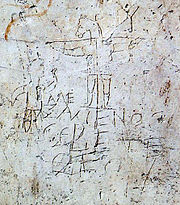
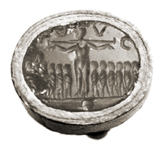
Here are a handful of pre- and 5th century depictions of crucifixion (there are said to be half a dozen of them all in all):


The Alexamenos Graffito, between 85 AD-3rd century

http://img240.imageshack.us/img240/389/crucifixiongemtu6.png

Magical Gem from the Eastern Mediterranean (perhaps Syria?) aka the Pereire Collection Gem, Late 2nd-3rd C.

http://www.hypotyposeis.org/weblog/uploaded_images/crucifix3-794756.JPG

Magical Gem from the Eastern Mediterranean, 4th-5th C.


Wooden panel from door in Santa Sabina, 5th C.


Magical Gem, 3rd C.?
 
Any way we look at it, crucifixion was ugly, barbaric, cruel and sadistic to the extreme. So why should not a crucifix be realistic. We agree here. I find the more “sanitized” a crucifix, the less it conveys the true meaning of crucifixion and the price of our redemption.
Prayers & blessings
Deacon Ed B
 
Status
Not open for further replies.
Back
Top