
You are using an out of date browser. It may not display this or other websites correctly.
You should upgrade or use an alternative browser.
You should upgrade or use an alternative browser.
- Status
- Not open for further replies.
E
Erethorn
Guest
I’m sorry, but do you realize how much this line of argumentation sounds like the “new light” doctrine of Jehova’s Witnesses ?God has given the gift of infallibility to His Church.
That does not mean however:
a) that the pope and bishops who were instrumental in formulating the doctrine necessarily understood it in the proper way
b) or that they had the fullness of understanding what all the terms in that doctrine encompassed – understanding that God might grant to His Church at a later date (growth in understanding of a previously declared doctrine).
M
mariafransisca2
Guest
It is not me who said it, St. Leonard of Port Maurice made a sermon.
You can read the sermon here:
romancatholicism.org/jansenism/leonard.htm
I myself am very much surprised when I read it.
Be that three
You can read the sermon here:
romancatholicism.org/jansenism/leonard.htm
I myself am very much surprised when I read it.
Be that three
M
mariafransisca2
Guest
Check out incorrupt bodies of the saints
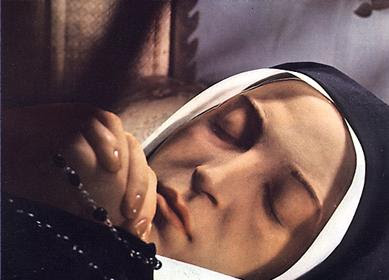
You can see many saints whose bodies are incorrupt on youtube
There are over 250 saints who are incorrupt in the catholic church, here are some of those
youtube.com/watch?v=9jE0j8M1Pfo
youtube.com/watch?v=F7uPLx8PM8c
youtube.com/watch?v=qi9_sASaMd8
youtube.com/watch?v=DdU9SMNfodM
youtube.com/watch?v=FZ2eKC2q4VE
youtube.com/watch?v=p87sWL4Zh7o
Here are the webpage with photos
overcomeproblems.com/incorruptables.htm
fisheaters.com/relics.html

If you want to see st. bernadette incorrupt bodies you can just type St. Bernadette incorrupt on youtube
There is a life of heaven

You can see many saints whose bodies are incorrupt on youtube
There are over 250 saints who are incorrupt in the catholic church, here are some of those
youtube.com/watch?v=9jE0j8M1Pfo
youtube.com/watch?v=F7uPLx8PM8c
youtube.com/watch?v=qi9_sASaMd8
youtube.com/watch?v=DdU9SMNfodM
youtube.com/watch?v=FZ2eKC2q4VE
youtube.com/watch?v=p87sWL4Zh7o
Here are the webpage with photos
overcomeproblems.com/incorruptables.htm
fisheaters.com/relics.html
If you want to see st. bernadette incorrupt bodies you can just type St. Bernadette incorrupt on youtube
There is a life of heaven
C
ComputerGeek25
Guest
This is very dangerous thinking. We do not know the exact numbers, nor do we know or are able to judge this.But Bush did the Iraqi war, and Clinton had a scandal with Lewinsky.
Even St. Leonard of Port Maurice said that out of 60.000 catholics, only 3 are saved
You can read it here
The Little Numbers of those who are saved
romancatholicism.org/jansenism/leonard.htm
I’m just gonna give you this links to my website:
everycatholicblog.blogspot.com/
I created it to help fellow catholics. I pray regularly for those who visit it
I pray for you
Learn to forgive. Forgive your parents, forgive your enemies. Thus you will obtain mercy and forgiveness from Jesus.
I love you. Jesus loves you more

M
mariafransisca2
Guest
It is not me who said it, St. Leonard of Port Maurice made a sermon.
You can read the sermon here:
romancatholicism.org/jansenism/leonard.htm
I myself am very much surprised when I read it.
Be that three
I did not believe it at first, but seeing the condition of the world and of the church generally, I can see why he said that
Erethorn, I would suggest you to go to confession weekly, be holy and be a saint.
Pray the divine mercy chaplet three times a day. Pray the rosary.
Pray for the conversion of your family so that they may be a catholic and be a good one.
I pray for you and your family.
Lead a good life, ok. Do good, and avoid evil
M
mariafransisca2
Guest
How to pray
Here I give you a prayer guidance from St. Anthony Mary Claret:
prayerguidance.blogspot.com/2011/06/how-st-anthonymary-claret-prayed.html
I have also made articles on prayer guidance
prayerguidance.blogspot.com/
Pray without ceasing, prayer is the weapon against the enemies. When we pray, satan cannot touch us because we are united with Jesus.
I’m praying for you
PS: I also do not agree with Papal Infallability. I have made a thread on this, I will give you the link
forums.catholic-questions.org/showthread.php?t=571523
It is somewhere in the middle of the post, the topic was bent
N
Nita
Guest
?? That doesn’t affect the validity of the type of argumentation.I’m sorry, but do you realize how much this line of argumentation sounds like the “new light” doctrine of Jehova’s Witnesses ?
To my knowledge they have no doctrine of infallibility residing in their leadership in regards to proclaiming God’s truths that are ** unchangeable **. The argumentation I presented is totally dependent on, and in reference to, the Catholic doctrine of infallibility. If they use the same line of rationalization in regard to something else, that has no bearing on the validity of the type of rationalization itself.
E
Erethorn
Guest
Well, to be honest, that makes it even worse.?? That doesn’t affect the validity of the type of argumentation.
To my knowledge they have no doctrine of infallibility residing in their leadership in regards to proclaiming God’s truths that are ** unchangeable **. The argumentation I presented is totally dependent on, and in reference to, the Catholic doctrine of infallibility. If they use the same line of rationalization in regard to something else, that has no bearing on the validity of the type of rationalization itself.
- JW’s go something like this:
- And to me, it seems like the Catholic Church goes something like this:
Anyway, where I stand now, I still believe in Christ, saints, Eucharist, Holy Virgin Mary, and even the Papacy, but I no longer believe that the Catholic Church is inffailible.
I can’t receive the Eucharist (because a catholic priest would be obligated to deny me the Eucharist once he knows I am no longer in agreement with all that the Church teaches, and withholding that from him would be wrong), but I can still pray.
More or less, I am a Catholic without a Church.
Am I a “cafeteria catholic” ?
M
mariafransisca2
Guest
There is never a teaching that the Church is infallible, sweetheart.
The Papal Infallability is something I cannot take either, there were wicked popes and they weren’t infallible.
We should love our mother church, she is suffering now.
It isn’t used to be this way, it used to be a tridentine mass. In Latin. Not in vernacular language.
It is changed by Pope Paul VI, in second vatican council
The Mass used to be like this
youtube.com/watch?v=enWiFcsBqIE
Now you tell me after watching this you don’t love the tradition of the church. Pope Paul VI has done a very wicked thing by taking this away from us.
Now there are scandals in the church everywhere.
The church consists of sinners, but the church is also holy.
Holy, Apostolic, Catholic Church.
We should love the church, she’s our mother. Listen to mother angelica, will you?
L
Lui
Guest
It doesn’t mean we have to believe it though. If I would know that only 3 out of 60000 Catholics will be saved, I would just give up. I know I won’t be one of the 3. What’s the sense even trying then:shrug:It is not me who said it, St. Leonard of Port Maurice made a sermon.
You can read the sermon here:
romancatholicism.org/jansenism/leonard.htm
N
Nita
Guest
The Church is not saying something that contradicts an earlier doctrine.Well, to be honest, that makes it even worse.
“Yes, we said something 50 years ago, and we say something tottaly different today; but it’s ok, we were wrong 50 years ago, but we are right now, because of new light that has come to us”.
- JW’s go something like this:
“Yes, we said something 400 years ago, and we say something else today, it’s in reality the same thing; although it seems that it’s logicaly contradictory, it’s not, because we are inffailible, and whatever we say is true and we are never wrong.”
- And to me, it seems like the Catholic Church goes something like this:
To correctly understand the teaching that there is no salvation outside of the Catholic Church requires a correct understanding of the meaning of “Catholic Church” as it is used here,
- To understand that you must keep in mind that the Church has long recognized the validity of Christian baptisms performed outside the earthly institutional Catholic Church. (This issue came up way back, after some of the very first heresies.)
- A valid baptism of course infuses the sanctifying life of grace into the soul of the baptized person. (As well as water Baptism, the Church also recognizes Baptism of desire and baptism of blood.)
- The Church teaches that those who die in the state of sanctifying grace are saved.
- The only way one loses this life of grace is thru deliberate, unrepented mortal sin.
So, the doctrinal teaching that there is no salvation outside the Catholic Church must be understood - actually assumes the teaching will be understood - in a way that does not contradict or void these teachings about sanctifying grace, but rather incorporates them. This interrelationship is true for any Catholic teaching; one doctrine is never to be understood in a way that contradicts another doctrine. Catholic teaching is a whole - it’s teachings are interconnected to form a whole, and they have to be understood in that way. When a doctrinal statement is formulated it does not include a repetition of all the various other previous teachings that have a relationship to it.
Also, as the Catechism says, “God has bound salvation to the sacrament of Baptism, but He Himself is not bound by His sacraments” (not limited to bestowing grace and acting only thru the sacraments). The Council of Florence document makes it clear that it is one’s state at the very end of their life that is critical. We have no idea what graces God may choose to bestow in those final moments. There are many of us who offer prayers daily for the salvation of souls - especially those souls who are not in the state of grace and will die today.
C
Carlan
Guest
Erethorn, why blame the Church for a persons disobedience of the required commandments.. Not going to Mass shouldn’t be something that can land you in hell. An eternity of torment for a most good, loving and caring man, because he decided that he doesn’t need to go to Mass every Sunday is not ok with me.
Perhaps I’m wrong and God really does send people to hell for not wanting to go to church.
If that be so, then I’m probably powerless to stop Him, but I won’t have any part in it, either. That is a god I don’t want.
And that’s why I think that the Church must be at least partially wrong, because God cannot be like that.
God’s 3rd commandment is, To Keep Holy the Lord’s Day.
Missing Mass on Sunday without serious reason is serious matter.
No matter how many virtues we display for people to admire and emulate, when we are
disobedient we must take responsibility for not keeping what is commanded by God.
Unless we repent and seek forgiveness and reconciliation in the Sacrament, serious sin will separate us from God and what is holy.
We pray for those people in our life who are struggling in such a way and ask that they will respond to God’s actual grace and return to full communion with the Church.
We do not do what you seem to be saying and despair that they will not reconcile.
We trust God for them, We love them, and pray heaven for ourselves and for them.
Peace, Carlan
C
ComputerGeek25
Guest
The Church is not saying something that contradicts an earlier doctrine.
To correctly understand the teaching that there is no salvation outside of the Catholic Church requires a correct understanding of the meaning of “Catholic Church” as it is used here,
These teachings were in place BEFORE the Council of Florence.
- To understand that you must keep in mind that the Church has long recognized the validity of Christian baptisms performed outside the earthly institutional Catholic Church. (This issue came up way back, after some of the very first heresies.)
- A valid baptism of course infuses the sanctifying life of grace into the soul of the baptized person. (As well as water Baptism, the Church also recognizes Baptism of desire and baptism of blood.)
- The Church teaches that those who die in the state of sanctifying grace are saved.
- The only way one loses this life of grace is thru deliberate, unrepented mortal sin.
So, the doctrinal teaching that there is no salvation outside the Catholic Church must be understood - actually assumes the teaching will be understood - in a way that does not contradict or void these teachings about sanctifying grace, but rather incorporates them. This interrelationship is true for any Catholic teaching; one doctrine is never to be understood in a way that contradicts another doctrine. Catholic teaching is a whole - it’s teachings are interconnected to form a whole, and they have to be understood in that way. When a doctrinal statement is formulated it does not include a repetition of all the various other previous teachings that have a relationship to it.
Also, as the Catechism says, “God has bound salvation to the sacrament of Baptism, but He Himself is not bound by His sacraments” (not limited to bestowing grace and acting only thru the sacraments). The Council of Florence document makes it clear that it is one’s state at the very end of their life that is critical. We have no idea what graces God may choose to bestow in those final moments. There are many of us who offer prayers daily for the salvation of souls - especially those souls who are not in the state of grace and will die today.

I think the confusion from the OP is the way he phrased the original question.
I think the key question that should be asked is: What does it mean to be outside of the Catholic Church and what ramifications does it pose?
C
ComputerGeek25
Guest
Erethorn, why blame the Church for a persons disobedience of the required commandments.
God’s 3rd commandment is, To Keep Holy the Lord’s Day.
Missing Mass on Sunday without serious reason is serious matter.
No matter how many virtues we display for people to admire and emulate, when we are
disobedient we must take responsibility for not keeping what is commanded by God.
Unless we repent and seek forgiveness and reconciliation in the Sacrament, serious sin will separate us from God and what is holy.
We pray for those people in our life who are struggling in such a way and ask that they will respond to God’s actual grace and return to full communion with the Church.
We do not do what you seem to be saying and despair that they will not reconcile.
We trust God for them, We love them, and pray heaven for ourselves and for them.
Peace, Carlan
You are correct. A poor analogy would be saying Mussolini was good because the trains finally ran on time and took on the mob and threw them in jail.
F
fred_conty
Guest
Erethorn’s comment:
And to me, it seems like the Catholic Church goes something like this:
My comments that there are no contradictions:
500 years ago the church said that Catholics who walk away from the church with sufficient knowledge of their act, are going to their spiritual death.
Today the church says that Catholics who walk away from the church with
Today the church says that today’s non-Catholic Christians are not held responsible for what non-Catholic Christians did 500 years ago.
And to me, it seems like the Catholic Church goes something like this:
“Yes, we said something 400 years ago, and we say something else today, it’s in reality the same thing; although it seems that it’s logicaly contradictory, it’s not, because we are inffailible…”
Hi,My comments that there are no contradictions:
500 years ago the church said that Catholics who walk away from the church with sufficient knowledge of their act, are going to their spiritual death.
Today the church says that Catholics who walk away from the church with
sufficient knowledge of their act, are going to their spiritual death.
Today the church says that today’s non-Catholic Christians are not held responsible for what non-Catholic Christians did 500 years ago.Today the church says that today’s Catholics are not held responsible for what Catholics diid 500 years ago although she has expressed her deepest apologies in some cases for what Catholics did 500 years ago. One example, to the holy Patriarch of the Greek Orthodox church; another, to God’s chosen of the Old Testament, the Jewish people.
Today the church says that today’s parents are not held responsible for what their parents did years ago.Today the church says that all Christians are not held responsible for what any Christians did 500 years ago.
“For many are we, and broken we’ve come, but we will become one.” Hymn
S
scoobydoo6v92
Guest
I don’t know, Look at Rhode Island or Boston more than 50% Catholic and they voted for PRO DEATH!!! politicians!! All the highly Catholic states vote for all the scumbags in office. There may be some truth to that statement. It did it’s job got us thinkingThis is very dangerous thinking. We do not know the exact numbers, nor do we know or are able to judge this.

F
fred_conty
Guest
Hi warrior1979, here is my comment that you referred to:
These 2 councils were addressing the issues with the Orthodox and Eastern Catholic churches in the 15th century.
Warrior1979’s comment:
Here is the statement about the Jews:
There were certain directions of separation and identification applied to non-beliving Jews to keep them from interacting with Christians and in some way affecting the Christian’s faith. And there was specific instructions also about those who accepted the faith.
“remains in the BOSOM of the church” refers to those in the state of charity or grace. There is no other way one may gain salvation except being in the state of grace and everthing else has lost meaning if grace is not present in the person.
These 2 councils were addressing the issues with the Orthodox and Eastern Catholic churches in the 15th century.
Warrior1979’s comment:
If this is indeed the case, I’m curious as to what the Jews had to do with this.
Here is the statement about the Jews:(N)o one remaining outside the Catholic Church, not just pagans, but also JEWS or heretics or schismatics, can become partakers of eternal life; but they will go to the “everlasting fire which was prepared for the devil and his angels” (Matt. 25:41), unless before the end of life they are joined to the Church… And no one can be saved, no matter how much alms he has given, even if he sheds his blood for the name of Christ, unless he remains in the BOSOM and the unity of the Catholic Church" - from the PAPAL BULL Cantate Domino
I believe this refers to the Jews who heard the Gospel preached to them and who REFUSED to believe. From the expressions of the council, there was much attention given to Jews who did not accept the faith.There were certain directions of separation and identification applied to non-beliving Jews to keep them from interacting with Christians and in some way affecting the Christian’s faith. And there was specific instructions also about those who accepted the faith.
“remains in the BOSOM of the church” refers to those in the state of charity or grace. There is no other way one may gain salvation except being in the state of grace and everthing else has lost meaning if grace is not present in the person.
E
Erethorn
Guest
This is an issue in and of itself. I’ve had some long and heated debates with some non Catholics on the matter, and there seemed to be some good arguments for the ideea that a baptism performed outside the Church, by heretics for example, though it might be efficacious, it would only be so by means of oiconomia, and only at the moment the person came back to the Church.
- To understand that you must keep in mind that the Church has long recognized the validity of Christian baptisms performed outside the earthly institutional Catholic Church. (This issue came up way back, after some of the very first heresies.)
However, the problem of EENS extends way beyond the non-catholic christians. Your line of reasoning does not account for jews and pagans.
But the inffailible teaching in Cantate Domino says otherwise, namely, that the Sacrament is not efficacious unless the person is and remains or becomes Catholic:
- A valid baptism of course infuses the sanctifying life of grace into the soul of the baptized person. (As well as water Baptism, the Church also recognizes Baptism of desire and baptism of blood.)
- The Church teaches that those who die in the state of sanctifying grace are saved.
only to those remaining in it are the sacraments of the Church of benefit for salvation
Even if they were, and even **if you can point me to the inffailible document stating that non Catholics can be saved, **the fact remain that Cantate Domino contradicts said teachings.These teachings were in place BEFORE the Council of Florence.
This is theory, but what about practice ? It’s fine to say that all my statements should be understood as being harmonious, but then one finds that yesterday I said “A is never B” and today I say “A is sometimes B” and none of my claims of necesary harmony can make up for the fact that there is no harmony.So, the doctrinal teaching that there is no salvation outside the Catholic Church must be understood - actually assumes the teaching will be understood - in a way that does not contradict or void these teachings about sanctifying grace, but rather incorporates them. This interrelationship is true for any Catholic teaching; one doctrine is never to be understood in a way that contradicts another doctrine.
No, it does not have to include a repetition, but it has to be formulated in such a manner that is consistent with those previous teachings. Those are well established criteria of truth: coherence and consistency.Catholic teaching is a whole - it’s teachings are interconnected to form a whole, and they have to be understood in that way. When a doctrinal statement is formulated it does not include a repetition of all the various other previous teachings that have a relationship to it.
That is just another way of saying that, although the Church is inffailible and can never be wrong, and allthough the Church once solemnly declared that those who die as non Catholics can not be saved, God is in fact so great that He may choose to go against the teaching of the Church.Also, as the Catechism says, “God has bound salvation to the sacrament of Baptism, but He Himself is not bound by His sacraments” (not limited to bestowing grace and acting only thru the sacraments). The Council of Florence document makes it clear that it is one’s state at the very end of their life that is critical. We have no idea what graces God may choose to bestow in those final moments. There are many of us who offer prayers daily for the salvation of souls - especially those souls who are not in the state of grace and will die today.
While I accept that wholeheartedly, It leaves me wondering where else the Church may be wrong.
Erethorn, why blame the Church for a persons disobedience of the required commandments.
God’s 3rd commandment is, To Keep Holy the Lord’s Day.
Missing Mass on Sunday without serious reason is serious matter.
I do not blame the Church, I am merely questioning the justfulnes (is that a word ?) of it’s position. I am wondering whether my own understanding of God as the supreme source of justice is compatible with a teaching that says a good person should go to hell and be tormented for all eternity because he didn’t want to go to church on Sunday.No matter how many virtues we display for people to admire and emulate, when we are
disobedient we must take responsibility for not keeping what is commanded by God.
Unless we repent and seek forgiveness and reconciliation in the Sacrament, serious sin will separate us from God and what is holy.
E
Erethorn
Guest
Could you please elaborate on those points ? What “directions of separation and identification” are we talking about ?
I believe this refers to the Jews who heard the Gospel preached to them and who REFUSED to believe. From the expressions of the council, there was much attention given to Jews who did not accept the faith.
There were certain directions of separation and identification applied to non-beliving Jews to keep them from interacting with Christians and in some way affecting the Christian’s faith. And there was specific instructions also about those who accepted the faith.
Because, to be honest, those words have just send some very nasty chills down my spine…
- Status
- Not open for further replies.