Historical accuracy of the gospel of John

  • Thread starter Thread starter Tomdstone
  • Start date Start date
Status
Not open for further replies.
12th century ?

Pontius Pilate was the Prefect (head of the Praetorian Guard) stationed at the Praetorium in Jerusalem.
I think you’re confusing terms here.

The term praetorium originally referred to an army commander’s (praetor, the highest-ranking civil servant in the Roman Republic) tent within a military encampment. By extension, it was later applied to large residential buildings or palaces like the residence of a governor or the emperor’s palace.

Re. the term ‘Praetorian Guard’ (cohors praetoria): it’s originally a term used for the bodyguards of any military general (Caesar, Mark Antony and Octavian (Augustus) each had their own), but it’s usually now used to refer to the emperor’s personal bodyguards in Rome. As mentioned, during the first half of Pilate’s tenure, the prefect of the Praetorian Guard was Sejanus.

And about Pilate:

We know that for most of the year, the Roman governor stayed in the gentile city of Caesarea Maritima, the official capital of Roman Judaea. He only went to Jerusalem during certain times of the year to keep close watch on the populace; otherwise, local Jewish leaders (such as the high priest and his council) ran daily government for Rome. The picture you see in movies of Roman soldiers patrolling the streets 24/7 is actually not that accurate: Rome preferred an indirect form of government - leave the leading natives to do the work for them while they watch behind the scenes. The Romans would only step in usually when there was some trouble that the local authorities couldn’t contain.

In the case of Jerusalem, for most times of the year therefore, the men in charge were the high priest, his council and the aristocracy, with the Temple guards being the police force. They answered to the governor. When the prefect was in the city, he would take over most government duties, but otherwise, he delegated much of his tasks - keeping order, collecting tribute - to these people.

Because Judaea was just a second-rank province, Pilate was a prefect, a knight of the equestrian order (ordo equester). Because he was only an equestrian, legally he did not have the authority to command legions; his immediate superior, the legate of Syria (who was of senatorial rank), had that power. Rather, the prefect only commanded control of auxiliaries, soldiers recruited from native subjects who did not hold Roman citizenship (although Roman citizens could also serve as auxiliaries). In the case of Pilate, he might have drawn manpower mainly from non-Jewish locals like Greek Syrians or Samaritans. (The Jews were usually granted exemption from military service, probably in light of their traditional customs like the Sabbath rest or kosher laws, which explains why there were almost no Jewish Roman soldiers.)

The prefect at the most commanded a force of only 3,000 men: just enough to quash small skirmishes, but not enough to contain serious large-scale trouble. When there was some trouble that the governor couldn’t stop on his own, he’ll have to contact the legate of Syria to send the legions he commanded down to Judaea. As far as we know, the legions didn’t have to come down during Pilate’s tenure, which shows that his sometimes heavy-handed methods of dealing with potential unrest were usually effective.

Most of these 3,000 soldiers were stationed across various garrisons and outposts in the province - the rest stayed with the prefect in Caesarea Maritima and went with him to Jerusalem. A cohort (500-1,000 strong), headed by a tribune, was permanently stationed in the Antonia, to keep an eye on the Temple. (They didn’t prominently exhibit themselves unless it was necessary - again, indirect rule and all that.) It was the tribune and the cohort he commanded that would have been staying in the Antonia; his superior, the prefect and the ‘extra’ troops he brought would have stayed somewhere else since the Antonia was already occupied.
 
4th century pilgrim from Bordeaux, says

“as you walk towards the (Damascus Gate) gate of Neapolis, towards the right, below in the valley, are walls (temple mount walls), where was the house or praetorium of Pontius Pilate”
Actually, it’s more likely that the “valley” here refers to the Tyropoeion Valley in the south of Jerusalem.

Climbing Sion you can see the place where once the house of Caiaphas used to stand, and the column at which they fell on Christ and scourged him still remains there.
Inside Sion, within the wall, you can see where David had his palace. Seven synagogues where there, but only one is left - the rest have been ‘ploughed and sown’ as was said by the prophet Isaiah. As you leave there and pass through the wall of Sion towards the Gate of Neapolis, down in the valley on your right you have some walls where Pilate had his house, the Praetorium where the Lord’s case was heard before He suffered. On your left is the hillock Golgotha where the Lord was crucified, and about a stone’s throw from it the vault where they laid His body, and He rose again on the third day. By order of the Emperor Constantine there has now been built there a ‘basilica’ - I mean a ‘place for the Lord’ - which has beside it cisterns of remarkable beauty, and beside them a bath where children are baptised. (Bordeaux Pilgrim, 333-334)

From Golgotha it is 200 paces to holy Sion, the mother of all churches; which Sion our Lord Christ founded with His apostles. It was the house of S. Mark the Evangelist. From holy Sion to the house of Caiphas, now the Church of S. Peter, it is 50 paces more or less. From the house of Caiphas to the Hall of Pilate it is 100 paces more or less. There is the Church of S. Sophia. Hard by holy Jeremiah was cast into the pit. (Theodosius, ca. 518)

Thence you go to a very great basilica on the holy Sion, wherein is the column at which the Lord Jesus was scourged. One may see there the print of His hands as He held it, marked as deep as though the stone were wax. Then you come up to the place of sacrifice, where is the stone with which Saint Stephen was stoned. …] Thence you go to the House of Caiaphas, where St. Peter denied [Christ]; where there is a large church dedicated to Saint Peter. Thence you go to the house of Pilate, where he delivered over our Lord to the Jews after He had been scourged; where there is a large basilica, and in it there is a chamber which is where they stripped Him and He was scourged; it is called [the church of] Saint Sophia. (Jerusalem Breviary, ca., 6th century)

And at the west gate of the Holy City is the Tower of David, in which the king sat in the dust [or ashes] and wrote the Psalter. On the right of the Tower is the Pavement, a small church where Judas betrayed the Lord. But to the right of the Pavement is the Holy Sion, the House of God. And at the great door on the left is the place where the holy Apostles carried the body of the most holy Mother of God after her departure. And … (nearby) is set up the stone at which they scourged Christ our God. And at the holy doors of the sanctuary are the footprints of Christ. There he stood when he was judged by Pilate. To the right side of the altar is the Upper Room, where Christ had the Supper with his disciples. … And in the apse of the Holy Sion, that is to say, of the Praetorium, there is a small structure with four columns containing the coal-brazier. In this place St. Peter was questioned by the little maid. … And in the same place is the palace of Pilate, and also of Annas and Caiaphas and of Caesar. (Epiphanius Hagiopolita, 780-800)

After he had asked him many questions, Pilate caused him to be led to the judgment hall, and sat down, by way of a judgment seat, in the place which is called the Pavement, which place is situated in front of the Church of St. Mary on Mount Sion. … In front of the church, on a stone cut in the likeness of a cross, these words are inscribed: “This place is called the ‘Pavement’, and here the Lord was judged.” (Theodericus, 1150s-60s)

Our Lord was betrayed, as we have said, by His disciple, was taken and bound by a Roman soldier, and brought to Mount Sion, where at that time stood the Praetorium, or Judgment-hall, of Pilate, which was called the Pavement, in Hebrew Gabbatha. For at that time the finest and strongest part of the whole city was on the top of that mountain, and also the Tower of David, which was the watch-tower and bulwark of the rest of the city, was built thereon, so that the lower part of the city, being as it were brought forth and cared by it like a mother, is called its daughter, whence the words, “Tell ye the daughter of Sion,” etc. … A]t the present day the place where the Judgment-hall (Praetorium) and the Tower of David stood, is shown. At that time, close to the Judgment-hall on the south side, stood the great building wherein the Lord supped with His disciples. (John of Würzburg, 1160-1170)

When I said ‘12th century’ I meant that that was when the location was definitively fixed. You might notice that earlier descriptions sort of jump all over the place as to the exact location of the praetorium: first it was on the Church of Hagia Sophia / St. Sophia (a church found only in pre-7th sources; it was likely destroyed during the Persian conquest of Jerusalem in 614 and never rebuilt since) on the Tyropoeon Valley, on the west side of the Temple Mount, then it was the Church of the Dormition on Mount Zion (the Western Hill), then it was on the place where the Antonia stood, on the north side of the Temple Mount.
 
What evidence ? The Bordeaux pilgrim was there in 333 AD and said “the house or praetorium of Pontius Pilate” was “below in the valley” where the “walls” are.

christusrex.org/www1/ofm/pilgr/bord/10Bord07bJerus.html
The “walls” referring to the western walls of the Temple, and the “valley” to the Tyropoeon Valley in between the Temple Mount (Mount Moriah) and the (South-)Western Hill (aka Mount Zion). In other words (cf. my last post), probably the ‘Church of Hagia Sophia’ that stood in that site mentioned in other pilgrims’ accounts predating the 7th century.

In other words: Church of Hagia Sophia on the Tyropoeon (4th-7th century) → Church of St. Mary / Church of the Dormition on Mount Zion (8th-12th century) → Antonia (12th century onwards)

(Please Note: This uploaded content is no longer available.)
 
PNEUMA;13962076:
4th century pilgrim from Bordeaux, says

“as you walk towards the (Damascus Gate) gate of Neapolis, towards the right, below in the valley, are walls (temple mount walls), where was the house or praetorium of Pontius Pilate”
Actually, it’s more likely that the “valley” here refers to the Tyropoeion Valley in the south of Jerusalem…
Of course he refers to the Tyropoeon Valley.That’s where the southern wall and western wall is ! And that’s where the praetorium of Pontius Pilate was, it’s as simple as that.

(Please Note: This uploaded content is no longer available.)
 
…When I said ‘12th century’ I meant that that was when the location was definitively fixed. You might notice that earlier descriptions sort of jump all over the place as to the exact location of the praetorium: first it was on the Church of Hagia Sophia / St. Sophia (a church found only in pre-7th sources; it was likely destroyed during the Persian conquest of Jerusalem in 614 and never rebuilt since) on the Tyropoeon Valley, on the west side of the Temple Mount, then it was the Church of the Dormition on Mount Zion (the Western Hill), then it was on the place where the Antonia stood, on the north side of the Temple Mount.
The whole problem is that it was on the Temple Mount. Fort Antonia/the praetorium was on the Temple Mount. That’s why they move it around, to get it out of the Temple Mount, away from the walls. The crusaders, the muslims, the jews want a Temple on the site.
 
The whole problem is that it was on the Temple Mount. Fort Antonia/the praetorium was on the Temple Mount. That’s why they move it around, to get it out of the Temple Mount, away from the walls. The crusaders, the muslims, the jews want a Temple on the site.
Okay, now I see where you’re going. In other words, you’re one of those who believe that the Antonia and not the Temple stood on where the Dome of the Rock now is? What do you make of Leen Ritmeyer?

biblicalarchaeology.org/daily/biblical-sites-places/temple-at-jerusalem/contested-temple-mount-history/
prophecywatchers.com/response-dr-ernest-l-martin/

And, just to ask, what’s your opinion on Josephus and Philo placing the governors and the Herods not on the tower of Antonia, but on the palace?
 
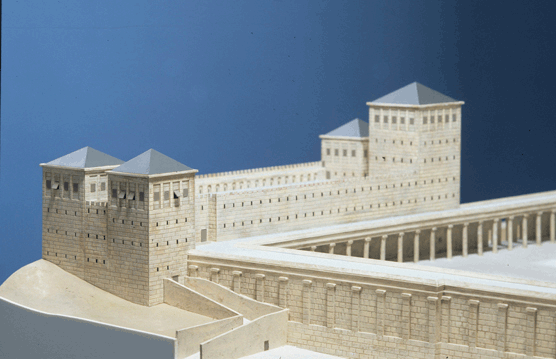
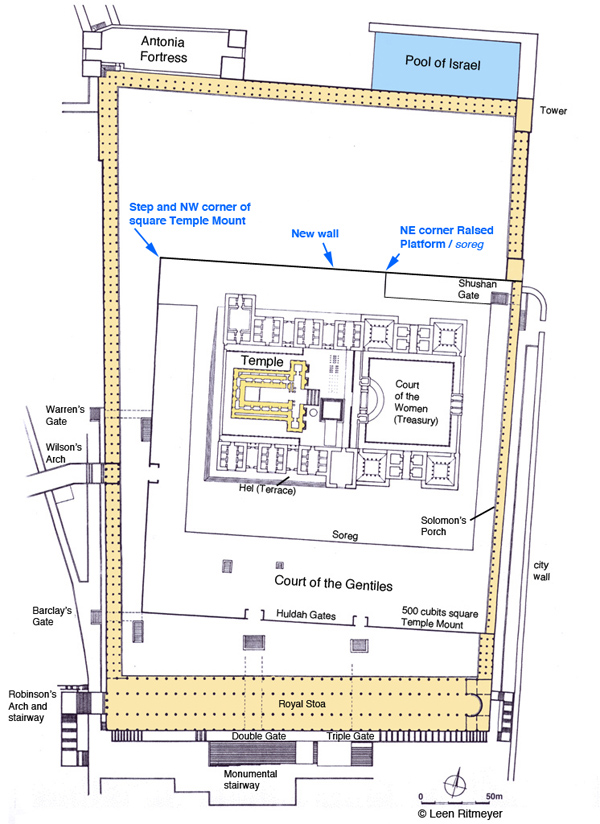
The read area was the Roman Fort Antonia, the blue area was the Temple area. Josephus says Fort Antonia was like a city within a city, that’s how big it was. Like every Roman Fort it had a praetorium, the commander’s house.


The read area was the Roman Fort Antonia, the blue area was the Temple area. Josephus says Fort Antonia was like a city within a city, that’s how big it was.

http://oi68.tinypic.com/21enpc8.jpg
ritmeyer.com/2009/02/02/the-antonia-herods-temple-mount-fortress/


As an aside, just to give some perspective, the current Church of the Condemnation and the Church of the Flagellation are north of the Temple mount.

(Please Note: This uploaded content is no longer available.)
 
Leen Ritmeyer wants to build a Jewish temple on the site of the Dome of the rock. That’s why he moves Fort Antonia out of the area in question.
What do you make of the archaeology then?

And an extract from his reply to Ernest Martin:

The Antonia Fortress

To accommodate his theory, Martin claims that the Herodian Temple Mount walls do not belong to the Temple Mount but to the Antonia Fortress. This idea is untenable however because Josephus said that Titus had “ordered the troops that were with him to raze the foundations of Antonia,” an undertaking that took seven days to complete (JW 6.93, 149). Indeed, apart from the rockscarp, nothing much has survived of the Antonia. The size of the Temple Mount is approximately 35 times that of the Antonia. If the Temple Mount remains represent those of the Antonia, then it would have been utterly impossible to destroy it in seven days.

The rocky platform on which the Antonia was built can still be seen at the north-west corner of the Temple Mount. I do not know of any serious archaeologist or historian who would place the Antonia elsewhere. Despite the destruction of the walls of the fortress by Titus, the rocky Antonia plateau continued to play a strategic role in the subsequent battle for the Temple Mount. Josephus writes that the commander the Fifth Legion directed some of the later attacks from this commanding height (JW 6. 133) and Titus oversaw the final destruction of the Temple from the same elevated spot (JW 6.246, 249). Josephus mentions the demolition of the Antonia for the last time in (JW 6.311):

The Jews, after the demolition of the Antonia, reduced the Temple to a square, although they had it recorded in their oracles that the city and the sanctuary would be taken when the Temple should become four-square.

This shows that by demolishing the Antonia, the Romans controlled the Herodian extensions around the original square Temple Mount and these became the next line of defense for the Jewish fighters.

Summary

During my years of excavating in Jerusalem, I discovered the archaeological remains of the early platform mentioned above. To say that the Temple Mount remained a small square platform shows an unfamiliarity with the historical sources as well as the archaeology. According to Martin’s interpretation of some sources, Jews did not begin to pray at the Western (Wailing) Wall until the end of the 16th Century AD. The writings of the Pilgrim of Bordeaux, which dates from AD 333, clearly indicate prayers were said there at the time:

The Jews come there [the ruins of the temple] once a year, weeping and wailing near a stone which survived the destruction of the Temple.

There remained more than just a stone because a Byzantine inscription quoting Isaiah 66:14, dating from AD 363, has been found near Robinson’s Arch. This shows beyond any doubt that the Western Wall of the Temple Mount was standing in the Byzantine period and was an important place for the Jewish population of Jerusalem.

Martin claims to have worked for many years with Profesor Benjamin Mazar. Although I was the dig’s architect from 1973 and continued to work with Mazar for a long time afterwards I do not remember meeting Martin or Mazar ever mentioning him. To say that the present walls of the Temple Mount belong to the Antonia is to do an injustice, to say the least, to Mazar and all who worked with him for 10 years. The excavation results have abundantly shown that these walls with their surviving gates belong to the Herodian Temple Mount and that the extant remains are also those described in the historical records. If the Temple Mount was merely a Roman camp as Martin asserts, why were Hebrew inscriptions such as the Is 66:14 one mentioned above, or the Trumpeting Stone, or the Korban (sacrifice) vessel found in Herodian strata together with many Jewish coins? Why are the beautiful domes of the Double Gate passageway decorated with botanic and geometric designs in accordance with the Mosaic prohibition instead of portraying humans and animals which were prevalent in the Roman architectural world? If Martin is assumed to be correct, I could go on asking many more such questions to which there are no answers.​
 
What do you make of the archaeology then?

And an extract from his reply to Ernest Martin:

The Antonia Fortress

To accommodate his theory, Martin claims that the Herodian Temple Mount walls do not belong to the Temple Mount but to the Antonia Fortress…
I do not say the southern and western walls (retaining walls) belong to or are the foundations of Fort Antonia.

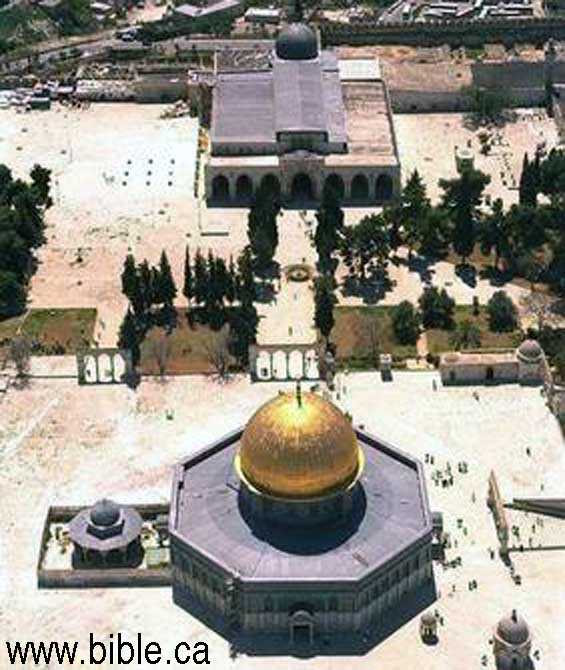
There was always two building there, the tower and the temple. The site of the Dome of the rock, was were the Roman soldiers was. And this is where they flogged Jesus.

 
I do not say the southern and western walls (retaining walls) belong to or are the foundations of Fort Antonia.

There was always two building there, the tower and the temple. The site of the Dome of the rock, was were the Roman soldiers was. And this is where they flogged Jesus.

http://www.bible.ca/archeology/bibl...m-temple-mount-dome-al-kas-al-aqsa-aerial.jpg
members.bib-arch.org/publication.asp?PubID=BSBA&Volume=22&Issue=1&ArticleID=5


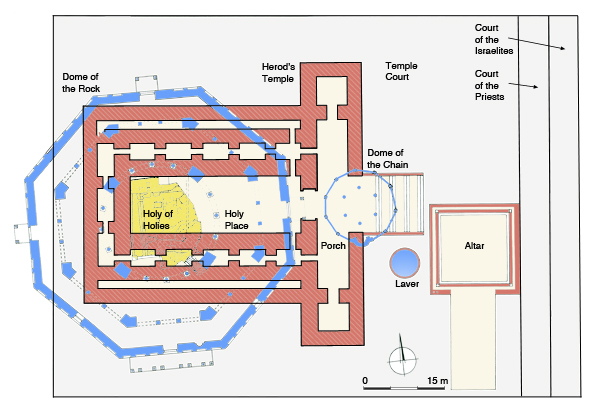
If we assume your theory that the Antonia stood over the Dome of the Rock, that would make for a very cramped Temple Mount. There would be no space for a Temple at all even.


If we assume your theory that the Antonia stood over the Dome of the Rock, that would make for a very cramped Temple Mount. There would be no space for a Temple at all even.

http://www.ritmeyer.com/wp-content/uploads/2014/01/jlm_herod_tm_plan_d01.jpg
All of your drawings are Leen Ritmeyer drawings, look what a joke he made out of the Roman fortress Antonia, you can hardly see it in the upper left corner. As I said Leen Ritmeyer wants to build a Jewish temple on the site of the Dome of the rock. That’s why he draws the way he does.

The temple square (500x500 cubits) fits nicely in the remaining area.

 
All of your drawings are Leen Ritmeyer drawings, look what a joke he made out of the Roman fortress Antonia, you can hardly see it in the upper left corner. As I said Leen Ritmeyer wants to build a Jewish temple on the site of the Dome of the rock. That’s why he draws the way he does.
Because the rockscarp where the Antonia would have stood still pretty much exists?

aias.org.uk/wp-content/uploads/2016/03/Bulletin%20of%20the%20Anglo-Israel%20Archaeological%20Society%20-%201990-1991%20-%20Volume%2010…pdf


The temple square (500x500 feet) fits nicely in the remaining area.
500 x 500 cubits.
 
All of your drawings are Leen Ritmeyer drawings, look what a joke he made out of the Roman fortress Antonia, you can hardly see it in the upper left corner. As I said Leen Ritmeyer wants to build a Jewish temple on the site of the Dome of the rock. That’s why he draws the way he does.
Because the rockscarp where the Antonia would have stood still pretty much exists?


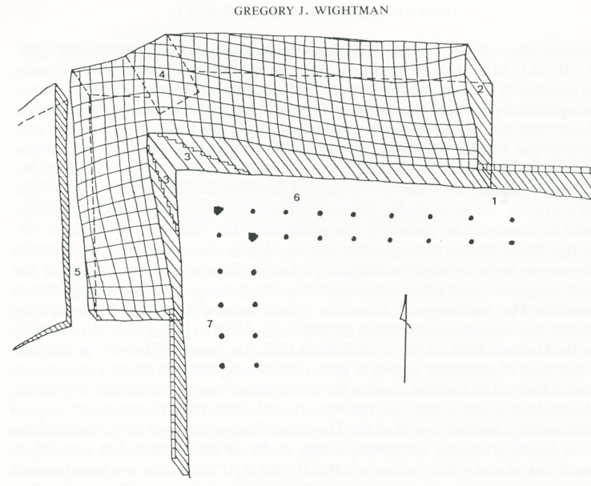
(Temple Fortresses in Jerusalem Part II: The Hasmonean Baris and Herodian Antonia, Gregory J. Wightman)
The temple square (500x500 feet) fits nicely in the remaining area.
I think you mean 500 x 500 cubits.
 
To rewind, Wightman on the praetorium of the gospels:

After reconstructing the fortress Vincent proceeded to identify it as the praetorium of the Gospel narratives, and to recognize in the pavement the infamous lithostrōtos of John 19:13:* ‘Hearing these words, Pilate had Jesus brought out [from the praetorium], and seated himself on the chair of judgment at a place called the lithostrōtos, in Hebrew gabbatha.’ The praetorium is mentioned also in John 18:28-29:* ‘They then led Jesus from the House of Caiaphas to the praetorium. They did not go into the praetorium themselves or they would have been defiled; so Pilate came out to them;’ and also in the Gospels of Matthew and Mark:* ‘the soldiers took Jesus with them into the praetorium’ (Matt. 27:27);* ‘the soldiers led Jesus away to inside the palace, which is the praetorium’ (Mark 15:16).

Josephus related that on the occasions when the Roman prefect/procurator visited Jerusalem he stayed in Herod’s palace in the Upper City along with his praetorian bodyguard, leaving the defence of the Temple area to the cohort stationed in the Antonia. Vincent believed, however, that on special feast days, when civil disturbances were more likely, the prefect/procurator would remove to the Antonia to personally supervise proceedings (Vincent 1954, 216ff.). Obviously, if the pavement dates to the 2nd century AD (which is likely), it could not be the lithostrōtos. Yet even if the pavement had been the central court of the Antonia, it would still not qualify as the New Testament lithostrōtos, because by law a Roman judgment tribunal could be set up only outside the praetorium in a public place, since the public was forbidden access to the interior of the praetorium. This is the sense of John 18:28-29 and 19:13: Jesus was taken into the praetorium for questioning by Pilate, but the Jewish mob remained outside for fear of defilement, and also because they simply were not allowed in. Pilate then came out of the praetorium and delivered his judgment at a tribunal set up on the lithostrōtos.

**Mark 15:16 draws an equivalence between the palace (aulē) and the praetorium (praitōrion). During the Imperial period ‘praetorium’ was the name given to the official residence of a provincial governor. Its equivalent names in Greek (apart from the simple transliteration) were stratēgion, ta basileia, hē aulē, or hē aulē basilikē (Benoit 1952, 531). Acts 23:35 refers to the residence of the prefect / procurator at Caesarea Maritima as the praitōrion tou Hērōidou (it had formerly been the palace of King Herod). Herod’s palace in the Upper City of Jerusalem was called by Josephus hē basilikē aulē (Life 46.407), hē basileas aulē (War V.176), and even hē anatera aulē (i.e. ‘the upper palace’; War II.429). Thus for Benoit there was no doubt that the aulē of Mk 15:16 is the same as the praetorium, the official residence of the Roman prefect/procurator in Jerusalem. **

In further support of this equation Benoit invoked a passage from the War (II. 301-08) which described the procurator Gessius Florus’ persecution of the seditious Jews, whom he had sentenced to death by scourging and crucifixion. Florus delivered his judgment at a tribunal (bēma) set up in front of (pro) the palace (basileia), in full view of the Chief Priests and Elders. The palace referred to here can mean only Herod’s palace in the Upper City, for at that time Herod Agrippa II’s sister, Berenice, happened to be staying in Jerusalem and, out of fear for her life, had sought refuge in another palace, which can have been none other than the family palace of the Hasmoneans, in which Agrippa II and his family lived whilst in the city. Although Vincent is probably correct in calling the Antonia ‘La palace primitive d’ Hérode’, used by the king before construction of the Upper Palace, and despite Josephus’ estimation of the Antonia as a palatial building in its own right, there is no clear evidence that the Antonia was commonly thought of as a palace during the 1st century AD. Only three palaces (called such) are known in the city of that period: two of them have been mentioned above; the third was that of queen Helena of Adiabene in the Lower City. It is also known, on the other hand, that during the 1st century AD the Antonia’s common name was the parembolē, i.e., soldiers’ barracks, mentioned several times in Acts (21:34-37, 22:24, 23:10,16,32). Just how common the name Antonia was among Jerusalem’s citizens during the Roman occupation is an interesting question. Josephus’ use of the name may have been conditioned to some extent by his pro-Roman sentiments and by the fact that he was writing for a Roman readership.
 
(Continued)

In any event, there seems little doubt that the Antonia was not the praetorium of the Gospels. Benoit was surely correct in identifying the praetorium with Herod’s palace in the Upper City, and in locating the lithostrōtos in an open, public area near the main gate of the palace (not, however, within the Upper Market/Forum, which is mentioned in connection with Florus’ persecution in War 11.301-08, but as a separate place where he set up his tribunal). Commenting on the Greek word lithostrōtos, transliterated from the Aramaic as gabbatha, Benoit, like most scholars before him, derived the word from the Hebrew root gavah, meaning ‘high’, ‘lofty’ , ‘tall’ or ‘exalted’. This is undoubtedly correct, though the Greek form gabbatha probably came directly from the Aramaic gāvuṯ or gāvuṯa’, meaning a ‘height’ or ‘elevation’ (as used in Aramaic targums on the Hebrew Bible), referring in the present context either to the exalted position of the tribunal and lithostrōtos or, as Benoit suggested (1952, 548-49), to the lithostrōtos being set up high in the Upper City (hence, gbh = anō).
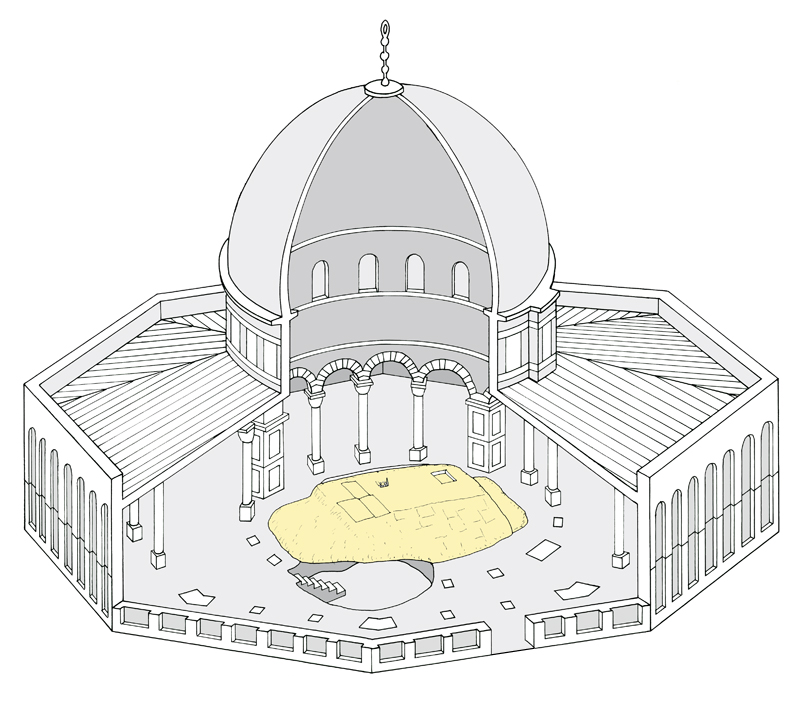
The rock on which fort Antonia was build is under the Dome of the rock. As Josephus said, fort Antonia was build on the highest rock, the Temple was lower then the fort.
This is the important question I think: Evidence? The rockscarp on the Umariyya School is apparently also higher than the Temple Mount proper, I mean.
 
PNEUMA;13963224:
The rock on which fort Antonia was build is under the Dome of the rock. As Josephus said, fort Antonia was build on the highest rock, the Temple was lower then the fort.
This is the important question I think: Evidence? The rockscarp on the Umariyya School is apparently also higher than the Temple Mount proper, I mean.
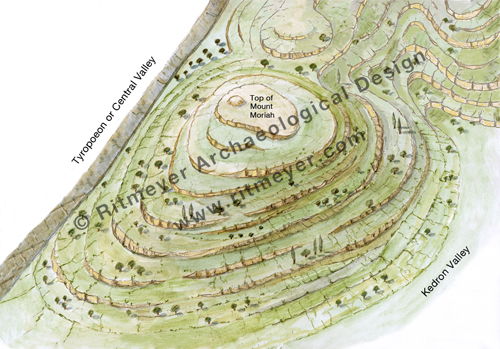
No Mount Moriah is higher, Antonia was build on this top, the Temple was lower down.

 
Status
Not open for further replies.
Back
Top