Historical accuracy of the gospel of John

  • Thread starter Thread starter Tomdstone
  • Start date Start date
Status
Not open for further replies.
Mount Moriah refers to the whole hill.

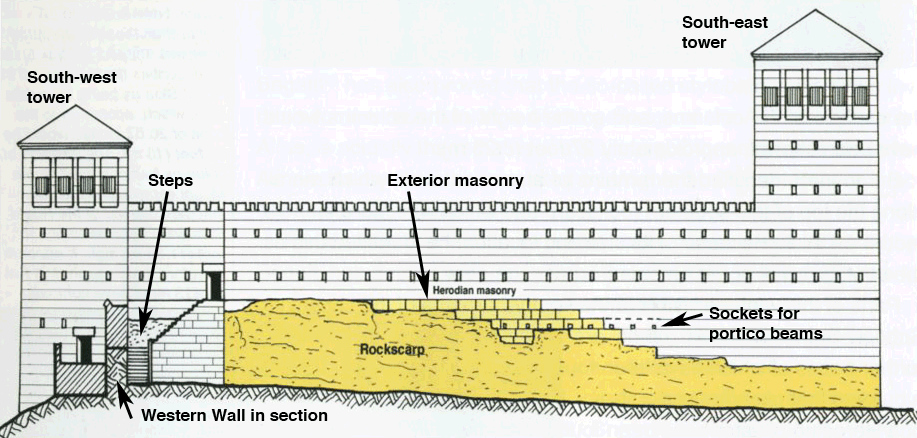
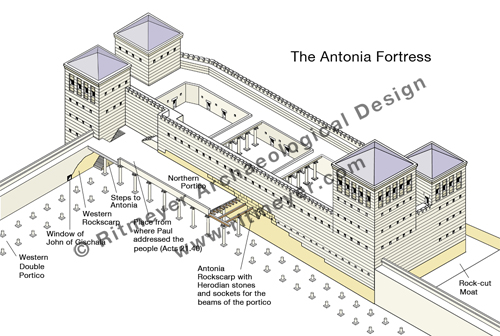
The fact that the rockscarp on the Umariyya School still juts out and that there are sockets for what may have been the roofing beams of the Herodian porticos is evidence that the Antonia - which we’ll assume for a moment was really built over this rock - was on higher ground.


(Please Note: This uploaded content is no longer available.)


The current
 
ccel.org/j/josephus/works/war-5.htm

“Now as to the tower of Antonia, it was situated at the corner of two cloisters of the court of the temple; of that on the west, and that on the north; it was erected upon a rock of fifty cubits in height, and was on a great precipice; it was the work of king Herod, wherein he demonstrated his natural magnanimity. In the first place, the rock itself was covered over with smooth pieces of stone, from its foundation, both for ornament, and that any one who would either try to get up or to go down it might not be able to hold his feet upon it. Next to this, and before you come to the edifice of the tower itself, there was a wall three cubits high; but within that wall all the space of the tower of Antonia itself was built upon, to the height of forty cubits. The inward parts had the largeness and form of a palace, it being parted into all kinds of rooms and other conveniences, such as courts, and places for bathing, and broad spaces for camps; insomuch that, by having all conveniences that cities wanted, it might seem to be composed of several cities, but by its magnificence it seemed a palace. And as the entire structure resembled that of a tower, it contained also four other distinct towers at its four corners; whereof the others were but fifty cubits high; whereas that which lay upon the southeast corner was seventy cubits high, that from thence the whole temple might be viewed; but on the corner where it joined to the two cloisters of the temple, it had passages down to them both, through which the guard (for there always lay in this tower a Roman legion) went several ways among the cloisters, with their arms, on the Jewish festivals, in order to watch the people, that they might not there attempt to make any innovations; for the temple was a fortress that guarded the city, as was the tower of Antonia a guard to the temple; and in that tower were the guards of those three . There was also a peculiar fortress belonging to the upper city, which was Herod’s palace; but for the hill Bezetha, it was divided from the tower Antonia, as we have already told you; and as that hill on which the tower of Antonia stood was the highest of these three, so did it adjoin to the new city, and was the only place that hindered the sight of the temple on the north.”
 
Another thing.

We know Herod the Great leveled the Temple Mount. So the actual height of the mountain was already obscured - just like now the area around the Temple would have been completely level. And yes, there is what appears to be the remains of Herodian-era pavement on the current Temple Mount.
 
Mount Moriah refers to the whole hill.

The fact that the rockscarp on the Umariyya School still juts out and that there are sockets for what may have been the roofing beams of the Herodian porticos is evidence that the Antonia - which we’ll assume for a moment was really built over this rock - was on higher ground.
1st-century historian Flavius Josephus (not Leen Ritmeyer) “that hill on which the tower of Antonia stood was the highest”

 
ccel.org/j/josephus/works/war-5.htm

“Now as to the tower of Antonia, it was situated at the corner of two cloisters of the court of the temple; of that on the west, and that on the north; it was erected upon a rock of fifty cubits in height, and was on a great precipice; it was the work of king Herod, wherein he demonstrated his natural magnanimity. In the first place, the rock itself was covered over with smooth pieces of stone, from its foundation, both for ornament, and that any one who would either try to get up or to go down it might not be able to hold his feet upon it. Next to this, and before you come to the edifice of the tower itself, there was a wall three cubits high; but within that wall all the space of the tower of Antonia itself was built upon, to the height of forty cubits. The inward parts had the largeness and form of a palace, it being parted into all kinds of rooms and other conveniences, such as courts, and places for bathing, and broad spaces for camps; insomuch that, by having all conveniences that cities wanted, it might seem to be composed of several cities, but by its magnificence it seemed a palace. And as the entire structure resembled that of a tower, it contained also four other distinct towers at its four corners; whereof the others were but fifty cubits high; whereas that which lay upon the southeast corner was seventy cubits high, that from thence the whole temple might be viewed; but on the corner where it joined to the two cloisters of the temple, it had passages down to them both, through which the guard (for there always lay in this tower a Roman legion) went several ways among the cloisters, with their arms, on the Jewish festivals, in order to watch the people, that they might not there attempt to make any innovations; for the temple was a fortress that guarded the city, as was the tower of Antonia a guard to the temple; and in that tower were the guards of those three . There was also a peculiar fortress belonging to the upper city, which was Herod’s palace; but for the hill Bezetha, it was divided from the tower Antonia, as we have already told you; and as that hill on which the tower of Antonia stood was the highest of these three, so did it adjoin to the new city, and was the only place that hindered the sight of the temple on the north.”
“There was also a peculiar fortress belonging to the upper city, which was Herod’s palace.”

For the record, remember when I quoted Philo?

[Pilate], not so much to honour Tiberius as to annoy the multitude, dedicated in Herod’s palace in the holy city some shields coated with gold. They had no image work traced on them nor anything else forbidden by the law apart from the barest inscription stating two facts, the name of the person who made the dedication and of him in whose honour it was made. …] Now at that time it was shields on which no likeness had been painted; now it is a colossal statue. Then too the installation = the shields] was in the house of the governors; now they say it = the statue] is to be in the inmost part of the temple in the special sanctuary itself …]
 
“that hill on which the tower of Antonia stood was the highest”

http://oi65.tinypic.com/vg0oe9.jpg
If we’re going to read Josephus overly-literally, then we would have to imagine that the Antonia stood on ‘Mount Zion’ (the Western Hill), because it is literally the highest hill in Jerusalem (approx. 2,510-40 ft), higher than even Mount Moriah / Temple Mount (approx. 2,430-40 ft). Even the hill north of Moriah is higher (approx. 2530 ft) - which would be consistent with Josephus. Heck, the rockscarp (2462 ft) is even higher than the Temple area and the Foundation Stone.

http://www.dabar.org/mcgarvey/lands/p145.gif
 
If we’re going to read Josephus overly-literally, then we would have to imagine that the Antonia stood on ‘Mount Zion’ (the Western Hill), because it is literally the highest hill in Jerusalem (approx. 2,510-40 ft), higher than even Mount Moriah / Temple Mount (approx. 2,430-40 ft). Even the hill north of Moriah is higher (approx. 2530 ft) - which would be consistent with Josephus. Heck, the rockscarp (2462 ft) is even higher than the Temple area and the Foundation Stone.

http://www.dabar.org/mcgarvey/lands/p145.gif
Drawings from old books ? I have some my self. Where is the Temple square ? and where is the Fort Antonia in my drawings ?


(Continuing from my last post)

The East Hill, or promontory, really starts from the plateau north of the present city-wall near the Church of St. Stephen, and runs between the W. Sitti Mariam and el-Wâd southward to its lowest point at Siloam: approximately 1968 years (1800 m.) long, or nearly a mile and an eighth; narrow and falling steeply on either side into the Wâdy Sitti Mariam and el-Wâd, which are now choked with debris, but were once 20 to 40 feet deeper. The East Hill has now four summits; but anciently had perhaps five. The northernmost is outside the present City: the knoll el-Edhemîyeh 2549 feet (about 777 m.) above the sea. The long trench between it and the city wall is artificial, some think on the line of an ancient, natural gully running east into the W. Sitti Mariam. The second summit of the East Hill is within the north-east angle of the present City, the Mohammedan quarter, anciently Bezetha: on which some of the levels, above the entrance to the Royal Quarries, are 2524 feet (769.5 m.) East of this summit the East Hill was cleft from north to south in ancient times by a ravine which begins to sink from the plateau outside the north wall, north-east of el-Edhemîyeh, and may be traced under that wall, past the Church of St. Anne (where it is 2411 feet or 735 m.) into the present Birket Israil (2344 or 714.3 m.), form which it bends eastward a little, and beneath the north-east corner of the Haram area issues on the W. Sitti Mariam, just north of the Golden Gate, at a level of about 2230 feet or 680 m. On the west of this gully the East Hill runs south by a narrow saddle to the prominent rock (2462 feet, 750.3 m.) on which the castle Antonia was built, the site of the present Turkish barracks. From this point the original gradients of the East Hill are masked by the artificial platform of the Haram esh-Sherîf, the ancient Temple area, the general level of which is about 2420 feet (circa 737 m.). The next original summit, however, the fourth, may be taken to be the Rock es-Sakhra, beneath the great Dome, 2440 feet or nearly 744 metres. From this the natural hill declines rapidly southwards beneath the present mosque el-Aḳṣâ and (I reserve in the meantime the question whether it originally rose once more into a hump or knoll south of the Haram) more gradually falls to about 2100 feet (640 m.) at Siloam.
  • Jerusalem: The Topography, Economics and History from the Earliest Times to A.D. 70, George Adam Smith (1907)
About those old maps: the important question is, when were these made? Were these made during or after the heyday of major archaeological explorations and surveys of Jerusalem (the mid-to-late 19th century to early-to-mid 20th century), or before?

More importantly, were these maps made during or after the surveys and expeditions carried out in or near the area by the likes of Edward Robinson (1838), Charles Wilson, Charles Warren, Conrad Schick (all 1860s-1870s), E.T. Richmond (1924) or R.W. Hamilton (1938-1942)?
 
(Continuing from my last post)
…About those old maps: the important question is, when were these made? Were these made during or after the heyday of major archaeological explorations and surveys of Jerusalem (the mid-to-late 19th century to early-to-mid 20th century), or before?

More importantly, were these maps made during or after the surveys and expeditions carried out in or near the area by the likes of Edward Robinson (1838), Charles Wilson, Charles Warren, Conrad Schick (all 1860s-1870s), E.T. Richmond (1924) or R.W. Hamilton (1938-1942)?
Oh, I get it, the newer the better. Leen Ritmeyer 2016 AD is correct, Pilgrim of Bordeaux 333 AD is wrong.

The praetorium and the retaining walls, were in the Tyropoeon valley. And prefect Pontius Pilate was there “early in the morning” when they brought Jesus to him (John 18:28) He was not in Herod’s palace, neither were his soldiers, they where there to guard Herods Temple during next days festival, the Passover.

http://www.sptimes.com/News/020501/photos/flo-roman.jpg
 
Oh, I get it, the newer the better. Leen Ritmeyer 2016 AD is correct, Pilgrim of Bordeaux 333 AD is wrong.
Obviously. 😉

But in seriousness, the Bordeaux Pilgrim would not have been in agreement with the view you’re expressing anyway, because he and other pre-7th century pilgrims place the praetorium / house of Pilate not in the Temple Mount itself, but on a church (the Hagia Sophia) near the western slope of the Tyropoeon Valley west of and outside the Temple Mount. If you read their descriptions carefully, you would notice that all these pilgrims speak of the church in conjunction with Mount Zion (the Western Hill) and shrines on the area such as the House of Caiaphas or the Hagia Sion (the Upper Room / the Cenacle), which are apparently nearby - not the Temple Mount.

I’m quoting the Bordeaux Pilgrim again - this time in a fuller form.

There are in Jerusalem two large pools at the side of the temple, that is, one upon the right hand, and one upon the left, which were made by Solomon; and further in the city are twin pools, with five porticoes, which are called Bethsaida. There persons who have been sick for many years are cured; the pools contain water which is red when it is disturbed. There is also here a crypt, in which Solomon used to torture devils. Here is also the corner of an exceeding high tower, where our Lord ascended and the tempter said to Him, ‘If thou be the Son of God, cast thyself down from hence.’ And the Lord answered, ‘Thou shalt not tempt the Lord thy God, but him only shalt thou serve.’ There is a great corner-stone, of which it was said, ‘The stone which the builders rejected is become the head of the corner.’ Under the pinnacle of the tower are many rooms, and here was Solomon’s palace. There also is the chamber in which he sat and wrote the (Book of) Wisdom; this chamber is covered with a single stone. There are also large subterranean reservoirs for water and pools constructed with great labour.

And in the building itself, where stood the temple which Solomon built, they say that the blood of Zacharias which was shed upon the stone pavement before the altar remains to this day. There are also to be seen the marks of the nails in the shoes of the soldiers who slew him, throughout the whole enclosure, so plain that you would think they were impressed upon wax. There are two statues of Hadrian, and not far from the statues there is a perforated stone, to which the Jews come every year and anoint it, bewail themselves with groans, rend their garments, and so depart. There also is the house of Hezekiah King of Judah.

Also as you come out of Jerusalem to go up Mount Sion, on the left hand, below in the valley, beside the wall, is a pool which is called Siloe and has four porticoes; and there is another large pool outside it. This spring runs for six days and nights, but on the seventh day, which is the Sabbath, it does not run at all, either by day or by night. On this side one goes up Sion, and sees where the house of Caiaphas the priest was, and there still stands a column against which Christ was beaten with rods. Within, however, inside the wall of Sion, is seen the place where was David’s palace. Of seven synagogues which once were there, one alone remains; the rest are ploughed over and sown upon, as said Isaiah the prophet.

From thence as you go out of the wall of Sion, as you walk towards the gate of Neapolis, towards the right, below in the valley, are walls, where was the house or praetorium of Pontius Pilate. Here our Lord was tried before His passion. On the left hand is the little hill of Golgotha where the Lord was crucified. About a stone’s throw from thence is a vault wherein His body was laid, and rose again on the third day. There, at present, by the command of the Emperor Constantine, has been built a basilica, that is to say, a church of wondrous beauty, having at the side reservoirs from which water is raised, and a bath behind in which infants are washed (baptized).

Also as one goes from Jerusalem to the gate which is to the eastward, in order to ascend the Mount of Olives, is the valley called that of Josaphat. Towards the left, where are vineyards, is a stone at the place where Judas Iscariot betrayed Christ (Matt 26,47-50); on the right is a palm tree, branches of which the children carried off and strewed in the way when Christ came (Matt 31:8). Not far from thence, about a stone’s throw, are two notable tombs of wondrous beauty; in the one, which is a true monolith, lies Isaiah the prophet, and in the other Hezekiah, King of the Jews.

From thence you ascend to the Mount of Olives, where before the Passion, the Lord taught His disciples. There by the orders of Constantine a basilica of wondrous beauty has been built. Not far from thence is the little hill which the Lord ascended to pray, when he took Peter and John with Him, and Moses and Elias were beheld.

Note - he distinguishes between the Temple Mount and the house of Pilate. In fact, the Es-Sakhra / Foundation Stone in the Dome of the Rock may be “the perforated stone” venerated by Jews that the pilgrim was describing, or some other stone in the precincts.


As per the pilgrim (and the other Byzantine-era pilgrims), the Byzantine praetorium would have been somewhere in that area circled in red. Incidentally, Josephus does say that there was a Hasmonean-era palace located west of the Temple Mount (west of the Western Wall), on the eastern slope of the Upper City - in other words, roughly around this area (War 2.16, 3, 344).
 

As per the pilgrim (and the other Byzantine-era pilgrims), the Byzantine praetorium would have been somewhere in that area circled in red. Incidentally, Josephus does say that there was a Hasmonean-era palace located west of the Temple Mount (west of the Western Wall), on the eastern slope of the Upper City - in other words, roughly around this area (War 2.16, 3, 344).
The Bordeaux Pilgrim did not say that the house or praetorium of Pontius Pilate was along the Cardo Maximus (broad street) of Jerusalem.

The Bordeaux Pilgrim was in fact walking down the Cardo Maximus, from mount Sion towards the Damascus gate, that is at the end of Cardo Maximus. (I have walked it my self)

Looking down and to the right (from todays Jewish quarter) he saw the temple mount walls and the Praetorium below in the Tyropoeon Valley.


This is the perforated foundation stone. The Solomon tempel, the statues of Hadrian, the subterranean reservoirs and all the rest was at the south end of the Temple Mount

 
Continuing my last post first.

I’ll quote the other Byzantine-era pilgrims.

This is the anonymous pilgrim of Piacenza:

Then we came to the basilica of Holy Zion, where there are many miraculous things, among which is the cornerstone about which it is written that it was rejected by the builders (Matt 21:42). As Lord Jesus entered into this church, which was the house of Saint James, he found that misshaped stone lying around, he picked it up and he placed it in the corner. …] In that church there is a column, where the Lord was whipped. That column has a great mark on it: while he clasped it, his chest inhered in that marble and both of his hands and his fingers and palms appear in that rock, such that measurements can be drawn out for all manner of ailments from it, and they wear them around their necks and they are healed. On that column there is a horn, from which the kings, including David, were anointed. There is in that church also the crown of thorns with which the Lord was crowned (Matt 27:29), and the lance with which the Lord’s side was pierced (John 19:34). There are many stones, with which Stephen was stoned (Acts 7). There is also the small column on which they cross of blessed Peter was set, on which he was crucified in Rome. There is the chalice of the apostles, with which they made communion after the Lord’s resurrection, and many other marvelous items which I can’t recall. There is a monastery of women. I saw a human head enclosed in a golden casket adorned with jewels, which they say is that of the holy martyr Theodota, from which many people drink for a blessing; so I drank, also.

From Zion we came to the basilica of Saint Mary, where there is a considerable congregation of monks and there are also hostels for men and women. They receive pilgrims with innumerable tables, and more than 3000 beds for the sick. We prayed in the praetorium where the Lord was tried, where there is the small basilica of Saint Sophia before the ruins of Solomon, beneath the streets which go down to the fountain of Siloam outside Solomon’s porch. In that basilica there is the seat where Pilate sat when he tried the Lord. Moreover the four-cornered stone is there, on which he was standing in the middle of the praetorium. The criminal being tried was raised up on this stone, so that all the people could see and hear him; the Lord was raised up on it when he was tried by Pilate, and his footprints remain on it. He had a pretty foot, small, delicate, and he was of a regular height, with a handsome appearance, curly hair, a shapely hand with long fingers; he is depicted in an image which was made of him while he was still living and is set in that same praetorium. From that rock, where he stood, many miracles are performed; a measure is taken from his footprints, and people wear them for various ailments and are cured. That stone is also decorated with gold and silver.

This is Theodosius (ca. 518):

In the city of Jerusalem at the Lord’s Sepulchre is the place of Calvary, where Abraham offered up his son for a burnt-offering, and because the mountain is rocky, Abraham made the altar in the mountain itself, i.e. At its foot. Above the altar the mountain towers and the ascent of the mountain is made by steps. There the Lord was crucified.
From the Lord’s Sepulchre to the place of Calvary it is 15 paces; it is all under one roof.
From the place of Calvary it is 15 paces to Golgotha, where the cross of the Lord was found.
From Golgotha it is 200 paces to holy Sion, the mother of all churches; which Sion our Lord Christ founded with His apostles. It was the house of S. Mark the Evangelist.
From holy Sion to the house of Caiphas, now the Church of S. Peter, it is 50 paces more or less.
From the house of Caiphas to the Hall of Pilate it is 100 paces more or less. There is the Church of S. Sophia. Hard by holy Jeremiah was cast into the pit.
The pillar formerly in the house of Caiaphas, at which the Lord Christ was scourged, is now in holy Sion. This pillar at the bidding of the Lord followed Him; and as He clung to it while He was being scourged, His arms, hands, and fingers sank into it, as if it were wax, and the marks appear to this day. Likewise His whole countenance, His chin, nose and eyes are imprinted on it as if it were wax.
S. Stephen was stoned outside the Galilean Gate; and there is his church, which was built by S. Eudocia, the wife of the emperor Theodosius.
The Pool of Siloam is 100 paces from the place where the prophet Jeremiah was cast into the pit; the pool is within the wall. From the house of Pilate to the Pool of the Sheep Market is about 100 paces. There the Lord Christ cured the palsied man, whose bed is still here. Also near the Pool of the Sheep Market is the Church of S. Mary.

This is from a breviarius or short guidebook of Jerusalem.

Thence you go to a very great basilica on the holy Sion, wherein is the column at which the Lord Jesus was scourged. One may see there the print of His hands as He held it, marked as deep as though the stone were wax. Then you come up to the place of sacrifice, where is the stone with which Saint Stephen was stoned. In the midst of this church is the crown of thorns which Jesus received. And there is the lamp [by the light of which] He taught His disciples after He had supped. There is the rod [with which He was scourged] enclosed within a column of silver.
Thence you go to the House of Caiaphas, where St. Peter denied [Christ]; where there is a large church dedicated to Saint Peter. Thence you go to the house of Pilate, where he delivered over our Lord to the Jews after He had been scourged; where there is a large basilica, and in it there is a chamber which is where they stripped Him and He was scourged; it is called [the church of] Saint Sophia.

 
Revising the pic from the second-to-last post a bit.


We have actually found what could be the possible location of the Hagia Sophia church, the Byzantine Praetorium - just west of the Western Wall, where the Yeshiva Porat Yosef is. So is the Byzantine location of Jeremiah’s pit (just by the Dung Gate).

Consistent with the Pilgrim of Bordeaux’s account, it is “as you walk towards the gate of Neapolis, towards the right, below in the valley.” Consistent with the pilgrim accounts, it is near where the New Church of St. Mary (the Nea Church) used to be.


(Please Note: This uploaded content is no longer available.)

 
For the record, while researching those last posts, I did find scholars who believe that the Hagia Sophia church = praetorium tradition may have something going for it.

I noted earlier that Josephus did say that there was a Hasmonean palace located west of and overlooking the Temple Mount, on the eastern slope of the Upper City (“the house of the Asamoneans … over the gallery, at the passage to the upper city, where the bridge joined the temple to the gallery” in War 2.344; cf. Antiquities 20.189-191). Interestingly, near the Porat Yosef Yeshiva, there’s another school called the Yeshiva ha-Kotel. The ruins of what was described as a “Herodian palatial mansion,” arguably the most beautiful Herodian-period building so far discovered, was discovered in it. The archaeologist Bargil Pixner (Paths of the Messiah and Sites of the Early Church from Galilee to Jerusalem) suggested that this “Palatial Mansion” is in reality “the house of the Asamoneans” described by Josephus, and that the praetorium of the gospels is in reality (part of) the long-lost Hasmonean palace - the Byzantine Hagia Sophia tradition is in other words accurate.

And from Pixner’s book: the area of the Hagia Sophia, the Nea church, and Jeremiah’s cistern.

 
We have actually found what could be the possible location of the Hagia Sophia church, the Byzantine Praetorium - just west of the Western Wall, where the Yeshiva Porat Yosef is. So is the Byzantine location of Jeremiah’s pit (just by the Dung Gate).
No the Praetorium was in front of the Temple

Pilgrim Antoninus of Piacenza 570 AD “From Sion we came to the Basilica of the Blessed Mary, where is a large congregation of monks, and where are also hospices (for strangers, both) for men and women. There I was received as a pilgrim ; there were countless tables, and more than three thousand beds for sick persons. We prayed in the Preatorium where the Lord was tried, which is now the Basilica of St. Sophia.’ In front of the ruins of the Temple of Solomon”

archive.org/stream/cu31924028534232/cu31924028534232_djvu.txt

And the the ruins of the Temple of Solomon are as we know, on the Temple mount.
 
No the Praetorium was in front of the Temple

Pilgrim Antoninus of Piacenza 570 AD “From Sion we came to the Basilica of the Blessed Mary, where is a large congregation of monks, and where are also hospices (for strangers, both) for men and women. There I was received as a pilgrim ; there were countless tables, and more than three thousand beds for sick persons. We prayed in the Preatorium where the Lord was tried, which is now the Basilica of St. Sophia.’ In front of the ruins of the Temple of Solomon”

archive.org/stream/cu31924028534232/cu31924028534232_djvu.txt

And the the ruins of the Temple of Solomon are as we know, on the Temple mount.
Please, quote the whole sentence!

Et oravimus in praetorio ubi auditus est dominus, ubimodo est basilica sancta Sophiae ante ruinas temple Salomonis sub platea quae decurrit ad Siloam fontem secus porticum Salomonis. In ipsa basilica est sedes ubi Pilatus sedit, quando dominum audiit.

The PPTS’ translation renders this as:

“We prayed in the Praetorium where the Lord was tried, which is now the Basilica of St. Sophia. In front of the ruins of the Temple of Solomon, under the street, water runs down to the fountain of Siloam. Near the porch of Solomon, in the church itself, is the seat upon which Pilate sat when he tried our Lord.”

But in a way, you’re right, since you could also render this passage as (if you parse the words differently):

And we prayed in the Praetorium where the Lord was tried, which is now the Basilica of St. Sophia before the ruins of the temple of Solomon, below the street which runs down to the fountain of Siloam near the porch of Solomon. In that basilica is the seat upon which Pilate sat when he tried our Lord.

But still, if you look at the context, obviously the Hagia Sophia would still be ‘before’ the ruins of the Temple, because the pilgrim’s route was Hagia Sion (Basilica of Holy Sion) → Nea Church (Basilica of St. Mary) → Hagia Sophia → Jeremiah’s Pit → Siloam. He was going (north)eastward, and since Hagia Sophia was just by the Western Wall and the Temple Mount’s southwest corner, it can be said to be ‘before’ the ruins of the Temple from the pilgrim’s perspective, but not if you go by your theory that the praetorium was the Antonia, no matter where exactly it was located in the Mount - since that would have been in the northern side, and that was not the direction the pilgrim was coming from.


Yes, there was some sort of Byzantine structure that might have been a church in the Temple Mount area (a mosaic floor was discovered), but it’s on the Al Aqsa mosque, not on the Dome of the Rock. As far as we know, based on the pilgrim accounts, the Temple Mount proper was left empty and ruined during the Byzantine period (aside from this possible structure on the Al-Aqsa).
 
Darnit, I didn’t make it past the edit limit, so:
Yes, there was some sort of Byzantine structure that might have been a church in the Temple Mount area (a mosaic floor was discovered), but it’s on the Al Aqsa mosque, not on the Dome of the Rock.
That, or it could be a house or some other structure. All we know is that it’s a Byzantine-era mosaic.
As far as we know, based on the pilgrim accounts, the Temple Mount proper was left empty and ruined during the Byzantine period (aside from this possible structure on the Al-Aqsa).
… although the southern end was used.

Aside from this, there was no church or even no anything special on the Temple Mount proper in the Byzantine era (much less the spot where the Dome of the ROck is); if there was, we would have expected pilgrims mentioning or visiting it. But all they say about the Temple - if they say anything about it all - is that it was essentially a pile of ruins. In the 6th century (AD 542) Madaba Map, the place where the Temple Mount is is scarcely shown or maybe even outright omitted. Which pretty much shows the contemporary Christian attitude toward it.

 
Darnit, I didn’t make it past the edit limit, so:

That, or it could be a house or some other structure. All we know is that it’s a Byzantine-era mosaic.

… although the southern end was used.

Aside from this, there was no church or even no anything special on the Temple Mount proper in the Byzantine era (much less the spot where the Dome of the ROck is); if there was, we would have expected pilgrims mentioning or visiting it. But all they say about the Temple - if they say anything about it all - is that it was essentially a pile of ruins. In the 6th century (AD 542) Madaba Map, the place where the Temple Mount is is scarcely shown or maybe even outright omitted. Which pretty much shows the contemporary Christian attitude toward it.

Should we not make another thread for this?
 
The rock on which fort Antonia was build is under the Dome of the rock. As Josephus said, fort Antonia was build on the highest rock, the Temple was lower then the fort.
Well what about that Shimon Gibson study in 2003 which found a listrotos in Herod’s palace?
 
Should we not make another thread for this?
Yeah, I think so.

To PNEUMA: Let me just make clear that I personally couldn’t care less where the Antonia and the Temple exactly stood in the 1st century. I just want you to show me proof that there was a Byzantine-era church on the Dome of the Rock (where you believe the Antonia to be), and that this church was the Hagia Sophia (aka St. Sophia) referred to by the Byzantine pilgrim accounts as the church that stood over what they believed then to be the Praetorium. Because that’s essentially where your argument is leading - will lead - since you quoted the Bordeaux pilgrim and the Piacenza pilgrim.
 
Status
Not open for further replies.
Back
Top