Just an aside.
The Pool of Bethesda
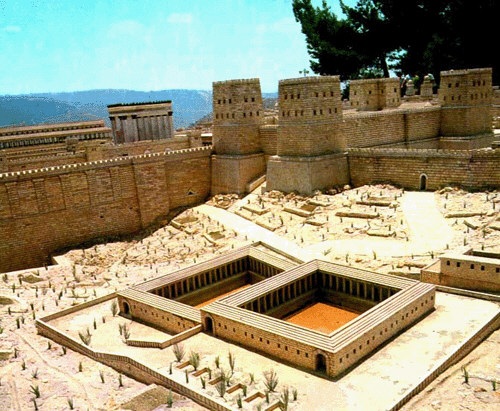
Now there is in Jerusalem by the Sheep Gate a pool, in Hebrew called Bethesda, which has five roofed colonnades. In these lay a multitude of invalids—blind, lame, and paralyzed [waiting for the moving of the water].
The interesting thing is (I believe this has been pointed out earlier in this thread), John’s gospel is the
only ancient text that ever mentions the Pool of Bethesda. (Josephus, one of our main sources for 1st century Jewish history, doesn’t mention it.) It was because for this reason that many early modern scholars doubted whether Bethesda was ever real at all. They came to the conclusion that John’s gospel was written by someone who had no first-hand knowledge of Jerusalem; Bethesda was seen as either a metaphorical place or as a figment of John’s imagination.
All this changed in the the late 19th century when German archaeologist Conrad Schick (1822-1901) discovered the remains of two large pools with five porches (four surrounding the two pools, one in between them) near
St Anne’s Church in the Muslim Quarter in Jerusalem. In the 1960s further excavations unearthed an adjacent Roman temple beneath the ruins of a medieval Crusader-era church and an even older Byzantine sanctuary that stood in the site.
As for the history of the Pool(s) of Bethesda: the original, northern pool - located northwest of the Temple Mount - was probably the “Upper Pool” mentioned in Isaiah 7:13 and 2 Kings 18:17-18. The remains of a pool cut across the shallow valley dating from the 8th century BC was also found at the site, which gives some credence to this identification. An opening in the reservoir allowed the height of the water to be controlled, and an open channel in the rock allowed water from the pool to be brought into the city.
Later, a second pool was added to the south, perhaps to increase the water capacity; the sluice gate is now used to drain the water of the northern pool into the southern pool. One theory is that this second pool was built by the high priest Simon II (ca. 220s-190s BC) during the late 3rd-early 2nd century BC as part of his construction projects across Jerusalem (cf. Sirach 50:2-3 “In his days a cistern for water was quarried out, a reservoir like the sea in circumference.”)
It’s still a matter of some debate as to what the original purpose of Bethesda was. The usual impression is that it was a dam or a reservoir for rainwater. But another idea is that it was (also) used, in addition to being a reservoir, as a
miqveh or a pool for ritual immersion, one of many in the city (the reason for this is that you’ve got to be ritually pure before entering the Temple Mount - therefore there were many such installations near the Temple for the use of worshipers and pilgrims). There is some support for this theory, in that there are a flight of steps extending down along the western side of the southern pool. (the pools are quite deep - 7-8 m / 21-24 ft.)
In addition, the presence of a Roman therapeutic establishment and John’s reference to invalids being there might suggest that Bethesda was also associated with healing. By the time the emperor Hadrian drove the Jews out of Jerusalem and turned it into the city of Aelia Capitolina around AD 130, there was an
asklepieion or
asclepium, a temple to the Greco-Roman god of healing Asclepius, just east of the southern pool, with natural caves located just to the north of it being converted into small baths.
A French scholar named Antoine Duprez put out a theory that this
asclepium had already existed earlier, during and maybe even slightly before the time of Jesus. In which case, Hadrian would have been renovating an already-existing establishment. Anticipating objections to his proposal, Duprez pointed out that Bethesda at that time was still outside the walls of Jerusalem (it would not be included into the city until Herod Agrippa’s reign in 41-44), not to mention that it was close enough to Antonia Fortress. The Roman troops stationed there, he says, could have been behind the development of a Greco-Roman cult in the area.
Now Duprez’s theory was not accepted by some scholars like Joachim Jeremias, since they found it hard to imagine that Jews before AD 70 could have put up with anything gentile within Jerusalem or even its precincts (we know from Josephus that they generally didn’t). But at the same time, it was pointed out that Duprez missed a possible analogy to his proposal. In the Mishnah, there is a reference to a place called ‘Gadyavan’ or ‘Gadyon’ which is apparently just located nearby the Pool of Siloam (or as it is called there, ‘Shiloh’). The name seems to be derived from the phrase
Gad Yavan “Greek (=
Yavan) Gad (= the name of a fortune deity).” Scholars therefore identify this
Gad Yavan with Fortuna Balnearis or Fortuna Salutaris, aspects of the Roman goddess of fortune associated with healing and bath-houses.
So even if there is a hesitancy to say that Bethesda was already an
asclepion at so early a date, one can’t totally rule out the possibility of an influence of the Asclepius cult in the area at that time (the pool also non-Jews in addition to Jews).
http://www.bible-history.com/jerusalem/pool_of_bethesda.jpg
A reconstruction of the Pool of Bethesda, with Antonia Fortress in the background
http://4.bp.blogspot.com/-1J6swsEvx...t8_-D4/s400/22b+Bethesda+-+biblewalks.com.jpg