
I heard someone say Christ was not crucified on a cross but an upright stake

  • Thread starter Thread starter Christine85
  • Start date Start date
Status
Not open for further replies.
Now, the problem with the Witnesses’ thinking is, the idea that Jesus died on a T or a †-shaped crux has more firm support in early Christianity.

Learn fully then, children of love, concerning all things, for Abraham, who first circumcised, did so looking forward in the spirit to Jesus, and had received the doctrines of three letters. For it says, “And Abraham circumcised from his household eighteen men and three hundred.” What then was the knowledge that was given to him? Notice that he first mentions the eighteen, and after a pause the three hundred. The eighteen is Ι (=10) and Η (=8) - you have Jesus (ΙΗϹΟΥϹ) - and because the cross was destined to have grace in the Τ (=300) he says “and three hundred.” So he indicates Jesus in the two letters and the cross in the other.

===

Similarly, again, he describes the cross in another Prophet, who says, “And when shall all these things be accomplished? saith the Lord. When the tree shall fall and rise, and when blood shall flow from the tree.” Here again you have a reference to the cross, and to him who should he crucified. And he says again to Moses, when Israel was warred upon by strangers, and in order to remind those who were warred upon that they were delivered unto death by reason of their sins - the Spirit speaks to the heart of Moses to make a representation of the cross, and of him who should suffer, because, he says, unless they put their trust in him, they shall suffer war for ever. Moses therefore placed one shield upon another in the midst of the fight, and standing there raised above them all kept stretching out his hands, and so Israel again began to be victorious: then, whenever he let them drop they began to perish. Why? That they may know that they cannot be saved if they do not hope on him. And again he says in another Prophet, “I stretched out my hands the whole day to a disobedient people and one that refuses my righteous way.”
  • Epistle of Barnabas (late 1st-early 2nd century), 9:7-8; 12:1-4
I extended my hands and hallowed my Lord,
For the expansion of my hands is His sign.
And my extension is the upright cross.
Hallelujah.
  • Odes of Solomon (1st-3rd century), 27
That lamb which was commanded to be wholly roasted was a symbol of the suffering of the cross which Christ would undergo. For the lamb, which is roasted, is roasted and dressed up in the form of the cross. For one spit is transfixed right through from the lower parts up to the head, and one across the back, to which are attached the legs of the lamb.

===

“Listen, therefore,” say I, “to what follows; for Moses first exhibited this seeming curse of Christ’s by the signs which he made.”
“Of what [signs] do you speak?” said he.
“When the people,” replied I, “waged war with Amalek, and the son of Nave (Nun) by name Jesus (Joshua), led the fight, Moses himself prayed to God, stretching out both hands, and Hur with Aaron supported them during the whole day, so that they might not hang down when he got wearied. For if he gave up any part of this sign, which was an imitation of the cross, the people were beaten, as is recorded in the writings of Moses; but if he remained in this form, Amalek was proportionally defeated, and he who prevailed prevailed by the cross. For it was not because Moses so prayed that the people were stronger, but because, while one who bore the name of Jesus (Joshua) was in the forefront of the battle, he himself made the sign of the cross. For who of you knows not that the prayer of one who accompanies it with lamentation and tears, with the body prostrate, or with bended knees, propitiates God most of all? But in such a manner neither he nor any other one, while sitting on a stone, prayed. Nor even the stone symbolized Christ, as I have shown.”
  • St. Justin Martyr, Dialogue with Trypho 50; 90:4
The sea is not traversed except that trophy which is called a sail abide safe in the ship … And the human form differs from that of the irrational animals in nothing else than in its being erect and having the hands extended, and having on the face extending from the forehead what is called the nose, through which there is respiration for the living creature; and this shows no other form than that of the cross (σταυρός).

But in no instance, not even in any of those called sons of Jupiter, did they imitate the being crucified; for it was not understood by them, all the things said of it having been put symbolically. And this, as the prophet foretold, is the greatest symbol of His power and role; as is also proved by the things which fall under our observation. For consider all the things in the world, whether without this form they could be administered or have any community. For the sea is not traversed except that trophy which is called a sail abide safe in the ship; and the earth is not ploughed without it: diggers and mechanics do not their work, except with tools which have this shape. And the human form differs from that of the irrational animals in nothing else than in its being erect and having the hands extended, and having on the face extending from the forehead what is called the nose, through which there is respiration for the living creature; and this shows no other form than that of the cross. And so it was said by the prophet, “The breath before our face is the Lord Christ.” And the power of this form is shown by your own symbols on what are called “vexilla” [banners] and trophies, with which all your state possessions are made, using these as the insignia of your power and government, even though you do so unwittingly.
  • St. Justin Martyr, First Apology 55
 
(continued)

But that this point is true, that that number which is called five, which agrees in no respect with their argument, and does not harmonize with their system, nor is suitable for a typical manifestation of the things in the Pleroma, [yet has a wide prevalence,] will be proved as follows from the Scriptures. Soter (Savior) is a name of five letters; Pater (Father), too, contains five letters; Agape (love), too, consists of five letters; and our Lord, after blessing the five loaves, fed with them five thousand men. Five virgins were called wise by the Lord; and, in like manner, five were styled foolish. Again, five men are said to have been with the Lord when He obtained testimony from the Father—namely, Peter, and James, and John, and Moses, and Elias. The Lord also, as the fifth person, entered into the apartment of the dead maiden, and raised her up again; for, says [the Scripture], He suffered no man to go in, save Peter and James, and the father and mother of the maiden. The rich man in hell declared that he had five brothers, to whom he desired that one rising from the dead should go. The pool from which the Lord commanded the paralytic man to go into his house, had five porches. The very form of the cross, too, has five extremities, two in length, two in breadth, and one in the middle, on which [last] the person rests who is fixed by the nails.

-St. Irenaeus of Lugdunum (Lyons) (d. ca. 202), Adversus Haereses 2.24.4

The skins which were put upon his arms are the sins of both peoples, which Christ, when His hands were stretched forth on the cross, fastened to it along with Himself.

-Hippolytus of Rome (ca. 170-ca. 236), as quoted in St. Jerome’s Epist. 36, Ad Damasum, 28

Crosses, moreover, we neither worship nor wish for. You, indeed, who consecrate gods of wood, adore wooden crosses perhaps as parts of your gods. For your very standards, as well as your banners; and flags of your camp, what else are they but crosses gilded and adorned? Your victorious trophies not only imitate the appearance of a simple cross, but also that of a man affixed to it. We assuredly see the sign of a cross, naturally, in the ship when it is carried along with swelling sails, when it glides forward with expanded oars; and when the military yoke is lifted up, it is the sign of a cross; and when a man adores God with a pure mind, with hands outstretched. Thus the sign of the cross either is sustained by a natural reason, or your own religion is formed with respect to it.

-Marcus Minucius Felix (active ca. 150-270), Octavius 29

As to the actual images, I regard them as simply pieces of matter akin to the vessels and utensils in common use among us, or even undergoing in their consecration a hapless change from these useful articles at the hands of reckless art, which in the transforming process treats them with utter contempt, nay, in the very act commits sacrilege; so that it might be no slight solace to us in all our punishments, suffering as we do because of these same gods, that in their making they suffer as we do themselves. You put Christians on crosses (crucibus) and stakes (stipitibus): what image is not formed from the clay in the first instance, set on cross and stake? The body of your god is first consecrated on the gibbet …

-Tertullian (ca. 160-ca. 220), Apologia 12

Premising, therefore, and likewise subjoining the fact that Christ suffered, He foretold that His just ones should suffer equally with Him— both the apostles and all the faithful in succession; and He signed them with that very seal of which Ezekiel spoke: “The Lord said unto me, ‘Go through the gate, through the midst of Jerusalem, and set the mark Tau upon the foreheads of the men.’” Now the Greek letter Tau and our own letter T is the very form of the cross, which He predicted would be the sign on our foreheads in the true Catholic Jerusalem, in which, according to the twenty-first Psalm, the brethren of Christ or children of God would ascribe glory to God the Father, in the person of Christ Himself addressing His Father; “I will declare Your name unto my brethren; in the midst of the congregation will I sing praise to You.” For that which had to come to pass in our day in His name, and by His Spirit, He rightly foretold would be of Him.

-Tertullian, Against Marcion, 3.22

Under the armour of prayer let us guard the standard of our commander, let us in prayer await the angel’s trump. All the angels likewise pray, and every creature, beasts of the field and wild beasts pray and bend the knee, and as they leave the stable or the cave, look up to heaven with no vain utterance, stirring their breath after their own manner. Even the birds as they rise in the morning, wing their way up to heaven, and make an outstretched cross with their wings in place of hands, and utter something that seems a prayer. What more, then, is there to say on the duty of prayer? Even the Lord Himself prayed, to whom be honour and power for ever and ever.
  • Tertullian, On Prayer, 29
As then in astronomy we have Abraham as an instance, so also in arithmetic we have the same Abraham. “For, hearing that Lot was taken captive, and having numbered his own servants, born in his house, 318 (ΤΙΗ),” he defeats a very great number of the enemy. They say, then, that the character representing 300 (Τ) is, as to shape, the type of the Lord’s sign, and that the Iota (Ι) and the Eta (Η) indicate the Saviour’s name; that it was indicated, accordingly, that Abraham’s domestics were in salvation, who having fled to the Sign and the Name became lords of the captives, and of the very many unbelieving nations that followed them.
  • Clement of Alexandria (ca.150-ca. 215), Stromata Book 6, 11
 
Here is a particularly favorite picture of mine.


A building called the domus Gelotiana was unearthed on the Palatine Hill in 1857, which the emperor Caligula had acquired for the imperial palace. After Caligula died, this building became used as a paedagogium or boarding-school for the imperial page boys. Later the street on which the house sat was walled off to give support to extensions to the buildings above, and it thus remained sealed for centuries. In one of the walls was a crude sketch carved in plaster dating from the late 1st to the late 3rd century AD, portraying a crucified humanoid figure with the head of a donkey. To the left of the image is a young man, raising one hand in a gesture possibly suggesting worship. Beneath the cross there is a caption written in crude Greek: Αλεξαμενος σεβετε Θεον. Translated, “Alexamenos, worship God.” However, it has been suggested that σεβετε should be understood as a variant spelling (possibly a phonetic misspelling) of σεβεται, ‘worships’. As a result, the full inscription would then be translated as “Alexamenos worships [his] God”. In the next chamber meanwhile, another inscription (in Latin) written by a different hand reads Alexamenos fidelis, “Alexamenos [the] faithful.” This has been suggested as a riposte to the mockery of Alexamenos in the sketch.

The inscription, believed to be one of, if not the, earliest pictorial representations of the crucified Jesus, is usually thought to be a mocking depiction of a Christian in the act of worship. The accusation that Christians practiced onolatry (donkey-worship) seems to have been common at the time. Tertullian, writing in the late second or early third century, reports that Christians, along with Jews, were accused of worshipping a donkey. He also mentions an apostate Jew who carried around Carthage a caricature which had donkey ears and hooves, labeled Deus Christianorum Onocoetes, “the God of the Christians born of a donkey.”
 
(Last one, I promise 😊) There are also other portrayals of the crucified Christ or symbols of the cross.
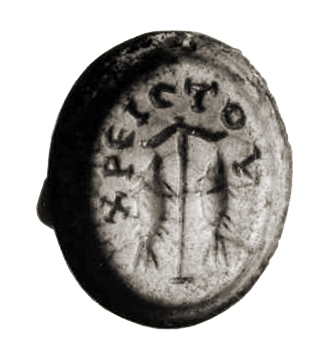
http://img189.imageshack.us/img189/4995/large2w.jpg
Crucifixion (Gaza), Paris, Pereire Collection: jasper. Late 2nd to 3rd century AD.

(Please Note: This uploaded content is no longer available.)
Memorial of Rufina and Irene, Catacomb of Callistus, Rome. early 3rd century.

(Please Note: This uploaded content is no longer available.)
Anchor and Fish, Catacombs of Domitilla, Rome. 3rd century.

http://www.friar.org/typo3temp/pics/a1e55f273c.jpg


Two fish flanking an anchor, ca. 3rd century.

http://img830.imageshack.us/img830/4012/37361658.jpg
Crucifixion, British Museum: carnelian. Mid 4th century AD.

http://img98.imageshack.us/img98/8783/gemr.jpg
Rome, Nott Collection: gem. 4th century AD.
 
Thankyou for all the posts. I will go through them tomorrow when I’m more awake 🙂
 
The person who said this would likely argue it’s plural because it was one through feet too…

But meanwhile I found this- gotquestions.org/cross-pole-stake.html
I wrote this in the middle of the night. Should have highlighted the verse differently.
25 The other disciples therefore said unto him, We have seen the Lord. But he said unto them,** Except I shall see in his hands the print of the nails,** and put my finger into the print of the nails, and thrust my hand into his side, I will not believe.
Hands…nails…plural. Has nothing to do with the feet.:). 😦

Fr. Mitch Pacwa used this verse as a defense to the death being on a cross (EWTN open radio show)
 
What some people try to do is point out a place in Sacred Scripture where the Church has got it “wrong.” “If the Church got that part wrong then what else did the get wrong?” That is what I hear mostly. It is simply a tactic to bring in doubt for the believer. I had someone, probably a JW, state that all Jewish Christians were not believers in the Holy Trinity. I asked why and she said that if they were Jewish, believing in the Trinity would be against their Jewish faith… Any well educated Christian can put down that argument, but for the Christian who is not so well educated with Church history and theology will be stumped.

Like I mentioned, they try to cause doubt and when doubt is there, they can plant their theology in your brain.

It does not matter if Christ died on a cross or stake. The key point to the argument is that HE DIED. lol

I was blessed to be at a Patrick Madrid talk last night. He stated a similar debate he had with an athiest.
 
I wrote this in the middle of the night. Should have highlighted the verse differently.

Hands…nails…plural. Has nothing to do with the feet.:). 😦

Fr. Mitch Pacwa used this verse as a defense to the death being on a cross (EWTN open radio show)
Here is an 16th century image of a crucifixion on a pole…one nail shown. Again, I would use all arguments on this post with your JW friend. I’m just trying to highlight a biblical answer that is also in their New World Translation bible too.
 
Here is an 16th century image of a crucifixion on a pole…one nail shown. Again, I would use all arguments on this post with your JW friend. I’m just trying to highlight a biblical answer that is also in their New World Translation bible too.
But they could answer: “But that’s just an artist’s conception. Jesus could very well have been nailed to the stake with two nails.” (Of course, you could question why their artists almost always choose to show only one nail. ;)) As I mentioned, I feel that arguments based on the number of the nails or the inscription being above Jesus’ head are not too very strong. Of course it may be good to gather as much artillery as one can, but IMHO we shouldn’t be making this our primary argument.

I should note that the Witnesses did not always believe in the stake thing (for instance, this, this and this; in fact, try searching Charles Taze Russell’s The New Creation for the words cross, crucified or crucifixion): they just cribbed it. Before the Watchtower Society even came on the scene there were already a number of people who contested the traditional idea that Jesus died on a T- or †-shaped cross, but instead died on a crux simplex (‘simple cross’; i.e. a vertical stake), like Henry Dana Ward (Episcopal; The History of the Cross, 1871), W. E. Vine (Plymouth Brethren; Expository Dictionary of New Testament Words, 1940) and E. W. Bullinger (Anglican; The Companion Bible, 1922). Most of them use as evidence the fact that stauros originally meant simply an upright pale or stake in earlier Greek: all three authors notably purport that the cross as we know it today was originally a pagan import, you know, the old story about how paganism supposedly infiltrated and corrupted Christianity. (Hmm…)
 
But they could answer: “But that’s just an artist’s conception. Jesus could very well have been nailed to the stake with two nails.” (Of course, you could question why their artists almost always choose to show only one nail. ;)) As I mentioned, I feel that arguments based on the number of the nails or the inscription being above Jesus’ head are not too very strong. Of course it may be good to gather as much artillery as one can, but IMHO we shouldn’t be making this our primary argument.

I should note that the Witnesses did not always believe in the stake thing (for instance, this, this and this; in fact, try searching Charles Taze Russell’s The New Creation for the words cross, crucified or crucifixion): they just cribbed it. Before the Watchtower Society even came on the scene there were already a number of people who contested the traditional idea that Jesus died on a T- or †-shaped cross, but instead died on a crux simplex (‘simple cross’; i.e. a vertical stake), like Henry Dana Ward (Episcopal; The History of the Cross, 1871), W. E. Vine (Plymouth Brethren; Expository Dictionary of New Testament Words, 1940) and E. W. Bullinger (Anglican; The Companion Bible, 1922). Most of them use as evidence the fact that stauros originally meant simply an upright pale or stake in earlier Greek: all three authors notably purport that the cross as we know it today was originally a pagan import, you know, the old story about how paganism supposedly infiltrated and corrupted Christianity. (Hmm…)
Hi Patrick -

I agree with you all the way around. 👍 I would use all sources available. I was only highlighting how scripture appears to be clear…that there were two nails…certainly implying crucifixion on the cross. Scripture is consistent with Tradition.

When did anyone, anywhere first suggest that Christ may have died on a stake? I don’t know the answer. I assume with the JW but I’d love to know the answer.

Tx,

Pork
 
Interestingly the guy in question says he’s studied Greek and Hebrew etc. Then suddenly it turns into how what I believe is wrong quoting Scripture verses about how the dead know nothing therefore not to pray To them and how we babble like pagans with the Rosary as he quoted in a Bible verse. I have asked him what he thinks of the eat my flesh drink my blood discourse still no reply. He says he has been evangelizing Catholic Churches and bringing people to the word of God.
 
Interestingly the guy in question says he’s studied Greek and Hebrew etc. Then suddenly it turns into how what I believe is wrong quoting Scripture verses about how the dead know nothing therefore not to pray To them and how we babble like pagans with the Rosary as he quoted in a Bible verse. I have asked him what he thinks of the eat my flesh drink my blood discourse still no reply. He says he has been evangelizing Catholic Churches and bringing people to the word of God.
Okay…I would begin my next conversation with him like this:

First, cite the example of St. Paul by quoting this:

Galatians 2:2 I went in response to a revelation and, meeting privately with those esteemed as leaders, I presented to them the gospel that I preach among the Gentiles. I wanted to be sure I was not running and had not been running my race in vain.

From the passage above…Paul has a direct revelation in his converstion, but when it was time for him to preach…it is revealed to him to go to the Apostles…to…" to be sure I was not running and had not been running my race in vain.

So ask your friend, how does he fulfill this biblical example of St. Paul? Ask him to whom did he present his gospel (with traceable apostolic roots) and who assured him it is in line with what the Apostles taught?

If he names someone, ask thim to trace his apostolic lineage.

If he can’t…then ask…then how can he be sure he is preaching the correct gospel.

Then cite this passage:

Romans 10:
15 And how can anyone preach unless they are sent? As it is written: “How beautiful are the feet of those who bring good news!”[g]

The ask thim…who sent him? Again, cite the example of St. Paul in acts 13, before he goes on his first missionary journey:

1 Now in the church at Antioch there were prophets and teachers: Barnabas, Simeon called Niger, Lucius of Cyrene, Manaen (who had been brought up with Herod the tetrarch) and Saul. 2 While they were worshiping the Lord and fasting, the Holy Spirit said, “Set apart for me Barnabas and Saul for the work to which I have called them.” 3 So after they had fasted and prayed, they placed their hands on them and sent them off.

Ask him how he fulfills the passage above?

Then comeback and to us and relate his reaction. 😉
 
Hi Patrick -

I agree with you all the way around. 👍 I would use all sources available. I was only highlighting how scripture appears to be clear…that there were two nails…certainly implying crucifixion on the cross. Scripture is consistent with Tradition.

When did anyone, anywhere first suggest that Christ may have died on a stake? I don’t know the answer. I assume with the JW but I’d love to know the answer.

Tx,

Pork
I just said that. 😃 The idea began to be espoused around the 19th century by some Christian (mainly Protestant) authors, who saw the cross as being a pagan import into Christianity. They appealed to the ancient meaning of stauros as ‘upright stake’ and thought that, since the cross must be pagan in origin, Jesus must have originally been impaled on a stake. The Watchtower Society only adopted this position in the 1930s (as seen, they originally used the cross), invoking these authors - just when the idea was losing currency elsewhere. So the result was that the JWs ended up being pretty much the only ones who thought that Christ was stake-ified.

I should note also that the medieval Cathars were alleged to have represented Jesus with His arms stretched upward on a vertical stake and with one nail through both feet, yielding three nails instead of the four that was more common then.
 
The interesting thing about this whole situation of him telling me what I believe is wrong has made me realize what I don’t want to be like… Telling people they must believe such and such. It reminds me of a time I told a Catholic friend ge shouldn’t use crystals. And a time when I wrote on fb people need to see the truth about God. It’s all too forcing now I can see that. I don’t want to be one of those people that shoves my beliefs down people’s throats. Yuck. It’s happened to me a lot and thank God I can see now I was starting to become that way. Thank God I can see clearly now
 
I just said that. 😃

So the result was that the JWs ended up being pretty much the only ones who thought that Christ was stake-ified.
I should note also that the medieval Cathars were alleged to have represented Jesus with His .
Hmmmm…interesting word…“stake-ified”…that is probably why St. Paul says he preaches Christ crucified…not “Stake-ified:…1 Cor 1, verse 23…”…but we preach Christ crucified…" because it was not a stake but a cross?

:hmmm::hmmm:
 
Hmmmm…interesting word…“stake-ified”…that is probably why St. Paul says he preaches Christ crucified…not “Stake-ified:…1 Cor 1, verse 23…”…but we preach Christ crucified…" because it was not a stake but a cross?

:hmmm::hmmm:
Again, the word ‘cross’ didn’t automatically imply a T- or t-shaped gibbet. It’s really difficult to explain this to us moderns (where we think of 'T’s or 't’s when we say ‘cross’), but in the lingo of the time, crux and other words simply meant the gibbet criminals are hung on, irrespective of its shape or form (I, T, t, X, etc.)

P.S. ‘Stakeification’ is just a neologism on my part. They use the word “impaled” where we usually translate “crucified.”
 
Again, the word ‘cross’ didn’t automatically imply a T- or t-shaped gibbet. It’s really difficult to explain this to us moderns (where we think of 'T’s or 't’s when we say ‘cross’), but in the lingo of the time, crux

and other words simply meant the gibbet criminals are hung on, irrespective of its shape or form (I, T, t, X, etc.)

👍
P.S. ‘Stakeification’ is just a neologism on my part. They use the word “impaled” where we usually translate “crucified.”
 
I was trying to inject some humor with your neologism…😃
To be honest, I’m not too happy with the word (for the record, to give credit where credit is due - I don’t think I’m the one who actually used the word first, though I do use it a lot). ‘Stakeification’ sounds more like a way of killing a vampire than a synonym for impalement. 😃
 
Does it matter? I don’t think it’s in any way an article of faith that He died on a traditional cross as opposed to a wooden stake, any more than that He was born on December 25th.

And depictions in art such as crucifixes are not highly significant either. It was common in the early centuries of Christianity to depict Christ as beardless, now we portray Him as bearded, doesn’t mean diddly squat either way. He has been depicted as African, Ethiopian, Asian, Native American, Aboriginal Australian, when clearly He was none of those things.
Come to think of it, in many Western depictions of the crucifixion today you often see Christ’s feet pierced by a single nail, but in the early centuries He was always portrayed as having His feet separate from each other (which is still the case today in most Eastern icons; not that the idea disappeared completely in post-medieval Western art). In fact, if you’ll look at the earliest images of crucifixions - some of which I already posted above - you’ll see something in common: not a single one of them show the crucified victim having one of his feet over the other.
 
The interesting thing about this whole situation of him telling me what I believe is wrong has made me realize what I don’t want to be like… Telling people they must believe such and such. It reminds me of a time I told a Catholic friend ge shouldn’t use crystals. And a time when I wrote on fb people need to see the truth about God. It’s all too forcing now I can see that. I don’t want to be one of those people that shoves my beliefs down people’s throats. Yuck. It’s happened to me a lot and thank God I can see now I was starting to become that way. Thank God I can see clearly now
The work of evangelizing and catechesis is valid and sometimes includes fraternal correction. But it is important that it be done with humility, charity and gentleness. You were correct to tell your Catholic friend not to use crystals, but it’s all in how you say it. Please do not back away from this important work- just learn to do it properly. Catholic Answers has a book on how to get started in Apologetics that addresses what NOT to do, like being prideful, domineering and pushy. This book teaches us to evangelize properly and respectfully. Scott Hahn also talks about this in several of his bboks, including Rome Sweet Home. You may want to read this book- it’s excellent!!👍
 
Status
Not open for further replies.
Back
Top