P
PetraG
Guest
Well, I think conduct generally is more informal now. There has also been a reaction against practices or ways of teaching the faith that literally instilled fear of God (as in, instilling serious doubt about the mercy and love of God) to an overreaction that resulted in the fear that practicing true reverence will make a devoted Catholic either smug about his chances of salvation or else petrified of the Most High. One can hope that now, as in the past, there has hardly been an action in the history of humankind that didn’t err on the side of overreaction at times. The current over-reaction now is the idea that awe is always a bad thing, that to hold someone in awe is to be in fear of them or somehow distanced from them, that awe stands in the way of love.Pre-Vatican II, it was the Holy Sacrifice if the Mass.
Post-Vatican II, it’s a celebratory gathering / family meal.
When there appears to be a conflict between pre and post Vatican II, one has to choose which one you’re going to agree with. “Shrug”.
I think there is a problem with what is percieved to be the repertoire for sacred music played on the guitar, though, and it is this: some of the most well-known pieces in the repertoire of music played at Mass and accompanied by the guitar have words that are fine–not uncommonly, we’re talking the Holy Scriptures sung either verbatim or paraphrased–but with music that is sometimes sounds as if it were literally taken straight off of pop radio or a contemporary Broadway production. It has no element of the awe before Heaven in it.
It wouldn’t matter what instrument was used to accompany it, it is still music that is secular rather than religious in tone. Such music has an informality to it or invokes agitated emotions. It lacks a medatative or worshipful quality. That’s not to say it is bad music. It might even be OK for everyday devotional music.
Mass isn’t just any devotion, though. It is the very sacrifice of the Body and Blood of the Lord Jesus, the memorial of his death and Resurrection that unites us with the liturgy of heaven. That is boundless rejoicing, yes, but it is the rejoicing of the elect who have survived the time of great distress. I think sometimes people forget that boundless joy has an awesome quality to it. That’s a different attitude than our “everyday” attitude.
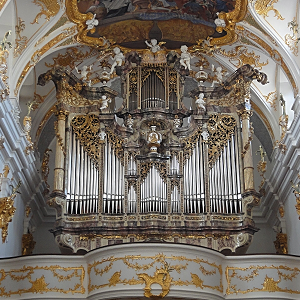
Again, though: although a pipe organ definitely has the capacity that gives itself to express both the awesome and the ethereal at the same time, particularly in the right setting, the guitar is not inherently incapable of expressing the sacred. If people started playing church pipe organs as if they were playing at Fenway Park, the pipe organ would lose some of its reputation, too.
Last edited: