Judge rules Obamacare unconstitutional, endangering coverage for 20 million

  • Thread starter Thread starter Stephen_C
  • Start date Start date
Status
Not open for further replies.
You’re doing it again, aren’t you? Just as those who favor some kind of national health insurance don’t support “government dictated health care,” the bishops have not spoken on a particular aspect of the ACA, nor did I say they have.
Take note I said, “if”.
It’s difficult to discuss this issue with you if you’re going to restate what is said in ways that twist one’s position out of all recognition.
This seems to be your go-to dialogue, “ it is difficult to discuss this with you…”
I didn’t restate, I said “if”.
 
OK, fair enough. Although I will say that I haven’t seen anyone here advocate for “government-dicated healthcare.” Not even close. Some here do advocate for national health insurance of one kind or another.
 
OK, fair enough. Although I will say that I haven’t seen anyone here advocate for “government-dicated healthcare.” Not even close. Some here do advocate for national health insurance of one kind or another.
Will the government dictate what the insurance looks like? Will government dictate what is and is not covered? How much it will cost?
Will there be a financial consequence, such as taxes being taken, if one chooses not to participate?
Will there be a penalty for “Cadillac plans”?

If so, that is government dictated.
 
Last edited:
Will the government dictate what the insurance looks like? Will government what is and is not covered? How much it will cost?
Almost certainly (to a point), much as private sector insurers do. How much will it cost? Hard to say. If it’s government insurance, I expect (hope) the cost will vary depending on income.
Will there be a financial consequence, such as taxes being taken, if one chooses not to participate?
I would hope so.
Will there be a penalty for “Cadillac plans”?
Of course (assuming there’s a “Cadillac plan” available. A more likely out come is a standard plan for everyone, with supplemental insurance being available on the market). Don’t “Cadillac plans” cost more on the free market?
If so, that is government dictated.
No more “dictated” than insurance is now.
 
Last edited:
OK, fair enough. Although I will say that I haven’t seen anyone here advocate for “government-dicated healthcare.” Not even close. Some here do advocate for national health insurance of one kind or another.
Might be a distinction without meaningful difference. He who pays the piper calls the tune, and he who pays the medical provider dictates care protocols. Medicare and private insurance use the very same algorithms for care and billing already.

But no matter what, it is unlikely the government will take over billing and determination of treatment. All government programs other than VA are administered by private insurance companies.
 
No more “dictated” than insurance is now.
Okay,
Will the government dictate what the insurance looks like? Will government what is and is not covered? How much it will cost?
If I don’t like the cost or what’s covered, I can seek another plan, or negotiate via a large association. One doesn’t negotiate with government in this way. Your answer indicates a dictated plan.
Will there be a financial consequence, such as taxes being taken, if one chooses not to participate?
Which private insurance company can charge me a tax if I don’t have a policy with them?
Please don’t get mad when I mention that this has the appearance of a collectivist approach, government power trumps individual rights. “You’ll do it because government says so.”
Will there be a penalty for “Cadillac plans”?
The cost more, but government has no business increasing the cost with punitive taxes. That’s government tyranny.
If so, that is government dictated.
Private insurance can’t force me to buy theirs, can’t tax me for not buying theirs.
Every part of your response says government power over individual rights, government dictated healthcare.
 
Please don’t get mad when I mention that this has the appearance of a collectivist approach, government power trumps individual rights. “You’ll do it because government says so.”
I suppose that’s true, given certain definitions of the word “collectivist” (I don’t want to reopen an earlier point of contention between us, but that word has certain Stalinist connotations that I don’t believe are applicable here).

That said, yes, I believe that health care is a public go
Your answer indicates a dictated plan.
I belive that health care is a public good, and a public responsibility, and should be addressed in a public way, i.e., by our government (and I believe the government is us, not the enemy). Government is a useful tool for some problems, that’s all. For me, this is a pragmatic approach, not an ideological approach.
Which private insurance company can charge me a tax if I don’t have a policy with them?
Well, none, of course. Here we part company at the most basic level.
The cost more, but government has no business increasing the cost with punitive taxes. That’s government tyranny.
I don’t believe every tax is “punitive.” Taxes like this are just the cost of doing what needs to be done.

Look, I’ve been fortunate in my life. I will be a net payor in a national health insurance scheme, not a beneficiary. That’s fine with me. I believe it’s my obligation to contribute to the physical well-being of my brothers and sisters. That’s all – for me, it’s that simple.
If I don’t like the cost or what’s covered, I can seek another plan, or negotiate via a large association. One doesn’t negotiate with government in this way. Your answer indicates a dictated plan.
I’m not sure that’s true. I would have no objection to supplemental insurance being available on the market, which would be negotiable, maybe through associations (although really, do you think you could negotiate with Blue Cross as an individual?).

 
Enumerate means to mention, to list, or itemize.
It doesn’t say healthcare, or air force, for that matter (so you think that is overstepping?) I think you are using the word enumerate to mean “specify”.

The Constitution not only does not specify what is considered the welfare of the nation, but uses the word “general” so that specification is not needed. “General welfare” is mentioned, listed, itemized.
 
The link above (on the USCCB website) indicates a need for changes, not jumping ship. In any case it is a heck of a long stretch to go from an opinion that disagrees with some bishop on some of the points of the program to saying the program is morally wrong, except in the most general sense that every endeavor of Man is immorally wrong to some extent.
 
Last edited:
You’re doing it again, aren’t you? Just as those who favor some kind of national health insurance don’t support “government dictated health care,” the bishops have not spoken on a particular aspect of the ACA
The bishops have spoken on this multiple times. Here is one.

The bishops thanked supporters from the Catholic community and beyond “who have stood firmly with us in our vigorous opposition to this unjust and illegal mandate.”
They have even acknowledge the idea of ending ACA, but have said it shouldn’t be done without a better solution in place immediately.
 
One of the problems with USCCB spokespersons is that they don’t necessarily represent anything other than their own opinions. I recall there was considerable consternation on the part of at least some of the bishops when they learned they had been had by the Democrats. They didn’t put it that way, of course, but praise for the meaningless Obama executive order that replaced the failed Stupak Amendment quickly faded when Obama issued the HHS mandate. The mandate drew not only a great deal of criticism but other Church organizations joining in the litigation against the mandate. There were letters from the bishops read in the parishes about it, condemning it.
 
I suppose that’s true, given certain definitions of the word “collectivist” (I don’t want to reopen an earlier point of contention between us, but that word has certain Stalinist connotations that I don’t believe are applicable here).

That said, yes, I believe that health care is a public go
I don’t think one needs to go to Stalinism. Fascism, communism, etc. are certainly at the end of that road, but collectivism/ statism doesn’t necessarily be that far to be well aware from the individual rights / limited government model upon which the American republic is built.
Your answer indicates a dictated plan.
If it must be dictated, then there is a question if it is a public good. If coercion must be used, how quickly does it move from a public responsibility to a government tyranny.
Government can be a useful tool, maybe facilitating local governments and charities to do their jobs ( thinking of the principle of subsidiarity here). But it is never a useful tool if it is interfering in the rights and sovereignty of the individual.
Which private insurance company can charge me a tax if I don’t have a policy with them?
Why? I don’t think they should be able to, either.
Do you not see the individual mandate as a government coercion of ostensibly free citizens?
I don’t believe every tax is “punitive.” Taxes like this are just the cost of doing what needs to be done.
I didn’t say all taxes are punitive, but charging a fee or tax because someone (labor unions?) can afford particularly extravagant plans is punitive.
Look, I’ve been fortunate in my life. I will be a net payor in a national health insurance scheme, not a beneficiary. That’s fine with me. I believe it’s my obligation to contribute to the physical well-being of my brothers and sisters. That’s all – for me, it’s that simple.
I do okay, too, so I believe I have a clear responsibility too. What I don’t have is the right to say that anyone else does. You and I can do much for the poor without using the power of government to force others to do the same.
 
40.png
JonNC:
Enumerate means to mention, to list, or itemize.
It doesn’t say healthcare, or air force, for that matter (so you think that is overstepping?) I think you are using the word enumerate to mean “specify”.

The Constitution not only does not specify what is considered the welfare of the nation, but uses the word “general” so that specification is not needed. “General welfare” is mentioned, listed, itemized.
It is listed as promoting the general welfare using the enumerated powers.
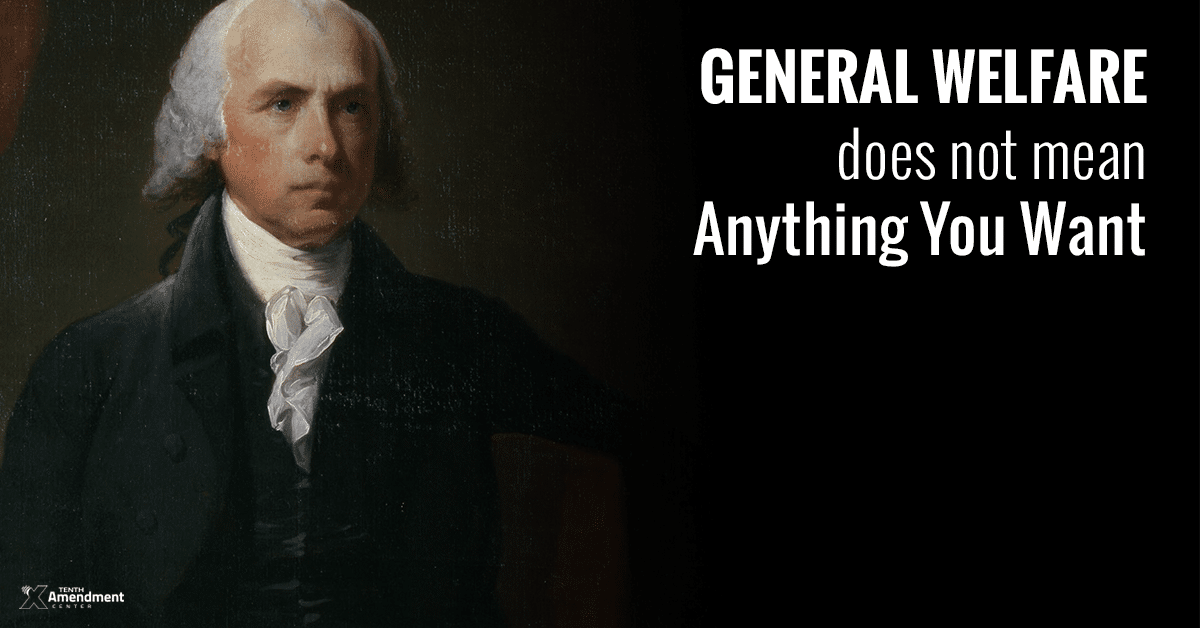
“If Congress can apply money indefinitely to the general welfare, and are the sole and supreme judges of the general welfare, they may take the care of religion into their own hands; they may establish teachers in every State, county, and parish, and pay them out of the public Treasury; they may take into their own hands the education of children, establishing in like manner schools throughout the Union; they may undertake the regulation of all roads other than post roads. In short, every thing, from the highest object of State legislation, down to the most minute object of police, would be thrown under the power of Congress; for every object I have mentioned would admit the application of money, and might be called, if Congress pleased, provisions for the general welfare.”

Now whether the phrases in question be construed to authorise every measure relating to the common defence and general welfare, as contended by some; or every measure only in which there might be an application of money, as suggested by the caution of others, the effect must substantially be the same, in destroying the import and force of the particular enumeration of powers, which follow these general phrases in the Constitution. For it is evident that there is not a single power whatever, which may not have some reference to the common defence, or the general welfare; nor a power of any magnitude which in its exercise does not involve or admit an application of money. The government therefore which possesses power in either one or other of these extents, is a government without the limitations formed by a particular enumeration of powers; and consequently the meaning and effect of this particular enumeration, is destroyed by the exposition given to these general phrases.
James Madison

 
If it must be dictated, then there is a question if it is a public good. If coercion must be used, how quickly does it move from a public responsibility to a government tyranny.
Would you believe paying taxes to support the military should be option, and of course, drafting out of the question?
 
James Madison does not get to interpret the Constitution ever, much less through eternity. That role is given to living people - the Supreme Court.
 
Last edited:
40.png
JonNC:
If it must be dictated, then there is a question if it is a public good. If coercion must be used, how quickly does it move from a public responsibility to a government tyranny.
Would you believe paying taxes to support the military should be option, and of course, drafting out of the question?
The draft is definitely out of the question.
There are numerous differences, but I will refer you back to the conversation. We were discussing government requiring me to buy or participate in an insurance plan for me.
So, I’m not sure what comparison there is between my personal healthcare choices, and the enumerated power known as the common defense.
 
James Madison does not get to interpret the Constitution ever, much less through eternity. That role is given to living people - the Supreme Court.
I would contend that dismissing the framers’ original intent is license to dismiss the entire document, which is what we see from many in the progressive movement.
On the other hand, if you have evidence from one of the framers that they understood the general welfare clause as carte blanche for the general government to do whatever it wants simply by deciding it is in the general welfare, well, I promise I won’t be dismissive.
 
So, I’m not sure what comparison there is between my personal healthcare choices, and the enumerated power known as the common defense.
You do not know why there is a comparison? The two terms are separated by three letters, the conjunction “and”. You simply cannot have two standards, one for the common defense and another standard on general welfare. The both are “enumerated” (as you like to say) in the same place. Which word is causing difficulty, “general” or “welfare”?
 
Last edited:
40.png
JonNC:
So, I’m not sure what comparison there is between my personal healthcare choices, and the enumerated power known as the common defense.
You do not know why there is a comparison? The two terms are separated by three letters, the conjunction “and”. You simply cannot have two standards, one for the common defense and another standard on general welfare. The both are “enumerated” (as you like to say) in the same place. Which word is causing difficulty, “general” or “welfare”?
But we weren’t talking about the general welfare, we were talking about an individual’s welfare, my personal choices regarding healthcare, which is frankly none of your business, nor the government’s.
Likewise, your’s is none of my business. I shouldn’t be able to cobble together a majority vote to force you to accept a health insurance plan you may not want. Additionally, you shouldn’t be able to cobble together a majority vote that forces me to pay for yours.

On the other hand, the general defense of the country, whether or not I care about it, is just that, the general defense.

There is no comparison.
 
It might be worth considering that the only health insurance program the federal government actually runs is VA, and I think we know that’s not the best.
To be fair, at least the VA does provide a baseline of coverage. Better than nothing.
And if we go full socialized medicine, will it be any different?
Hypothetically, even if socialized medicine has its issues like inconvenience such as waiting lists, those who are possibly desperate like the uninsured and the under-insured may be willing to take their chances.
 
Status
Not open for further replies.
Back
Top