please explain TULIP and then Catholic disagreements

  • Thread starter Thread starter Cr8ton
  • Start date Start date
Status
Not open for further replies.
He gives a very tempting presentation of someone who really wishes to engage, I think.


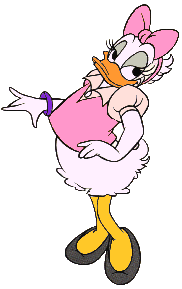
Since you have been silent on the issue, I will assume you find Daisy to be very attractive.

I personally like TULIPS over Daisy.
 
Code:
I do acknowledge that the Reformed view and Thomism's view have differences which will come out through our discussion of TULIP. :flowers:
That would be nice. Up to this point, it does not appear that it is going to happen,
Code:
 You see, the TULIP is not as ugly as you first thought.
Who could tell? I guess if we ever progress into TULIP that will become obvious.

There is nothing inherently “ugly” about theological speculation. However, when people use it to create doctrine, and mislead the flock by it, that does get “ugly”.
Code:
 I believe all Christians are either a form of a TULIP or a form of a Daisy.
Must be a relief to have all Christians so neatly sorted like that! 👍
It is my view, I believe that all Daisy Christians will become TULIP Christians in heaven.
Well, at least their doctrinal distinctives are not keeping them out of heaven.
 
That would be nice. Up to this point, it does not appear that it is going to happen,

Who could tell? I guess if we ever progress into TULIP that will become obvious.

There is nothing inherently “ugly” about theological speculation. However, when people use it to create doctrine, and mislead the flock by it, that does get “ugly”.

Must be a relief to have all Christians so neatly sorted like that! 👍

Well, at least their doctrinal distinctives are not keeping them out of heaven.
Please respond to post 130 and 132 so we can discuss the TULIP.

http://www.valleyway.ca/images/tuliphead.jpg
 
Perhaps I have erred in my references to you as “he”. If you really are this cutesy, it is doubtful that you are a male. 😉
Since you have been silent on the issue, I will assume you find Daisy to be very attractive.

I personally like TULIPS over Daisy.
Well, you know where those assumptions get people, 2nd! Let’s look and see, since Depravity is one of the issues I wanted to discuss. I don’t know if the website you linked is, in fact, an accurate representation, but for the sake of discussion, I will use what is printed there.
] THE 5 POINTS OF
ARMINIANISM
D.A.I.S.Y.
Diminished Depravity (Free Will or Human Ability)
Although human nature was seriously affected by the fall, man has not been left in a state of total spiritual helplessness.
I don’t think this captures the Apostolic Teaching very well. The Apostles taught that we are completely unable to save ourselves, and in that sense, we are "helpless’. They also taught that we are made in the image and likeness of God, and that image contains the ability to choose. Although this ability was wounded in the Fall, it was not “unmade”.
Code:
God graciously enables every sinner to repent and believe, but He does not interfere with man's freedom.
I don’t think this quite captures it either. Man cannot repent and believe apart from grace (this is clear in the JDDJ you have linked. I am not sure what “interfere” means here. God calls all to repent and believe. Some do not respond to this grace that calls them.
Each sinner possesses a free will, and his eternal destiny depends on how he uses it. Man’s freedom consists of his ability to choose good over evil in spiritual matters; his will is not enslaved to his sinful nature.
This part is totally false. I don’t know anywhere the Apostles taught that we are not enslaved by our sinful nature.
The sinner has the power to either cooperate with God’s Spirit and be regenerated or resist God’s grace and perish.
This statement is true, but only because that power is given to us by His grace (pre-venient). We don’t have it naturally in ourselves.
The lost sinner needs the Spirit’s assistance, but he does not have to be regenerated by the Spirit before he can believe, for faith is man’s act and precedes the new birth.
This is true about regeneration. We do not consider the actions of grace in a person prior to the conversion “regeneration”. They are, however, no less acts of His grace. We choose, and in that way mix our faith with His grace resulting in salvation. He gives us the ability to make that choice by grace.
Faith is the sinner’s gift to God; it is man’s contribution to salvation
I think it is also important to point out that faith, though it is part of our human makeup, cannot be directed toward anything Holy without grace. A person who is not kindled by grace can apply their faith to all manner of ungodly things such as greed, power, material posessions (any of the 7 deadlies). This is why Jesus said so often “where is your faith”? People put it places it did not belong.
 
Please respond to post 130 and 132 so we can discuss the TULIP.

I guess I am lost on what one has to do with the other. How does my understanding of human depravity get impacted by predestination? It seems to me that whatever one beleives about it will apply to both the daisies,and the tulips. I am willing to accept that it may impact what I believe as well, though it seems to me that what the Apostles taught does not fit into either pidgeonhole.
2nd Adam;5904760:
If you pass on this one, then I don’t think you are qualified to give your views on TULIP.
Wow. Well, I guess I am not qualified, then. 😦

The forum seems to have picked up some new rules since I read them last. 🤷
Code:
 I will pass over you (not respond to your threads) until you give me your view on predestination and double predestnation. :)
This is certianly your perogative, of course. I think you got the “ignore” instructions I posted, if that makes it easier.
 
If I am predestined, but obviously I don’t know what I’m predestined for, and I accept the Lord as my saviour, as per some non-C’s, and I end up in hell because I’m predestined for it, then where does that leave Christianity - Whoever believes in Me etc., etc.
I say I’m predestined; but what person told *me *personally that I’m predestined, and predestined for what place, exactly?
Did God tell me through the Scriptures that ‘Whoever’ believes in Me will not remain in darkness.
46 I am come a light into the world; that *whosoever *believeth in me, may not remain in darkness.

Whosoever… …not a qualified whosoever… :hmmm:

Whoever believes is predestined?
Can you lose your predestination?
Or be assigned to another destination?

So am I predestined for heaven, but wait!, who is this? what is He saying? - 5 But I will shew you whom you shall fear: fear ye him, who after he hath killed, hath power to cast into hell. Yea, I say to you, fear him.

But I am predestined… or, am I?
 
That would be nice. Up to this point, it does not appear that it is going to happen,

Who could tell? I guess if we ever progress into TULIP that will become obvious.

There is nothing inherently “ugly” about theological speculation. However, when people use it to create doctrine, and mislead the flock by it, that does get “ugly”.

Must be a relief to have all Christians so neatly sorted like that! 👍

Well, at least their doctrinal distinctives are not keeping them out of heaven.
Well you do sort Christians and not so neatly most of the time.
 
Well you do sort Christians and not so neatly most of the time.
I suppose we all do some sorting.

In your case, though, it is not so much sorting persons as it is doctrine. The doctrine you hold (or claim to hold - and you say you are not role playing) is not Catholic. Only persons who hold Catholic doctrine are Catholic. To the extent they reject the doctrine, they are no longer Catholic.

This is a truth that applies to all of us, not just you.

In my case, I find that I do not fit into 2nd’s “daisy” or “tulip” categories.
 
I suppose we all do some sorting.

To the extent they reject the doctrine, they are no longer Catholic.

This is a truth that applies to all of us, not just you.
So is it true that anyone who is Catholic must accept ALL the doctrines of the Catholic Church or else they are not Catholic? Or does that just mean they are less Catholic than they were if they accepted it?

If so, how many doctrines must be rejected before someone is considered no longer Catholic at all?

I’m sincere when I ask these questions and am not trying provoke anyone.
 
Do you know see that the Catholic Church and Reformed Christians reject an unbiblical position of double predestination known as hyper-Calvinism (positive-positive schema)?
References?
Can you know see that a Thomism’s understanding of predestination is quite similar to a Reformed view of predestination, which is really a form of double-predestination (positive-negative schema) in which God passes over the reprobate, or does not apply the same amount or type of grace that He does to His elect?
No, I can’t. Thomism is not a form of double predestination.
I do acknowledge that the Reformed view and Thomism’s view have differences which will come out through our discussion of TULIP. :flowers:
Ya think?
Do you personally hold to a Thomism form of predestination?
From what I’ve studied of it, Molinism makes more sense to me. But it doesn’t really matter as I’m allowed to believe either.
 
Well you do sort Christians and not so neatly most of the time.
He doesn’t sort Christians themselves Tweety. He “sorts” official Catholic teaching. Christians fall in or out depending on their own beliefs.
 
I am the OP and I was more concerned about the explanation of TULIP in reformed view such as 2nd seems to hold. I do not have much to say as I am still in the learning process but I’m very interested in going deeper into it slowly so we all get a clarified understanding of it. After the clarity has set in I would be curious as to where Catholics would disagree with certain elements but I don’t think it’s as simple as posting definitions then refuting instantly based on a held scripture in mind. The more we focus on the heart of the matter and where it leads us in our spiritual journey is most important [of course Sacred Scripture being our basis for what we believe], so may we discuss this in the grace of God so that we may come to understand our Lord’s will and how our beliefs relate to that. :extrahappy:
Howdy, Cr8ton, et al,

I’m very new to the site, as this is only my 2nd post. (Hey, everybody 👋 :grouphug:) I’ve only briefly perused the thread, as I was mostly searching to see if there were any other Calvinist critters about, and this thread popped up. I’m not even entirely clear yet on the nuances of here discussing theologies which might be considered out of kilter with RCC dogma. But, hey, I’m a Calvinist and willing to be brain-picked a bit if it will help to sort things out.

I did notice a few links to Reformed sites, which can be helpful. It might also be helpful, as I’m sure many here realize, to recognize that the typical Calvinist/Arminian discussion or divide or whatever is one of those long-standing ‘issues’ in Christendom, both predating Calvin and the originators of the TULIP acronym, and continually refining itself into all manner of tangents and idiosyncracies. To get hopefully not too technical, the acronym TULIP has come under a lot of scrutiny in the past couple of generations and is perhaps in dire need of clarification back toward it’s original intent and theological distinctiveness. Again, having not yet followed the thread in great detail, it may somewhat help to more precisely understand TULIP as follows:

T = total inability, or radical corruption. These days “Total depravity” tends to convey the concept that man is as bad as he can be, and this is not what the Reformers had in mind, but that as a creature fallen into sin, man is incapable in the entirety of his being of being completely holy as God requires. He is utterly dependant upon the grace of almighty God for righteousness. God has created us with a continuing natural ability to make choices, but our* moral ability* is enslaved by the Fall to our own desires. Without a wholly holy inclination to be good, we are bound to be evil in some respect, which is insufficient for perfect fellowship with our Holy God.
U = unconditional election. As has been said, this indeed conveys that in and of Himself and for His own glory God chooses those whom he will. It is God who determines who will enter into His Paradise. He sovereignly is the Gatekeeper, and is not conditioned upon any of His Creation to allow anything, to ‘elect’ anyone, other than as He alone determines.
L = limited atonement. There’s quite a lot of modern confusion over “limited”. A better term would be “particular” or “purposeful”, that God particularly and purposely redeems each and every person He qualifies for Heaven by the remission of their sins and infusion with righteousness as His new spiritual creation.
I = irresistible grace. Again, better termed efficacious grace. His grace is completely effective or efficacious toward salvation. That is, it accomplishes that to which it is applied Once the Holy Spirit inwardly calls and enables a righteous decision, a righteous decision will be made. If God has predestined one to an eternity in right fellowship with Him, if this is the sovereign choice of our King, it will not be thwarted or prevented by any force outside of God Himself. Which leads us to…
P = perseverance, or preservation of the saints. That is, that God preserves His own from this life to the next - that He is faithful and wholly capable of keeping each of those he has chosen to a life of holiness in His hands and by the power of His Spirit.

I may not be here too often, but thanks for welcoming me, and I’m happy to help out where I may. 👍
 
Howdy, Cr8ton, et al,

I’m very new to the site, as this is only my 2nd post. (Hey, everybody 👋 :grouphug:) I’ve only briefly perused the thread, as I was mostly searching to see if there were any other Calvinist critters about, and this thread popped up. I’m not even entirely clear yet on the nuances of here discussing theologies which might be considered out of kilter with RCC dogma. But, hey, I’m a Calvinist and willing to be brain-picked a bit if it will help to sort things out.

I did notice a few links to Reformed sites, which can be helpful. It might also be helpful, as I’m sure many here realize, to recognize that the typical Calvinist/Arminian discussion or divide or whatever is one of those long-standing ‘issues’ in Christendom, both predating Calvin and the originators of the TULIP acronym, and continually refining itself into all manner of tangents and idiosyncracies. To get hopefully not too technical, the acronym TULIP has come under a lot of scrutiny in the past couple of generations and is perhaps in dire need of clarification back toward it’s original intent and theological distinctiveness. Again, having not yet followed the thread in great detail, it may somewhat help to more precisely understand TULIP as follows:

T = total inability, or radical corruption. These days “Total depravity” tends to convey the concept that man is as bad as he can be, and this is not what the Reformers had in mind, but that as a creature fallen into sin, man is incapable in the entirety of his being of being completely holy as God requires. He is utterly dependant upon the grace of almighty God for righteousness. God has created us with a continuing natural ability to make choices, but our* moral ability* is enslaved by the Fall to our own desires. Without a wholly holy inclination to be good, we are bound to be evil in some respect, which is insufficient for perfect fellowship with our Holy God.
U = unconditional election. As has been said, this indeed conveys that in and of Himself and for His own glory God chooses those whom he will. It is God who determines who will enter into His Paradise. He sovereignly is the Gatekeeper, and is not conditioned upon any of His Creation to allow anything, to ‘elect’ anyone, other than as He alone determines.
L = limited atonement. There’s quite a lot of modern confusion over “limited”. A better term would be “particular” or “purposeful”, that God particularly and purposely redeems each and every person He qualifies for Heaven by the remission of their sins and infusion with righteousness as His new spiritual creation.
I = irresistible grace. Again, better termed efficacious grace. His grace is completely effective or efficacious toward salvation. That is, it accomplishes that to which it is applied Once the Holy Spirit inwardly calls and enables a righteous decision, a righteous decision will be made. If God has predestined one to an eternity in right fellowship with Him, if this is the sovereign choice of our King, it will not be thwarted or prevented by any force outside of God Himself. Which leads us to…
P = perseverance, or preservation of the saints. That is, that God preserves His own from this life to the next - that He is faithful and wholly capable of keeping each of those he has chosen to a life of holiness in His hands and by the power of His Spirit.

I may not be here too often, but thanks for welcoming me, and I’m happy to help out where I may. 👍

I know other Calvinists were predestined to join us… and a very grounded one at that. Now, did God send this guy to us, or did He just allow it?
 
No, I can’t. Thomism is not a form of double predestination.
Thomism is the good kind of double predestination. I learned this from a very grounded Catholic Christian. It is similar to a Reformed double predestination of a positive-negative schema. The Catholic Catechism opposes the same kind of double predestination that Calvinists refute too - positive-positive schema). Thomists are saying the same things Calvinists believe. God does not provide what He has provided to His elect. So, the retrobate is passed over by God.
A Catholic form of double predestination:
  1. Man is born in a state of sin, and must be called by God in order to accept Him and thus receive the merits of Christ’s sacrifice.
The main difference between the various schools of thought is how the calling grace of point 4 get dispensed, and its effects. Thomists maintain that God does not bestow it on everyone
 
Yup…

1 Corinthians 11

19 For there must be also heresies: that they also, who are approved, may be made manifest among you.
LOL… that’s a good one. And yes, I know that verse very well. Please share your Catholic version of predestination.
 
So is it true that anyone who is Catholic must accept ALL the doctrines of the Catholic Church or else they are not Catholic? Or does that just mean they are less Catholic than they were if they accepted it?

If so, how many doctrines must be rejected before someone is considered no longer Catholic at all?

I’m sincere when I ask these questions and am not trying provoke anyone.
Well a “cafeteria” Catholic will tell you He/She can pretty much reject the whole thing and still be “Catholic”.

In a sense they are correct. The Church very seldom actually excommunicates anyone.

That said it really is a necessity that you accept everything the Church teaches to be in full communion with the Church.

That doesn’t necessarily mean that you need to even understand everything the Church teaches.

For example, you might not understand why women cannot be priests, you might even argue that this is not an issue that has not been settled (though it has) and want to debate the doctrine, but when push comes to shove, a Catholic must accept that this is true, simply because it is what the Church teaches.

Frankly, accepting, many of the doctrines that non Catholics object to really are of no practical importance.

For example, you may be uncomfortable in believing that Mary was the Immaculate Conception, or that she is Queen of Heaven, even so you can still accept that the Church’s teaching on the subject is the truth. You are never going to be “required” to pray to Mary.

Clear as mud?

Chuck
 
Status
Not open for further replies.
Back
Top