
Pope Francis: rigidity, worldliness a disaster for priests

  • Thread starter Thread starter gilliam
  • Start date Start date
Status
Not open for further replies.
Side with them?

/…/

It really is incidental that these sarees are inexpensive. They are inexpensive because the sisters love the poor and want to devote their resources to the poor, not because they are worried about how much they cost.

The saree itself signifies the riches of God’s mercy. So while it’s not properly called ostentatious, it is deeply expressive. And it’s part of their mission to “dress for the job”.
There are many orders who have cast off this type of uniquely expressive dress.
I have to say that, for those who knew Mother and knew her mission, this is offensive. Incidental that the saris are inexpensive? “Dress for the job,” you say? Is that what you say of the words of Jesus to Mother in 1947?

*In September 1946 Mother Teresa was sent for her annual retreat to the Loreto Convent in Darjeeling. During this train journey, on September 10, 1946, she had a mystical encounter with Christ. In this encounter, which Mother later referred to as the ‘call within a call’, Christ urged her to give up all and follow Him into the slums to serve Him in the poorest of the poor. “Come be my light,” He commanded, “I cannot go alone - they don’t know me, so they don’t want me. Go amongst them, carry me with you into them…”

Mother then began receiving a series of interior locutions, in which she was really hearing the voice of Jesus and intimately conversing with Him, that continued until the middle of the following year. In one of these visions she had in 1947 Jesus said to her, “I want Indian nuns, victims of My love, who would be Mary and Martha, who would be so very united to Me as to radiate My love on souls. I want free nuns covered with My poverty of the Cross. … You will dress in simple Indian clothes or rather like My Mother dressed - simple and poor. … Your sari will become holy because it will be My symbol.

/…/

However, when her pupils finally saw Mother in her sari after she had returned from her medical training in Patna, their initial reaction was that of shock. Magdalena Polton, who later became Sr. Gertrude, the second nun to join the Missionaries of Charity, recollects her first meeting with Mother in her new religious dress, “It was the 26th of April, 1949, the day I had myself come to join Mother. When I arrived, Mother was not at home. She came after midday and it was then that for the very first time in my life I saw her in her white sari with three blue borders. And what a shock it was for me - Mother Teresa, a Loreto nun, my Headmistress was now dressed like a poor Bengali woman in a simple white cotton sari with three blue borders!"

In the early days the saris used to be bought from Harrison Road near Howrah. In fact, the first two saris of Mother that Father van Exem blessed were also bought from there. Sr. Gertrude, who accompanied Mother to purchase 11 pairs of three-striped handloom saris from Harrison Road before the day Mother was to make her Final Profession and the first group of 10 sisters their First Profession, remembers the rows of shops lining the pavements on both sides selling these saris. “The saris that used to be sold there usually had borders of red, green and blue,” she recollects, “Mother selected the blue border, for we associate the colour blue with Mother Mary. It stands for purity. Also in those days women who swept the streets used to wear a similar kind of a sari. So Mother adopted a religious dress that was both symbolic and practical - it not only helped to identify ourselves with the poor but was also suitable to Calcutta’s searing climate. The saris, I think, cost about Rs. 2.50 each and we used to buy a pair for each one of us.”

/…/

Mother Teresa’s inspiration to adopt the white sari with three blue borders as the religious dress of the Missionaries of Charity and wear it in the true Bengali style was thus inspired by Jesus’ Words. It was a choice led by God.

Heartfelt gratitude to Sr. Gertrude, M.C. (who was the 2nd to join Mother Teresa and who went home to Jesus in 2015.12.05.) for her help with writing this feature.

motherteresa.org/08_info/Sari.html
*

So, positively no to what you allege: it is not “incidental” that the saris are inexpensive…it was exactly why they were chosen.

I remember once, the sisters were taking possession of a house and were removing from it anything they deemed contravening their radical poverty…even a poor throw rug. When they saw their beds, they rejected the netting as a “finery”…until after the first night, when they made the horrific discovery that the netting was indeed not ornamental. It was allowed to come back the next day. They live the virtue of poverty in a heroic manner.
 
I have to say that, for those who knew Mother and knew her mission, this is offensive. Incidental that the saris are inexpensive? “Dress for the job,” you say? Is that what you say of the words of Jesus to Mother in 1947?

*In September 1946 Mother Teresa was sent for her annual retreat to the Loreto Convent in Darjeeling. During this train journey, on September 10, 1946, she had a mystical encounter with Christ. In this encounter, which Mother later referred to as the ‘call within a call’, Christ urged her to give up all and follow Him into the slums to serve Him in the poorest of the poor. “Come be my light,” He commanded, “I cannot go alone - they don’t know me, so they don’t want me. Go amongst them, carry me with you into them…”

Mother then began receiving a series of interior locutions, in which she was really hearing the voice of Jesus and intimately conversing with Him, that continued until the middle of the following year. In one of these visions she had in 1947 Jesus said to her, “I want Indian nuns, victims of My love, who would be Mary and Martha, who would be so very united to Me as to radiate My love on souls. I want free nuns covered with My poverty of the Cross. … You will dress in simple Indian clothes or rather like My Mother dressed - simple and poor. … Your sari will become holy because it will be My symbol.*”

/…/

However, when her pupils finally saw Mother in her sari after she had returned from her medical training in Patna, their initial reaction was that of shock. Magdalena Polton, who later became Sr. Gertrude, the second nun to join the Missionaries of Charity, recollects her first meeting with Mother in her new religious dress, “It was the 26th of April, 1949, the day I had myself come to join Mother. When I arrived, Mother was not at home. She came after midday and it was then that for the very first time in my life I saw her in her white sari with three blue borders. And what a shock it was for me - Mother Teresa, a Loreto nun, my Headmistress was now dressed like a poor Bengali woman in a simple white cotton sari with three blue borders!"

In the early days the saris used to be bought from Harrison Road near Howrah. In fact, the first two saris of Mother that Father van Exem blessed were also bought from there. Sr. Gertrude, who accompanied Mother to purchase 11 pairs of three-striped handloom saris from Harrison Road before the day Mother was to make her Final Profession and the first group of 10 sisters their First Profession, remembers the rows of shops lining the pavements on both sides selling these saris. “The saris that used to be sold there usually had borders of red, green and blue,” she recollects, “Mother selected the blue border, for we associate the colour blue with Mother Mary. It stands for purity. Also in those days women who swept the streets used to wear a similar kind of a sari. So Mother adopted a religious dress that was both symbolic and practical - it not only helped to identify ourselves with the poor but was also suitable to Calcutta’s searing climate. The saris, I think, cost about Rs. 2.50 each and we used to buy a pair for each one of us.”

/…/

Mother Teresa’s inspiration to adopt the white sari with three blue borders as the religious dress of the Missionaries of Charity and wear it in the true Bengali style was thus inspired by Jesus’ Words. It was a choice led by God.

Heartfelt gratitude to Sr. Gertrude, M.C. (who was the 2nd to join Mother Teresa and who went home to Jesus in 2015.12.05.) for her help with writing this feature.

motherteresa.org/08_info/Sari.html

So, positively no to what you allege: it is not “incidental” that the saris are inexpensive…it was exactly why they were chosen.

I remember once, the sisters were taking possession of a house and were removing from it anything they deemed contravening their radical poverty…even a poor throw rug. When they saw their beds, they rejected the netting as a “finery”…until after the first night, when they made the horrific discovery that the netting was indeed not ornamental. It was allowed to come back the next day. They live the virtue of poverty in a heroic manner.
My point was (and I am not going to argue with a priest on the internet) was that they are not inexpensive for the sake of being inexpensive, or for showing the world they are inexpensive.
I though my full comments reflected that and actually spoke well to your observations. I was probably not very clear.
 
Perhaps he would not confront the same situation, but that’s not the point this anecdote is trying to make, Father. So it really doesn’t matter if he would confront that situation or not as the lesson here can be applied to us today. Especially if we’re receiving that story second hand, as we are in this homily by His Holiness.
Since the Blessed Paul VI reformed clerical attire, the very concept that Saint Francis de Sales articulated in your quote
Moreover, I wish to call your attention that for many reasons it is a matter of necessity that the princes of the Church should keep up an appearance befitting their rank.
no longer even applies. The Popes do not want an effort to “keep up an appearance” but rather a more pragmatic and simple approach in dress, in titles, and in all external appearing.

As the Popes of the last fifty years have well articulated, there is not to be an affectation to a princedom wrapped in worldly trappings that is today seen as utterly counter-productive to the Church’s actual mission. And I have gladly watched over these decades, since the Council, as the Church has relentlessly and methodically divested itself of these trappings.
Fair enough, but as a descendant of Ukrainian-Greek Catholics, your comments about being “pleased” at seeing a decline in beautiful and elegant liturgical and clerical dress seems a bit dismissive of the traditions that have developed in the other particular Churches of the universal Catholic Church. Convert in 99 also noted that, “it’s my opinion but such riches should not be adorning priests. I believe that extent of adornment belongs to Jesus alone.” Well,the Latin Church also has these traditions of liturgical dress as the various Eastern Catholic Churches do, for example, as seen in the papal tiara and pretiosa. The former, of course, hasn’t been used in a few decades, but the latter has been worn more recently. Just because the Latin Church has overwhelmingly decided to move away from such traditional dress, doesn’t mean that Byzantine and West Syrian Catholics must lose such traditions to, or that they are mistaken in holding on to such traditions.
Well, then you should express your wish to the hierarchs of your sui juris Church.

It is not that the papal tiara “hasn’t been used.” Blessed Paul, in a prophetic gesture, placed it on the altar over the tomb of Saint Peter and then gave it away. The days of the coronation of Popes, thankfully, is history. Pope Benedict even removed the image of the tiara from the papal coat of arms.

Finally, as one who actually is an ecclesiastic and who actually does wear the soutane on a frequent basis, there is a marked distinction to be drawn between retaining what is from centuries past that serves a purpose, moderating against excesses, purifying of worldly influences, adapting to serve new times and new situations, and employing contemporary possibilities.

Returning to dear Mother Teresa of Calcutta, how beautiful it was to see the habit of her Missionaries of Charity which abandoned aspects of the Religious Habits of women Religious of that era, which were counter-indicated there where the Lord had called her…the elaborate veils and multiple layers of wool that marked northern and western European religious habits for women.
 
Wow. Again, it’s my opinion but such riches should not be adorning priests. I believe that extent of adornment belongs to Jesus alone.
Thank you for this contribution.

It is interesting to read the posts one finds here, as one who is coming toward the end of my pilgrimage.

One thing that is quite clear to me is that this forum, based in the United States, is quite detached from what actually exists in parishes even in that country, which I have visited broadly enough…let alone in Europe or the rest of the world.

Even for those of us who still have monarchies – and the monarchs themselves with their families – they have progressively adapted to life in post war Europe and then to the 21st century in terms of how they carry themselves and present themselves and fulfill their role in society.

One yet encounters people of a certain sort who yearn for the days of absolute monarchs just as one encounters those who have a fixation about the accoutrements of ecclesiastical persons of another era. They are, thankfully, not that prevalent in real life.

In part, when changes were made within the Church, a process which did not begin I hasten to add with Blessed Paul VI, it was because there was a clear need for change in order not to become living anachronisms or like a specimen in amber. It was like the needed changes effected by the Second Vatican Council.

How wonderful it was, as but one example, to hear the Pope address us in a more every day fashion and without the use of the Royal We. I remember it like it was yesterday – and it was welcomed.

I think back, across my life, to people who would see certain displays of ostentation and just shudder. Of course, the issues which provoked the shudder – and I have to say much worse, especially in years more remote – are very much part of our history as a continent and their after-effect is still with us today.
 
Since the Blessed Paul VI reformed clerical attire, the very concept that Saint Francis de Sales articulated in your quote
Moreover, I wish to call your attention that for many reasons it is a matter of necessity that the princes of the Church should keep up an appearance befitting their rank.
no longer even applies. The Popes do not want an effort to “keep up an appearance” but rather a more pragmatic and simple approach in dress, in titles, and in all external appearing.

As the Popes of the last fifty years have well articulated, there is not to be an affectation to a princedom wrapped in worldly trappings that is today seen as utterly counter-productive to the Church’s actual mission. And I have gladly watched over these decades, since the Council, as the Church has relentlessly and methodically divested itself of these trappings.

Well, then you should express your wish to the hierarchs of your sui juris Church.

It is not that the papal tiara “hasn’t been used.” Blessed Paul, in a prophetic gesture, placed it on the altar over the tomb of Saint Peter and then gave it away. The days of the coronation of Popes, thankfully, is history. Pope Benedict even removed the image of the tiara from the papal coat of arms.

Finally, as one who actually is an ecclesiastic and who actually does wear the soutane on a frequent basis, there is a marked distinction to be drawn between retaining what is from centuries past that serves a purpose, moderating against excesses, purifying of worldly influences, adapting to serve new times and new situations, and employing contemporary possibilities.

Returning to dear Mother Teresa of Calcutta, how beautiful it was to see the habit of her Missionaries of Charity which abandoned aspects of the Religious Habits of women Religious of that era, which were counter-indicated there where the Lord had called her…the elaborate veils and multiple layers of wool that marked northern and western European religious habits for women.
Father,
I wonder why reforms that seemed so necessary for the Latin Church don’t seem to apply to the Eastern Churches. Of course our theology, spirituality, and general approach to the faith are very different, but the reasons you describe above sound quite universal to me. Yet, while I have often encountered scandal at Latin bishops availing themselves of the more elaborate traditional garb of yesteryear, no one ever blinks twice when an Eastern bishop, Catholic or Orthodox, processes through the Church, even when a visitor at a Latin event, looking every bit a Byzantine Emperor in all his glory. It strikes me as a double standard.
 
Thank you for this contribution.

It is interesting to read the posts one finds here, as one who is coming toward the end of my pilgrimage.

One thing that is quite clear to me is that this forum, based in the United States, is quite detached from what actually exists in parishes even in that country, which I have visited broadly enough…let alone in Europe or the rest of the world.

Even for those of us who still have monarchies – and the monarchs themselves with their families – they have progressively adapted to life in post war Europe and then to the 21st century in terms of how they carry themselves and present themselves and fulfill their role in society.

One yet encounters people of a certain sort who yearn for the days of absolute monarchs just as one encounters those who have a fixation about the accoutrements of ecclesiastical persons of another era. They are, thankfully, not that prevalent in real life.

In part, when changes were made within the Church, a process which did not begin I hasten to add with Blessed Paul VI, it was because there was a clear need for change in order not to become living anachronisms or like a specimen in amber. It was like the needed changes effected by the Second Vatican Council.

How wonderful it was, as but one example, to hear the Pope address us in a more every day fashion and without the use of the Royal We. I remember it like it was yesterday – and it was welcomed.

I think back, across my life, to people who would see certain displays of ostentation and just shudder. Of course, the issues which provoked the shudder – and I have to say much worse, especially in years more remote – are very much part of our history as a continent and their after-effect is still with us today.
Father,
I don’t disagree with anything you’ve written here, though I do think there can be some debate as to what “degree” trappings of the past should be done away with. Based on personal observations, at least in my corner of the world, I find that younger priests are more likely to wear a cassock or to use vestments of a finer cut than priests who were formed in say the 60s or 70s. I’m not talking about a wholesale return to “how it was” in 1960, but an increased respect for external signs that add a certain solemnity to the priestly office and to liturgical celebrations. Perhaps some individuals were a little too hasty to throw out the baby with the bathwater in the wake of the reforms?
 
Wow. Again, it’s my opinion but such riches should not be adorning priests. I believe that extent of adornment belongs to Jesus alone.
Where do you draw the line? Priests should be, in their ministry to their people, living icons of Christ the servant who humbled himself, but they are also, when celebrating the sacred mysteries, a living icon of Christ the King who sits enthroned in glory. With all due respect, I don’t think it is appropriate for you to judge the vestment choices of the primates of Churches Sui Iuris.
 
Don Ruggero:
One thing that is quite clear to me is that this forum, based in the United States, is quite detached from what actually exists in parishes even in that country, which I have visited broadly enough…let alone in Europe or the rest of the world.
I think this is to be expected, and is an attitude that exists on any forum, whether related to religion or not. People who have specific interests in particular automotive topics, sports, electronics and whatnot are far more likely to be passionately discussing these items of interest than others.

The other issue, a lot of people don’t like talking about their religion, much less on a public platform.

It has to be said, however, that without the help of posters (both past and present) here on CAF, I wouldn’t have amassed such knowledge of my faith in the time I was contemplating conversion to the Catholic Church.

The course of discussion has been interesting. I can’t say I agree with every opinion shared by everyone, but I enjoy seeing the opinions of others.
 
I think back, across my life, to people who would see certain displays of ostentation and just shudder. Of course, the issues which provoked the shudder – and I have to say much worse, especially in years more remote – are very much part of our history as a continent and their after-effect is still with us today.
I think this is to be expected, and is an attitude that exists on any forum, whether related to religion or not. People who have specific interests in particular automotive topics, sports, electronics and whatnot are far more likely to be passionately discussing these items of interest than others.
I agree with basically all of what you said here TWF, and Mike’s analysis is pretty accurate too. I’m certainly not “detached” from parish life; I am simply committed to embracing the beautiful traditions of my Byzantine (from my mother) and Latin (from my father) heritage. Again, the Byzantines (and other Eastern Rites) have been exhorted (by several Popes, including St. John Paul II) to keep their traditions. Why not the Latin Rite? The bathwater analogy given by TWF is pretty accurate, in my humble opinion.

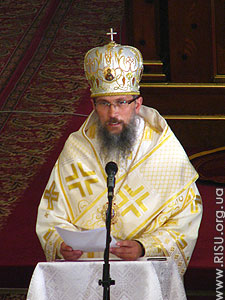
I’d like to post here something that I hope will not be considered worldly or rigid by anyone; the vesting ceremony for a bishop before Vespers in a Ukrainian-Greek Catholic parish. This is at St. Elias in Ontario, with Bishop Benedict Aleksiychuk. Fr. Tom Loya, another Byzantine Catholic priest, describes how a similar vesting happened at his parish, and I think this serves as a nice preface for the video:
The liturgy and spirituality of Eastern Christianity has its own unique evangelical power. This means that if we discover and allow to flourish what I call the “inner dynamism” of our Liturgical life the Eastern Churches will evangelize and they will do so in a powerful way. This inner dynamism means to rediscover and live what has a perennial evangelical value. When that happens it is powerful. The past weekend at our parish offers testimony:
Bishop Kudrick attends Matins prior to Liturgy. But here is the best part: He does the complete Rite of vesting of the bishop in front of a church full of people, mostly young people, just prior to the beginning of Liturgy. The deacon incenses each vestment. There is a full choir who responds during this Rite as well as throughout what would be a Hierarchical Divine Liturgy–deacon, servers, choir, cantors, packed church, tons of incense, floor-to-ceiling icon murals and at least half of the congregation (including children) appropriately standing throughout the entire Liturgy.
Throughout the day the parishioners are “buzzing” about witnessing the vesting of the bishop, especially the moment when the bishop assumed the posture as though on the Cross while the servers fasten the buttons of his sleeves.
A powerful weekend and one that knocked the many visitors off of their feet. Yet, it was doing nothing more than being honest to the inner dynamism of our own tradition. Herein lies the “New Evangelization” for the Eastern Catholic Churches. Be who we really are without compromise and we will evangelize. We WILL impact the world because what we have to offer is of perennial value and it is absolutely relevant for our times.


Video of the Vesting of Bishop Venedykt Aleksiychuk

Cannot Latin Catholics evangelize in this way too? There are similarities between the vesting of the bishop in the tradition of the Latin West and that of the vesting of a bishop in the Byzantine rite, but the Byzantine tradition of doing so is beautiful, and I do not think it is in any way “archaic”, but shows how TWF mentioned that our priests and bishops can be “living icon of Christ the King”.

I sincerely hope that Bishop Aleksiychuk, Cardinal Cleemis, and other Eastern prelates (and Latin prelates, such as Archbishop Alexander Sample, who wears traditional vestments and attire) are not seen as “living anachronisms”. I agree, there is a time and a place not to be gaudy, especially when dealing with those who have become thoroughly secularized in the Western world and scoff at anything resembling heavenly things… but our clergy should NOT be dismissed as “worldly” and rigid" based solely on their dress. There is a reason they dress this way, and if the dress of the Eastern Catholic prelates was truly archaic, then why is such dress the norm? I sincerely hope they who are “keeping their traditions” as St. John Paul told them, are not seen as ostentatious.
 
Here’s another perspective a Byzantine Catholic priest on why their clergy dresses the way they do. Byzantine Catholics are just as Catholic as Latin Catholics are; so when I see Latin Catholic clergy being looked on down for wearing lace or other vestments that have gone out of vogue since Vatican II, I can’t help but wonder how Eastern Catholics cannot find such sentiments offensive, as they have not given up this type of dress, and it is still a very important part of the way they worship:
The adoption of the kingly miter should be seen in the same way. We are called by our Baptism to be a Priestly People, a Holy Nation, a People set apart by the Lord to be His own. Obviously we all don’t wear a miter that is visible, but we all have one that God sees because He has crowned us in Baptism. Beyond that, the miter is a reminder that it is Christ Who serves the Liturgy and He is the Eternal King. The man standing in His place by ordination reminds us of that fact. That’s why he is vested: so he won’t look like an ordinary man but being transformed in outward appearance we might be reminded on another level that it is Christ Who leads us to the Father in worship.
 
**
Rigidity brings us to push away people who seek consolation**

Jesus had a powerful message for the “go-betweens” of his day, who enjoyed to stroll the squares to be seen:

“But to make themselves important, intermediary priests must take the path of rigidity: often disconnected from the people, they do not know what human suffering is; they forget what they had learned at home, with dad’s work, with mom’s, grandfather’s, grandmother’s, his brothers’ … They lose these things. They are rigid, [they are] those rigid ones that load upon the faithful so many things that they do not carry [themselves], as Jesus said to the intermediaries of his time: rigidity. [They face] the people of God with a switch in their hand: ‘This cannot be, this cannot be …’. And so many people approaching, looking for a bit of consolation, a little understanding, are chased away with this rigidity.”

You can recognize a good priest by whether he knows how to play with children

“In the examination of conscience,” Pope Francis said, “consider this: today was I a functionary or a mediator? Did I look after myself, did I look to my own comfort, my own comfort, or did I spend the day in the service of others?” The Pope went on to say, “Once, a person told me how he knew what kind of priest a man was by the attitude they had with children: if they knew how to caress a child, to smile at a child, to play with a child … It is interesting, that, because it means that they know this means lowering oneself, getting close to the little things.” Rather, said Pope Francis, “the go-between is sad, always with that sad face or the too serious, dark face. The intermediary has the dark eyes, very dark! The mediator is open: the smile, the warmth, the understanding, the caresses.”
**

en.radiovaticana.va/news/2016/12/09/pope_francis_rigidity,_worldliness_a_disaster_for_priests/1277926**

True… it’s not good for clergy to be this way. I’ve experienced more of this from laity though. I’m wondering if pope Francis is using the clergy as a euphemism for the entire Church when he speaks about these things.

I wouldn’t care to count the people who I’ve known that have been chased away in exactly the manner in which pope Francis describes. But it’s by laity, not clergy. Then there are the stories I’ve heard from my parents generation about nuns with rulers and rigid priests…well, those days are gone - is pope Francis suggesting we are in danger of those days returning?

I’ve heard that young priests coming out of seminary today are more orthodox and being taught differently than the earlier post Vatican ll seminarians, but I haven’t seen examples of that myself.

The priest who was pastor of my parish, when I was in Catholic school, recently described himself as a child of Vatican ll. He was probably the most well rounded priest I’ve ever known and would never chase away a seeking soul in favor of rules. It makes me grateful to have had him as pastor in my formative childhood years.

It concerns me to hear folks who want to roll back mercy and compassion in favor of canon law or traditional practices.

The example of the young priest trying on accessories is a reminder for all of us to keep focused on our interior, lest our exterior show through. I would say the priest’s accessories are a stand in for honor or aggrandizement.
 
It concerns me to hear folks who want to roll back mercy and compassion in favor of canon law or traditional practices.
Why do we have to choose one or the other? Mercy and canon law aren’t contradictory. (Although I can see why someone might think that.)
 
The example of the young priest trying on accessories is a reminder for all of us to keep focused on our interior, lest our exterior show through. I would say the priest’s accessories are a stand in for honor or aggrandizement.
I care little about fancy clothing and tradition; i even do not mind ugly churches much.

But i see a corelation between certain interior tendencies and the emphasize put on such externa things such that when i for whatever reason have the choice to go to one of two priests i would probably go with the one favouring fancy clothing and tradition.
 
“They make their phylacteries wide and the tassels on their garments long”
:bible1:

I think I know what Pope Francis is getting at with his story (see Matthew 23).

“The greatest among you will be your servant.”
 
Well, this is not an accusation, but depending on how one judges those in fur coats, this comment could be construed as such, but I don’t know how men in fur coats are particularly regarded, and there’s no qualification:
” Well, this is not an accusation, but …” is the left-handed manner in which one often does just what one claims not to do.
Are you judging the writer’s intent with the best possible interpretation or “construing” the worst? If so, then are you not guilty of that which you accuse another – rash judgment?
And then, from the first page of the thread, there’s the text of the homily itself:
“He then took the Saturno [wide-brimmed clerical headgear], he put it on and looked himself over. A rigid and worldly one.”
This is not a negative judgement on a worldly act; this is a negative judgement on a worldly man, a worldly one.
The language is not clear as to the reference for “one” in the second sentence fragment. Does “one” refer to an act or a man? The best interpretation is that “one” refers to the act. To avoid detraction, we are obliged to make the best interpretation of another when multiple interpretations are possible.
 
“They make their phylacteries wide and the tassels on their garments long”
:bible1:

I think I know what Pope Francis is getting at with his story (see Matthew 23).

“The greatest among you will be your servant.”
He wants us to live according to what those priest with too much over the top clothing preach?

Cause when i checked an online bible it seemed this critiques is aimed at pharisees who are explicetly critized for not living according to what they preach but the listeners are still instructed to live according to what they preach.
 
This is apparently a discussion about modesty.

Again, from the stance of mere construction, some of the “fancier” vestments are far simpler in cut and construction than a coat or pair of jeans. In fact, I was mildly questioned for not doing something more complicated for my capstone.
 
I propose that the priests who really desire to wear fine vestments wear mundane ones, and priests who really don’t want to wear fine vestments do so.

I’m being a little tongue in cheek of course, but few things are as good for our egos as either being forced to be mundane or forced to stick out.

The priests who get out of this are the ones who aren’t attached either way.
 
“Thank God I am not like that rigid traditionalist priest in his fancy garments but dress poor and humbly.”

With that out of the way, it’s interesting to note that those who are most loudly criticizing the Church for being worldly are in fact the ones who want the Church to be more like the world. Our culture is hardly becoming less casual. So the obvious solution is not to stand in opposition to these trends but to embrace them. Become just as bland, utilitarian, dare I say democratic as the rest of society. Suspicious of anyone who would dare put on a suit and a necktie (the ultimate in non-utilitarian menswear). “What, does he think he’s better than me, getting all dressed up like that!” I think it’s not coincidence that those bad old ages produced beautiful cathedrals and palaces that have stood for centuries while the modern age produces office buildings and strip malls (that don’t get the chance to stand the test of time, we just tear them down as soon as they’re no longer useful).

The strange double-standard regarding the Eastern Churches is also indicative. We Latins must be drab and unadorned; let the Greeks have their crowns of gold.
 
https://scontent-dft4-2.xx.fbcdn.ne...=5334b8184bb786c9b98f385feaf1df2f&oe=58F965A0

From the Council of Trent:
If anyone says that the ceremonies, vestments, and outward signs which the Catholic Church uses in the celebration of Masses, are incentives to piety rather than stimulants to piety, let him be anathema.
Session XXII, Canon 7 (Sept. 17, 1562)
This debate is not about the Mass, but I thought the Church’s longstanding teaching on beautiful (not “ostentatious”) external things, specifically during the Mass, would be worth repeating. Consequently, one cannot conclude that our Eastern brothers and sisters, for example, are guilty of pride, pretension, etc. based solely upon their apparel; as many posters have pointed out, clothing does not necessarily prove anything. Other questions must be asked and one’s behavior must be observed.

I think the young priest/seminarian should be more careful/prudent when it comes trying out Saturnos. It may be confused with modeling! Granted, this event took place at the clergy store, but, as Father Ruggero pointed out, many laity shop there as well. The internal workings of his heart are alone known to God. Pope Francis is in a position where he can chastise such behavior, and if it is occurring, he should do so. Is a homily the proper place to address such a concern? I dunno; you tell me.

Anyways, I wonder how often this behavior actually occurs. Maybe I am naive because I am part of the laity (and I mean that with all honesty - I don’t hear other priests’ confessions), but I don’t think it is a widespread problem. I DO think there is a serious problem with priests who refuse to wear the Roman collar, especially in public. Of course, there are various occasions where a priest may not wear clerical attire, but a priest is a priest of Jesus Christ 24/7. My parents never remove their wedding rings, and I like to imagine both vocations are similar in terms of the importance of external signs.

I cannot (and will not) judge the souls of priests who choose not to dress as a presbyter. However, I will point out that I think it is a bigger problem than clergy dressing elaborately nowadays. Priests are not offered worldly luxuries (free meal, etc.) anymore by virtue of their vocation. More than likely, they are mocked and ridiculed for being a priest (Fr. James Martin said an individual complimented his “dress”). I don’t think too many priests are concerned with dressing ornately anymore. I think more are nervous to even put on the collar.

Like other polarizing threads, we need to appreciate the traditions of the Church as well as our Holy Father’s words. We need to prayerfully discern them and stop demonizing others, specifically younger priests who wear the traditional garb. It is wrong and destructive - an attack by the Father of Lies.
 
Status
Not open for further replies.
Back
Top