Protestants try to disprove Kepha in Matthew 16:18

  • Thread starter Thread starter RedDeathsMask
  • Start date Start date
Status
Not open for further replies.
Much of the writing in the very early Church was in Greek. Once Latin took over, knowledge of Greek seem to fade
I have seen (literally) graphic evidence of this: in the catacombs just outside of Rome, the early areas have Greek inscriptions, the later ones Latin words written in Greek letters, and the latest ones Latin inscriptions. That middle layer is quite strange to behold.
And this means that some of the original texts could not be easily read. What I hear - and not from you - is that all of this seeming confusion about Matt 16:18 is because the early Catholic Church mistranslated / misunderstood the Greek. And, here comes the 16th Century revolt and suddenly this is not understood properly - because there is not need for the Magisterium - anyone can correctly interpret Scripture. And, there inlies the problem.
I know what you mean, and it drives me up the wall when people are prepared to dismiss a millennium and a half of Christian scholarship in order to “score points” in an argument. Once we cross from a heuristic (discovering) to an eristic (argumentative) exercise, communication has already ended.
 
No he didnt what?
This - which I quoted in my post:
If you read the article I posted from Scott Hahn you see that the first thing that happens in scripture in Acts 1 is that Peter stands up amongst them and chooses as a successor for Judas.
Peter did not name a successor. No one is arguing that he was not the most prominent of the Apostles. But he didn’t exert authority over them, they all chose candidates and then they voted on it.
“Christianity was corrupted” all along, during the Incarnation, and Jesus corrected it, albeit Judas wasn’t listening, I guess, and has continued to be and Christians have continued to battle, often both sides truly believing they are the ones following Christ most closely. But this is also not the topic.
Corruption exists amongst Christians. That’s just a fact. Always has. At all levels. As this quote is at least part of the Scripture, we are at least on-topic. What do you think “the gates of hades will not prevail against it” means?
 
You had said, “All people who come to Christ Jesus in this way are given the keys to the kingdom”, a claim which this text does not support. Do you mean some other passage?
Well, you think the text doesn’t support it, others think it does. It’s why there is debate. Just as Jesus often spoke to an individual, but we take it as a teaching for each of us, these keys are seen as being given to the disciples of Christ.
It is neither a typo nor a test: I was presuming that that was what you meant by “a Greek word is simply ignored and not translated at all”. I do not see how it would be possible to render it, nor how there are two untranslated words


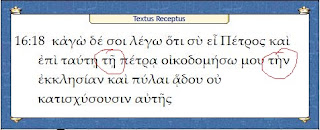
The two words circled in red are forms of the definite Greek article we would translate as “the, that, those.” I asked about a typo as you can see it’s spelled wrong (I don’t even know how to put Greek letters in a post so I think that’s not unusual) in your post. I don’t want to get bogged down, but there are several alternative ways of translating the text and that’s part of the argument that comes from Protestants. If you put the definite articles in, then Jesus isn’t saying “my church” He is saying He will be the creator of “the group of followers.” (the ecclesia)

There is also the issue of the last word in the passage (autos) which is easily translated “them.” If we remember that ecclesia refers to people, not institutions, that makes more sense than “it.” Then Jesus is saying His disciples will be cut from the same kind of rock as Peter, and the gates of hades (death) will not prevail against them, or: they will have eternal life. What kind of rock is Peter? The kind that can hear and understand the promptings of the Holy Spirit - accept what they are told from above and believe in faith.

The thread is about answering the objections to the Roman Catholic interpretation of the passage as supporting the Pope as absolute Christian monarch on earth. I think it’s important to understand and respect that their arguments are reasonably based in Scripture.
 
Hi, Julia Mae,

What we really need to focus on is staying with facts - and not inventing ‘facts’ as one goes along.
Peter did not name a successor. No one is arguing that he was not the most prominent of the Apostles. But he didn’t exert authority over them, they all chose candidates and then they voted on it.
How can you possibly know what Peter did or did not do speciic to his successor? Really. And then to present this without any reference.

How can you possibly say that he did not exert authority - when there are clear Biblical references to Peter’s exercise of authority. Here are a dozen specifically disproving your statement:

**1.) John 21:15-17 - Jesus charges Peter to “feed my lambs,” “tend my sheep,” “feed my sheep.” Sheep means all people, even the apostles.

2.) Acts 1:15 - Peter initiates the selection of a successor to Judas right after Jesus ascended into heaven, and no one questions him. Further, if the Church needed a successor to Judas, wouldn’t it need one to Peter?

3.) Acts 2:14 - Peter is first to speak for the apostles after the Holy Spirit descended upon them at Pentecost. Peter is the first to preach the Gospel.

4.) Acts 2:38 - Peter gives first preaching in the early Church on repentance and baptism in the name of Jesus Christ.

5.) Acts 5:3 - Peter declares the first anathema of Ananias and Sapphira which is ratified by God, and brings about their death. Peter exercises his binding authority.

6.) Acts 8:20-23 - Peter casts judgment on Simon’s quest for gaining authority through the laying on of hands. Peter exercises his binding and loosing authority.

7.) Acts 10:34-48, 11:1-18 - Peter is first to teach about salvation for all (Jews and Gentiles).

8.) Acts 12:5 - this verse implies that the “whole Church” offered “earnest prayers” for Peter, their leader, during his imprisonment.

9.) Acts 15:7-12 - Peter resolves the first doctrinal issue on circumcision at the Church’s first council at Jerusalem, and no one questions him. After Peter the Papa spoke, all were kept silent.

10.) Acts 15:12 - only after Peter (the Pope) speaks do Paul and Barnabas (bishops) speak in support of Peter’s definitive teaching.

11.) Acts 15:13-14 - then James speaks to further acknowledge Peter’s definitive teaching. “Simeon (Peter) has related how God first visited…”

12.) 2 Peter 3:16 - Peter is making a judgment on the proper interpretation of Paul’s letters. Peter is the chief shepherd of the flock. **

And, if you would like more where these came from - here is the link: scripturecatholic.com/primacy_of_peter.html

Seriously, the more you spin out these hand-crafted fables - the more you undermine your own position. Your posts appear to be in serious need of factual research - as opposed to the on-going imaginative journeys.

God bless

God bless
 
I am sorry, but this is making less and less sense to me.
Well, you think the text doesn’t support it, others think it does. It’s why there is debate.
Some think that the world is flat. The mere existence of an opinion is no recommendation of the validity of the opinion, and the self-evident fact here is that the text in question is addressed to a singular individual and one cannot, therefore, logically claim that “It has complete support from the text”. That is eisegetic in the extreme.
The two words circled in red are forms of the definite Greek article we would translate as “the, that, those.” I asked about a typo as you can see it’s spelled wrong (I don’t even know how to put Greek letters in a post so I think that’s not unusual) in your post.
Um … what? :confused:

:nope:
No, τηι isn’t misspelt, and merely has an iota adscript rather than an iota subscript (which is hardly a complex difference).
If you put the definite articles in, then Jesus isn’t saying “my church” He is saying He will be the creator of “the group of followers.” (the ecclesia)
:nope:
Also no.

First, rendering the passage with the articles: επι ταυτηι τηι πετραι οικοδομησω μου την εκκλησιαν - “on this the rock I will build of me the church”. This is not done for the first definite article, τηι, because English only uses one determiner per noun, and so “this” trumps “the”. It is not done for the second, την, because it is less euphonious in English than “I will build my church”.

Second, εκκλησια, ‘summoned group’, is used throughout the NT both for the individual gathering in a given city (i.e. local churches) and for the collection of all believers (i.e. the Church as a whole, q.v. 1 Co 12:28, Eph 5:23-4), following on from the three-century tradition of usage in the LXX for the assembly of tribes. Still, this whole line of argument utterly fails to support any attempted severing of πετρα from its cognate πετρος, since Jesus is still saying that he will build his assembly/church upon the stuff of which Simon was formed.
There is also the issue of the last word in the passage (autos) which is easily translated “them.”
:tsktsk:

First, the word there is the feminine genitive αυτης, not the masculine nominative αυτος, and that gender difference is important because feminine pronouns were not used in Greek for mixed-sex groups such as the church.
Second, both αυτης and αυτος are singular, not plural, and thus cannot properly be translated “them” (a plural). For it to be “them”, it would have to be αυτων.

It does not mean “them” in Greek and cannot be rendered “them” in English unless one wants to abandon what the source text actually says, which is probably why I have yet to see a published translation attempt to pluralise the singular there.

I would advise giving up on whomsoever you have been reading on this topic, and going back to the people who were actually reading the Scriptures in their own language. John Chrysostom, for example, covers this passage in his 54th homily on Matthew.
 
Hi, Mystophilus,

A truly excellent post …👍 but, the distinctions in the Greek were just lost on me…😃

And, I noted one priceless item:
I am sorry, but this is making less and less sense to me.

Some think that the world is flat. The mere existence of an opinion is no recommendation of the validity of the opinion, and the self-evident fact here is that the text in question is addressed to a singular individual and one cannot, therefore, logically claim that “It has complete support from the text”. That is eisegetic in the extreme.
God bless
 
I am sorry, but this is making less and less sense to me.
Yeah, I’m not interested in a 40 page debate on Greek language and useage, I get enough of that on Greek forums. Suffice it to say there are other equally valid translations, IMO. If you don’t share that opinion, then we are much too far apart on even the most basic truths of translation.
No, τηι isn’t misspelt, and merely has an iota adscript rather than an iota subscript (which is hardly a complex difference).
:nope:
Jesus is still saying that he will build his assembly/church upon the stuff of which Simon was formed.
Exactly the Protestant point. He is not saying He will build on Peter, but *of the stuff of which he was formed. *
I would advise giving up on whomsoever you have been reading on this topic,
And I would advise OP, you, or anyone who wishes to engage with Protestants on this issue to understand exactly where they are coming from and respect their position before engaging. Throwing endless quotes from the Church at them will not change any opinion they hold. Waste of time.
 
Hi, Julia Mae,

How interesting. Then what is it you are trying to do on CAF, Julia?

The historical context of the majority of people accepting the Bishop of Rome as the head of the Catholic Church prior to 400AD is a historical fact and has nothing to do with scripture. Yet you just dance around this with a quote here or there from some who did not agree at that time - as if this were the dominant feature.

Both Luther and Calvin (both clerics) and Henry VIII (wrote paper defending the Pope and the Sacraments) accepted the authority of the Pope - until their desire to have their own way opened the door to them denying what they had once believed. And, again, this too is historical and not Scriptural.

I am guessing that your lack of response to post #187 with the Scriptural quotes identifying the authority Peter exercised and refuting your position, was not something to simpy evade - is that accurate?

If you are looking for anyone who has been wasting time, may I suggest a mirror.

God bless
And I would advise OP, you, or anyone who wishes to engage with Protestants on this issue to understand exactly where they are coming from and respect their position before engaging. Throwing endless quotes from the Church at them will not change any opinion they hold. Waste of time.
 
tqualey, Mystophilus, LionHeart - and - anybody else who wants to comment…

wow… I’m gone for just a few days, and look what happens! hehehe… quite a thread going…

Well, OK - I’m back, and I’m definately going to preface my stuff below by saying “don’t take what I’m saying as ‘argumentative’ in some ‘accusatory’ fashion. But, as always, take it as a sincere effort to communicate something that I’m giving a whole-hearted effort to working through”… And, here goes…

In the most literal translation, Matt 16:18 says - "…you are Petros, and upon this petra I will be building of me the “out-called”.

We translate that verb “οiκοδομήσω” as “shall build”, but it’s actually “will be building”… This implies that the thing that will be happening is a process, not an event. It is not a proclamation of the formation of an organization, but a statement of what Jesus will be continually doing.

Second, let’s just go ahead and take out the capital-C “Church”, because it REALLY says “the out-called”. Those that are “called out” by Jesus to be his. It’s not an “organization”, per se, but rather, is a referece to ALL those that are called by Jesus. Any method of “organization” of that group of out-called people is a secondary matter.

Now, the scripture says that Jesus will be building his “group of those called out” on “this petra”.

If that petra is Peter, then so be it. But, any way you cut the cake, it is a simple statement of fact: Jesus will be building the group of those that are called out on Peter.

But here’s the fine point of it: JESUS, not Peter, is doing the building. And, the
“materials” for that building - the people “called out” - are of JESUS’ choosing, not Peters. In short, that “group of the out-called” is NOT defined as "those who accept “Peter”, but rather, as “those chosen by Jesus”. Peter simply doesn’t have a say in
that matter, and whether or not any given one of those “out-called” can accept Peter, or
even know about Peter, is totally irrelevant. That group - the “ecclesia” - is being built on Peter BY JESUS, whether they know it or not, and whether Peter likes it or not, he’s “stuck” with whomever Jesus calls.

Peter is not given the authority to put “conditions” on who is part of “those that are called out”. He is not given the authority to say “you have to accept ME before you can be included”, because it is Jesus who does the deciding on who is or is not included. Again, it is Jesus, not Peter, who is both providing the building materials and doing the building. Besides, there are literally millions of Christians in the world - people that have been called out by Jesus, for His purposes - that have no more of an idea of what “Peter”
(or subsequent Popes) have to do with their lives, and it’s not their fault. Many of them are like me: called by Jesus to be His, and then, just started reading the bible. Maybe for many, if not most of them, the idea that they were being built “on Peter” never even occurred to them.

Why then does “Peter” act like I’m* NOT* one of those built on him? Heck, just because I don’t know about about the “Peter connection” doesn’t mean that HE doesn’t know about it. After all, having that place was the job Jesus gave him. Guys like me could go the rest of our lives without EVER reading Matt 16:18, or if it was read, might go the rest of our lives never figuring out what it means. But “Peter” knows what it means, and he’s responsible for it, because it’s the position that Jesus gave him.

It seems to me that “Peter” ought to be reaching out to ME, telling me “Jesus built you on me… You may not know that, but He did. And, because of that, I absolutely want you to know you belong here. I don’t have any conditions, because I CAN’T have any conditions, since it was Jesus’ choice putting you here. My job is to work with what I’m given, and thats YOU, and do my best to make sure you know this is where you
belong”.

Instead, “Peter” has done all kinds of weird stuff over the centuries, and come up with all kinds of weird notions that are virtually guaranteed to be “exclusive”. It’s like he’s said “Christ built you, as part of the out-called, on me, but now, I’M telling you that if you REALLY want to belong, you have to believe in stuff like the ever-virgin Mary, the ascension of Mary, and you have to believe that when the bible talks about Jesus’ brothers and sisters that it really means “cousins” or something else, and that “holy water” has some special qualities, and that the bread and wine of communion actually become the literal body and blood of Christ, and the need for infant baptism, based on a belief in ‘the Peter concept’ of Original Sin, and - above all - you can’t have communion with any other of those others that were called out by Jesus, and placed on me, until they all adopt these same ‘Peter beliefs’. In short, I’m telling you that you’ve got to accept a bunch of Traditions of people you don’t know a thing about, and are not found in the bible, and stuff that has led to some really horrific “splits” among the ‘out-called’. I’m telling you that I’m going to deny that you belong here until and unless you get with MY program, even if my program is sometimes whacko”.

Do you see what I’m getting at here? If Christ is building his group of those He called out, and building them on “Peter”, then it is what it is, whether I’m really aware of it or not. But, it would seem to me that “Peter” has more of a problem with me than I do with him. It seems like “Peter” wants to reject some of those that Christ has already chosen…

OK - the floor is open for comments and kind conversation…. 🙂
 
Hi, Aussie,

Well, you certainly have been busy. Now, since you have been reading all these back posts, you know that this issue about Peter being a small rock and Christ having 11 other sets fo keys that just were never mentioned…has been around the block for quite some time… And beginning in the 16th Century we have the full flowering of this line of thought. But let me see what I can do to help you move this concern forward. 🙂
** Do you see what I’m getting at here? If Christ is building his group of those He called out, and building them on “Peter”, then it is what it is, whether I’m really aware of it or not. But, it would seem to me that “Peter” has more of a problem with me than I do with him. It seems** like “Peter” wants to reject some of those that Christ has already chosen…

OK - the floor is open for comments and kind conversation…. 🙂

Now, this is a brand new theory, Aussie - really. I have never read it and have never written about it. This is 100% my opinion - and it’s so new to me the ink is still wet…so don’t go looking for a vintage, because there isn’t one. 🙂

Let’s take a look at ‘reverse engineering’ for a moment and put in the context of the various groups all claiming to be the Church (it really does deserve to be capitalized - sorry, I can’t help you on that one). Now, a lot of Protestants get upset when someone says that there are 30,000 groups all claiming to be the Church founded by Christ. So, following your good example and not wishing to be argumentative… pick any number you like - that
does not exceed 30,000, and just look at what they are teaching right now. Fair enough.

In an effort to simplify things - the ONLY item that they all agree on is that the Catholic Church is not the True Church founded by Christ. Really, after that - no two of them agree on everything else. For example, take Baptism as an item. Some say it is absolutely requried, some say one does not need this at all, others claim it is only a symbol and many of those that say it is at least somewhat important, deny it to children. So, there really isn’t a lot of unity here. Yet Christ said a couple of things that bear mentioninng:

He said Baptism was necessary and here are a couple of references:

1.) John 1:32 - when Jesus was baptized, He was baptized in the water and the Spirit, which descended upon Him in the form of a dove. The Holy Spirit and water are required for baptism. Also, Jesus’ baptism was not the Christian baptism He later instituted. Jesus’ baptism was instead a royal anointing of the Son of David (Jesus) conferred by a Levite (John the Baptist) to reveal Christ to Israel, as it was foreshadowed in 1 Kings 1:39 when the Son of David (Solomon) was anointed by the Levitical priest Zadok. See John 1:31; cf. Matt. 3:16; Mark 1:9; Luke 3:21.

2.)John 3:3,5 - Jesus says, “Truly, truly, unless one is born of water and the Spirit, he cannot enter the kingdom of God.” When Jesus said “water and the Spirit,” He was referring to baptism (which requires the use of water, and the work of the Spirit).

But, there is more to this process then one item - it does get more complicated…😃 Now take the forgiveness of sin. Most Protestants claim that one goes directly to God and asks God to forgive him. Not bad…but, certainly not based on Scripture! :eek: Christ delegated the Power of God to these men to forgive sin - and here are the references for that:

1.) John 20:21 - before He grants them the authority to forgive sins, Jesus says to the apostles, “as the Father sent me, so I send you.” As Christ was sent by the Father to forgive sins, so Christ sends the apostles and their successors forgive sins.

2.)John 20:22 - the Lord “breathes” on the apostles, and then gives them the power to forgive and retain sins. The only other moment in Scripture where God breathes on man is in Gen. 2:7, when the Lord “breathes” divine life into man. When this happens, a significant transformation takes place.

3.)John 20:23 - Jesus says, “If you forgive the sins of any, they are forgiven. If you retain the sins of any, they are retained.” In order for the apostles to exercise this gift of forgiving sins, the penitents must orally confess their sins to them because the apostles are not mind readers. The text makes this very clear.

4.) Matt. 9:8 - this verse shows that God has given the authority to forgive sins to “men.” Hence, those Protestants who acknowledge that the apostles had the authority to forgive sins (which this verse demonstrates) must prove that this gift ended with the apostles. Otherwise, the apostles’ successors still possess this gift. Where in Scripture is the gift of authority to forgive sins taken away from the apostles or their successors?

And if you want even more information - here is the link these items came from: scripturecatholic.com/index.html

Even though the Christian Faith is more involved then two items, let’s start our ‘reverse engineering’ process. How many groups do you think you can find that have both of these Scripturally based elements? Really. My guess is not many.

Jump ahead to today’s cultural issues: abortion, homosexual behavior, and euthansia. Do you think Christ - who rebuked the Apostles for trying to stop the women who wanted to bring their children to Christ (Matt 19:14, Mark 10:13) would approve of butchering this new and innocent life in its mother’s womb? I don’t.

Do you think that God in creating man and woman and joined them together would approve of ‘gay marriage’? Or, do you think that St Paul in the 1st chapter to the Romans was actually approving if not blesing homosexual behavior? I don’t.

Scripture tells us that Christ brought back to life several people - and probably the most famous was Lazarus in Bethany when Christ told him to come out of his tomb (Jn 11:43). Do you think Christ would approve of killing innocent people whose only offense was that they were old, or sick or not of their right mind? I don’t.

As I see it - we have to be honest and read the Bible with the words that are there. Most Protestants find ways to turn clearly written words upside down to suit a contemporary agenda. Think back - 100 years ago, no assembly, fellowship, temple, tabernacle or and so-called main line Protestant church approved of: abortion, homosexual behavior or euthansia. Today this has totally changed. Admittedly, some really do condemn these practices - but, just look at all the ones that have embraced the current cultural standards. Do you think that these condemnation were valid in the 16th Century but now they are OK in the 21st Century? I don’t.

Now, let’s see what we have here. I think you will find that Protestant churches are truly dis-united on many significant issues. But, you do your own research in that area. With all of the churches you will be looking at, it will take some time.

If you take a look at the Catholic Church - all these items that we find today, can be traced back to the First Bishops - the Apostles, to Peter - the leader of the Apostles, and to Christ - True God and true man. Admittedly there are those who love to confuse others with their interpretation of Scripture - but few will tell you that the Scriptures themselves come from the Catholic Church in about 400AD. cathtruth.com/catholicbible/earlyhis.htm If you don’t think Christ founded His Church on Peter - fine! You tell me which one Christ did found.

Looking forward to hearing from you.

God bless

 
A truly excellent post …👍 but, the distinctions in the Greek were just lost on me…😃
Mostly, it is just me being confused by someone not understanding exceedingly basic elements of Greek grammar, analogous to the function of a question mark or the role of the past tense in English.
 
He is not saying He will build on Peter, but *of the stuff of which he was formed. *
Actually, he is saying both, as the Greek readers of the text have long attested.
And I would advise OP, you, or anyone who wishes to engage with Protestants on this issue to understand exactly where they are coming from and respect their position before engaging.
I am a Protestant.
:rolleyes:
 
We translate that verb “οiκοδομήσω” as “shall build”, but it’s actually “will be building”… This implies that the thing that will be happening is a process, not an event. It is not a proclamation of the formation of an organization, but a statement of what Jesus will be continually doing.
Sure, and the ongoing process has to have an initial point, and Peter is described as that here.
Second, let’s just go ahead and take out the capital-C “Church”, because it REALLY says “the out-called”… It’s not an “organization”, per se
That deletion would be rather hasty, because the word εκκλησια was not new. It had been extensively used for assemblies of various kinds in Greek city states, and then, more significantly, for the assembly of the tribes of Israel in the OT, when that was translated into Greek (the LXX) in the early C3rd BC. Thus, by the point at which Matthew wrote, the Jewish people had been using the term for the gathered, coherent body of believers for 300 years. That is very definitely an organisation. This is the same sense in which we find it used in such passages as 1 Co 12:28 and Eph 5:23-4, for the whole Church, as well as being used in other passages for the individual churches.

Since, in Mt 16:18, Jesus is talking about his Church, I would say that it is far more appropriate to use the capital C for the general Body of Christ than the lowercase C for a local congregation.
Instead, “Peter” has done all kinds of weird stuff over the centuries
While I agree with you on the general statement that Catholicism has fallen down in various ways over the centuries, I would hasten to add that we all do. Like Palestinians and Israelis, we are well past the point at which we can reasonably say, “It is their fault, not ours.”
and you have to believe that when the bible talks about Jesus’ brothers and sisters that it really means “cousins” or something else
Um, that is another one which is actually much more sensible in Greek than it seems in English.

In relation both to that and to Mt 16:18, I would strongly suggest going back to the people who were reading the NT untranslated in their own first language, and seeing how they understood both the bestowal of the keys and the perpetual virginity of Mary.
 
tqualey —

Regarding your response that began with the quote below… I read it all, actually a couple of times…

I would like to ask you to re-read my post which you were responding to. As you know, I don’t speak for “Protestants”, nor for anybody else. I just speak for me.

You always seem to have some good insights, etc, but I’m kind of thinking that you might have missed the point that I was making in my post. Granted, I may not have made it very clear. But, if you wouldn’t mind, would you consider re-reading it? You usually seem to have a good idea of “where I’m going” in my (rambling) posts, but I’m just thinking that maybe you didn’t quite get my last one (and again, I may not have communicated clearly)…

BTW - believe it or not, I’m actually proceeding from the notion that Peter is indeed the rock in my last msg…

So, if you can take time to re-read it, I’m hoping you might see something different in it, and might be able to respond to the “issue” that I attempted to present. Since you are usually very good about getting what I’m attempting to say, then I’ll try, in another post, to re-state myself more clearly, in case your response doesn’t quite seem to address what I’m hoping to get at… 🙂

Aussie
Hi, Aussie,

Well, you certainly have been busy. Now, since you have been reading all these back posts, you know that this issue about Peter being a small rock and Christ having 11 other sets fo keys that just were never mentioned…has been around the block for quite some time… And beginning in the 16th Century we have the full flowering of this line of thought. But let me see what I can do to help you move this concern forward. 🙂
 
**Mystophilus –
**

Thanks for your fine “forensic” analysis of my earlier posting…

I’m about to conclude that I have not communicated my “issue” well at all. It appears that neither you nor tqualy have addressed the central theme of my post even slightly, but rather, have “nibbled at the edges”, but have missed the Elephant In The Room…

Perhaps I need to re-write my posting.
 
By the way, I just wanted to thank you for the charity and patience which you have demonstrated in dealing with those of us who dissent from Catholic belief. It is a refreshing to change to get away from the usual daft polemics which come from all sides on such topics.
👍
 
I’m about to conclude that I have not communicated my “issue” well at all. It appears that neither you nor tqualy have addressed the central theme of my post even slightly, but rather, have “nibbled at the edges”, but have missed the Elephant In The Room…
Sorry about that. :o

The majority of what you wrote comments upon “Peter”, apparently a reference to the Catholic Church, making others such as yourself feel excluded, in part by demands for belief in teachings not founded in Scripture.

Is that not correct?

That is what I wanted to address in regard to us all failing. We Protestants have historically been just as good at excluding Catholics as they have been at excluding us.
 
Mostly, it is just me being confused by someone not understanding exceedingly basic elements of Greek grammar, analogous to the function of a question mark or the role of the past tense in English.
Or someone not understanding more complex elements of translation.
 
Sure, and the ongoing process has to have an initial point, and Peter is described as that here.
Unless, as you and I previously said, it is not Peter the individual, but the “stuff” of Peter, the kind of person who knows by hearing from above.
That deletion would be rather hasty, because the word εκκλησια was not new. It had been extensively used for assemblies of various kinds in Greek city states, and then, more significantly, for the assembly of the tribes of Israel in the OT, when that was translated into Greek (the LXX) in the early C3rd BC.
It also meant “noisy rabble .” But I doubt Jesus meant that.
Since, in Mt 16:18, Jesus is talking about his Church, I would say that it is far more appropriate to use the capital C for the general Body of Christ than the lowercase C for a local congregation.
I disagree. I don’t think modern translations should use the word “church” at all, as what Jesus said was that He would assemble His “tribe” from a certain type. There is nothing to indicate it had to be a single, homogenous corporate body. In Scripture, in fact, Jesus indicates that it’s fine for people to be His followers and not be in His group with the Apostles and other disciples that were a single body.
 
Status
Not open for further replies.
Back
Top