M
Monte_RCMS
Guest
Might be what the bears do in the woods.Darn polar bears and their SUVs…
[Actually, if there is a mile-thick glacier, then there aren’t any woods.]

Might be what the bears do in the woods.Darn polar bears and their SUVs…
It’s false to assume there can be only one cause for an event.The Wisconsin glacier that covered a huge amount of the United States and North America, melted 10,000 years ago. There was no human involvement.
What are your error bars?1880-2009:
http://ossfoundation.us/projects/en...-records/HADCRUT3_1880-2009.png/image_preview
On this last graph, eyeball the 1880 through 1940s temps and guesstimate an average horizontal line for that period and draw it out to the end. See how many of the temps after the 1940s are above that line, even the relative cooler 2008 temp.
There are high odds that something is driving the climate to become warmer – it is very unlikely temps in the recent decades are just natural fluctuations.
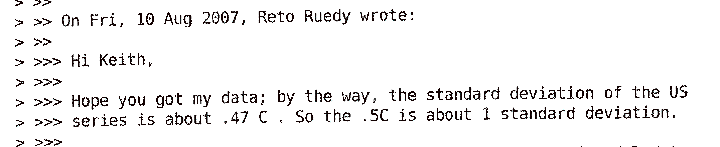
The US has the most complete coverage and the most accurate sensors out there, and it is too noisy to make any historic conclusions from?He [McCyntire] concentrates on the US time series which (US covering less than 2% of the world) is so noisy and has such a large margin of error that no conclusions can be drawn from it at this point.
Page 36“In response to a freedom of information request, NASA’s GISS was required to produce a series of emails, which in turn revealed that (a) NASA admits the current warm period is not historically different from the period around 1921-1950, and (b) that there has been no sign of global warming in North America or the US.
ONLY if you dismiss coming out of the Little Ice Age and PDO and AMO.There are high odds that something is driving the climate to become warmer – it is very unlikely temps in the recent decades are just natural fluctuations.
![URL]](http://[URL]http://www.drroyspencer.com/wp-content/uploads/UAH_LT_current.gif[/URL])
There is much more to that story.NOTE: I quote the famous Ch. 10 Asia of the 4AR IPCC WGII Impacts (Cruz, et al.). Since I had given the paper as a conference presentation years ago, I read about the 2035 glacier melt date (p. 493), and greatly suspected it was wrong, bec of what I knew from climate scientists, and tracked it to a non-peer-reviewed source. So I did not include that date in my paper.
No it was included …KNOWN to be false.Most climate scientists work on WGI “science” chapters, not these WGII impact chapters, so it was sometime later that a glaciologist discovered the error.
But even before the 2007 report was published, it now emerges, the offending claim was challenged, not least by a leading Austrian glaciologist, Dr Georg Kaser, a lead author on the 2007 report. He described Dr Hasnain’s prediction of glaciers disappearing by 2035 as “so wrong that it is not even worth dismissing”.

The second glacier, the Siachin glacier in Kashmir, is even more stable. Claims reported in the popular press that Siachin has shrunk as much as 50% are simply wrong, says Raina, whose report notes that the glacier has “not shown any remarkable retreat in the last 50 years.” These conclusions were based in part on field measurements by ecologist Kireet Kumar of the G. B. Pant Institute of Himalayan Environment and Development in Almora. Much like the hysteria about Greenland’s ice cap, it seems reports of the glaciers’ demise are a bit premature.
According to a report in the journal Science, “several Western experts who have conducted studies in the region agree with Raina’s nuanced analysis—even if it clashes with IPCC’s take on the Himalayas.” The “extremely provocative” findings “are consistent with what I have learned independently,” says Jeffrey S. Kargel, a glaciologist at the University of Arizona, Tucson. Many glaciers in the Karakoram Mountains, on the border of India and Pakistan, have “stabilized or undergone an aggressive advance,” he says, citing new evidence gathered by a team led by Michael Bishop, a mountain geomorphologist at the University of Nebraska.
theresilientearth.com/files/images/himilayan_glacier.jpgHaving recently returned from an expedition to K2, one of the highest peaks in the world, Canadian glaciologist Kenneth Hewitt says he observed five advancing glaciers and only a single one in retreat. Such evidence “challenges the view that the upper Indus glaciers are ‘disappearing’ quickly and will be gone in 30 years,” said Hewitt. “There is no evidence to support this view and, indeed, rates of retreat have been less in the past 30 years than the previous 60 years.”
Since methane hydrate decomposition is an endothermic reaction absorbing heat ] it is self-quenching. This should have been a question that was asked and answered when it was first proposed. It’s a testament to the lack of scientific knowledge that the AGW’ ers bring to the discussion.It’s false to assume there can be only one cause for an event.
As mentioned above there are many factors that impact climate – the sun (short solar irradiation cycles and long term solar warming), earth’s orbit, earth’s wobble, natural short term fluctuations (el nino, arctic oscillations, etc), and greenhouse gases. Re the latter, these could be emitted by nature – like the extreme Siberian trap volcanic activity that is thought to have started the end-Permian great warming hysteresis; or as feedbacks as when warming melts permafrost & ocean hydrates, releasing methane, which causes further warming and further melting, etc; or when the warming melts ice and snow, revealing darker land and ocean, which absorb more heat and cause more melting, causing more heat, etc. – or they could be emitted by humans as they burn coal and oil, etc.
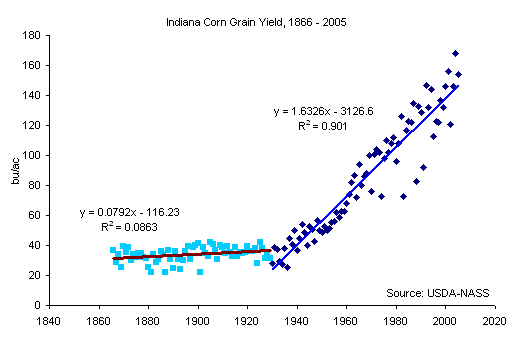
Here are the graphs LynnVamericanthinker.com/2009/12/understanding_climategates_hid.html
tomnelson.blogspot.com/2011/12/for-michael-mann-oh-what-tangled-web-in.html
climateaudit.org/2011/12/01/hide-the-decline-plus/
I challenge you to defend the above actions and authors.


So? Seems pretty much to prove that various factors can cause the climate to get warmer and cooler, which all the climate scientists know.Here are the graphs LynnV
Melting ice/snow also absorbs heat/energy, but eventually the dark land & sea it reveals will absorb more heat and contribute to the warming.Since methane hydrate decomposition is an endothermic reaction absorbing heat ] it is self-quenching. This should have been a question that was asked and answered when it was first proposed. It’s a testament to the lack of scientific knowledge that the AGW’ ers bring to the discussion.
Here’s the answer to that from Gavin Schmidt and Jim Bouldin.Since methane hydrate decomposition is an endothermic reaction absorbing heat ] it is self-quenching. This should have been a question that was asked and answered when it was first proposed. It’s a testament to the lack of scientific knowledge that the AGW’ ers bring to the discussion.
Again like others out to give wrong representations and attack scientists (instead of attacking the problem of GW) you are giving Hansen’s 1980s high end projection, not his most likely projection re climate change (which is very close to what panned out in succeeding decades). His most likely projection is just a tad above reality, and pretty good for a projection made way back in the 1980s, when they didn’t have such good computer power or models, which nowadays include many more factors, including coupled ocean-atmospheric dynamics. The scientists are constantly tweaking their models and projections based on most recent data, theory, and technological aids. It’s not like that old 80s chart (with the most likely and low end projections purposely edited out) represents something carved in stone for all time. Science advances.Mr Hansen’s Model
http://stevengoddard.files.wordpress.com/2011/08/paintimage3119.jpg
A “Business as usual” = Solid line
B “Reduced emissions” = Bolded Broken Line
C “Drastic reductions 0 ] emissions” = faint broken line
In July 2011 The GISS July anomaly went up to 0.60C, which places it squarely on top of Mr. Hansen’s scenario C – i.e. zero emissions after the year 2000.
THIS IS THE MODEL THAT STARTED IT ALL
This may be the most accurate projection of future global temperatures I have ever seen. This says categorically that the climate is behaving as if CO2 is NOT a major factor in any way! It reflects zero effective emissions.
Your knowledge of CO2 is flawed.A portion of CO2 can remain in the atmosphere up to 100,000 years.
CO2 is CO2… because it is 1 part Carbon and 2 parts Oxygen - there isn’t a “portion” to it. Take the O2 away and you aren’t talking of CO2 but of Heavy Carbon - Take the Carbon C ] Away and it’s Oxygen.A portion of CO2
Physically impossible in Earths constraints!CO2 can remain in the atmosphere up to 100,000 years.
Why do you insist on being insulting?As it is, even the **deniers **have been using nature’s GHG emissions in this way to claim that our human emissions are nothing by comparison. Seems like the deniers want to have it both ways.

I thought I might have provided it. Here are some of David Archer’s articles, his post, and book on it. I didn’t just make it up; I got it from a real climate scientist who specializes in GHGs:Your knowledge of CO2 is flawed.
You keep repeating this claim - I keep asking you for your evidence.
That’s an interesting point, but I’m thinking it is not the weight, but the fact that CH4 is less stable and degrades for why it stays in the atmosphere a much shorter time than CO2.CO2 is heavier than the atmosphere. CO2 is much heavier than Methane.
CO2’s Molar mass molecular weight ] is 44.0096 g/mol. It has a net atmospheric lifetime of about 5 years.
Methane’s CH4 ] Molecular weight : 16.043 g/mol. It has a net atmospheric lifetime of about 10 years.
climateresearchnews.com/2009/08/atmospheric-residence-time-of-man-made-co2/The IPCC First 1990 Climate Change Report where, in the opening policymakers summary of the report, the RT is stated to be in the range of 50−200 years, and (largely) on the basis of that, it was also concluded in the report and from subsequent related studies that the current rising level of CO2 was due to combustion of fossil fuels, thus carrying the, now widely accepted, rider that CO2 emissions from combustion should therefore be curbed.** However, the actual data in the text of the IPCC report separately states a value of 4 years.** The differential of these two times is then clearly identified in the relevant supporting documents of the report as being, separately (1) a long-term (100 years) adjustment or response time to accommodate imbalance increases in CO2 emissions from all sources and (2)** the actual RT in the atmosphere of 4 years.**
Whoever said the IPCC was up to snuff. It is exceedingly conservative and averse to making claims. It didn’t even guessimate the searise well, leaving out glacier and icesheet collapse mechanics and dynamics (because these are difficult to predict and quantify, tho they are certainly happening), and only considered seawater expansion from the warming. Single scientific studies are conservative in their striving to avoid the false positive of making untrue claims, which makes the IPCC (based on many such studies) conservative squared or conservative to some exponential factor.Even the IPCC mocks your 100,000 year claim
David Archer’s answer:…CO2 is heavier than the atmosphere. CO2 is much heavier than Methane. CO2’s Molar mass molecular weight ] is 44.0096 g/mol. It has a net atmospheric lifetime of about 5 years. Methane’s CH4 ] Molecular weight : 16.043 g/mol. It has a net atmospheric lifetime of about 10 years.