Note I didn’t discuss TEMPERATURE in the upper atmosphere, but water vapor concentrations.
We’re discussing temperature trends in the atmosphere at the surface. If you think it invalidates the data somehow, feel free to show us. The idea that more cloud cover can compensate for warming is probably true, but so far, we haven’t reached equillibrium. So there will have to be a lot more cloud cover, and that at higher temperatures than we have now, before the decrease in solar flux will balance the increase in greenhouse effect. At least I hope it will happen; the alternative is a runaway effect, which I think is highly unlikely, but which would be truly catastrophic. The problem is that solubility of water in air depends on temperature. And water vapor is itself an effective greenhouse gas.
Your challenge, like most of the AGW bandwagon folks, presumes that proving a short term warming trend inherently proves that it was caused by human activity.
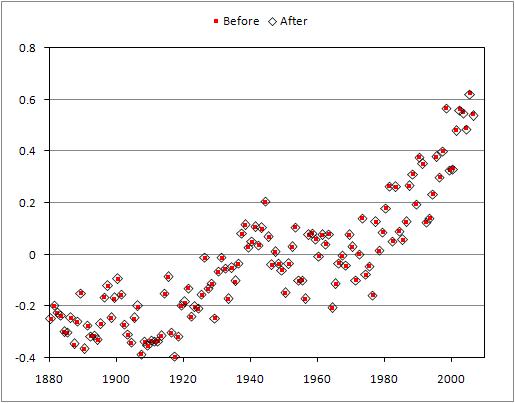
No, it is a simple prediction. The next five years will be warmer than the preceding five years. Very precise and direct, with no cause mentioned. The reason no denier will take the challenge is that they have mostly realized that the next five years will indeed be warmer. You for example, seem to realize that it would be unwise to pick up the gauntlet. And, to be fair; I know what’s going to happen, so I’m not really risking anything.
Another honest question. I’ve never heard a plausible rebuttal for Michael Crichton’s criticism of the global temperature records being unduly influences by local ‘urban heat islands.’
Essentially he’s saying “this is unfair; there are more cities and urban areas, and those are hotter than countryside, so it shouldn’t count.”
If you can’t see what’s goofy about this, I’ll explain it to you. Do I need to? Crichton, BTW, also apparently believes that science doesn’t proceed by consensus, another amazingly strange claim. There is no official science position; a theory is considered settled when most people in the field accept it.
According to his hypothesis, the population correction used by the IPCC to account for heat island effect is severly flawed since heat island isn’t caused by the number of PEOPLE, but by the development footprint they create. In the last hundred years, the acreage of roofs, asphalt and turf lawns per capita has grown enormously! These land covers absorb a LOT more heat than native prairie and forest ground covers ever did.
I suppose that might partially explain why the IPCC estimates of global warming were somewhat low; a lot more heat was being generated by these structures than might be estimated from the number of people. But doesn’t this undermine your argument?
Would you happen to have any links to resources that discuss this issue?
Doesn’t seem to be a problem, but if you think it’s really warming things more than models suggest, I’ll take a look.
It would sure be a shame if we focused enormous human energy and money and CO2 on trying to fix the problem only to find out later that parking lots skewed the data and the real warming trend was not particularly threatening.
Interesting idea, but urbanization always means a large increase in CO2 being generated. So the correlation isn’t necessarily an indication of causation. Moreover, the same things that reduce CO2, would reduce the amount of new cities, factories, etc.
The question is not whether or not it’s a problem, it’s whether or not we have the will and the economic wherewithall to do something about it.