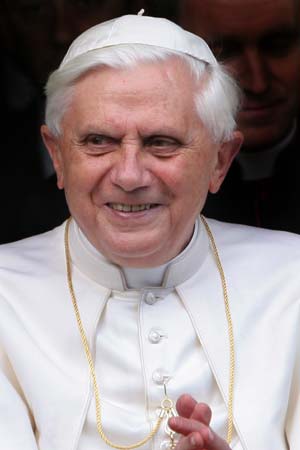
Should Pope Benedict start wearing the papal tiara?

  • Thread starter Thread starter Lepanto
  • Start date Start date
Status
Not open for further replies.
I say bring it back, at least for the coronation of the next Pope. Any fallicies about the Pope not being humble have obviously been dispelled by both Pope JP and Pope JP II, Its time for the tiara to return. If Benedict doesn’t bring it back, I hope he leaves instructions for his successor to be coronated and not just inagurated.
That is not allowed. Once the pope dies the seat of Peter is vacant. A pope cannot rule from the grave.

At the moment that he accepts the election, he is the Pope. The coronation or the installation are a matter of his personal discretion. Bendict XVI will be a former pope with no authority over the new pope. The new pope can choose to be crowned or installed.

There is not such thing as a “pope-elect” like we have with the presidency. There is actually no need for an installation or a coronation. The election and the acceptance of the election is the defining moment. The rest is ritual. He is the Pope once he is asked if he accepts the election and he says, “I Accept.”

The only time that you have to go through all of the rituals is if the elected Pope is not a bishop, which has happened twice. Ten Popes were not priests. None the less he was the Pope, while waiting for the sacrament of Holy

Orders.vaticaninexile.com/TheologicalDiscussions/Papacy/laypope.html

Popes cannot impose the rules of installation or coronation to their successors. Only the rules in Canon Law apply. These apply at the discretion of the Pope. He can change them through a Motu Proprio.

JR 🙂
 
I voted no, because I think that in the 21st century there are many other means to emphasize the role of the Roman Pontiff, than to put the tiara.
Maybe the tiara was something very useful in the 14th century. But today, I don’t think that people would respect the Pope or the Chruch more just because he wears a tiara.
I think that the pope’s white vestments are more than enough, because they are companied by our Pope’s great intellect, wisdom and spiritual authority that no tiara can give.
p.s.his liturgical vestments are always very expensive, very beautiful. I like that, it belongs to the liturgy.But other that that, in my opinion, the white vestments are more than enough.

 
Forgive me in advance for this response, as I am sure you are more knowledgable than I in these matters, but I sometimes seem to step on some toes in my search to understand.
That is not allowed. Once the pope dies the seat of Peter is vacant. A pope cannot rule from the grave.

At the moment that he accepts the election, he is the Pope. The coronation or the installation are a matter of his personal discretion. Bendict XVI will be a former pope with no authority over the new pope. The new pope can choose to be crowned or installed.

There is not such thing as a “pope-elect” like we have with the presidency. There is actually no need for an installation or a coronation. The election and the acceptance of the election is the defining moment. The rest is ritual. He is the Pope once he is asked if he accepts the election and he says, “I Accept.”

The only time that you have to go through all of the rituals is if the elected Pope is not a bishop, which has happened twice. Ten Popes were not priests. None the less he was the Pope, while waiting for the sacrament of Holy Orders.
What happened here???

en.wikipedia.org/wiki/Pope-elect_Stephen

en.wikipedia.org/wiki/Vicedomino_de_Vicedominis
 
That is not allowed. Once the pope dies the seat of Peter is vacant. A pope cannot rule from the grave.

At the moment that he accepts the election, he is the Pope. The coronation or the installation are a matter of his personal discretion. Bendict XVI will be a former pope with no authority over the new pope. The new pope can choose to be crowned or installed.

There is not such thing as a “pope-elect” like we have with the presidency. There is actually no need for an installation or a coronation. The election and the acceptance of the election is the defining moment. The rest is ritual. He is the Pope once he is asked if he accepts the election and he says, “I Accept.”

The only time that you have to go through all of the rituals is if the elected Pope is not a bishop, which has happened twice. Ten Popes were not priests. None the less he was the Pope, while waiting for the sacrament of Holy Orders. vaticaninexile.com/TheologicalDiscussions/Papacy/laypope.html

Popes cannot impose the rules of installation or coronation to their successors. Only the rules in Canon Law apply. These apply at the discretion of the Pope. He can change them through a Motu Proprio.
I understood Jsmith17 to be saying that the Pope would leave something like a personal note to his successor saying that he thought there should be a coronation instead of an inauguration, not a command.


I’m wondering if John Paul I also heard a similar voice from Christ. Maybe the time was right for the Pope to take a step down on the socio-political ladder. Maybe he should be a visible spiritual father, shepherd and bishop rather than a monarch. I can’t imagine that John Paul I would put aside the tiara on a whim. Nor can I imagine that John Paul II and Benedict XVI would continue to practice had it been just a whim. There has to be some spiritual, maybe even mystical motive for simplifying the Pope’s external appearance. The Church normally does not act on whims. It is very cautious about such things.

Someone as grounded in logic as is Benedict XVI would most definitely not bow to whims or fads. Maybe, like Mother Teresa who was instructed to be an Indian instead of a European, to be a sister instead of a nun, and to dress in the simple dress of the poorest Indian women for a reason that only Christ and Mother really understood, the same may have happened with the Pope and the tiara. Maybe there is a call here to simplify the image of the monarch, in order to make more visible the image of the spiritual father, shepherd and bishop.

I just thought it very interesting, because Mother had these locutions from Christ and during the research done for her beatification it has been revealed that the Archbishop of Calcutta and Pope Pius XII believed those locutions to be real. That’s why they jointly approved the change.

Maybe Christ is calling the Church to a more pastoral image and downplaying any image that can be negative. If Christ felt that the image of the European nun in India was a negative for the Indian people, could it be possible that he also feels that the image the Vatican monarch can be negative for modern man? The tiara is not a matter of dogma or morals, it can be dispensed with.

These are just random thoughts.

Fraternally,

JR 🙂
I agree. The image of spiritual father, shepard, and bishop is what Pope John Paul I exhibited in his short pontificate.
I voted no, because I think that in the 21st century there are many other means to emphasize the role of the Roman Pontiff, than to put the tiara.
Maybe the tiara was something very useful in the 14th century. But today, I don’t think that people would respect the Pope or the Chruch more just because he wears a tiara.
I think that the pope’s white vestments are more than enough, because they are companied by our Pope’s great intellect, wisdom and spiritual authority that no tiara can give.
p.s.his liturgical vestments are always very expensive, very beautiful. I like that, it belongs to the liturgy.But other that that, in my opinion, the white vestments are more than enough.

http://thescroogereport.files.wordpress.com/2007/07/pope.jpg
There is no question the world recognizes the pope and his role as head of the Catholic Church. The tiara does not add to that authority. Even wearing a simple scull cap, Pope Benedict is seen as spiritual leader.

What is the last image that we have of Christ before His crucifixion? Jesus stripped to the waist and washed the feet of his disciples, commanding them to do likewise. Christ gave us an example of servant leadership to be emulated.
 
And what need does the Son of God, the creator of all the universe, have of such man - made objects such as a medieval tiara?
Oh, that thing Jesus said about washing his feet with fine oil comes to mind.

And, heck, let’s just get rid of the tabernacle, and the churches, and the institution! What need does he have with such common elements?
 
You support the tiara by attacking the Mass. Nice logic.
Nah, you misread me.

And, worrying about the sensibilities of heretics (material and formal!) has only sought to damage the Church, and drive Her members away from Her (please see: irreverent Novus Ordo Mass, and clap-trap/clap-happy Protestant influence on the Most Holy Sacrifice of the Mass).

That’s what I said. When I was referring to the NO and clap-happy Prottie influence on the Mass, I was referring to “oh, we have to make happy music! we must entertain people! it must become a talk show! the priest must face the PEOPLE!” type things, which are HEAVILY Protestant in nature.

But go ahead and read me wrong if it supports your viewpoint.
 
Forgive me in advance for this response, as I am sure you are more knowledgable than I in these matters, but I sometimes seem to step on some toes in my search to understand.

What happened here???

en.wikipedia.org/wiki/Pope-elect_Stephen

en.wikipedia.org/wiki/Vicedomino_de_Vicedominis
In the first case there are the multiple Stephens. There were two problems, one was that rules for election were not fixed. It was believed that the Pope had to be elected from among those who qualified to be the Bishop of Rome.

Those rules were eventually clarified and it became clear that the Pope must be the Bishop of Rome, but he could come from any part of the Church, even the laity.

The other rule that was clarified was the papacy is not part of the Sacrament of Holy Orders. Therefore, a man who is elected to the papacy is a legitimate pope as soon as he accepts the election, even if he is not ordained. The papacy is the Office of Peter. Peter was both bishop and Vicar of Christ. Being Vicar of Christ is not part of the Sacrament of Holy Orders. That’s why a pope is not ordained pope. There is no consecration or ordination for a pope. There is an installation. Many years into the history of the Church, about 300, Popes also became monarchs of the Papal States. The ritual of coronation was instituted. Later the Papal States were reduced to the Vatican, which is still an independent nation and a monarchy.

In the second citation that you posted they are speaking about the election of a pope who died the next morning and his name is not listed, because he was never proclaimed. This means that he is not listed among the reigning popes, because no one ever knew he had been elected. In those days, unlike today, the election of the Pope was not announced immediately to the public. It first had to be announced to the Emperor. He was still a valid pope, never a reigning pope.

In 1983 the rules were changed again. The pope must be elected from a member of the clergy. He can be a deacon, priest or bishop. Until canon law is changed again, the Electoral College is bound by these rules.

It is important to understand that Canon Law binds the Church, but not the Pope. This is where some people have a problem. People sometimes argue that canon law says one thing and the pope did another. As the keeper of the Keys he is also the Supreme law giver of the Church. The only law that a pope cannot change is the law of God, not a law that is made by the Church.

Hope this helps.

Fraternally,

JR 🙂
 
I understood Jsmith17 to be saying that the Pope would leave something like a personal note to his successor saying that he thought there should be a coronation instead of an inauguration, not a command.
That was done by John Paul I. I don’t know if he left a note, but he made his position very clear to the Curia. That’s why I said that it must have been a very strong position, because John Paul II and Benedict XVI both continue to follow what he started. Both of these men are scholars and theologians. Neither of them were bound by John Paul I. It was their choice not to be crowned.

I have heard comments, but they are just that. I have never read anything official as to why John Paul I chose to do away with the coronation. But I’ll share the comments.

Apparently, he felt very strongly that the Church needed a strong image of a bishop and that he wanted to bring the laity to see the Pope as a priest rather than a monarch.

I’m not sure about this, because this was a commentary at the time of John Paul I’s election.

JR 🙂
 
In the first case there are the multiple Stephens. There were two problems, one was that rules for election were not fixed. It was believed that the Pope had to be elected from among those who qualified to be the Bishop of Rome.

Those rules were eventually clarified and it became clear that the Pope must be the Bishop of Rome, but he could come from any part of the Church, even the laity.

The other rule that was clarified was the papacy is not part of the Sacrament of Holy Orders.
I believe that the issue here was not whether the Papacy was part of the Holy Orders but whether the Pope exercised jurisdiction form the moment of his election or from the moment of his ordination/consecration.
In 1983 the rules were changed again. The pope must be elected from a member of the clergy. He can be a deacon, priest or bishop. Until canon law is changed again, the Electoral College is bound by these rules.
Which canon says this?
 
There were no conversions before the tiara was dropped? :confused: Staples, et. al. would not have converted if the tiara was still used? I don’t think that they are that shallow. :confused: Seems to me that Catholic evangelization has done nothing but slow down in the past several decades.
Yes, it might seem shallow to look at the crown rather than the Faith. But I would think that many people start from some aspect of “shallowness”- perhaps by looking at what is easily available and presented to them, especially in the lives of the adherents and of the public figures. Only then perhaps do they move in deeper and start leanring about the different mysteries of the faith until perhaps eventually the Faith would mean more than the crown.
My guess is that many Catholic people don’t care, don’t believe, or don’t know anything about the Real Presence, either. Poor catechesis should not drive our theologies or disciplines.
Most certainly it should not drive the theology but the disciplines? I would venture to say that disciplines that do not directly affect say, the sacraments, *can *be evaluated- not for the sake of appeasing people, but for the sake of souls. If, as you mention, many Catholic people “don’t care, don’t believe, or don’t know anything about the Real Presence” evidently, that catechesis is lacking. How then do we expect to catechize people on the true meaning of the triple tiara?
 
Bring it back - along with the Sedia gestatoria (ie. that big awful portable throne that all those arrogant Popes, many of whom happen to be saints, used because they were so very lacking in humility).

that is hillarious “those arrogant unhumble saintly popes”

Thats why i like sarcasm (spelling?)😃 😃 😃
 
Oh, that thing Jesus said about washing his feet with fine oil comes to mind.

And, heck, let’s just get rid of the tabernacle, and the churches, and the institution! What need does he have with such common elements?
I have a better idea. Why don’t we just get rid of those things, such as tiaras, that are not essential to the practice of our faith and which, in fact, distract us from focusing on the Gospel. Having said that, I would also say that the tabernacle, statues of saints, even the Church itself, though desirable and supportive of the practice of our faith, are not for the sake of the Lord, but for the sake of his followers here and now. As you said, the Lord has no need of common elements, but we, at least to some extent, do. In my opinion the papal tiara is not one such element.
 
I have a better idea. Why don’t we just get rid of those things, such as tiaras, that are not essential to the practice of our faith and which, in fact, distract us from focusing on the Gospel. Having said that, I would also say that the tabernacle, statues of saints, even the Church itself, though desirable and supportive of the practice of our faith, are not for the sake of the Lord, but for the sake of his followers here and now. As you said, the Lord has no need of common elements, but we, at least to some extent, do. In my opinion the papal tiara is not one such element.
Ah, ok. And your enlightened, modern mind knows much better than the hundreds of years that the tiara was used to show the faithful that the Vicar of Christ also has temporal power (he still does!) in addition to spiritual power.
 
Ah, ok. And your enlightened, modern mind knows much better than the hundreds of years that the tiara was used to show the faithful that the Vicar of Christ also has temporal power (he still does!) in addition to spiritual power.
TEMPORAL POWER:
That is what I think some Catholics forget that the Pope has.
I would expect non-catholics say that he doesn’t have it but CATHOLICS
o well…i guess i shouldn’t be surprised :rolleyes:
 
I believe that the issue here was not whether the Papacy was part of the Holy Orders but whether the Pope exercised jurisdiction form the moment of his election or from the moment of his ordination/consecration.

Which canon says this?
I apologize for that mistake. The rule is regarding the cardinals. In the past non clerics could be cardinals. That’s no longer the case.

I assume that that the rule for the election of a pope remains the same, a baptized male Catholic.

As to when he becomes pope here is what canon law has to say about it.

Can. 332 §1. The Roman Pontiff obtains full and supreme power in the Church by his acceptance of legitimate election together with episcopal consecration. Therefore, a person elected to the supreme pontificate who is marked with episcopal character obtains this power from the moment of acceptance. If the person elected lacks episcopal character, however, he is to be ordained a bishop immediately.

The last part of the canon addresses the old question as to when a pope begins his papacy. If he is already a bishop, he is pope when he accepts. Non bishops must be ordained immediately.

However, the canon is not as clear as the theology is. The canon seems to imply that the episcopal character is a pre-requisite for the exercise of the office, which the theology does not.

This is not really a conflict. Because the theology can say that the Sacrament of Holy Orders does not include the papacy and the canons can prescribe that all popes be ordained. The other way around, would be a problem.

JR 🙂
 
I say yes because for instance, the current pope and his MC like nice vestments and the like (even if the crown isn’t a vestment per se liturgically, still worn at blessings, etc). Had we had the old MC we’d probably see something like a Burger King crown be used in a ceremony involving children.
 
I found this interesting:

Accipe thiaram tribus coronis ornatam, et scias te esse Patrem Principum et Regum, Rectorem Orbis, in terra Vicarium Salvatoris Nostri Jesu Christi, cui est honor et gloria in sæcula sæculorum.

“Receive the tiara adorned with three crowns and know that thou art Father of Princes and Kings, Ruler of the World, Vicar of Our Savior Jesus Christ on earth, to Whom is the honor and glory, forever and ever.”
 
I found this interesting:

Accipe thiaram tribus coronis ornatam, et scias te esse Patrem Principum et Regum, Rectorem Orbis, in terra Vicarium Salvatoris Nostri Jesu Christi, cui est honor et gloria in sæcula sæculorum.

“Receive the tiara adorned with three crowns and know that thou art Father of Princes and Kings, Ruler of the World, Vicar of Our Savior Jesus Christ on earth, to Whom is the honor and glory, forever and ever.”
The subscript is mine.

From the comments that I remember being made by several bishops at the time that John Paul I became pope this was the part that he wanted to down play. He wanted to call attention to the Vicar of Christ and the Shepherd (bishop). According to the comments, he felt strongly that the role of the Pope as a universal shepherd came out very strongly in the papacies of John XXIII and Paul VI, because of their involvement in the Council and because they were the first two popes in many years to ever leave the confines of Vatican City.

John XXIII of course was well known for his escapres to visit the sick and poor in the Diocese of Rome and for his active participation in diocesan affairs, which no pope had done for centuries. The Diocese of Rome has been left in the hands of a vicar who for all practical purposes serves as the Ordinary of the diocese. John XXIII actually became involved with the diocese, even with its seminary policies.

Then came Paul VI who actually traveled outside of Italy and became involved in world affairs at a personal level. Not only was his encyclical Humanae Vitae very concerned about life, but it was concerned about women, marriage and the family. It had a moral and a pastoral message, as did his other writings.

John Paul I wanted to promote this image of the pastoral pope which he found to be such an inspiration from his predecessors. There are letters by him as Cardinal Luciani, where he expresses his admiration for their pastoral leadership. Maybe this the the reason for dispensing with the tiara.

Also, Paul VI had given one up for the poor. I almost forgot that too.

JR 🙂
 
Status
Not open for further replies.
Back
Top