The Minor, Trivial Stuff Thread

  • Thread starter Thread starter patrick457
  • Start date Start date
Status
Not open for further replies.
The 'Upper Room’

http://www.sacred-destinations.com/italy/images/ravenna/san-apollinare-nuovo/resized/xti_6926p.jpg

And He said to them, “Behold, when you have entered into the city, there shall meet you a man, carrying a jar of water. Follow him to the house that he enters, and you shall say to the householder of the house, ‘The Teacher says to you, “Where is the guest-room where I may eat the Passover with my disciples?”’ And he shall show you a large upper-room, furnished; there make ready.

-Luke 22:10-12

The Last Supper, one of the most important events in the life of Christ wherein He instituted the Eucharist, was held in an anagaion (anything that is above ground; an ‘upper’ room). Now what exactly is this? Let’s check how houses looked like in the 1st century.

1st-century houses in Roman Judea were small, box-like buildings, usually built from hand-made and sun-dried day bricks or stone. Interior walls (or also the exterior if one could afford it) were covered with a mixture of soil, chalk and straw or lime plaster. Wide benches of mud brick or stone for sitting and sleeping, and shelves for storage, were built into the structure itself.

http://www.bible-architecture.info/Housin1.jpg

Stairs or a wooden ladder led up onto the flat roof (the roofs of houses were flat; the rounded domes you commonly see in some artworks are actually anachronistic). The roof was usually composed of timber covered with reeds, followed by a layer of mud and a dry mixture of chalk, earth and ash, which provided insulation. This layer was applied while the mud plaster was still damp. Finally a mixture of mud rich in lime was added, to keep out water. A stone roller was then used to compact each layer. It was because of this mud that weeds sometimes grew on rooftops. In some areas where timber was scarce, another possible alternative was stone beams covered with plaster. The roof was usually bordered with a wall around 2 feet high as a safety measure.

The inside rooms tended to be small and dark (due to the small and high windows, which prevented intruders and the cold from entering), so the courtyard and/or the roof tended to be important parts of the house, since they were used for tasks that needed good light - such as spinning and weaving, and food preparation. The roof might also be used for sleeping at hot days, or for drying food or textiles, or as a dining area.

Now, at times tent-like structures were sometimes set up on the rooftop for shading. It is thought by some that it may be possible that the ‘upper room’ where Jesus and His disciples ate the Seder was a sort of booth or stall, probably made out of thatch or tree branches, erected on the rooftop of the home furnished with tables and couches and whatnot (the word for ‘furnished’, estrōsan, literally means ‘carpeted’ or ‘spread over’).

Another possibility is that the house was a two-storey house. In such a dwelling, a lower room or cellar was used as a storeroom and stables for animals. The main living area, partitioned into several sections, was located on the upper level, accessed by a flight of stairs. It had a work and kitchen area, where the children often slept, and a separate bedroom for the parents. In a more wealthier home, a third room would be added for guests and for entertaining.

http://img208.imageshack.us/img208/2415/nvpatriarchcourtyard.jpg

Passover was a season when pilgrims flocked into the Holy City, swelling its population probably tenfold, and there were a lot of people on the streets, many of them trying to find houses that would let them stay in for the feastdays or build temporary structures in any place they could (the word used for ‘guest-room’ here, katalyma, is the same word that was used by Luke to describe the place where Joseph and Mary found no room for the birth of Jesus - incidentally, the instance of katalyma there should apparently be understood in the sense of “guest-area” in light of the backdrop of Jewish family life at the time rather than the traditional translation “inn”). What is interesting is that the words, ‘the Teacher’ and ‘my guest-room’, suggest that Jesus was well-known to that householder.
 
Just a simple one.

And having taken the cup, and having given thanks, He gave it to them, saying, “Drink from it, all of you, for this is my blood of the covenant, which is poured out for many for the remission of sins; and I tell you, that I will not drink henceforth on this fruit of the vine until that day when I drink it with you new in the kingdom of my Father.

-Matthew 26:28-29


We today can still connect red wine with blood, on the basis of color. However, the connection was more powerful for a first century Jew: it could remind them of the blood of the Passover sacrifice.

The sacrificial animal, which was either a lamb or kid, was necessarily a male, one year old, and without blemish. Each family or society offered one animal together, which did not require the semikah (laying on of hands), although it was obligatory to determine who were to take part in the sacrifice that the killing might take place with the proper intentions. Only those who were circumcised and clean before the Law might participate, and they were forbidden to have leavened food in their possession during the act of killing the paschal lamb. The animal was slain on the eve of the Passover, on the afternoon of the 14th of Nisan, after the afternoon tamid (the daily sacrifice) had been killed, i.e., at three o’clock, or, in case the eve of the Passover fell on Friday, at two.

And the sixth hour having come, darkness came over the whole land until the ninth hour, and at the ninth hour Jesus cried with a great voice, saying, "Eloi, Eloi, lama sabachtani?" (which means, ‘My God, my God, why did you abandon me?’)
And some of those standing by, having heard, said, “Behold, He is calling for Elias!” Now one having run and having filled a sponge with vinegar, having put it on a reed, was giving Him to drink, saying, “Let Him be! Let us see if Elias will come to take Him down!” Now Jesus having cried with a great voice, breathed His last.

-Mark 15:32-37

The killing took place in the court of the Temple, and might be performed by a layman, although the blood had to be caught by a priest, and rows of priests with gold or silver cups in their hands stood in line from the Temple court to the altar, where the blood was sprinkled. These cups were rounded on the bottom, so that they could not be set down; for in that case the blood might coagulate. The priest who caught the blood as it dropped from the victim then handed the cup to the priest next to him, receiving from him an empty one, and the full cup was passed along the line until it reached the last priest, who sprinkled its contents on the altar.

Jesus was evoking the cup of the blood of the sacrificed Paschal lamb, which He and His disciples would have witnessed just hours ago in the Temple, with the cup of His, the Lamb of God’s, blood. His words also evoke yet another thing:

And Moses wrote all the words of YHWH, and rose early in the morning, and built an altar at the foot of the mountain, and twelve standing-stones for the twelve tribes of Israel; and he sent the young men of the sons of Israel, and they caused burnt-offerings to go up, and sacrificed sacrifices of peace-offerings to YHWH - young bulls. And Moses took half of the blood, and out it in bowls, and half of the blood he threw against the altar. And he took the book of the covenant, and read it the ears of the people, and they said, “All that YHWH has spoken we will do, and we will be obedient!” And Moses took the blood, and threw it out on the people, and said, "Behold the blood of the covenant that YHWH has made with you according to all these words."

-Exodus 24:4-8
 
Since it’s Holy Thursday, we might as well continue talking about the particulars of the Last Supper.

Bread

Bread is one of the oldest foods mankind has prepared, dating back to the Neolithic era. The first bread produced was probably cooked versions of a grain-paste, made from ground cereal grains and water, and may have been developed by accidental cooking or deliberate experimentation with water and grain flour.

Flat bread also formed a staple in the diet of many early civilizations with the Sumerians eating a type of barley flat cake, and the 12th century BC Egyptians being able to purchase a flat bread called ta from stalls in the village streets.

The development of leavened bread can probably also be traced to prehistoric times. Yeast spores occur everywhere, including the surface of cereal grains, so any dough left to rest will become naturally leavened. Although leavening is likely of prehistoric origin, the earliest archaeological evidence is from ancient Egypt. Scanning electron microscopy has detected yeast cells in some ancient Egyptian loaves. However, ancient Egyptian bread was made from emmer and has a dense crumb. In cases where yeast cells are not visible, it is difficult, by visual examination, to determine whether the bread was leavened. As a result, the extent to which bread was leavened in ancient Egypt remains uncertain.


In the Near East bread is the staple and is one of the mainstays of the diet (along with wine and oil), other articles of food merely accessory; while in the West meat and other things chiefly constitute the meal, and bread is merely secondary. Accordingly “bread” in the Bible, from Genesis 3:19 onward, usually stands for ‘food’ in general.

For the ancient Israelites, bread and other wheat products provided over half of their caloric intake (estimated to be between around 53 to 75 percent). There were two main cereal crops: wheat and barley. The importance of these were apparent in the annual Israelite festivals, for the completion of the wheat harvest was celebrated at the Feast of Weeks (Deuteronomy 16:1-12).

The main form of wheat cultivated in Israel was durum or ‘hard’ wheat. Durum was developed by artificial selection of the domesticated emmer wheat strains formerly grown in Central Europe and Near East around 7000 B.C., which developed a naked, free-threshing (i.e. the grains do not need to be freed from hulls by pounding) form; it was especially suited to the warm and dry climate of Palestine. It flourishes in regions where annual rainfall is between 500 and 700 millimeters, but can be cultivated when rainfall is above 225 millimeters. In ancient Israel it was sown in November and December and harvested in May. The timely appearance of the winter rain and the continuation of the rainy season until April were necessary to ensure the highest yields. In the OT these rains were known respectively as the ‘early’ and the ‘later’ rain and were viewed as a gift of God (cf. Deut. 11:14).

In addition to this free-threshing wheat, a hulled wheat was also known; this was probably emmer, known as kussemet. Evidence from the ancient world suggests that hulled cereals were steadily replaced by free-threshing varieties, although the hulled varieties continued to persist with a minority status. In Egypt, emmer continued to be the principal type of wheat well into the Hellenistic period, but in Iron Age Israel durum had achieved dominance.

Barley was the first domesticated grain in the Near East, near the same time as einkorn and emmer. It is able to tolerate a far less hospitable environment than wheat. it matures early and its shorter growing season allows it to flourish in areas with low rainfall; conesequently it could be grown in areas at the limits of agricultural cultivation. It is also less sensitive to salinity and alkalinity than wheat. This tolerance allows barley to be cultivated in the chalk and limestone-derived soils that characterize the hill country of Palestine.

Historically, barley was considered to be an inferior wheat due to its lower extraction rate compared to wheat and does not rise as well. In Israel, the assessment of barley was no different: the prescribed grain offerings to God are solet, fine wheat flour - the best there is. The only exception prescribed is the offering for the woman suspected of unfaithfulness in Numbers 5, and the negative context of this offering might explain its atypicality. There are also various instances where barley is shown in an inferior status (1 Kings 4:28; 2 Kings 7:16). Josephus also reports that in Roman times, the rich usually ate wheat bread while the poor consumed loaves of barley.
 
Wheat and barley could be consumed in a variety of ways. By far the simplest way was to pluck the fresh ears and eat them (2 Kings 4:42; Matthew 12:1; Mark 2:23; Luke 6:1) or to roast the grain in a fire (Joshua 5:11). If threshed, winnowed, and milled, the flour could be used to make bread. Processing grains for bread was a time-consuming job usually performed by women and servants (Jeremiah 7:18). It has been calculated that three hour’s labor with a hand mill per day was needed to produce sufficient flour for a family of five or six.

The quality of the flour was determined by how much it is sifted. Ancient technology could achieve only a high extraction (low sieving) rate, and it was not unusual for some impurities, such as stones from the mill, to get mixed up with the flour.

Bread could be baked in a variety of ways. One of the most common ways was baking the dough over a large, flat stone that had been heated in the ashes (1 Kings 19:6) or on a metal griddle (Ezekiel 4:3). Fire was built on top of the stone; after the fire was removed, the ashes were removed, the dough was placed on the heated stone and then covered again with the ashes. Afterwards the ashes were removed, and the bread was ready to eat. This is thought to be the method usually employed when bread needed to be baked in haste.
When a griddle was used, it was set on stones over a pit in which a fire is kindled; then the dough was baked directly on the griddle.

Ovens (tannur) were also known in ancient Israel, which usually were beehive-shaped and constructed of a mixture of clay, straw and gypsum. A large opening at the top allowed the cook to stick dough molded into circular pancakes onto the interior walls. After placing the dough, the opening was then sealed with a lid and grass and reeds were placed in another, smaller opening near the bottom as fuel for the fire.

In both Egypt and Mesopotamia cereals were also used to make beer, one of the main beverages in these cultures. By contrast, Israelite consumption of beer was probably rare because of the widespread cultivation of vines on the hillsides.

Now, as you probably know, unleavened bread was consumed during Passover, in which any leaven was forbidden. It was eaten in memory of the bread that did not have time to rise due to the haste the Israelites left Egypt. Now it is not known when yeast was first used to bake bread, but the first records that show this use indeed came from Ancient Egypt. Researchers speculate that a mixture of flour meal and water was left longer than usual on a warm day and the yeasts that occur in natural contaminants of the flour caused it to ferment before baking. The resulting bread would have been lighter and tastier than the normal flat, hard cake.

It was precisely because consumption of leavened bread was widespread due to its being more tastier and more filling among the nations that the Israelites were commanded to eat matzo, the bread without any leaven, during Passover: so that they would not forget their slavery in Egypt and the wonders that God wrought to deliver them out of it, which was the point of the whole feast: keeping the memory of the Exodus alive for posterity. Eating the rather bland cracker for a full week tended to fix the idea in one’s consciousness.
 
oh boy…I hate it when I get stones in my bread 😛
I can sympathize…😃

We now go on to the Gospel accounts of Jesus’ words of institution.

(Please Note: This uploaded content is no longer available.)

We have four accounts relating the story of what Jesus did at that meal the night before He was executed: that of Matthew’s, Mark’s, Luke’s and Paul’s. The tradition is preserved in two distinct forms: one in Matthew and Mark (which we will dub A), and another in Luke and 1 Corinthians (B). Each tradition has their own characteristics:

(1) In Tradition A Jesus is described as ‘blessing’ the bread; in Tradition B He is ‘giving thanks’.
(2) A has the simple “this is my body” over the bread; B includes “which is [given] for you,” etc.
(3) A gives the words over the cup as “This is my blood of the covenant, which is poured out for many”; B has “This cup is the new covenant in my blood.

Some think that these variations ought to be explained not as being due to textual interdepence nor of one or another form being easily retrojected into the original Aramaic Jesus would have used, but due to two slightly different liturgical traditions. Matthew-Mark’s “This is my body; this is my blood” are set in parallel with each other, probably indicating a liturgical shaping to bring out the parallelism. Luke-Paul meanwhile preserves the framework of a meal, with the bread presumably distributed at the beginning, in accordance with normal Jewish meal patterns, and the cup handed out “after supper”, bringing the meal to a close. In A emphasis is more on the wine, while on B the cup is emphasized more.

(Please Note: This uploaded content is no longer available.)

Here it is somewhat farcical to think that the writers were familiar with this only as written tradition and only by hearing it read from another written source. The more obvious explanation is that the words were familiar to most early Christian communities, who regularly recited the words in their celebration of the Eucharist: this was living oral tradition before and after it was written down in formal and semi-formal documentation. It was something St. Paul ascribes to “the Lord” and one that he took great pains to hand down to the churches that he founded, the sort of tradition which gave these churches their identity and by the performance of which they affirmed their identity (1 Corinthians 11:23).
 
Now, the 9th chapter of the Didache, concerning the Eucharist, does not indeed make any mention of any ‘words of institution’, but we need not jump to the conclusion (as J.D. Crossan argues) that the tradition as reflected in the NT accounts are later and that the Didache is the earlier stage. It could well be that it assumes the traditional core and attests simply the addition of thanksgiving prayers deemed appropriate in a more liturgically solemnized act (cf. Didache 10). John’s gospel also does not say anything about the supper, but there are eucharistic overtones elsewhere in the work (John 6).

Now concerning the Eucharist, give thanks this way. First, concerning the cup:

We thank Thee, our Father, for the holy vine of David Thy servant, which Thou madest known to us through Jesus Thy Servant; to Thee be the glory for ever.
And concerning the broken bread:

We thank Thee, our Father, for the life and knowledge which Thou madest known to us through Jesus Thy Servant; to Thee be the glory for ever.
Even as this broken bread was scattered over the hills, and was gathered together and became one, so let Thy Church be gathered together from the ends of the earth into Thy kingdom; for Thine is the glory and the power through Jesus Christ for ever.
But let no one eat or drink of your Eucharist, unless they have been baptized into the name of the Lord; for concerning this also the Lord has said, “Give not that which is holy to the dogs.”​

Now, it is a fair question as to whether in the earliest form Jesus is remembered as celebrating a Passover meal or instituting a new ritual to be repeated. On the latter issue, A does not say so, and the call for or assumption of memorial and repetition is a distinctive feature of B and 1 Corinthians 11:25b-26. Nevertheless the characteristics of oral tradition remain clear: a concern to retain the key elements of Jesus’ words as carefully as necessary, with a flexibility (including elaboration) which in this case no doubt reflects the developing liturgical traditions of different churches.

When he was about to surrender himself to voluntary suffering in order to destroy death, to break the devil’s chains, to tread hell underfoot, to pour out his light upon the just, to establish the covenant and manifest resurrection, he took bread, gave you thanks and said, “Take, eat; this is my body which is broken for you.
In like manner for the cup, he said, “This is my blood which is poured out for you. When you do this, do this in commemoration of me.

-From the Anaphora of Hippolytus

Together with these blessed powers, Master who loves mankind, we also proclaim and say: You are holy and all-holy, you and your only-begotten Son and your Holy Spirit. You are holy and all-holy, and sublime is your glory. You so loved your world that you gave your only-begotten Son so that whoever believes in Him should not perish, but have eternal life. He came and fulfilled the divine plan for us.
On the night when He was handed over, or rather when He handed Himself over for the life of the world, He took bread in His holy, pure, and blameless hands, gave thanks, blessed, sanctified, broke and gave to His holy disciples and apostles, saying, “Take, eat; this is my body which is broken for you, for the remission of sins.
R: Amen.

Likewise, after supper, He took the cup, saying, “Drink of it, all of you; this is my blood of the new covenant which is shed for you and for many for the remission of sins.
R: Amen.

-From the Divine Liturgy of St. John Chrysostom

We beg you, God, to deign to make this offering in every way blessed, approved, ratified, right and acceptable, so that it may become for our benefit the Body and Blood of your dearly beloved Son, our Lord Jesus Christ; who, the day before he suffered, took bread in his holy and venerable hands, and having raised His eyes to heaven to you, God, His Almighty Father, giving thanks to you, he blessed, broke, and gave it to his disciples, saying, “Take and eat of this, all of you: for this is my body.

Similarly, when the supper was ended, taking also this excellent chalice into his holy and venerable hands; again giving thanks to you, he blessed, and gave it to his disciples, saying: “Take and drink of this, all of you, for this is the cup of my blood, of the new and eternal covenant; the mystery of faith: which will be shed for you and for many for the remission of sins. As often as you shall do these things, you shall do in memory of me.
  • From the Roman Canon
Our Lord Jesus Christ, on the night in which He was handed over, took bread: and, giving thanks, blessed and broke: and gave to His disciples, saying, “Take and eat; this is my body which will be given up for you. As often as you shall eat, this do in commemoration of me.

Likewise also the chalice, after He had supped, saying, “This cup is the new covenant in my blood, which will be shed for you and for many for the remission of sins. As often as you shall drink, this do in commemoration of me.

-From the old Mozarabic Post-Sanctus
 
The Crown of Thorns

And the soldiers twisted together a crown of thorns and put it on his head and arrayed him in a purple robe…
  • John 19:2 (ESV)
The word used for the crown in all four gospels is stephanos, usually denoting a sort of wreath or garland (stepho means ‘to encircle, twine or wreathe’) which were made out of foliage and encircled the head.

Along with the scarlet or purple robe that was meant to be a parody of the clothes Hellenistic rulers wore, the crown was mainly designed in mock imitation of the gilded wreaths these vassal kings had on their heads (of course, the thorns also had the side effect of inflicting severe pain on Jesus’ scalp but their primary purpose was that of being part of the mock royal attire): the soldiers are thus dressing Jesus, King of the Judeans, as a sort of vassal ruler.

There is still some uncertainty what thorns were actually used; various writers suggest different species of plants for potential candidates.

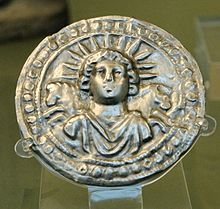
The crown could also well have been an improvised caricature of the radiate crown signifying divine kingship and frequently depicted in coins of the period; many of the thorns would have been pointed outward like the crown’s rays. Since the radiate crown was not a part of actual insginia of Hellenistic rulers or Roman emperors, the soldiers may have also been drawing from known portraits of gods and rulers sporting the headgear when mocking Jesus (c.f. the coins above).


A Roman coin showing Tiberius with a laurel wreath and Augustus with a radiate crown.


Repoussé silver disc of the god Sol Invictus wearing a radiate solar crown, found at Pessinus (3rd century)


Pilate, therefore, having heard this word, brought Jesus outside, and he sat down upon the judgment-seat to a place called Lithostrotos [Stone-Pavement], and in Hebrew, Gabbatha (and it was the Preparation of the Passover, about the sixth hour). And he says to the Judeans, “Behold, your king!

-John 19:13-14

One crucial phrase here is the word translated as “sat down upon the judgment-seat”, ekathisen epi bēmatos. The word ekathisen (the first aorist active of the verb ‘to sit’) in Greek is ambiguous and could be understood in two ways: if the construction is intransitive, then Pilate sat upon the tribunal; if transitive, Pilate made Jesus sit down upon it (cf. the NAB footnote for John 19:13).

Fr. Raymond Brown summarizes the following arguments against the transitive meaning:
  • One would expect a pronomial object; e.g. “he set Him down upon the judgment-seat.”
  • The transitive meaning assumes Pilate was engaging in buffoonery by seating Jesus in the tribunal; an unthinkable act in this solemn context.
In favor of the intransitive meaning are the historical setting (there are things a Roman judge might do and would not do, and sitting the accused on the tribunal is one of the latter) and the intransitive use of kathizein in John 12:14 (Jesus, finding a donkey, “sat on it”), which is the only other appearance of the verb in the gospel. Fr. Brown also objects to a double meaning because “Johannine double meanings do not allow contradictory views.”

However, his objections are not insurmountable. The presence of a pronomial would destroy all possibility of a double meaning; while the absence of an object makes the phrase purposely vague, allowing for Pilate as the subject or Jesus as the object, or both. Further, there is no reason to assume that Pilate was engaging in buffoonery by sitting Jesus upon the seat.

The phrase does allow for serious possibilities. Historically, it was Pilate who may have sat down on the tribunal (preserving the solemnity of the occasion). On the other, the audience is allowed to imagine that Jesus, as the real Judge, sits on the chair. Thus, the primary historical sense is the intransitive; while a secondary, theological sense proceeds from the transitive interpretation: the latter is the sense some 2nd-century writers, like St. Justin Martyr and the author of the apocryphal Gospel of Peter understood it.

And he delivered him to the people on the day before the Unleavened Bread, their feast. And they took the Lord and pushed him as they ran, and said, Let us drag away the Son of God, having obtained power over him. And they clothed him with purple, and set him on the seat of judgement, saying, “Judge righteously, O king of Israel. And one of them brought a crown of thorns and put it on the head of the Lord. And others stood and spat in his eyes, and others smote his cheeks: others pricked him with a reed; and some scourged him, saying, “With this honour let us honour the Son of God.
  • Gospel of Peter III.7-9
And again in other words, through another prophet, He says, “They pierced My hands and My feet, and for My vesture they cast lots.” And indeed David, the king and prophet, who uttered these things, suffered none of them; but Jesus Christ stretched forth His hands, being crucified by the Jews speaking against Him, and denying that He was the Christ. And as the prophet spoke, they tormented Him, and set Him on the judgment-seat, and said, "Judge us."
  • St. Justin Martyr, First Apology 35
Now we check the word bēma. The word originally denoted a raised platform (bēma = ‘step’), probably made of stone. The original use of the bema in Athens was as a tribunal from which orators addressed the citizens as well as the courts of law. In Greek law courts the two parties to a dispute presented their arguments each from separate bemas. Thw word was also used as the name for a place of judgment or a tribunal, i.e. the raised seat of the judge as described in the New Testament, in Matthew 27:19 and John 19:13, and further, as the seat of the Roman emperor, in Acts 25:10, and of God, in Romans 14:10, when speaking in judgment.

(continued)
 
We now go to Gabbatha. The place name appears to be Aramaic, either gabb[sup]e[/sup]ṯā’ ‘height’ or gabbaḥtā’ ‘open space’. To quote from the International Standard Bible Encyclopedia:

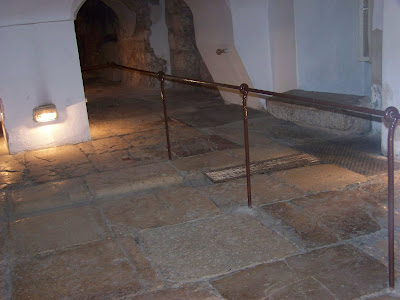
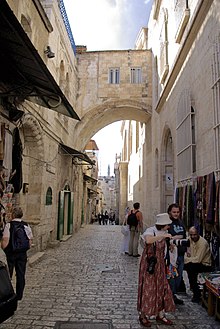
The excavations by L.-H. Vincent at the site of Herod’s fortress, Antonia, include a massive Roman pavement, of which the central area is about 2000 sq. m. (2400 sq. yds.) and the blocks 1.2 by 1 by 0.6 m. (4 by 3.5 by 2 ft.). Some of these blocks have Roman games scratched on them (cf. Jn. 19:24f.). Theodosius (A.D. 530) called Antonia “the house of Pilate,” and Vincent’s discovery of this pavement supports this identification. Some think the pavement over the cisterns of Antonia dates to ca. A.D. 135. The so-called Ecce Homo Arch spanning the traditional Via Dolorosa at the west end of the pavement, the central arch of a triple triumphal arch, is also of Hadrianic construction.
Related data in Philo and Josephus indicate that Gabbatha was more likely located E of Herod’s Palace, the so-called Tower of David near the Jaffa Gate (but see Jerusalem III.H.10). The sella curulis, the judgment seat of the Romans, however, was a portable chair.


A model of the Antonia Fortress


The pavement in Antonia


The Ecce Homo Arch today


A model of Herod’s Palace in Jerusalem


Two pairs of bronze legs, belonging to sellae curules, preserved in the museum at Naples (Museo Borbonico, vol. vi. tav. 28); and a sella curulis, copied from the Vatican collection.

Shimon Gibson and James Tabor, while agreeing with the theory that the Praetorium was located inside Herod’s Palace instead of the traditional location in Antonia Fortress, meanwhile sport another theory for the location of Gabbatha: a platform just outside the western wall of the Old City, with the Praetorium inside the wall through a gate leading inside Herod’s palace.

http://jamestabor.com/wp-content/uploads/2009/04/gabbatha.jpg
The area today

http://jamestabor.com/wp-content/uploads/2009/04/pilatetrial.jpg
A reconstruction of the area as Gabbatha, by Balage Balogh (from James Tabor’s The Jesus Dynasty)
 
One test question: do you believe the Romans ate potato pies?
The potato was a New World crop, being only introduced to Europe by Spain during the 15th-16th centuries (it was originally Peruvian, if memory serves me right), so NO. 😉
 
Can I ask? So the men of the old testament (post-law) entered into the covenant via circumcision… Were women required to do something or were they “assumed” into the covenant some other way? Thanks in advance and Happy Easter!
 
Jesus Barabbas

http://wpcontent.answers.com/wikipe...9/GiveUsBarabbas.png/360px-GiveUsBarabbas.png

Now at the feast the governor was accustomed to release for the crowd any one prisoner whom they wanted. And they had then a notorious prisoner called Barabbas. So when they had gathered, Pilate said to them, “Whom do you want me to release for you: Barabbas, or Jesus who is called Christ?” For he knew that it was out of envy that they had delivered him up.

Matthew 27:15-18 (ESV)

Many commentators note the irony in the name Barabbas, noting the similarity of -abbas with 'abba ‘father’, thus yielding ‘son of [the] father’. This irony becomes much more stronger when we note that several Greek manuscripts of Matthew’s Gospel have Iēsous Barabbas, “Jesus Barabbas” - which is believed by a number of scholars to be more likely the original reading, with Iēsous being deleted either accidentally or on purpose:

Although the external evidence for the inclusion of “Jesus” before “Barabbas” (in vv. 16 and 17) is rather sparse, being restricted virtually to the Caesarean text (Θ Ë1 700* pc sys), the omission of the Lord’s name in apposition to “Barabbas” is such a strongly motivated reading that it can hardly be original. There is no good explanation for a scribe unintentionally adding ᾿Ιησοῦν (Iēsoun) before Βαραββᾶν (Barabban), especially since Barabbas is mentioned first in each verse (thus dittography is ruled out). Further, the addition of τὸν λεγόμενον Χριστόν (ton legomenon Christon, “who is called Christ”) to ᾿Ιησοῦν in v. 17 makes better sense if Barabbas is also called “Jesus” (otherwise, a mere “Jesus” would have been a sufficient appellation to distinguish the two).
  • NET footnote for Matthew 27:19
Some authors like Hyam Maccoby and Benjamin Urrutia think that ‘Jesus Barabbas’ was a mere invention of the early Christian Church, perhaps as part of an agenda to shift the blame for the death of Jesus away from the Romans and more to Jews and that it originally referred to Jesus Himself. Even so, the name or the person himself need not be invented, as the use of 'Abba as a proper name is attested in 6th- or 5th-century B.C. texts, in one near-contemporary funerary inscription from near Jerusalem (ca. 110 BC - AD 100) and in rabbinic literature*. Some believe, meanwhile, that Barabbas should be reconstructed as bar-Rabban, ‘son of the teacher’ or ‘son of the master’. Nor is Iēsous (probably derived from Late Hebrew/Aramaic Yeshua, in turn from Yehoshua, whence came our ‘Joshua’) a unique name; Josephus lists nearly a dozen men named Iēsous, and the name Yeshua appears in at least 99 tombs and on 22 ossuaries dating from the 1st century.
  • For example, the 3rd century Talmudist Rabbi 'Abba Arika, Samuel of Nehardea (aka Samuel bar-'Abba), Nathan bar-'Abba, and Hiyya and Simeon bar-'Abba.
There was in fact a story/joke/pun in the Babylonian Talmud (Berakoth 18) which goes:

Come and hear: the father of Samuel had some money belonging to orphans deposited with him. When he died, Samuel was not with him, and they called him, ‘The son who consumes the money of orphans’.
So he went after his father to the cemetery, and said to them [the dead], “I am looking for Abba.
They said to him, “There are many Abbas here.
I want 'Abba bar-'Abba,” he said.
They replied, “There are also several 'Abbas bar-'Abba here.
He then said to them, “I want 'Abba bar-'Abba the father of Samuel; where is he?
They replied: "He has gone up to the Academy of the Sky."
 
Can I ask? So the men of the old testament (post-law) entered into the covenant via circumcision… Were women required to do something or were they “assumed” into the covenant some other way? Thanks in advance and Happy Easter!
Happy Easter to you too.

As for your question:

For the Israelites circumcision was the sign of covenant kinship between God and Israel. This is why circumcisions are often called bris today: bris is the Ashkenazic/Yiddish pronunciation of the Hebrew word bĕrît, ‘covenant’! Sure gives the Hebrew idiom kārat bĕrît, ‘to cut a covenant’ (i.e. to make a covenant; ‘cutting’ originally referred to the cutting the animals at the ratification of the agreement, as I’ve mentioned before in this thread) a whole new meaning. 😛

Even adults had to undergo circumcision to become members of the community, as well as the household slaves and the ‘aliens’ living with the Israelites. Only a circumcised male was qualified to participate in the Passover ritual (Exodus 12:48-49).

Now as for women, women aren’t circumcised because in ancient thought, a nation’s citizens were its men, hence the expression bənê Yiśərā’ēl “sons of Israel” (traditionally rendered as ‘children of Israel’) used often in the Bible when referring to the Israelite nation as a whole. The Israelites who constituted the people of Israel and who needed to be marked as distinctive were the males. I know this may sound rather sexist in this day and age, but that is how things were.
 
Status
Not open for further replies.
Back
Top