There are a few things I want to go over on the article you referenced, which I’ll do in the next day or two.
From the article:
Reason, secularism asserts, must be restricted only to what is material and measurable. The mutilation occurs because secularism then assumes that what is not material and measurable is not real, or at best, merely a subjective fancy.
First, as an aside and a pet peeve, he’s using “secularism” synonymously with “non-religious”. He needs to realize that secularism means not showing favoritism to a particular religious viewpoint in the public sphere. One can be both devoutly religious and secular.
To the main point, I complete disagree with the notion that reason must be restricted to what is material and measurable and that anything outside of that is not real.
I’m going to throw out an analogy that, while not perfectly analogous, helps to define how we can rationally discuss the possibility of immaterial things.
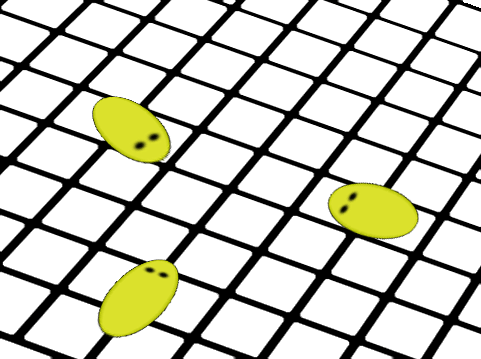
Let’s imagine there are creatures living on a geometric plane. They can only move about in two dimensions and can only perceive things in two dimensions. We’ll call them two-ders.
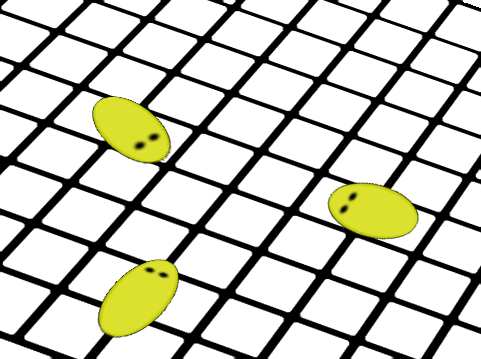
A two-der philosopher hypothesizes that there is more than that which they can perceive. He could suggest there are multiple planes all parallel to each other that act in the same way. But without being able to cross between planes it remains a hypothesis. It does
not disprove the idea of parallel planes.
He could suggest that perhaps there are objects that are more complex than they can imagine. Take a sphere and have it cross our plane:

Any two-der watching it would only be able to perceive it as an small circle popping out of nowhere, growing larger (until it reaches the diameter of the sphere), then shrinking, and finally disappering.

The two-ders may misinterpret that as a normal function of their 2-d universe. They may see it as a sign. Two-der scientists may calculate how this proves the existence of a third dimension. But no matter what the fallout, in the end something from outside the perceivable interacted with the perceivable.
So let’s bring it back to our world. Often times on CAF, people will say that science can only study the material world and is out of it’s area when it tries to discuss the immaterial. Perhaps, but we may be able to study how the immaterial interacts with the material. Some might argue that the immaterial
doesn’t interact with the material, but it must if we want to say it impacts us. Whether it be miracles, or mind-body dualism, or transubstantion, or any number of things, the religious say that the immaterial affects the material. We can try to study where the two are said to meet and see if they can be explained by a wholly material world or not.
Now with all of that being said, is it rational to say that there is only the material? Similar to what the two-ders think, there are three possibilities:
Possibility 1: There is no immaterial world.
Possibility 2: There is possibly an immaterial world, but we can only speculate since there has not been a proven instance of the immaterial interacting with the material.
Possibility 3: There is definitely an immaterial world, and it can be proven by (an answered prayer, an apparition, a miracle, deva vu, etc.)
Theists often will peg non-theists as only believing in possibility 1; but I think if you ask you’ll find that most (not all) will fall under possibility 2. We can’t necessarily rule out what is beyond our scope, but we can’t just take it on faith that there is something beyond our scope. We discount those things that some claim prove the existance of the immaterial. Obviously theists will find non-theists foolish for discounting those claims (or at least the specific ones they believe in) but I don’t think we’re going to make headway on that here

Next up, I’ll try to refute the author’s argument that materialism leads to irrationality and totalitarianism.