Vernacular with Traditional rites

  • Thread starter Thread starter paulthehanna
  • Start date Start date
Status
Not open for further replies.
I guess this all raises a separate question but now about traditionalists! Why desire TLM so much if the OF can be celebrated in what seems to be a very similar way? I suppose that is a question for them. Perhaps the association is so great. I guess the other question is why Latin is preferred by some even at the expense of some understanding. I think I need to attend some services and then chat to some folk.
 
Our Church is very much split re: language preference but we take notes from other Orthodox communities in the area. The Greek Orthodox Church has virtually lost 2 generations of parishioners where I live because the liturgy has remained in Koine Greek apart from readings and an occasional sermon. That’s a 3 hour service where you understand a sum total of maybe 15 minutes.

This was similar to the Coptic Church although we began to introduce English despite protests. There are now all-english services but they are treated as suspect by many. However we now have a vibrant diocese with converts from many streams. It sounds like your was more about the imposition of Ukrainian rather than an organic slow transition to the preferred language.

The fact is virtually no one - clergy included - completely understands Coptic. There is a vague desire to keep ‘tradition’ at the expense of all understanding which seems to me to betray Christ. I don’t care for old languages, I want mainly to practice my faith and grow in Christ.
 
Last edited:
As @Tis_Bearself posted:

“One big reason Latin was used in the old days was that wherever you went in the world, and whatever language you personally spoke, you would be hearing the same Mass when you went to church. Use of a common language was seen as a unifier.”

That’s how Slavonic was when I was growing up. Both Byzantine and Ukrainian Greek Catholics used and sang Slavonic.

English has been used in the Divine Liturgy since the 1940s. I have both Byzantine and Ukrainian Greek Catholic prayerbooks with English translations from the 1940s, 1954, 1961, 1965, 1976, 1988 and 2004. Some phrases are standard, e.g. “Lord, have mercy” but others like the Cherubicon, the Doxology after the post-Megalynarion Ektenia etc change depending on which translation is used.

I understand how you feel because that’s how I feel when I occasionally attend the Liturgy at the cathedral and it’s mostly Ukrainian. I also felt the same way when the Liturgy was all in Slavonic.

However, now that I’m older I can appreciate Slavonic more. I think that if young people learn the language and appreciate it then they will learn to love the Qorbono even if it’s in Coptic.

Just wondering: Are you in Pennsylvania? Because there’s a Coptic Orthodox church being built in our area. If you’re there maybe we could meet in person!
 
There are a huge number of reasons why traditionalists want the TLM rather than some modified OF Mass, and I’m sure the traditionalists will share them all with you.
Speaking for myself personally, I’m not a strict traditionalist and I attend many different types of Masses, but when I go to TLM I am seeking to worship how my ancestors worshipped. My Catholic grandparents died before Vatican II. If I want the Mass like Grandma, Grandpa, Great-grands used to have it, and how my parents had it before I was born and my mother had it growing up, I want a TLM, not some modified version of OF.

Also, one nice thing about TLM is that it’s pretty much set in stone at this point. There have been numerous tweaks made to the OF Mass prayers since they were invented. One prayer in English was changed when I was a young child and the change was kept for like 40 years and then it was changed back again to what it was when I was young. That was just weird. Why was it even changed in the first place? A couple of the acclamations were eliminated, never to be heard again, wording was changed in other prayers that affected the familiar musical settings of the prayers and the new settings aren’t as nice IMHO. We’re told that these tweaks often have to do with translations, at other times the liturgy “experts” in the Vatican decide that some prayer doesn’t quite fit and chuck it out, and sometimes people also raise gender-neutral language concerns. It’s annoying. Especially when one sees a Church struggling with so many substantive problems, like the clergy abuse scandal, and yet it’s someone’s paramount concern to twiddle the words of a prayer we’ve been saying just fine for 20 or 30 years. The Latin Mass is mercifully free of all that. It stays the same.
 
Last edited:
However, now that I’m older I can appreciate Slavonic more. I think that if young people learn the language and appreciate it then they will learn to love the Qorbono even if it’s in Coptic.
I have no issue with any language provided the faithful understand it. But as it stands in the Coptic church there is no quality education. I went through schools to learn it but came out knowing very little. That’s factoring in that I am one of the more passionate parishioners and a theology student so I do not hold much hope for our young ballooning congregations.

Thank you for the kind offer. I am in Australia actually so bit of a different milieu.
 
Very interesting! Why is this the case? Was there a desire to standardise the liturgy? (as for example happened with the Greeks imposing on the Antiochians)

(Please Note: This uploaded content is no longer available.) dochawk:
The church was reeling with the challenge of Protestantism. In part a unified front, in part an assertion of church authority for the sake of showing that it existed, in part preventing various areas going their own ways.

I suspect (but it’s nothing more than suspicion) that moving towards “the way Rome does it” had been on the rise for centuries–at least where corruption wasn’t rampant.

It certainly makes sense to take a unified approach when there’s is an attack at your very core.
The OF is the Novus Ordo which includes different rites such as the priest facing the people etc. right?
“Novus Ordo” (New Order ) was the name originally on the books for the revised Mass. It is not on the books for the last coupe revision (no would it be accurate half a century later). Today, it seems to be used most often in a condescending manner.

In the actual rubrics of the OF, the presumption is the priest facing East (not “away from the people”, although the two are usually the same [bot note ancient chuches in Rome itself, where facing East meant towards the people, and that they turned East at multiple points in even the pre-tridentine Mass!]). It I an option in the OF for the priest to face the people instead of Was

Chant can certainly be used in the OF, and is descale, although I don’t think (but could be wrong) tat the older vestments can be used.
Does EF imply things like incense and vestments and so forth? or is it simply the older form of the Mass from before Vatican II?
It’s the older form. I really couldn’t tell you if incense can be omitted (or whether it happened or not, regardless of whether it should have been)
When I was in my early teens the Sunday Divine Liturgy was part Slavonic, part English.
That’s really what the Eastern churches did so much better than the RCC, although with varying degrees of success (you note a lesser degree!)

The bit at a time approach worked better than “ta-dah! new Mass and new language!”.

I’ll also note that when I went to my first DL, had it not been in English (or primarily so), I would have been impressed with it as something beautiful–but probably wouldn’t have returned. Today, I’m “all in” as eastern. And, as a practical matter, the majority of so many of our parishes were not born into the East . . .

 
I’ll also note that when I went to my first DL, had it not been in English (or primarily so), I would have been impressed with it as something beautiful–but probably wouldn’t have returned.
I attended the Maronite liturgy and loved the non-English parts. The consecration in Aramaic, I mean how cool is that?
 
I get the sense from many ‘trads’ that the vernacular has become tainted ever since Vatican II. I have been to TLM which is nice but I cannot understand why it does not exist in English. My understanding of liturgy is as the thing that builds up God’s people, as the fundamental and original Christian education and so I cannot appreciate why liturgy should be said in a foreign language.
The reasons for the Mass being said in Latin are numerous and certainly too great to be listed in a forum like this.The desire amongst “Trads” ( I suppose, some would classify me as being one ) to continue with practices, in addition to the reasons, are equally complex and I would suggest reading the book listed below to give some information that may address your queries
https://www.amazon.com/Latin-Mass-E...=1579506294&sprefix=latin+mass,aps,271&sr=8-1
 
Last edited:
With reference to my post above:
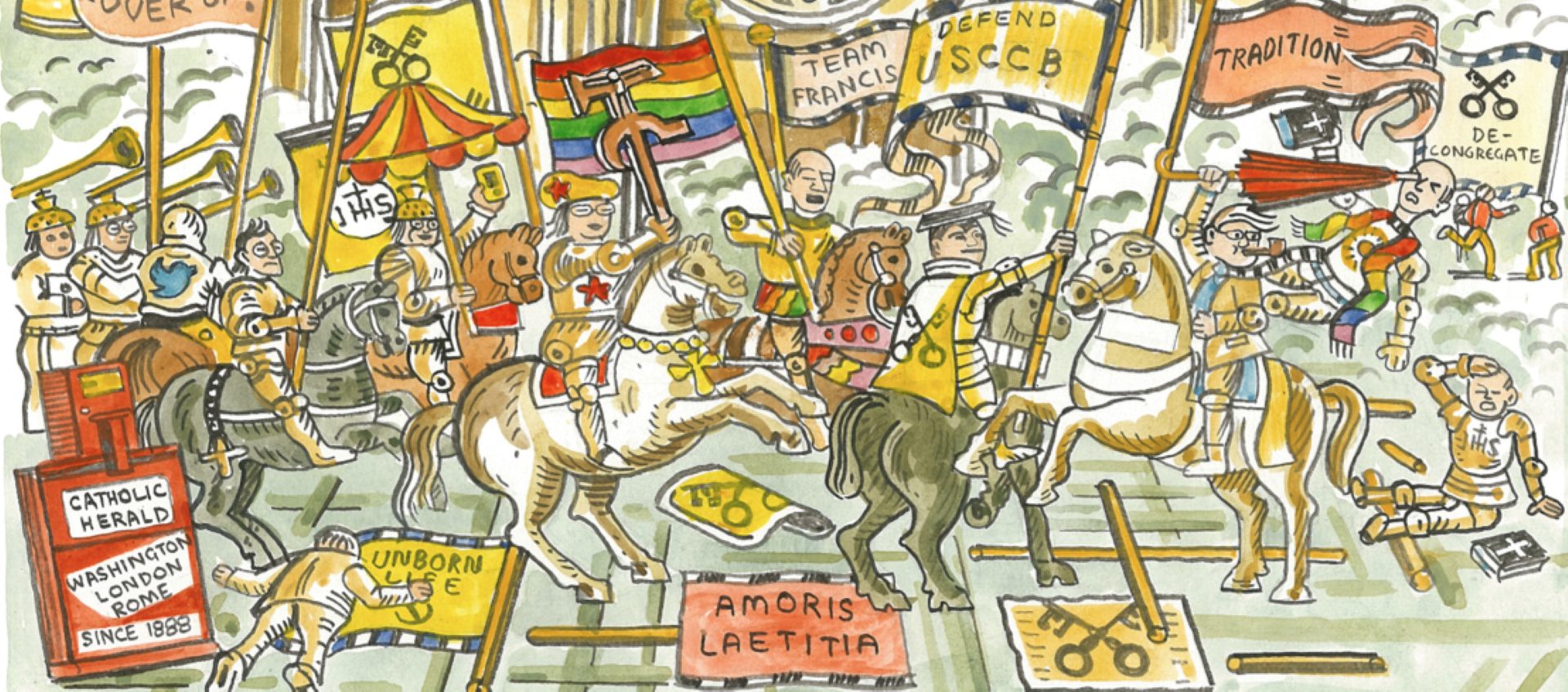
You may enjoy this amusing piece from The Catholic Herald from a while back, which still makes me smile!

 
There are a huge number of reasons why traditionalists want the TLM rather than some modified OF Mass, and I’m sure the traditionalists will share them all with you.
Well until now I did not know what a solemn OF mass was, so perhaps now I can have that informed discussion.
how my ancestors worshipped
This sentiment is highly familiar to me as many Copts speak similarly. I don’t know that I feel it in the same way but I can appreciate it.
The Latin Mass is mercifully free of all that. It stays the same.
I can also appreciate the stability. I suspect in the early church things were often tweaked (supposedly in the Coptic church there was lots of improvisation!). But I can still understand that.

I think all of this for me is relevant because I couldn’t see myself worshipping at a Latin Parish after all the struggle we’ve had at my home parishes. Yet my like minded Catholic friends prefer it and I was trying to tease out why. But I suppose the Orthodox ‘struggle’ around language is slightly different to the Catholic.

Thank you for your insights.
the way Rome does it”
I have heard of this ‘pressure towards latinisation’. If I may, is this not a shame? The Catholic Church is universal, should she not maintain a wide variety of rites? I suppose under pressure, all sorts of things go amiss though.
The way the Ordinary Form of the Mass is meant to be:
Thanks for this. This ‘flavour’ of service is familiar to me bar a few things.
I attended the Maronite liturgy and loved the non-English parts. The consecration in Aramaic, I mean how cool is that?
Sure its cool but I don’t go to Liturgy/Mass for cool things… I go to meet Christ first and foremost.
You may enjoy this amusing piece from The Catholic Herald from a while back, which still makes me smile!
I definitely did not get most of the references but that did seem hilarious. Also I will check out the book. I see Fr. Michael Scmitz is one of the authors - I have watched many of his videos. Thank you kindly!
 
I have heard of this ‘pressure towards latinisation’. If I may, is this not a shame? The Catholic Church is universal, should she not maintain a wide variety of rites? I suppose under pressure, all sorts of things go amiss though.
As an Eastern Catholic . . . yes truly horrific. The term for this is “latinization”, and we’re recovering from centuries of it.

I"d never really thought of it in the context of the standardization after Trent before . . .
 
I did not know you were eastern. Which jurisdiction if you don’t mind my asking? I have encountered Maronite services but Byzantine Catholic liturgies seem to be exceedingly rare.
 
It is not a case of traditionalists holding out for anything. What some refer to as the Traditional Latin Mass (TLM) and the Church officially calls the Extraordinary Form (EF), has to be celebrated in Latin as per Church law. It may not be celebrated in any vernacular language.
 
I did not know you were eastern. Which jurisdiction if you don’t mind my asking? I have encountered Maronite services but Byzantine Catholic liturgies seem to be exceedingly rare.
While I’m “legally” RC, I’ve been at a Byzantine (Pittsburgh nee Ruthenian) parish for well over a decade. If there were a Melchite parish here, that’s probably where I’d be, but there isn’t.
 
I’m trying to give a practical explanation of why the Church continued to use it until the 1960s instead of creating umpty-frat vernacular Masses.
What does “umpty-frat” mean?
It is not a case of traditionalists holding out for anything. What some refer to as the Traditional Latin Mass (TLM) and the Church officially calls the Extraordinary Form (EF), has to be celebrated in Latin as per Church law. It may not be celebrated in any vernacular language.
There was a desire, among some professional liturgists and reformers, not only to have the Mass in the vernacular, but to simplify, streamline, and introduce different elements into the Mass. If the only thing going on prior to Vatican II had been some kind of massive groundswell — which there was not — to have the Mass in the vernacular, it most certainly could have been translated, and that could have been the end of it. It went much further and deeper than that.

The changes were imposed from the top down, and people were basically told “this is how it is going to be from now on”. They were told that they were supposed to like it, and to get on board with it, and Catholics being obedient in those days, that is precisely what they did.

Please note that I am not saying any of this was a bad thing. I am just stating what happened.
 
Status
Not open for further replies.
Back
Top