M
Margaret_Ann
Guest
So you’re in the Archeparchy/Archdiocese of Pittsburgh?

but is it more or less than “lebenty-leven”?“Umpty-frat” is like “umpteenth”, it’s an expression meaning some number.

Yes, and the Eparchy of phoenix (nee Van Nuys), and specifically in Las VegasSo you’re in the Archeparchy/Archdiocese of Pittsburgh?
err, uhm, I thought they were in ConnecticutDo your diaconal candidates go to Stamford, Chicago or St. Josaphat in Parma?

I think you go not to overstate this.To the OP: much of why the traditional Mass is celebrated in Latin is due to how it organically developed
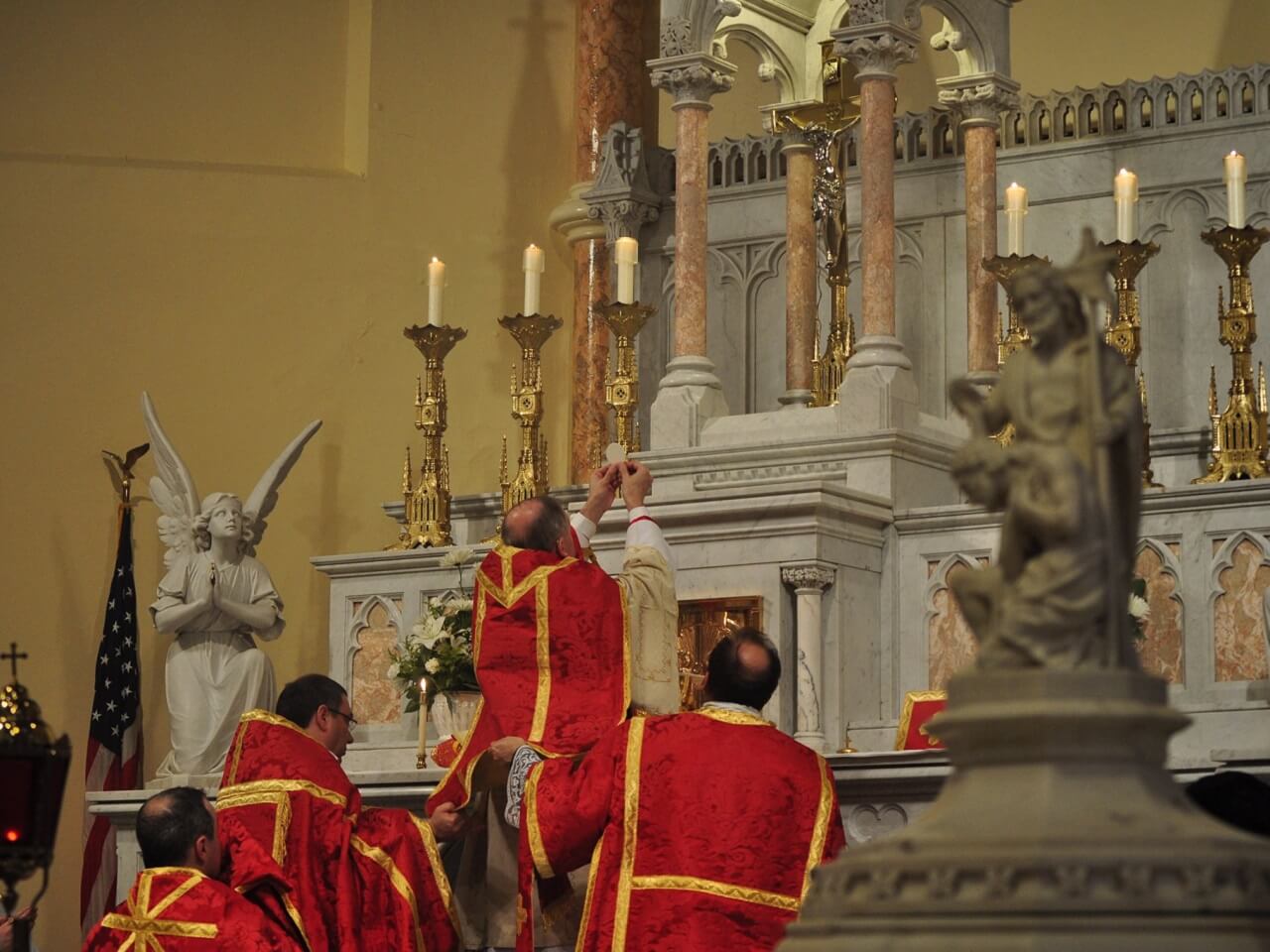
But why? From the Orthodox POV the combination of traditional service with vernacular solves so many problems.It is not a case of traditionalists holding out for anything. What some refer to as the Traditional Latin Mass (TLM) and the Church officially calls the Extraordinary Form (EF), has to be celebrated in Latin as per Church law. It may not be celebrated in any vernacular language.
I guess I assumed this was the case. This has been the case with the Orthodox. Although there are some who wish to simplify the liturgy, they are not a sizeable group.massive groundswell
I don’t know, I think the simple answer is simply to translate what exists and keep whatever rites are beneficial to the sanctity of the faithful. Perhaps there’s something huge I’m missing but I see those that wish to blindly keep tradition as holding onto culture instead of Christ and it’s pretty clear which way is right (to me).This tension exists in some of the Eastern rites as well, as you mentioned with your Coptic heritage; the tension between the desire to keep the tradition and heritage that had been formed through language, along with the desire to adopt a language that is easily understood by the people. There’s no easy answer.
Because that is the tradition of the Latin Catholic Church. It is not appropriate to say the Latin Catholic Church should do this because the Eastern Orthodox do. Equally, it would be wrong to say the Eastern Orthodox should do something and to give as your reason because the Latin Catholics do it.But why? From the Orthodox POV the combination of traditional service with vernacular solves so many problems.
I must be missing the point but I cannot find what relevance these comments have to my post you quoted. I was simply pointing out to the OP that having the EF Mass in Latin is not the result of some conspiracy of traditionalist Catholics but is the Church’s own law.There was a desire, among some professional liturgists and reformers, not only to have the Mass in the vernacular, but to simplify, streamline, and introduce different elements into the Mass. If the only thing going on prior to Vatican II had been some kind of massive groundswell — which there was not — to have the Mass in the vernacular, it most certainly could have been translated, and that could have been the end of it. It went much further and deeper than that.
The changes were imposed from the top down, and people were basically told “this is how it is going to be from now on”. They were told that they were supposed to like it, and to get on board with it, and Catholics being obedient in those days, that is precisely what they did.
Please note that I am not saying any of this was a bad thing. I am just stating what happened.
As a Latin Catholic, I’m getting a bit confused as to why you keep bringing this up after numerous people have offered you explanations on why the Western Church had Latin Mass for so long and why some people still like to have it.From the Orthodox POV the combination of traditional service with vernacular solves so many problems.

The “point” is that the Mass was not merely translated, but given an overhaul from top to bottom. This was not a gradual, organic development, but a deconstruction and rebuilding of the Mass basically “overnight” (seven years in “Catholic time” would be pretty much “overnight”). Some say this was good, some say this was not so good. There may have been a few who said “yee-hah, Mass is finally what it’s supposed to be, hallelujah!”, but many people were deeply disturbed by the radical changes to the only form of worship they had ever known — the vast majority of these just “sucked it up” under the rubric of blind obedience, and the Latin Mass became “something we don’t talk or think about anymore”. A few people cried foul, took action, some of it licit, some of it not, and after much “wailing and gnashing of teeth” from all sides, the Church finally relented and issued blanket permission for the restoration of the TLM where people desire it. And so it is today. Without saying one thing bad about the “new Mass”, anyone who goes to a TLM church will see instantly that it is a hotbed of very serious, very reverent, “high-test” Catholicism, and many grow to prefer it.There was a desire, among some professional liturgists and reformers, not only to have the Mass in the vernacular, but to simplify, streamline, and introduce different elements into the Mass. If the only thing going on prior to Vatican II had been some kind of massive groundswell — which there was not — to have the Mass in the vernacular, it most certainly could have been translated, and that could have been the end of it. It went much further and deeper than that.
The changes were imposed from the top down, and people were basically told “this is how it is going to be from now on”. They were told that they were supposed to like it, and to get on board with it, and Catholics being obedient in those days, that is precisely what they did.
Please note that I am not saying any of this was a bad thing. I am just stating what happened.
While they are very nice, these translations are unofficial and could not be used to “celebrate the traditional Mass in the vernacular”. They exist solely for the convenience of the faithful who may not understand Latin.Of course, the EF has been translated and can be found alongside Latin in many EF missals. It is always interesting to note that in the English translation of those missals the response to the ‘Lord be with you’ was always ‘And with your spirit’, which in 1970 suddenly became ‘And also with you’ and which quite a lot of people found strange in 2011 when it became ‘And with your spirit’.
Please understand that in the Western Church, most people have little or no idea of what the Orthodox do or why they do it or why we would want to do the same thing.
For my part, I have no problem with someone bringing up Orthodox practices. Aside from irregularities that may have been introduced post-schism (whatever these might have been), their practices and traditions are just as old, just as venerable, as ours are in the Western Church, and I think it is a good thing to ask the question “how have the Orthodox handled Situation X?”. Their approach, for instance, to marriages subsequent to the first one, deserves serious study before it is dismissed simply as a case of “we’re right and they’re wrong”. And if I am understanding it correctly (not having a scholarly knowledge of either language), to try to render the concept of filioque in Greek “just doesn’t sound right” and really cannot be done, hence much (if not all) of the reason for the dispute in the first place.You constantly bringing up Orthodox this and Orthodox that makes no sense to me. I don’t want to be rude and say, “I don’t care what the Orthodox do, and why should I?” but it’s hard seeing the relevance. As someone else said, it’s not our tradition.
Where’s your source? That makes no sense; there would have to be an official translation to use if that were the case, and as far as I know, there is no such translation.I think that a Bishop can give a dispensation for parts of the Tridentine Mass (TLM) to be celebrated in English or another language.
 onepeterfive.com
 www.hprweb.com
I am fully aware of this but it has no relation o what I told the OP.The “point” is that the Mass was not merely translated, but given an overhaul from top to bottom. This was not a gradual, organic development, but a deconstruction and rebuilding of the Mass basically “overnight” (seven years in “Catholic time” would be pretty much “overnight”). Some say this was good, some say this was not so good. There may have been a few who said “yee-hah, Mass is finally what it’s supposed to be, hallelujah!” , but many people were deeply disturbed by the radical changes to the only form of worship they had ever known — the vast majority of these just “sucked it up” under the rubric of blind obedience, and the Latin Mass became “something we don’t talk or think about anymore”. A few people cried foul, took action, some of it licit, some of it not, and after much “wailing and gnashing of teeth” from all sides, the Church finally relented and issued blanket permission for the restoration of the TLM where people desire it. And so it is today. Without saying one thing bad about the “new Mass”, anyone who goes to a TLM church will see instantly that it is a hotbed of very serious, very reverent, “high-test” Catholicism, and many grow to prefer it.
I know they are not officially approved translations. I know that the Extraordinary Form of the Mass may only be offered in the Latin. I was simply saying translations have been done and exist.While they are very nice, these translations are unofficial and could not be used to “celebrate the traditional Mass in the vernacular”. They exist solely for the convenience of the faithful who may not understand Latin.
Yeah, I agree, based on my reading of Sacrosanctum Concilium. The more I’ve read about the ‘65 Missal, the more I like.I actually think that the so-called 1965 missal, with the Offertory and Canon in Latin and the option for vernacular in the remainder of the Mass, was ideal given what was envisioned in SC.