What color phelonion is a priest supposed wear to concelebrate a funeral Mass?

  • Thread starter Thread starter Draper
  • Start date Start date
Status
Not open for further replies.
Thats fine fir the Latins…

My point was if the Byzantines should follow Latin customs when visiting a Latin Church, the Latins should have no problem then when visiting a Byzantine Church to follow Byzantine customs. Even wearing dark vestments to a funeral! The horror!
I didn’t say anything about “Latin customs.” I simply said they should vest in the same color as the principal celebrant.

Wearing white during a funeral Mass (which are probably 90-95% of all funeral Masses today) shouldn’t be too difficult.
 
I didn’t say anything about “Latin customs.” I simply said they should vest in the same color as the principal celebrant.

Wearing white during a funeral Mass (which are probably 90-95% of all funeral Masses today) shouldn’t be too difficult.
The Eastern Catholic clergy "should vest in the same color as the principal [Latin] celebrant ", "Wearing white during a funeral Mass (which are probably 90-95% of all funeral Masses today) " in the Roman Rite.

It “shouldn’t be too difficult” for Eastern Catholic clergy to not follow the rubrics and patrimony of their Eastern Catholic Church.

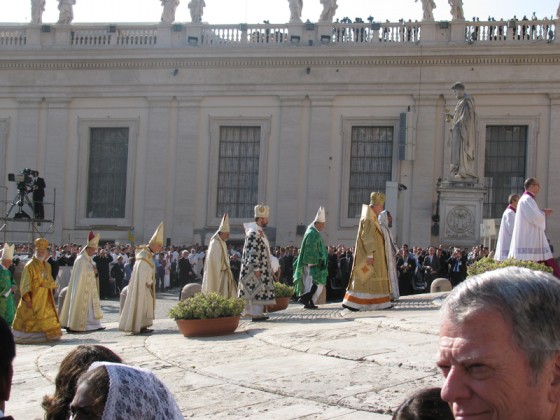
The Latin Church is the largest of the Catholic Churches, and may even be 95% of the Universal Church but we Eastern Catholics are not required to abandon our proper vesture in any concelebrations in order to not offend those who may be unfamiliar with the fullness of the Catholic Church East and West. Rome does not expect it, as can be seen in every Mass concelebrated with HH Francis, and the Popes of Rome before him, where our Eastern Catholic clergy are clearly visible due to their being properly vested in their own Liturgical “variety of fabrics and colors”.
The Byzantine tradition is to wear red vestments for a funeral, sometimes other “dark” colors like purple/violet, or combinations of these, but mostly red.
…The Ruthenian priest probably wore red because that’s his own proper color for funerals.
…Therefore it would be perfectly normal for a concelebrating Byzantine priest at a Latin funeral to wear dark (red) vestments.
 
The Eastern Catholic clergy "should vest in the same color as the principal [Latin] celebrant ", "Wearing white during a funeral Mass (which are probably 90-95% of all funeral Masses today) " in the Roman Rite.

It “shouldn’t be too difficult” for Eastern Catholic clergy to not follow the rubrics and patrimony of their Eastern Catholic Church.

The Latin Church is the largest of the Catholic Churches, and may even be 95% of the Universal Church but we Eastern Catholics are not required to abandon our proper vesture in any concelebrations in order to not offend those who may be unfamiliar with the fullness of the Catholic Church East and West. Rome does not expect it, as can be seen in every Mass concelebrated with HH Francis, and the Popes of Rome before him, where our Eastern Catholic clergy are clearly visible due to their being properly vested in their own Liturgical “variety of fabrics and colors”.
This is not really a matter of abandoning the proper customs of the Eastern Churches–not this particular situation.

When a priest is invited to concelebrate at another place (whether that’s another parish, or it’s another ritual Church), hospitality and good manners say that he should follow the instructions of the host.

If an invitation to a Latin ordination says “please bring white chasuble/stole” then that’s what every priest should wear.

If an invitation to a Byzantine ordination says “please bring full vestments in festive color” then that’s what every priest should wear. In the East, this can mean different specific-colors such as white, gold, silver, festive red, blue, white with gold, etc. In this case, they are all “matching” the main celebrant because the criteria that matters (namely “festive”) is uniform. If the invitation is more specific and reads “please bring gold vestments” then that’s what every priest should wear.

In the Latin usage, the colors are more specific. If there is a shortage of vestments of the proper color, then it’s acceptable for the concelebrants to wear white, regardless of what the main celebrant wears. At the same time, if it is possible, they should all match the color which the main celebrant wears.

Again, I want to say that I do not know what motivated that particular priest to choose that vestment at that moment—so I offer no speculation as to his motive. All I know is that, objectively, red is a typical funeral color for his Church.

In the end, this is not about “which color is appropriate for funerals.” It is about common courtesy to wear what the host requests the guest to wear.
 
This is not really a matter of abandoning the proper customs of the Eastern Churches–not this particular situation.

When a priest is invited to concelebrate at another place (whether that’s another parish, or it’s another ritual Church), hospitality and good manners say that he should follow the instructions of the host.

If an invitation to a Latin ordination says “please bring white chasuble/stole” then that’s what every priest should wear.

If an invitation to a Byzantine ordination says “please bring full vestments in festive color” then that’s what every priest should wear. In the East, this can mean different specific-colors such as white, gold, silver, festive red, blue, white with gold, etc. In this case, they are all “matching” the main celebrant because the criteria that matters (namely “festive”) is uniform. If the invitation is more specific and reads “please bring gold vestments” then that’s what every priest should wear.

In the Latin usage, the colors are more specific. If there is a shortage of vestments of the proper color, then it’s acceptable for the concelebrants to wear white, regardless of what the main celebrant wears. At the same time, if it is possible, they should all match the color which the main celebrant wears.

Again, I want to say that I do not know what motivated that particular priest to choose that vestment at that moment—so I offer no speculation as to his motive. All I know is that, objectively, red is a typical funeral color for his Church.

In the end, this is not about “which color is appropriate for funerals.” It is about common courtesy to wear what the host requests the guest to wear.
Thank you for such a wonderful response/explanation!
 
The Eastern Catholic clergy "should vest in the same color as the principal [Latin] celebrant ", "Wearing white during a funeral Mass (which are probably 90-95% of all funeral Masses today) " in the Roman Rite.

It “shouldn’t be too difficult” for Eastern Catholic clergy to not follow the rubrics and patrimony of their Eastern Catholic Church.

The Latin Church is the largest of the Catholic Churches, and may even be 95% of the Universal Church but we Eastern Catholics are not required to abandon our proper vesture in any concelebrations in order to not offend those who may be unfamiliar with the fullness of the Catholic Church East and West. Rome does not expect it, as can be seen in every Mass concelebrated with HH Francis, and the Popes of Rome before him, where our Eastern Catholic clergy are clearly visible due to their being properly vested in their own Liturgical “variety of fabrics and colors”.
That Latin Rite of the Church comprises far more than 95% of the entire Catholic Church.
 
If an invitation to a Latin ordination says “please bring white chasuble/stole” then that’s what every priest should wear.
Fr. David, are you suggesting that a Byzantine priest should not even wear his own vestments to concelebrate? Why would your average Byzantine priest even be expected to own his own chasuble and stole?
If an invitation to a Byzantine ordination says “please bring full vestments in festive color” then that’s what every priest should wear. In the East, this can mean different specific-colors such as white, gold, silver, festive red, blue, white with gold, etc. In this case, they are all “matching” the main celebrant because the criteria that matters (namely “festive”) is uniform. If the invitation is more specific and reads “please bring gold vestments” then that’s what every priest should wear.
Likewise, if a Latin priest were to concelebrate at a Divine Liturgy on Pentecost, I would be expecting him to wear red. It just makes sense to me that way. I suppose he could wear his green chasuble, but that would be doubly weird. 🤷
 
Fr. David, are you suggesting that a Byzantine priest should not even wear his own vestments to concelebrate? Why would your average Byzantine priest even be expected to own his own chasuble and stole?

Likewise, if a Latin priest were to concelebrate at a Divine Liturgy on Pentecost, I would be expecting him to wear red. It just makes sense to me that way. I suppose he could wear his green chasuble, but that would be doubly weird. 🤷
Upon further research:
This post from Fr. Z seems pertinent to the conversation, though it is about the vesture of deacons. wdtprs.com/blog/2015/05/ask-father-latin-deacons-in-eastern-divine-liturgy/
He says that the law says that a minister assisting at the liturgy of a different ritual church wear the vestments of his own proper ritual church. In that case, it would be entirely inappropriate for him to show up in a chasuble and stole.
 
Fr. David, are you suggesting that a Byzantine priest should not even wear his own vestments to concelebrate? Why would your average Byzantine priest even be expected to own his own chasuble and stole?

Likewise, if a Latin priest were to concelebrate at a Divine Liturgy on Pentecost, I would be expecting him to wear red. It just makes sense to me that way. I suppose he could wear his green chasuble, but that would be doubly weird.
He’s suggesting a Byzantine Priest should wear white vestments in that situation.

Red is the color of the day in the Latin Rite on Pentecost Sunday.
 
Fr. David, are you suggesting that a Byzantine priest should not even wear his own vestments to concelebrate? Why would your average Byzantine priest even be expected to own his own chasuble and stole?
You’re nitpicking.

It was clear from what I wrote that the meaning was “if he’s asked to wear white, he should wear white.” Naturally, he would wear the style of vestment that matches his own liturgical tradition.
Likewise, if a Latin priest were to concelebrate at a Divine Liturgy on Pentecost, I would be expecting him to wear red. It just makes sense to me that way. I suppose he could wear his green chasuble, but that would be doubly weird. 🤷
If the other concelebrants are likewise wearing green, then there would nothing weird about it.

I rather think the opposite. If it’s a situation of 20 Byzantine priests and 2 deacons all wearing green, the Holy Table vested in green, the veils in green, and everything else in green, then the one priest wearing red would be the one to look weird.

If the host requests that he wear green, then that’s what he should wear. He should make every reasonable effort to follow the request of the host.
 
Upon further research:
This post from Fr. Z seems pertinent to the conversation, though it is about the vesture of deacons. wdtprs.com/blog/2015/05/ask-father-latin-deacons-in-eastern-divine-liturgy/
He says that the law says that a minister assisting at the liturgy of a different ritual church wear the vestments of his own proper ritual church. In that case, it would be entirely inappropriate for him to show up in a chasuble and stole.
Yes. He wears the vestments of his own ritual Church. That’s true for both priests and deacons (for that matter, minor clerics as well).

If that is not possible, then he can borrow a set from the host parish/priest, even if it is different from his own.

Still, every effort should be made to match the color of the celebration itself. If the criteria is “festive” then he should wear anything festive. If the criteria is more specific then he should wear whatever matches that criteria.
 
Yes. He wears the vestments of his own ritual Church. That’s true for both priests and deacons (for that matter, minor clerics as well).

If that is not possible, then he can borrow a set from the host parish/priest, even if it is different from his own.

Still, every effort should be made to match the color of the celebration itself. If the criteria is “festive” then he should wear anything festive. If the criteria is more specific then he should wear whatever matches that criteria.
Ok, so here’s this hypothetical Pentecost Divine Liturgy, at which 20 Byzantine priests and 1 Latin Rite priest are expected to concelebrate. An email goes out to all the concelebrating priests, saying “Looking forward to seeing everybody next week. As a reminder, it is Pentecost, so be sure to bring your green vestments.” Are you saying that the Latin Rite priest should wear his green, ordinary time vestments in order to fit in, rather than the red appropriate to his rite? Likewise, if the situation were reversed and everyone had been requested to wear Latin Rite red, the lone Byzantien priest should wear a color appropriate to pennetential seasons on the 3rd biggest feast of the year, just so he could blend in?
 
Ok, so here’s this hypothetical Pentecost Divine Liturgy, at which 20 Byzantine priests and 1 Latin Rite priest are expected to concelebrate. An email goes out to all the concelebrating priests, saying “Looking forward to seeing everybody next week. As a reminder, it is Pentecost, so be sure to bring your green vestments.” Are you saying that the Latin Rite priest should wear his green, ordinary time vestments in order to fit in, rather than the red appropriate to his rite?
Yes. That’s exactly what I am saying. Because the celebration is not occurring in his own rite. When the color of the celebration is green, he should wear green.

He does this because the Liturgy itself must follow the Byzantine norms with regard to color (not the Latin norms). The priest does not bring rubrics with him when he goes to visit another ritual Church.
Likewise, if the situation were reversed and everyone had been requested to wear Latin Rite red, the lone Byzantien priest should wear a color appropriate to pennetential seasons on the 3rd biggest feast of the year, just so he could blend in?
It is the same. When the color of the celebration is red, he should wear red. He should wear his own vestment, but in a color that corresponds to the celebration itself.

If he has a festive red vestment, then that would be appropriate.

Think of it this way:

What if your Byzantine parish has a special occasion of some sort and the local Latin priest is invited to join and concelebrate. What would you think if he went over during the Preparation and dropped an unleavened host next to the Prosphora? Would you not be scandalized, and rightly so? Would you not want to say to him that when he is visiting some other place he should respect their liturgical norms rather than to try to bring his and insert them into the Divine Liturgy?
 
Yes. That’s exactly what I am saying. Because the celebration is not occurring in his own rite. When the color of the celebration is green, he should wear green.

He does this because the Liturgy itself must follow the Byzantine norms with regard to color (not the Latin norms). The priest does not bring rubrics with him when he goes to visit another ritual Church.
So the liturgy itself must follow Byzantine norms with regard to color, but that rule doesn’t apply to style? That doesn’t make sense. There are liturgical norms regarding both color and style of vestments. You’re saying that one must be followed, the other not.
What if your Byzantine parish has a special occasion of some sort and the local Latin priest is invited to join and concelebrate. What would you think if he went over during the Preparation and dropped an unleavened host next to the Prosphora? Would you not be scandalized, and rightly so? Would you not want to say to him that when he is visiting some other place he should respect their liturgical norms rather than to try to bring his and insert them into the Divine Liturgy?
I’m saying that he should follow the rules. There are rules that cover both of these situations. In the first, the rules state that he should wear vestments appropriate to his own ritual church. Vestments have both color and style. This is what the rules prescribe, and they do not separate color and style. The rules also deal with using unleavened bread in a Byzantine liturgy. It is forbidden, except in exceptional circumstances. In either case, I would have the same expectiation.
 
So the liturgy itself must follow Byzantine norms with regard to color, but that rule doesn’t apply to style? That doesn’t make sense. There are liturgical norms regarding both color and style of vestments. You’re saying that one must be followed, the other not.
Because we’re talking about 2 different rules. I am not saying we follow one or the other, I am saying that we follow both.

1 rule says the priest wears the vestments of his own church. It does not add that he wears his own color. He wears his own vestments.

The other rule says that each Liturgy or Mass has its own color. Everyone should follow that rule.
I’m saying that he should follow the rules. There are rules that cover both of these situations. In the first, the rules state that he should wear vestments appropriate to his own ritual church. Vestments have both color and style. This is what the rules prescribe, and they do not separate color and style.
Yes, they do separate color and style. They are 2 different rules.

There is no such rule that a priest wears his own color when he visits another ritual Church. I don’t know why you seem to think that there is one. There is no such thing.
The rules also deal with using unleavened bread in a Byzantine liturgy. It is forbidden, except in exceptional circumstances. In either case, I would have the same expectiation.
I hardly think that you would expect a visiting Latin priest to bring an unleavened host to the Divine Liturgy.

He follows the rubrics and norms of whatever service he is participating. When the service calls for leavened bread, he uses that. When the service calls for a certain color, he wears it.
 
I hardly think that you would expect a visiting Latin priest to bring an unleavened host to the Divine Liturgy.
.
I never said I would. You’re the one who brought that up.

At any rate, I shared this discussion with my pastor tonight and asked him what he understood to be appropriate and what he would do in such a situation, giving him the Pentecost scenario. Father is knowledgable, has bi-ritual faculties, says Mass twice each week, and is a liturgical stickler. So I asked him: “If you were concelebrating at Mass on Pentecost, what color would you wear?” Without hesitation, he answered that he would wear green. I asked him why, and he said “Because I am a Byzantine priest.” We talked a bit more, and he mentioned that in many places the Byzantine priests would not even know that red was the liturgical color for Pentecost in the Latin Rite. He gave the example of going to the Vatican, prepared for concelebration. A priest would bring his vestments, prepared to celebrate the Divine Liturgy. I asked, “What if you get an email telling you to bring red vestments?” He said that he would think that someone had died and they need to be ready for a funeral. The whole idea of wearing vestments of his own rite, but not according to the prescriptions of his own rite seemed strange to him.

I was looking through the internet, searching for some pictures to see what was generally done in these situations and found this. I guess these Eastern heirarchs, including our very own Metropolitan William, didn’t get the memo to bring their Pentecost vestments to the Vatican during Ordinary Time. 🙂


Likewise, where are the Pentecost vestments on those Latin bishops at the funeral of Bishop Andrew?
(Please Note: This uploaded content is no longer available.)

I found well over a dozen images, and not one of them showed what you suggest - a priest wearing vestments of his own rite, but in a liturgical color that followed the Latin rite.

 
I never said I would. You’re the one who brought that up.

At any rate, I shared this discussion with my pastor tonight and asked him what he understood to be appropriate and what he would do in such a situation, giving him the Pentecost scenario. Father is knowledgable, has bi-ritual faculties, says Mass twice each week, and is a liturgical stickler. So I asked him: “If you were concelebrating at Mass on Pentecost, what color would you wear?” Without hesitation, he answered that he would wear green. I asked him why, and he said “Because I am a Byzantine priest.” We talked a bit more, and he mentioned that in many places the Byzantine priests would not even know that red was the liturgical color for Pentecost in the Latin Rite. He gave the example of going to the Vatican, prepared for concelebration. A priest would bring his vestments, prepared to celebrate the Divine Liturgy. I asked, “What if you get an email telling you to bring red vestments?” He said that he would think that someone had died and they need to be ready for a funeral. The whole idea of wearing vestments of his own rite, but not according to the prescriptions of his own rite seemed strange to him.

I was looking through the internet, searching for some pictures to see what was generally done in these situations and found this. I guess these Eastern heirarchs, including our very own Metropolitan William, didn’t get the memo to bring their Pentecost vestments to the Vatican during Ordinary Time. 🙂

Likewise, where are the Pentecost vestments on those Latin bishops at the funeral of Bishop Andrew?

I found well over a dozen images, and not one of them showed what you suggest - a priest wearing vestments of his own rite, but in a liturgical color that followed the Latin rite.
Amen.

It is not about a particular color, white or red. It is about which vesture is proper for the Church *sui iuris * of that clergyman. And it is about no Church telling another autonomous particular Church that they are offending by upholding the rubrics of their own particular Church. This is the kind of “interference” by the Latin Church that Orthodox bring up for why there can’t be reunion of our Churches.

The only letters I’m aware of Eastern clergy getting from another EC “hosting” a Liturgy is something like this from a large symposium a while back: “clergy in any rank must provide a letter from their diocesan hierarch, confirming canonical standing and that your bishop has blessed you to either commune in the Holy Altar, or concelebrate the Divine Services as may be permitted by the local hierarch.” Our clergy know what they should wear, either “dark”, and “bright” depending on the time and service.

It is unthinkable that any Eastern Church would tell a Latin Church priest what to wear when he concelebrates in our Church, because it is none of our business. It’s the business of the Latin Church priest and his own Church’s rubrics as to what vesture is proper for him.

Early in the thread Fr Moses politely said
IMO it’s more important to follow proper protocol and the directives of your bishop then to try and “fit in”.
I would go further and say that since the Second Vatican Council Rome has instructed and called upon us to embrace our patrimony, follow our proper rubrics, and for the entire Church to become familiar with the Churches of the East and respect and honor their norms, for the benefit of the entire Church. This is the essential theme in Orientalium Ecclesiarum, Orientale Lumen amongst other documents.

Khouria Krista West talks about the advantage for a newly ordained priest or deacon of the Eastern Churches only having “dark”, and “bright”. With just two sets of vestments, one “dark”, and one “bright”, she points out that he has everything he needs to be property vested for every occasion. Two sets, (phelonion, epitrachelion, zone & cuffs for a priest, or sticharion, orarion & cuffs for a deacon) he could get for between $2,000 and $3,000.

Photos attached are of Maundy Thursday Papal Mass with HH Benedict XVI Basilica of St John Lateran.
 
My baby is keeping me up all night, so I have nothing better to do than look at pictures online. I finally found one, at the funeral of Bishop Basil, in which Latin Rite priest wore their own red vestments. I guess it happens, but doesn’t seem to be what is usually done.

http://www.mgce.uz.ua/albums/922/IMG_0015.jpg
 
There is confusion here between respecting the practices of the Eastern Churches on the one hand, and mixing the rubrics of the various Churches on the other hand.

Rubrics apply to whatever service is being celebrated. The priest does not “bring” his own rubrics when he joins the celebration at another ritual Church.
 
My baby is keeping me up all night, so I have nothing better to do than look at pictures online. I finally found one, at the funeral of Bishop Basil, in which Latin Rite priest wore their own red vestments. I guess it happens, but doesn’t seem to be what is usually done.
Looks like it might just be a case of good manners trumping the need to advertise they are (in this case) Latin Rite clerics.
 
Status
Not open for further replies.
Back
Top