During the Byzantine period, there was a trend of portraying Jesus with stereotypical ‘Semitic’ features: short, curly (almost frizzy) hair and a matching beard. This was one main iconographic variation that existed alongside the ‘short/long-haired beardless young man’ form and the ‘long-haired bearded man’ (i.e. the way we often depict Jesus today) version.
http://img684.imageshack.us/img684/967/6thsinaipantocrator.jpg
http://img514.imageshack.us/img514/4467/solidusjustinianiichris.jpg
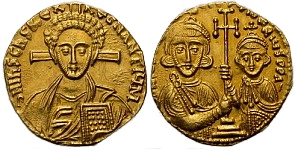
This depiction of a shorter-haired Jesus also enjoyed the support of some personages, such as
Theodorus Lector in the early 6th centuy, who once recorded the story of a certain painter who painted an icon of Christ “
in the likeness of Zeus” (
tou en taxei Dios) for a pagan (‘Hellene’) patron in Constantinople, whereupon his hands withered. It wasn’t until Gennadius I (Patriarch of Constantinople 458-471) prayed for the painter that his punishment was relieved. St. John of Damascus quotes this story, and adds the description: “
the hair on the head was painted as dividing on either side so that the eyes were not hidden. For in such manner, the Greeks painted their Zeus.” He goes further: “
The historian says that the other type of the Savior, the curly and short-haired (
to oulon kai oligotrichon)
, is more truthful.”
This has led some writers to opine that one possible root of the longer-haired Jesus in iconography is the portraiture of Zeus (the statue of
Zeus at Olympia was believed by some to be at Constantinople during the earlier half of the 5th century, where it was destroyed in the great fire of the Lauseion in 475), but it cannot have been convincingly solely derived only from there, since the exact iconography of Christ’s long hair seems to deviate from that of Zeus as well. This issue is also brought up in a text attributed to St. Epiphanius of Salamis, which also complains about depictions of Jesus with long hair - based on what the author believes to be an illogical opinion: that since Christ was called a Nazarene, He ought to have long hair (cf. Nazarite). Another theory is that the (other) source for the long-haired depictions of Jesus is the Mandylion of Edessa - sometimes connected with the
Shroud of Turin.
Some iconophile writers during the 9th century even go on to describe that in paintings and mosaics in the Holy Land Constantine the Great depicted our Lord “
as the ancients described, with eyebrows that joined, (This corresponds with St. Andrew of Crete’s rather dubious citation of Josephus which supposedly says Jesus had “
meeting eyebrows”)
fine eyes, a long nose, frizzy hair, flesh tones like His Mother’s, the color of wheat.” This description eventually became more detailed as time went on, as we can see from
Epiphanius the Monk’s description of Jesus as a handsome man, six feet tall with not-too thick blondish lightly waved hair and beard, clear and beautiful eyes, a long nose, black eyebrows, a slightly-bent neck, and a face pointed towards the chin. These later detailed purported descriptions of Jesus may be the genesis of the medieval Publius Lentulus letter.



