What is the best argument to promote the TLM?

  • Thread starter Thread starter tradboy
  • Start date Start date
Status
Not open for further replies.
How would your statement even make sense then if we know God prefers the Catholic Church (the one He started) over other denominations?
My statement makes sense from the point of view that the celebration of any approved, valid liturgy of the Catholic Church is equally pleasing to God. Other denominations are more properly described as “ecclesial communities,” not true Churches. I have no idea how efficacious their forms of worship are for them…we’ll have to leave that to God. Certainly, Catholic forms of worship are superior to anything else; as you said, the Catholic Church is the True Church of Christ.
 
"Nevertheless, this is a doctrine of the Church, and that oath of coronation is a document of the Church’s tradition that the Popes indeed do not have the power to abolish that which is the received and approved Rite and replace it with another. It is defined by the Church, therefore it is the law of God. The customary received Rites must be adhered to. That is the profession of faith. That is why the Council of Trent, Session 7, Canon 13, declared the proposition, “If anyone says that the received and approved Rites of the Catholic Church customarily used in the solemn administration of the sacraments can be changed into other new Rites by any Church pastor whosoever, let him be anathema.”

It is very clear that this anathema declares that it is a heresy to say that any pastor of the Catholic Church, whosoever has the power to revise the sacred liturgy, the traditional Rites, changing the customary Rites into new Rites.

When the Synod of Pistoia in 1786, proposed the simplification of the liturgy, the use of the vernacular throughout, and the reciting of the Canon of the Mass in a loud voice, Pope Pius VI condemned these propositions. Those reforms proposed at the Synod of Pistoia are precisely the same things that were proposed at the Second Vatican Council."

cfnews.org/kramer.htm
 
“And as we go through them one by one, we see that the changes made in the liturgy reflect exactly those changes undertaken by the Protestant Reformers in the 16th Century. Does it not seem to be more than coincidence that all the changes made in the liturgy were precisely those made by the Protestant Reformers? And whatever was found to be offensive to the Protestants, whatever was most dear to traditional Catholic Eucharistic doctrine and the doctrine of the Holy Mass, was either toned down or removed altogether from the liturgy, so that one of the Protestant observers at Vatican II, who helped and gave advice in making the new liturgy, said that “Evangelical Protestants with all tranquility may use this new Rite of Mass.” The “new foundation” of Eucharistic theology is clearly Protestant.”

Father Paul Kramer

cfnews.org/kramer.htm
I’ve never understood this. If one reviews the Pauline Missal he will see the same form of the Mass as in the Tridentine Missal. The first Eucharistic Prayer is the Roman Canon; the second is the ancient anaphora of St. Hippolytus, hardly protestant in nature; the third has the word “sacrifice” in it several times with the explicit intent to change simple bread and wine into the Body and Blood of Jesus. The fact that a protestant can be so simple minded to pretend that the text is something different than what it is is hardly an intellectual argument claiming that the text is “protestantized.” To me, it only shows the deficiency of protestant theology.
 
I’ve never understood this. If one reviews the Pauline Missal he will see the same form of the Mass as in the Tridentine Missal.
Tim, why are there two forms then if they are the same? Were changes such as ad populus, vernacular, CITH not changes Protestants like Lutherans wanted?
 
Tim, why are there two forms then if they are the same? Were changes such as ad populus, vernacular, CITH not changes Protestants like Lutherans wanted?
I’m talking about the missal. I’ve always read here how “protestant” the Pauline Missal is, yet noone ever points to anything specific in it that smacks of protestantism. Ad populus, vernacular, CITH are disciplines that are subject to change; they, in themselves, are not “protestant.”

I’ve also read here how some have been to Lutheran services that were nearly identical to the liturgy in the Pauline Missal. It did not take much research to discover that in the late 1970’s the Lutherans revised their book of worship. What did they use as the basis? The Roman Missal of the Catholic Church. So, it would seem that the Lutherans copied the Church and not the other way around, hence the similarity.
 
I’m talking about the missal. I’ve always read here how “protestant” the Pauline Missal is, yet noone ever points to anything specific in it that smacks of protestantism. Ad populus, vernacular, CITH are disciplines that are subject to change; they, in themselves, are not “protestant.”

I’ve also read here how some have been to Lutheran services that were nearly identical to the liturgy in the Pauline Missal. It did not take much research to discover that in the late 1970’s the Lutherans revised their book of worship. What did they use as the basis? The Roman Missal of the Catholic Church. So, it would seem that the Lutherans copied the Church and not the other way around, hence the similarity.
So the Pauline Rite is very similar to Luther’s. Do you see a problem here?
 
Is “good luck” the best you can do to counter? You don’t deny the basically untested aspects of the new rite but just hope it hangs in there for another 40 years?

Personally I hope the OF sticks around as I go to it myself, though I do prefer the more developed EF.
I don’t deny your points because I think there is no way to prove what would have been. You don’t know, neither do I, and so the debate itself is pointless. Besides, the “time-tested” Latin Mass wouldn’t have ever happened if the Church hadn’t let someone “test” what the Mass would be like outside of Greek. It is not as if you were a cardinal, I were a cardinal, and it was 1960. Forty years is enough time to introduce a Mass to a billion people, so that most don’t even remember the Latin Mass and few priests who used to offer the Latin Mass daily could do it justice anymore. The horse of contention is long out of the barn.

I have no idea what you mean by “I prefer the more developed EF” coupled with “I hope the OF sticks around”. If you want to promote the EF, then attend the EF. There is no argument to replace that. Opera houses close all the time because people say they prefer opera to pop, but never buy Rossini over the Beatles when they’re actually in a record store. The Church isn’t going to do much to promote a rite that few actually attend when it is offered. OTOH, if you can get people, especially the musicians, to listen to Rossini and Mozart on a regular basis, I guarantee you’ll hear better stuff on the pop stations in a very short period of time. You don’t have to make poets write sonnets. You only have to get the poets to read and appreciate them more, and the beautiful melodies of the sonnet will start showing up in the free verse.

As for “good luck”, I only meant that you’ll attract more ponies with sugar than with vinegar. A glowing report after having attended an actual EF, in which you bubble with ideas about how your experience might be translated into the OF, carries a lot more weight than walking out of an OF Mass, muttering how awful things are and opining about who and what is to blame. There is a big difference between being correct and being successful.
 
So the Pauline Rite is very similar to Luther’s. Do you see a problem here?
It is what we have. It is not going away. Think that terrible if you like, but I would rather have lemon pie than to wish my lemons were apples.
 
It is what we have. It is not going away. Think that terrible if you like, but I would rather have lemon pie than to wish my lemons were apples.
How do you know it is not going away? Comparing the original 1969 version to what it is today, clearly it is fluid and changeable. Who knows what it will be if it even survives a hundred years, a small length of time relatively speaking.
 
… the “time-tested” Latin Mass wouldn’t have ever happened if the Church hadn’t let someone “test” what the Mass would be like outside of Greek.
Sorry I started a fight. There is no evidence that the Latin Mass was promulgated like the Novus Ordo. If you remember the Church was running rampant with (over 20) different canons in the 60’s until Pope Paul finally consolidated them into four canons. It was necessary that he do this; things would have become even more chaotic had he not. There had been a lot of “testing” going on so it isn’t entirely correct that the Pope tried something untested unless you look at the whole picture, the Mass in the setting of all the different vernaculars and options. Some were accepted better than others but that had more to do with cultures rather than flaws in the liturgy per se.

As we see now, the first English Mass’s days are numbered. We will soon have version 2.0, which will be part of still another “test.” Its first test in Africa didn’t go too well; let’s hope it gets accepted better in the U.S. But then even if it does, it will no doubt be changed again in a generation or so. English (nor most vernaculars for that matter) is not very stable, you see. Pope John XXIII said something to this effect in his Veterum Sapientia.

Meanwhile the EF goes on and could be still easily recognizable for someone who lived four hundred years ago and perhaps even sixteen hundred years ago. But I’m sure this won’t sell it today.

By the way, a lot of people like lemon pie but I don’t think you meant in that way. 🙂
 
I’m talking about the missal. I’ve always read here how “protestant” the Pauline Missal is, yet noone ever points to anything specific in it that smacks of protestantism. Ad populus, vernacular, CITH are disciplines that are subject to change; they, in themselves, are not “protestant.”

I’ve also read here how some have been to Lutheran services that were nearly identical to the liturgy in the Pauline Missal. It did not take much research to discover that in the late 1970’s the Lutherans revised their book of worship. What did they use as the basis? The Roman Missal of the Catholic Church. So, it would seem that the Lutherans copied the Church and not the other way around, hence the similarity.
It seems to me they copied one another. How else would stuff like CITH, girl altar servers (not all Masses had this, of course, but after Vatican II it’s still considered ok even though it was considered wrong before), Eucharistic Ministers, etc. get in there after previously having been considered wrong by the Church? And also it must be noted that all of those things were and still are in Protestant churches today. I think Ockham is on to something here, there is a problem that lies right in front of us.

And actually Luther didn’t really copy the Catholic Church because he broke away from it because he didn’t agree with all of its teachings. In a way he copied it, but mostly went against it.
 
So the Pauline Rite is very similar to Luther’s. Do you see a problem here?
No. The Lutheran service is very similar to the Pauline Missal because the Lutherans *copied from the Roman Missal. * Big, big difference. If the reality was that Vatican officials copied from the Lutheran missal(?), then I would see a problem but not the other way around.

If the Lutherans copied from the Tridentine Missal, would you, then, have a problem with it?
 
Is “good luck” the best you can do to counter? You don’t deny the basically untested aspects of the new rite but just hope it hangs in there for another 40 years?

Personally I hope the OF sticks around as I go to it myself, though I do prefer the more developed EF.
Considering that 99%+ of Masses around the world are the OF, that would be a guaranteed bet. One does not have to hope it will be around. It will be.

Odds are that the OF will have some changes to it in that period of time.

Odds are the EF will alos have some changes to it, in that period of time. Want a reference? Go read the letter Benedict 16 wrote accompanying SP.
 
It seems to me they copied one another.
No. The Lutherans revised their service in the late 1970s. The Pauline Missal was promulgated in 1970. There was no “copying” of the Lutheran service.
How else would stuff like CITH, girl altar servers (not all Masses had this, of course, but after Vatican II it’s still considered ok even though it was considered wrong before), Eucharistic Ministers, etc. get in there after previously having been considered wrong by the Church? And also it must be noted that all of those things were and still are in Protestant churches today. I think Ockham is on to something here, there is a problem that lies right in front of us.
These things are NOT in the Missal!!!
And actually Luther didn’t really copy the Catholic Church because he broke away from it because he didn’t agree with all of its teachings. In a way he copied it, but mostly went against it.
I’m not speaking about Martin Luther but the current Lutheran church/service. However, I always understood that Luther was not that much different from other “reformers” of his day. His problem was that he placed himself outside of the Church and became obstinate in his disobedience, even until his death. There were many reformers throughout the centuries…the good ones stayed loyal to the Church.
 
I cut and pasted my stats to you with a link.

I’m not going to go start researching your specific statistics for you.
You don’t have to research my statistics; I already did. I simply gave you the source, which it seemed you were asking for. If you didn’t want them, then you should not have asked.
 
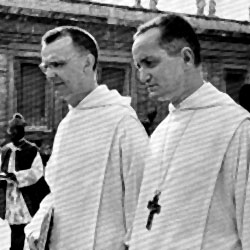
In 1969, Max Thurian, (left in photo) an important protestant theologian, who helped found the ecumenical Taizé community in France, made this statement: “It is now theologically possible for Protestants to use the same Mass as Catholics.”

 
Sorry I started a fight. There is no evidence that the Latin Mass was promulgated like the Novus Ordo. If you remember the Church was running rampant with (over 20) different canons in the 60’s until Pope Paul finally consolidated them into four canons. It was necessary that he do this; things would have become even more chaotic had he not. There had been a lot of “testing” going on so it isn’t entirely correct that the Pope tried something untested unless you look at the whole picture, the Mass in the setting of all the different vernaculars and options. Some were accepted better than others but that had more to do with cultures rather than flaws in the liturgy per se.

As we see now, the first English Mass’s days are numbered. We will soon have version 2.0, which will be part of still another “test.” Its first test in Africa didn’t go too well; let’s hope it gets accepted better in the U.S. But then even if it does, it will no doubt be changed again in a generation or so. English (nor most vernaculars for that matter) is not very stable, you see. Pope John XXIII said something to this effect in his Veterum Sapientia.

Meanwhile the EF goes on and could be still easily recognizable for someone who lived four hundred years ago and perhaps even sixteen hundred years ago. But I’m sure this won’t sell it today.

By the way, a lot of people like lemon pie but I don’t think you meant in that way. 🙂

Aside: Would I be correct in saying this, though: there hasn’t been an English Mass. There have been translations of a Latin Mass…that is, even for the OF, the definitive version is in Latin, not a vernacular language. For the Roman rite, anyway, Latin is the mother of all vernaculars.

I like lemon pie and apple both, and don’t want a bad version of either. I would choose the one done right over the one done with less skill, regardless of flavor!

Anyway, to get back to the original point–which was not which was better, but how to promote the less well-known, more-feared, and less-widely-appreciated of the two–I don’t think that direct comparisons unflattering to the OF will make the EF more often experienced, less feared, or more widely appreciated. I think those who want to promote the EF need to keep their eyes on that prize. If they are right, then they only have to lead the horse to water. Once the water is tasted, that old horse will drink, and the taste of that fine water will never be forgotten.
 
Status
Not open for further replies.
Back
Top