Why did the Catholic Church change the Ten Commandments?

  • Thread starter Thread starter coolcatholicguy
  • Start date Start date
Status
Not open for further replies.
Numbers were not put on the verses until well after the invention of the printing press- so if you really want to get the full meaning of the Bible read it from start to finish and ignore the chapter and verse numbers.
 
Numbers were not put on the verses until well after the invention of the printing press- so if you really want to get the full meaning of the Bible read it from start to finish and ignore the chapter and verse numbers.
Yes but the phrases themselves are switched around in the Biblical text, numbers or not. Exodus has house-wife-manservant-maidservant-ox--anything; Deuteronomy has wife-house-field-manservant-maidservant-ox--anything, a significant revision.
 
Actually, Moses was an Israelite, more specifically a Levite (i.e. a member of the tribe of Levi) due to his parentage. 😉 Strictly speaking, the word Jew originally referred to a member of the tribe of Judah or the people of the kingdom of Judah. It was only later, with the destruction of the northern kingdom of Israel, that the term came to be applied to say, the surviving Israelites in general and their descendants as well as converts to native Israelite religion (and much later, the inhabitants of Yehud Medinata/the Kingdom of Iudaea/the Tetrarchy of Iudaea/Iudaea Province). So in a sense, using the term ‘Jew’ for Moses is somewhat anachronistic.
Well he is Catholic now!

🙂
 
God and the Jews fundamentally changed the way all people regarded religion. Until the Jews, religion was something that dealt with man’s relationship to God. The Jews irrevocably changed that concept.For Jews religion dealt not only with man’s relationship to God but also man’s relationship to other people.

The second revolution was the connection between laws and commandments and God. The concept of laws was already well known. However, with God’s revelation to the entire Jewish nation at Sinai, we establish the concept that these laws and commandments are not merely rules to be followed but a Divine imperative.

If we understand those concepts we can understand the division of the ten commandments.The first five commandments (having faith in God’s existence, prohibition of idolatry, prohibition of vain oaths, the Sabbath and honoring parents [which in Judaism is equal to honoring God] - all deal with the relationship between man and God. The second five commandments (prohibition against murder,prohibition against adultery,prohibition against kidnapping [usually misunderstood to mean simple theft],prohibition against bearing false witness and prohibition against coveting) - all deal with relationships among people.

 
Why did they take out the part about worshipping idols and make up for that by splitting another commandment into 2?
The 10 Commandments in the Bible are found in two separate passages: Ex 20:2-17 and Dt 5:6-21.

The importance of the 10 Commandments is shown by the fact that, unlike other parts of the Law given by God through Moses, they are written by God Himself on two stone tablets (Ex 24:12; 31:18; 34:1; Dt 4:13; 5:22). There is no numerical division of the Commandments in either passage above although the total of ten is given in several places (Ex 34:28; Dt 4:13; 10:4).

Differences in enumeration of the 10 Commandments arise from differences in their formulation in Exodus as opposed to Deuteronomy. The single last commandment in Exodus (20:17) against “coveting” a neighbor’s possessions (included among which is his wife) is divided into two in Deuteronomy (5:21) against “coveting” his wife and then “desiring” his possessions. The use of two different verbs in the Hebrew text and placing the wife first suggests two different commandments.

The division used by Roman Catholics and Lutherans today draws on Deuteronomy and goes back to Origin, Clement of Alexandria, Augustine (Questions on the Heptateuch, II, 71) and was adopted by the Council of Trent.
(1) No false gods or idols. (2) No vain use of divine Name. (3) Sabbath.
(4) Parents. (5) Murder. (6) Adultery. (7) Theft. (8) False Witness. (9) Coveting wife.
(10) Coveting goods.]
In this arrangement the First Commandment groups the worship of false gods and false worship under a single class–the prohibition of idols being regarded as an application of the precept to adore one God. From a Roman Catholic point of view, it also seems as logical to separate the last two as to group the first two, for while one single object is aimed at under worship, two specifically different sins are forbidden under covetousness: if adultery and theft are two distinct types of moral wrong with two separate commandments, the same must be said of the desire to commit them.

The division used by the Orthodox Churches and Protestant Denominations (excluding Lutherans) draws on Exodus and goes back to Philo of Alexandria, Josephus, Jerome, and the Greek Fathers.
(1) No false gods. (2) No idols. (3) No vain use of divine Name. (4) Sabbath. (5) Parents.
(6) Murder. (7) Adultery. (8) Theft. (9) False Witness. (10) Coveting wife and goods.]

The division used by modern Jews draws on Exodus as well.
(1) I am the Lord your God, who brought you out of the land of Egypt, that place of slavery.
(2) No false gods or idols. (3) No vain use of divine Name. (4) Sabbath. (5) Parents. (6) Murder. (7) Adultery. (8) Theft. (9) False Witness. (10) Coveting wife and goods.]

I hope this helps.
 
Another advantage of the “Catholic” (Augustinian) numbering is that this allows the first three commandments to match the “Greatest and First Commandment” of love of God, while the following seven correspond to love of neighbor. (see Mark 12:28-34) Using the other numbering, these sets become four for God and six for neighbors. Three and seven are “nice” symbolic numbers, while four and six are not.
 
First of all, the First Commandment as stated in every Catholic book and classroom is:

I am the LORD your God; you shall not have strange gods [or other gods] before Me.

So that definitely forbids idolatry. The question is whether there is a *separate *commandment that goes “you shall not make any graven image” and that is apart from the 1st commandment. Seeing as the Jews went on to make, at God’s behest, a number of graven images (Ex 25:18-19, Num 21:8-9, 1Kgs 6:23-29, 1Kgs 7:25-45, etc.) it would be ridiculous to say that there is a separate “no graven images” commandment because then God would be a sinner.

Moreover the Fundamentalists who claim there is a separate commandment forbidding the making of and honoring the images of “dead people” are total and complete hypocrites. Why? Because all of them walk around with wallets full of images of dead people whom they honor.
Mary is dead. Where on earth have you got such an unbiblical
These images look like this:

So, if they really believed what they accused the Church of then they should give all of their “graven images” to me for disposition. 🙂

Seriously though… they clearly honor Washington and Jefferson and Franklin like every American does. And those honorees are dead. So how is carrying a $100 bill any different from carrying a holy card of the Blessed Virgin* (as George Washington himself did!)… Who is more honorable, the Mother of God or someone who denied the divinity of Jesus like Ben Franklin?
  • Bonus points if you answered, “of course it’s different–Mary isn’t dead!”
Mary is dead. Where on earth have you got such an unbiblical doctrine from. We shouldn’t bow down to any graven image. Even if the image is a person who is alive. Even bowing down to an image of Christ Jesus is wrong according to the bible.
 
Mary is dead. Where on earth have you got such an unbiblical doctrine from. We shouldn’t bow down to any graven image. Even if the image is a person who is alive. Even bowing down to an image of Christ Jesus is wrong according to the bible.
No bonus points for you then.😉

Do you mean bowing in worship or bowing in reverence?

There were lots of bowing in the OT but not all of them were in worship.
 
But the bible says not to bow down to any graven image. This must include a graven image of Jesus surely. Reverence or worship doesn’t matter, does it? :confused:
 
Mary is dead. Where on earth have you got such an unbiblical doctrine from. We shouldn’t bow down to any graven image. Even if the image is a person who is alive. Even bowing down to an image of Christ Jesus is wrong according to the bible.
First, you are incorrect on several points. Second --and you are new here so you may not have realized this-- THIS is an OLD thread. Forum policy is not to respond to threads like this which are over a year old, but rather, to make a new thread and to if necessary in the body of your text show a LINK to this one.
 
First, you are incorrect on several points. Second --and you are new here so you may not have realized this-- THIS is an OLD thread. Forum policy is not to respond to threads like this which are over a year old, but rather, to make a new thread and to if necessary in the body of your text show a LINK to this one.
I didn’t know it was forum rules not to respond to posts older than 1 year, so I apologise and will start a new one later. However I am not wrong saying that it is wrong to bow down in worship or reverence to a graven image of Mary and Jesus. King James Version (KJV)Exodus 20:4-6 4 Thou shalt not make unto thee any graven image, or any likeness of any thing that is in heaven above, or that is in the earth beneath, or that is in the water under the earth.
5 Thou shalt not bow down thyself to them, nor serve them: for I the Lord thy God am a jealous God, visiting the iniquity of the fathers upon the children unto the third and fourth generation of them that hate me;
6 And shewing mercy unto thousands of them that love me, and keep my commandments.

I understand that I use the KJV bible and not the Douay-Rheims Bible but it also says the same

Douay-Rheims Bible
Thou shalt not make to thyself a graven thing, nor the likeness of any thing that is in heaven above, or in the earth beneath, nor of those things that are in the waters under the earth.

Can you not understand that I have made a valid point saying the bible teaches that we shouldn’t bow down to graven images of Mary or Jesus. Also I find nothing in the bible which teaches that Mary didn’t die. Also while I’m on the topic of Mary. Another thing I’ve been taught is that Mary didn’t sin, which is also wrong for all have sinned and fallen short of the glory of God. By saying that Mary was sinless makes a mockery out of the bible. Why are we told these wrong teachings. It’s bad for our faith in God.

Once again I apologise for responding to an old post but I sincerely didn’t know the forum rules. I’m also not trying to start trouble because Jesus wouldn’t like that. God bless:thumbsup:
 
But the bible says not to bow down to any graven image. This must include a graven image of Jesus surely. Reverence or worship doesn’t matter, does it? :confused:
How can worship does not matter? That’s the whole context of that commandment - not to worship other gods. As been said, as happened all the times in the OT, bowing did not necessarily mean worship. Without the element of worship,then bowing is rendered harmless. Graven image is an idol, meant to be worshipped. Statues and other work of art were not prohibited as God did instruct the Israelites to make them on some occasions.
 
I didn’t know it was forum rules not to respond to posts older than 1 year, so I apologise and will start a new one later. However I am not wrong saying that it is wrong to bow down in worship or reverence to a graven image of Mary and Jesus. King James Version (KJV)Exodus 20:4-6 4 Thou shalt not make unto thee any graven image, or any likeness of any thing that is in heaven above, or that is in the earth beneath, or that is in the water under the earth.
5 Thou shalt not bow down thyself to them, nor serve them: for I the Lord thy God am a jealous God, visiting the iniquity of the fathers upon the children unto the third and fourth generation of them that hate me;
6 And shewing mercy unto thousands of them that love me, and keep my commandments.

I understand that I use the KJV bible and not the Douay-Rheims Bible but it also says the same

Douay-Rheims Bible
Thou shalt not make to thyself a graven thing, nor the likeness of any thing that is in heaven above, or in the earth beneath, nor of those things that are in the waters under the earth.

Can you not understand that I have made a valid point saying the bible teaches that we shouldn’t bow down to graven images of Mary or Jesus. Also I find nothing in the bible which teaches that Mary didn’t die. Also while I’m on the topic of Mary. Another thing I’ve been taught is that Mary didn’t sin, which is also wrong for all have sinned and fallen short of the glory of God. By saying that Mary was sinless makes a mockery out of the bible. Why are we told these wrong teachings. It’s bad for our faith in God.

Once again I apologise for responding to an old post but I sincerely didn’t know the forum rules. I’m also not trying to start trouble because Jesus wouldn’t like that. God bless:thumbsup:
No problem and please feel free to start a new thread. . .

But again, you’re still wrong. You are privately interpreting Biblical passages (a no-no according to 2 Peter) and also wrong in using your private interpretations of the Bible and claiming it as the authority for Christians. A book cannot be an authority as it cannot interpret itself. Good luck on starting your thread and have a Merry Christmas.
 
=coolcatholicguy;8077421]Why did they take out the part about worshipping idols and make up for that by splitting another commandment into 2?
Here’s the shrot explaination:

Where did the Bible originate from? Was it NOT the CC? :hmmm:

So the Bible existed for MORE than 1,000 years AS the CC birthed it:whistle: B4 the KJB was printed.

So it wasn’t the CC that changed it but someone else. WHO COULD HAVE DONE THAT AND WHY?

2Kgs.17: 12, 15
“and they served idols, of which the LORD had said to them, “You shall not do this.” They despised his statutes, and his covenant that he made with their fathers, and the warnings which he gave them. They went after false idols, and became false, and they followed the nations that were round about them, concerning whom the LORD had commanded them that they should not do like them"

THEN compare this passage to these:

Exod.25: 18, 20[GOD COMMANDING MOSES] "And you shall make two cherubim of gold; [ANGELS] of hammered work shall you make them, on the two ends of the mercy seat. The cherubim shall spread out their wings above, overshadowing the mercy seat with their wings, their faces one to another; toward the mercy seat shall the faces of the cherubim be

Num.21: 8-9 And the LORD said to Moses, “**Make a fiery serpent, and set it on a pole; and every one who is bitten, when he sees it, shall live.” **So Moses made a bronze serpent, and set it on a pole; and if a serpent bit any man, he would look at the bronze serpent and live."

SO HERE COMMANDS MOSES TO DO EXACTLY WHAT YOU CLAIM GOD FORBIDS::hypno: why AND HOW CAN THIS BE?

non-catholics made the change so that THEY could then accuse the CC of being “idol worshipers”; know [IMO!] that was not true.

**What God FORBIDS is “images” made to turn someone AWAY fro God to “false-gods.”

What Catholics do is USE images to GROW closer to God through intercessors!**

Is this “necessary?” NO it’s not:dts:

Is it BENEFICAL? YES IT IS

Images of holy people; places and things are a means to a very good end. Ones own salvation and relationship with Christ. ANYTHING and EVERYTHING that leads one TOWARDS Christ is acceptable to God!

Now as to the difference:

None Catholics make TWO commandments out of one to accomidate their agenda; at the expense of trating people as mere “things.”

The CC holds to the SAME 10 Commandments as all oter Christians. The difference is we seperate things from people; and give the proper respect to SOULS; not treating them as simply property.👍

I pray this addresses the question. It’s the same CC that Christ founded through Peter; 2,000 years ago.

God Bless,
pat/PJM
 
I didn’t know it was forum rules not to respond to posts older than 1 year, so I apologise and will start a new one later. However I am not wrong saying that it is wrong to bow down in worship or reverence to a graven image of Mary and Jesus. King James Version (KJV)Exodus 20:4-6 4 Thou shalt not make unto thee any graven image, or any likeness of any thing that is in heaven above, or that is in the earth beneath, or that is in the water under the earth.
5 Thou shalt not bow down thyself to them, nor serve them: for I the Lord thy God am a jealous God, visiting the iniquity of the fathers upon the children unto the third and fourth generation of them that hate me;
6 And shewing mercy unto thousands of them that love me, and keep my commandments.

I understand that I use the KJV bible and not the Douay-Rheims Bible but it also says the same

Douay-Rheims Bible
Thou shalt not make to thyself a graven thing, nor the likeness of any thing that is in heaven above, or in the earth beneath, nor of those things that are in the waters under the earth.
I believe a little historical explanation is in order here. (Emphasis on historical.)

First of all, it is true that the historical Israelites did not develop a unique art style of their own or contributed much in the way of arts and crafts precisely because of the ban against pesalim (‘carved images’). Nonetheless, images did exist throughout the history of Israel until the postexilic period: for instance, Gideon fashions an ephod of gold (Judges 8:27) and Micah’s mother contributed silver for the making of an idol (pesel) in Judges 17:3. The Tabernacle and the Temple of Solomon themselves were, on the face of it, a direct contravention of the literal understanding of the commandment. They were filled with images of cherubim and other flora and fauna, yet the Biblical authors did not denounce them.

The prohibition in Exodus was not so much against the act of making of images themselves but against idolatry (i.e. making an image in the purpose of worshipping it) to which the art could lead. The Israelites did, in fact, fashion images, which the prophets regarded, in a concept unique to Israel, as “idols” (cf. Isaiah 30:22; Hosea 13:2).

We now need to qualify this prohibition against images. Obviously, cherubim, serpents, lions, oxen, humans, and other images of ‘nature’ and ‘mythology’ were at times exempt from the ban - and it would seem that the prohibition of representations was less rigid in the preexilic period compared to later periods. (More on this later.) What seems to be forbidden is more often than not the depiction of the Deity Himself. We have as possible extant examples of such both the winged sun-disc symbol above the bull-calf on the top tier of the Ta’anach cult stand and the winged disc/beetle symbol on the seal impressionslmlk on the handles of royal Judahite storage jars.


It seems that what is really discouraged is the depiction of the Deity Himself, although as the records themselves suggest this rule is not always followed. Aniconism (the use of an abstract symbol or an empty space to symbolically represent a given deity) wasn’t unique to the Israelites: it was a common feature of West Semitic religions in general. The active prohibition against idols however was unique to them.
 
Quoting myself for a moment from another thread:

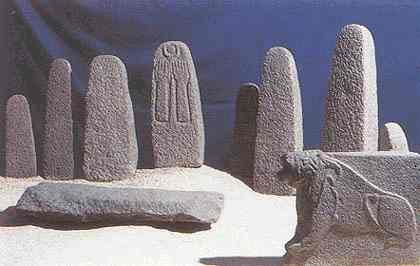
Scholars generally define two types of aniconism, both related to one another: material aniconism, which refrains from using effigies, but rather makes use of abstract images or symbols - like poles ('asherah) or standing stones (maṣṣeboth) to symbolize the divine (cf. Greek xoanon and the Hindu lingam), and empty space aniconism, which makes use of an empty space as a symbol for the god’s presence. Genuine West Semitic (Canaanite) religion in general was aniconic: for most West Semitic religions, a sacred place meant an open-air temenos with stelae. (There were exceptions to this, particularly in areas like cities, where we have evidence of iconic cults.) Now there are some cultures, like the Phoenicians who favored the ‘sacred emptiness’-type of aniconism: very often what was chosen was the image of an empty throne or animals like bulls, where the deity is envisioned to sit or ride upon.

West Semitic aniconism wasn’t of the “thou shalt not make any graven image” type, as the Israelite version was: while the norm amongst the majority was to use abstract symbols, there was nothing which prevented the use of actual effigies or figurines to represent gods. It was not a question of prohibition, but of preference and mentality.

We could see that the early Hebrews originally held the former, although they would also eventually adopt the latter. Within the Old Testament we often hear of maṣṣeboth being set up in commemoration of some event (usually a divine revelation) or in memory of someone. On at least four occasions, Jacob sets up a standing stone in connection with certain events of his life: the most well-known is, of course, after he receives the vision of the stairway reaching to heaven in Luz/Bethel (Genesis 28:18). In Genesis 31 (v. 45-54), Jacob erects another stone, as well as a mound, as a witness of his decision to leave Laban. After his return to Bethel, God appears again to Jacob, and once more, Jacob erects yet another maṣṣebah in memory of this (Genesis 35:14-15). Not too long after this event, Rachel dies and Jacob sets up one last stone in his wife’s grave (35:20). Also, God’s covenant with Israel through Moses was represented by twelve maṣṣeboth erected at the foot of Mount Sinai, one stone for each tribe (Exodus 24:4). Finally, the book of Joshua also records a number of times that such monuments were erected pointing to the power of God: in Joshua 4:20-24 for example, Joshua sets up twelve stones taken from the Jordan in memory of Israel’s miraculous crossing of the river. Near the end of his life, after Joshua challenged the Israelites to serve God, he takes a large stone and sets it “under the oak that was in the sanctuary of Yhwh” as a witness against them should they deny the Lord (24:25-27).

It was not a huge step from the idea of the standing-stone as a sign of the presence of the divine or the manifestation of a god to accepting the stone itself as a representation of the deity, and there was not need for it to be hewn in the shape of a statue: even in its crude, natural shape, the maṣṣebah is a symbol of the god. In latter days, the connection between maṣṣeboth and worship of false gods seems to have strengthened to the point that even making one was eventually frowned upon altogether.

The cherubim in the Ark of the Covenant and in Solomon’s Temple, as well as the golden calf (and Jeroboam’s calves) all seem to be representatives of the latter category of empty space aniconism: the cherubim (we shouldn’t imagine here the cute babies of the Renaissance, but rather the winged men or human-animal hybrids of Ancient Near Eastern and Egyptian iconography) and the ‘calves’ are envisioned to be the steeds and/or the throne of the invisible Yhwh, the “Rider of the cherubim.”


Standing stones (Gezer)


Standing stones (Hazor)


Standing stone (Shechem)

http://www.bu.edu/anep/BethShanthrone.gif
Empty throne (Beth-Shan)


Empty throne (Tyre)
 
Status
Not open for further replies.
Back
Top