Why I Can't Be Catholic

  • Thread starter Thread starter TristanCross
  • Start date Start date
Status
Not open for further replies.
The Didache, which was likely written by an apostle, taught baptism by immersion and sprinkling.

 
The Didache, which was likely written by an apostle, taught baptism by immersion and sprinkling.
How so? This is all it says on baptism:

And concerning baptism, baptize this way: Having first said all these things, baptize into the name of the Father, and of the Son, and of the Holy Spirit, in living water. But if you have no living water, baptize into other water; and if you cannot do so in cold water, do so in warm. But if you have neither, pour out water three times upon the head into the name of Father and Son and Holy Spirit. But before the baptism let the baptizer fast, and the baptized, and whoever else can; but you shall order the baptized to fast one or two days before.
 
The RCC did not form and organize until after 300 AD when Constantine legalized Christianity and it was the religion of Rome. Buildings were erected and the church of Rome was married to the state where the emperor and kings had just as much to say about church matters.
Not to be nit-picky, but when Constantine legalized Christinaity in 313 AD with the Edict of Milan, he did not make Christianity the state religion. In addition, the Church and state were not “married”, until after the fall of Rome, when the Popes stepped in to try and re-establish social order out of the mess that had been created. Emperors and kinds did not have “just as much to say about church matters”, as evidenced by the fact that emperor Julian (355-363) is called “the Apostate” for trying to establish pagan elements into Catholicism.
 
How so? This is all it says on baptism:

And concerning baptism, baptize this way: Having first said all these things, baptize into the name of the Father, and of the Son, and of the Holy Spirit, in living water. But if you have no living water, baptize into other water; and if you cannot do so in cold water, do so in warm. But if you have neither, pour out water three times upon the head into the name of Father and Son and Holy Spirit. But before the baptism let the baptizer fast, and the baptized, and whoever else can; but you shall order the baptized to fast one or two days before.
It says to baptize in living water, or other water. This is speaking of immersion. Then, they say, to pour water three times upon the head, if you can not use immersion.
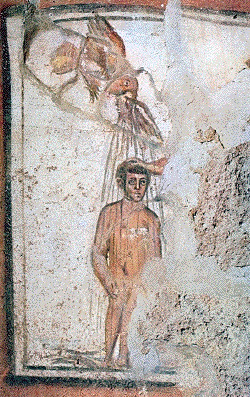
 
It says to baptize in living water, or other water. This is speaking of immersion. Then, they say, to pour water three times upon the head, if you can not use immersion.
Ah, now I see. My bad. The Church considers it acceptable, actually, and baptism by immersion was the norm until the 1100s. However, immersion does not mean fully putting someone under the water as we see done by many Protestants today. If you look at many drawings from the period, you’ll see that they are standing with water up to their waist, but it is also still being sprinkled over their heads.

 
And concerning baptism, baptize this way: Having first said all these things, baptize into the name of the Father, and of the Son, and of the Holy Spirit, in living water. But if you have no living water, baptize into other water; and if you cannot do so in cold water, do so in warm. But if you have neither, pour out water three times upon the head into the name of Father and Son and Holy Spirit. But before the baptism let the baptizer fast, and the baptized, and whoever else can; but you shall order the baptized to fast one or two days before.
“…Baptism is performed in the most expressive way by triple immersion in the baptismal water, However, from ancient times it has also been able to be conferred by pouring the water three times over the candidate’s head.” (Catechism of the Catholic Church #1239)

Seems like the Church’s teachings are in line with the Didache. If both ways are taught from apostolic times as being acceptable, and at one time one way is more common, and at another the other way is more common, I’m not sure how that is a doctrinal change.

–Jen
 
James,

Tell me, how could the RCC have existed in its present form with its elaborate hierarchical structure in 96 AD when Christianity was illegal and underground for nearly 300 years. There were no church buildings, bur rather people gathered in small groups, often in homes. When Clement wrote of the “catholic” church, (note the small “c”) he was referring to the meaning of “universal” which is what catholic means. He was talking about the Universal Church that Christ built. The very Church which consists of the body of true believers whom Christ Himself is coming back for. When the RCC formed and organized under Constantine’s rule, who made it possible for buildings to be erected, the Roman Church adopted the use of the word “catholic.”

James, you wrote: On another point, since you believe that the Catholic Church “Formed” around 300 under Constantine, and the Catholic Church, indeed any church, was not preserved from error, how is it that you accept the Bible??

Since the Holy Spirit is the author of the Holy Scriptures they were canonized the moment they were written and no council was needed to tell us that. The apostle Paul said he had preached the entire gospel, that of Christ and Him crucified. If Paul failed to tell us of any other things needed for salvation, etc. then he was not being truthful in his claim. God never says in His holy Word that anything else is needed. Man says that. 1Timothy 3:15 tells us that the Scriptures are profitable for reproof and correction of doctrine. That tells me that the Holy Bible itself is more than sufficient.

Rev. 2 tells us about the local churches. The Lord admonishes some for forsaking their first love. For falling and their need to repent. Some were holding to the teaching of balaam. These passages reveal that when a church continues in Christ’s Word, it keeps its identity as His church, but when it fails to abide in His Word, it is no longer regarded as His church. It reveals that Christ did not establish His church as one that could never fall into error, because some of those churches went into error.

The RCC only subsequently ratified the decisions** which had already been reached by the Christian communities**, or more exactly, by the individual believers. The organized Church as such did not create the Canon; it recognized the Canon which had already been created. An Orthodox leader admits: “The councils did not legislate the canon so much as set forth what had become self-evident truth and practice within the churches of God.” (Which Came First: The Church or the New Testament?, Fr. James Bernstein, Orthodox churchman, 1994, p 13)

No church council set the canon, and it was not by “church authority” that the canon was set. Rather there was a common understood canon of 22 books that had never been questioned and widely distributed since 100 AD, along with 5 other books that were in full circulation since 100 AD, but questioned.

Instead of repeating over and over what your church has taught, which by its repetitions does not make something true, research the history of Christianity.
 
James,

Tell me, how could the RCC have existed in its present form with its elaborate hierarchical structure in 96 AD when Christianity was illegal and underground for nearly 300 years. There were no church buildings, bur rather people gathered in small groups, often in homes.
Where did I ever say in this conversation that the Church in 96 AD looked like the church of today? I said that the Church was One and shared the same doctrines.
I have already demonstrated from Scripture where a local Church appealed to a higher authority for a determination on a doctrinal matter (Acts 15). Acts 15 flies in the face of your assertion that the local churches were autonomous.

If you could demonstrate from Protestantism, the kind of interaction, the kind of Church councils we see in Acts and later, where Protestants meet together and hammer out decisions that require all to submit their personal wills for the sake of Truth and Unity then you might have a case for saying Antioch was independent of Corinth.
When Clement wrote of the “catholic” church, (note the small “c”) he was referring to the meaning of “universal” which is what catholic means. He was talking about the Universal Church that Christ built. The very Church which consists of the body of true believers whom Christ Himself is coming back for. When the RCC formed and organized under Constantine’s rule, who made it possible for buildings to be erected, the Roman Church adopted the use of the word “catholic.”
Here you have a seed of truth. Clement used the word catholic. Catholic means universal. Just as it means universal today. The Catholic Church is the “universal” Church. It is the Church which consists of the Body of true beleivers and within that body of believers is a structure that allows us to maintain unity, and preserve Christ’s teachings and Truth. The Catholic Church consists of the Latin Rite as well as a number of Eastern Rites. All under the Guardianship of the Vicar of Christ and awaiting the REturn of Our Lord Jesus Christ.
Trying to seperate the Structure from the members is an impossibility. No large group of members exists without some kind of structure.
As to the reference to Constantine and the buildings etc. Of course it is logical that, once the Church was legal, she could come out of hiding and develop above ground.
James, you wrote: On another point, since you believe that the Catholic Church “Formed” around 300 under Constantine, and the Catholic Church, indeed any church, was not preserved from error, how is it that you accept the Bible??
Since the Holy Spirit is the author of the Holy Scriptures they were canonized the moment they were written and no council was needed to tell us that. The apostle Paul said he had preached the entire gospel, that of Christ and Him crucified. If Paul failed to tell us of any other things needed for salvation, etc. then he was not being truthful in his claim. God never says in His holy Word that anything else is needed. Man says that. 1Timothy 3:15 tells us that the Scriptures are profitable for reproof and correction of doctrine. That tells me that the Holy Bible itself is more than sufficient.
  1. 2Tim 3:16 tells us that All Scripture is useful… (Note it says useful, not sufficient)
  2. 1Tim 3:15 tells us that That it is …The “Church” which is the House of God, the Pillar And Ground of Truth.
    So St Paul himself tells us that Scripture is useful but that it is the Church which upholds the Truth. Again, look at Acts to see how the church members, including St Paul himself looked to the Church council in Jerusalem to resolve a “Scriptural” debate.
The Holy Spirit of God inspired the writing of Scripture, but it was written by men.(2Tim 3:16)
The RCC only subsequently ratified the decisions** which had already been reached by the Christian communities**, or more exactly, by the individual believers. The organized Church as such did not create the Canon; it recognized the Canon which had already been created. An Orthodox leader admits: “The councils did not legislate the canon so much as set forth what had become self-evident truth and practice within the churches of God.” (Which Came First: The Church or the New Testament?, Fr. James Bernstein, Orthodox churchman, 1994, p 13)
No church council set the canon, and it was not by “church authority” that the canon was set. Rather there was a common understood canon of 22 books that had never been questioned and widely distributed since 100 AD, along with 5 other books that were in full circulation since 100 AD, but questioned.
So, by your line of reasoning above, the canon of the Bible, as adopted by the RCC in 400 AD, has to be correct, since all the Church did was to gather together the books that the Holy Spirit had shown to the faithful as being “Holy Scripture”.
In such a vital matter as the canon of Scrpture it is unlikely that the Holy Spirit of God is going to allow an error in such a collection by including wrong books or excluding right books. So why is it then, that the Bible as used by Protestants has a different canon thant the one accepted and used by the Universal Christian Church for 1000 years before that? Why does your bible have books missing?
If Gods Word as contained in the Holy Bible is to be accepted as complete then one or the other of these is wrong. Which is it? This cannot be readily determined from the bible istelf for no book in the Bible lists the books in the Bible. This must be deremined by an authority outside of the Bible. Namely the Church.
Rev. 2 tells us about the local churches. The Lord admonishes some for forsaking their first love. For falling and their need to repent. Some were holding to the teaching of balaam. These passages reveal that when a church continues in Christ’s Word, it keeps its identity as His church, but when it fails to abide in His Word, it is no longer regarded as His church. It reveals that Christ did not establish His church as one that could never fall into error, because some of those churches went into error.
I will read up on these when I have a chance.
Instead of repeating over and over what your church has taught, which by its repetitions does not make something true, research the history of Christianity.
Why do you assume I am just parroting that which the Church has taught.
I left the church for 30 years before coming back. My research led me home to the Catholic Church.
Why won’t you, for your part, take a good honest look at the facts as recorded in the NT that Christ wants us to submit to His Church and that His Church has authority on Earth to Act in His will.

Peace
James
 
I am Proud of the Catholic Church and to be Catholic?

1.Catholic Church was prefigured by Old Testament prophets.
2.Catholic Church has a Holy Founder in Jesus Christ.
3.Catholic Church was built upon the Rock of Peter and the foundation of the Apostles.
4.God guaranteed that the Gates of Hell would not prevail against it.
5.Jesus Christ said it would last forever, as He would be with it always.
6.Therefore it can be found in every day, in every century, from the time He said it.
7.Jesus Christ left His legacy, the Kingdom of GOD, His Church, to the care of the Apostles.
8.Catholic Church is guided by the Holy Spirit. Acts 15:28
9.Catholic Church is a living Church.
10.Catholic Church is the Mystical Body of Christ.
11.Catholic Church can neither be confused nor separated from its head.
12.The thread of the Church is woven throughout Holy Scripture.
Catholic Church is a Christ based Church, whereas the Bible is Catholic Church based.
13.Catholic Church has all of the pieces to the puzzle.
14.Catholic Church is indefectible. Ephesians 5:27
15.Catholic Church is The Bride of Christ.
16.Catholic Church is infallible in matters of faith and morals since it is guided by the Holy Spirit.
17.Catholic Church is infallible in its teaching of Holy Scripture since it is guided by the Holy Spirit.
18.Catholic Church fits the blueprint laid out for it in Holy Scripture.
19.Catholic Church is a visible Church that could not be hidden.
20.Jesus Christ would be the invisible head and we, the body of His Church.
21.His Church would cover the earth. Matthew 28:19, Acts 1:8.
22.GOD appointed a visible Father Figure to shepherd His flock on earth, as He had always done.
23.Catholic Church is the Pillar and the Foundation of Truth. 1Timothy 3:15
24.Catholic Church alone has the fullness of truth.
25.GOD’s Church would have an hierarchal form of government.
26.GOD’s Church would have Bishops, Priests, and Deacons within it.
27.Catholic Church has a system of Apostolic Succession in order to perpetuate the visible Church on earth.
28.Catholic Church is traceable through an unbroken line of Apostolic Succession all the way back to St. Peter.
29This unbroken line is shown in secular encyclopedias as well as Catholic archives.
30.Catholic Church has a succession of truth in teaching all the way from 31.Jesus Christ down to present day Bishops.
32.Catholic Church is almost 1500 years older than the oldest Protestant church.
33.Catholic Church has the authority to abolish or enforce rules of conduct, through binding and loosing.
34.Catholic Church has the authority to forgive or to retain sins, through binding and loosing. John 20:21-23
35.Catholic Church teaches that we are not automatically saved, but our salvation depends upon us as well.
36.Catholic Church has the authority to form Councils when needed, in order to settle the issues that arise. Acts 15
37.Catholic Church was given the authority to decide the Canons of both the Old and New Testaments of Scripture.
38.Catholic Church decided the Canon of both testaments by infallible decision of several Councils.
39.Catholic Church more finely develops revealed public revelation.
40.Catholic Church does not twist Scripture to conform to its teachings. It conforms its teaching to Scripture.
41.Catholic Church has faithfully copied and preserved Holy Scripture down through the ages.
42.Catholic Church has known that The Word was Heard and not Read by the masses before the printing press.
43.Catholic Church has the final authority. Matthew 18:15-18
44.Catholic Church holds many traditions which are followed by Catholics and Protestants alike.
45.Catholic Church is an “And” Church, not “Or”.
46.Catholic Church is a teaching Church as commanded by Holy Scripture.
47.Catholic Church is consistent in its teaching and does not ‘flip-flop’ as do other churches for the whims of people.
48.Catholic Church faithfully feeds the sheep as commanded by Jesus Christ.
49.Catholic Church is rock solid and unchanging in its teaching.
50.Catholic Church stands upon a solid three legged stool, of Scripture, of Apostolic Tradition, and the Magisterium.
51.Catholic Church is the guardian of both Sacred Scripture and of Sacred Tradition.
52.Catholic Church has the True Presence of Jesus Christ in the Holy Eucharist. Matthew 26:26
53.The Apostles knew that the truth was in Jesus Christ and in His one true Church.
54.Catholic Church has Eucharistic Adoration.
55.Catholic Church offers a clean oblation around the world and around the clock, in the Holy Mass. Malachi 1:11
56.In every minute of every day, a Mass is being celebrated somewhere.
57.Catholic Church venerates Christ on the Cross as a sacrifice and not just a plain cross devoid of Christ.
58.Catholic Church preaches the Gospel to the whole world. Matthew 24:14
59.Catholic Church has produced many thousands of Holy Saints.
60.The Church venerates the Mother of GOD. Luke 1:26-56
61.The Church venerates the Saints who have done so much for it.
62.The Mother of GOD is also the Mother of the Church. John 19:26-27
63.Catholic Church has all seven Sacraments.
64.Catholic Church treats marriage as a Sacrament.
65.Catholic Church has an annulment procedure.
66.Catholic Church has many varied Devotions.
67.Catholic Church can be found by its name, the Catholic Church, in thousands of early writings.
68.Catholic Church can be shown from these same writings that it is the same Church which Jesus Christ founded.
69.Catholic Church houses the remains of all of the Apostles and Gospel writers.
70.Catholic Church is the New Jerusalem.
71.Catholic Church is our Mother Church.
72.Catholic Church has withstood the ravages of thousands of detractors and heretics from its very foundation.
73.Catholic Church has performed many successful exorcisms.
74.Catholic Church is unbending and unmovable in its pro-life stance.
75.Catholic Church has scores of separate services of help. 1Corinthians 12:28
76.Catholic Church preaches the Word of GOD to the entire world through E.W.T.N. and other resources.
77.Catholic Church tries to unite all of Christianity into one fold.
78.Catholic Church has incredible openness.
79.Catholic Church Has provided us with a comprehensive catechism.
80.Catholic Church has a vast influx of intellectuals
sdtouchton.webs.com/proud2bcatholic.htm
This is an exceptional list that you took the time to post on this particular thread!👍
I am going to make some copies of this stupendous list and give it to all the
folks I have on my prayer list for conversion. :o
 
Something to consider – I had a great deal of trouble with scrupulosity starting in my late teens and then got relief from a good spiritual director, Scrupulous Anonymous, and other sources. Something in TristanCross’s mention of fear struck a chord in me and made me wonder if perhaps the fear and anxiety need to be addressed and the theological issues only later – and maybe they would be easier to resolve with more peace of mind.

I used to live in constant fear of sin. One terrible day, I wrote a journal entry exploring what I saw as my only options – leaving the Church or taking my life. By the grace of God, I met my first spiritual director soon afterward and found resources on scrupulosity that helped me discover and deepen my knowledge of our loving, merciful God – right in the Catholic Church! :newidea:

Many years later, I watched the movie “Luther” about Martin Luther, and read things that indicated that he suffered from fears such as mine. He dealt with them by starting a different church with different theology, but I wonder if he had received some consolation for his fears if he would have taken such a drastic step. I mean no disrespect to Lutherans who might be reading this, btw. Just giving TristanCross some food for thought.

:blessyou: – I will also pray for you. Be at peace – pray simply, ask God for help, go slowly.
 
Yankee Drifter,
I Have started a New Thread relating to the issues we have been discussing about Church autonomy and Authoroty. It is Here

Peace
James
 
James,

Let’s look at the book of Acts and the so-called Council of Jerusalem. It in no way resembled the General Councils of the RCC, either in its history, its constitution, or its object. It was not a convention of ordained delegates, but a meeting of the entire church of Jerusalem to receive a deputation from the church of Antioch. Even Paul and Barnabas seem to have had no vote in the decision, nor was their allegiance due in any way to James. It consisted not of the apostles alone, but of apostles, elders, and brethren. We know that Peter, Paul, John, Barnabas, and Titus were present, perhaps all the other apostles. James presided as the local bishop, and proposed the compromise which was adopted. The transactions were public, before the congregation, and the brethren took part in the deliberations. Although the discussion was sharp, the spirit of love prevailed over the pride of opinion. The apostles passed and framed the decree not without, but with the elders and with the whole church and sent the circular letter not in their own name only, but also in the name of “the brother elders” or “elder brethren” to “the brethren” of the congregations disturbed by the question of circumcision.

All of this clearly proves the right of Christians to take part in some way in the government of the church, as they do in the acts of worship. The spirit and practice of the apostles favored a certain kind of popular self-government, and the harmonious, fraternal co-operation of the different elements of the church. No distinction of clergy and laity is even remotely hinted at. All believers are called to the prophetic, priestly, and kingly offices in Christ. (1 Peter 2:9)

It was the Greek and Roman churches which gradually departed from the apostolic polity and excluded not only the laity, but also the lower clergy from all participation in the legislative councils. Paul himself refused to be tied down to particular patterns of behavior and practice. In 1 Cor 9:20-23. he does not engage in a dispute with those Corinthians who apparently feel quite free to eat anything offered to idols, never appealing or even mentioning the Jerusalem council.
 
James,

In 1 Timothy 3:15 when Paul speaks of the church as the pillar and foundation of the truth, he does not mean the church is the source from which truth will come. Pillars and foundations are not sources. Rather, Paul is echoing the point made often in Scripture that Christ has entrusted the truth to the church and wants the church both to preserve that truth and to proclaim it. In his Great Commission (Mt 28:20; Eph 3:10) Jesus tells believers, the church, to go to every nation with the gospel and teach people to obey and preserve everything Jesus told us. John warns that anyone who adds anything to the Word of God, given us in the Bible by inspiration of the Holy Spirit, will lose his place in heaven (Re 22:18-19). All the churches down through history that have claimed the right to add to the Bible, not only have disregarded this warning, but they have added things that are contrary to what the Bible says, thus earning God’s double condemnation (2 Pe 2:1-2).

The local church is described in Galatians 1:1-2: “Paul, an apostle…and all the brothers with me, to the churches in Galatia.” Here we see that in the province of Galatia there were many churches: what we call local churches. A Baptist church, Lutheran church, Catholic church, etc, is not the church, as in the “universal church,” but rather is a local church, a local body of believers. The universal church is comprised of those who belong to Christ and who have trusted Him for salvation. These members of the universal church should seek fellowship and edification in a local church.

It is not even possible for the RCC to be the original Christian church. The apostles came to Rome rather late in the NT. There was a congregation in Rome, served by Paul and maybe later by Peter, but the RCC is vastly different concerning many core doctrines and dogmas. The errors of the RCC are similar to the errors made during the apostolic era by the opponents of the apostles, for example, in the Judaizers who opposed Paul in regard to the doctrine of justification by faith alone and in Diotrophes who opposed the apostle John by setting himself up as a “little pope”.

Let’s examine some of the doctrines of the RCC. Prayers to Mary and the saints is not scriptural. The Scriptures are very clear about why praying to anyone but the Triune God is wrong:
Prayer is worship (Mt 15:8-9), and we are to worship only God (1st Commandment);
Scripture urges us to pray to God (Phi. 4:6), but never tells us to pray to any human being, nor is there any example in Scripture of any believer praying to anyone but God.
We have only one mediator between God and us, namely, Jesus. (1 Ti 2:5).
Those who have died cannot communicate with us nor we with them (Is 63:16)

Scripture nowhere says that Mary was sinless, nor was she taken to heaven bodily. Mary has absolutely nothing to do with our salvation. She is not co-redeemer. Salvation is only found in Jesus.

Purgatory is not scriptural. Christ taught there are only 2 gates, 2 roads, 2 groups of people and 2 eternal destinies. The Bible says nothing about any sins being able to be forgiven in eternity. Once a person is in hell he stays there. Heb. 1:3 tells us that Jesus by Himself has effected man’s purgation from sin. So there is no purification after death.

The sacrifice of the Mass is not scriptural. The Bible tells us there is no forgiveness of sins without the shedding of blood. No more sacrifice is needed since Christ shed His blood on the Cross.

Only God can forgive sins, a priest cannot absolve us and Christ is the only Mediator between man and God. Look at Simon the sorcerer and his experience with Peter. Instead of hearing Simon’s confession and giving absolution, Peter sent Simon to the only One who can forgive sin: God.

The RCC teaches that salvation cannot be guaranteed or assured. 1 John 5:13 states that the letter of 1 John was written for the purpose of assuring believers of the CERTAINTY of their salvation.

The Bible contains God’s eternal truths about salvation for mankind. It is the Holy Spirit that is the teaching authority of the church not the Pope or any anointed man. The Spirit was sent into the world to convince men of sin, righteousness and judgment. He is an infallible Person like Christ.

The church did not give us the Bible the apostles did, and they began the church that Jesus founded. The Bible can exist where there is no church building or assembly but the church cannot exist where there is no Bible.

The Holy Spirit is the source of Scripture and all spiritually reborn believers in Jesus Christ are given the indwelling Spirit to interpret what He wrote. What better guide and teacher can we have than the same One who inspired the apostles to write Scriptures. 2 Peter 1:21 tells us the Bible did not come to be by the will of men, but holy men spoke as they were moved by the Holy Ghost.
 
Ah, yes. Lone Ranger Christianity. Just me, my Bible, and Jesus Christ as my personal Savior.

I always wondered, if Jesus wanted the Bible to be the sole authority for His followers then why didn’t He write any of it?
 
Yankee,
I have copied your posts to the new thread that I referenced above.
Please see comments there.

Peace
James
 
Why didn’t Jesus write any of the Bible?
The Gospel was transmitted orally before it was written down. Jesus taught it and many of His sayings, parables and miracles were later put in writing for preservation by holy men who were moved by God, the Holy Spirit. We see the Triune God very much involved with the Holy Scriptures. The promise of a Savior made to Adam and Eve (Genesis 3:15) was repeated for generations until the writing of the Pentateuch by Moses. However, after God chose to have his Word recorded in written form He bound His people to what was written ( Deut 4:2, Joshua 23:6). Only God could add to it from time to time through his prophets. Jesus said that this written record was sufficient for salvation. In the story of the rich man and Lazarus the truth is stated, “If they do not listen to Moses and the Prophets, they will not listen even if someone rises from the dead” (Luke 16:31). “Moses and the Prophets” was a standard designation for the Old Testament canon. Of the sufficiency of Scriptures Paul assures Timothy, "You have known the Holy Scriptures which are able to make you wise for salvation through faith in Christ Jesus. The prophets and apostles claimed that what they were speaking and recording was God’s Word.

The apostles equated what they spoke with what they wrote (1 John 1:2-4). Paul equates his oral proclamation with his written proclamation, “So then brothers, stand firm and hold to the teachings (traditions) we passed on to you, whether by word of mouth or letter” (2 Thess. 2:15). That means that oral tradition has nothing to add to the written Word. The apostles spoke and wrote the same message.

How do we know where to find the message of the apostles with certainty?" The writings of the NT have been preserved for us. According to Paul and John what they taught orally is what they wrote (1 John 1:2-4, 2 Thess. 2:15). And Paul did not hesitate to repeat in writing what he had already taught, so that his readers might be certain. “It is no trouble for me to write the same things to you again, and it is a safeguard for you” (Phil. 3:1). The written Word gives certainty.

If Catholic tradition agrees with the Bible, we don’t need the tradition. If it disagrees with the Bible, it can’t be right. One must reject tradition that disagrees with the Bible. It is not merely an addition to the Bible. It is against the Bible. Rev. 22:18-19 are an example of a warning against either adding to or subtracting from the Bible.

Did the Holy Scriptures fail to tell us what is needed for salvation? If it did, then what is missing? If not, then what do we need tradition for? We have no certainty as to what might have been passed on orally, but we have certainty in the written record.

The Apostle John calls Jesus “the Word.” The Holy Scriptures are also God’s Word.
 
Any church that nullifies the Gospel of grace by adding additional requirements for salvation, such as church membership, the 7 sacraments, obeying the commandments, good works and the repeated sacrifice of Christ in the mass as being necessary for salvation, is not the church Christ built. It is another gospel, and those who teach it are condemned (Gal 1:6-9). The Scriptures nowhere teach that priests are needed to dispense salvation through seven sacraments. It nowhere teaches that a person can gain a right standing before God by what they do instead of believing what God has done for them through Christ. The Bible does not teach we “can merit the graces needed for the attainment of eternal life”, nor must we attain our own salvation. To believe this is to deny salvation on the merits of Christ alone

Indulgences are not scriptural. Neither Jesus nor the apostles ever taught one can attain their own salvation and at the same time cooperate in saving their brothers". The pope claims to have the power to transfer the merits of one sinner to another to reduce their punishment for sin. “An indulgence is a remission of the temporal punishment due to sins which the sinner gains through the Church, which dispenses from the Vatican treasury the prayers and good works of Mary and all the saints”. Rome also “commends alms giving and works of penance undertaken on behalf of the dead”. From Scripture we know that “no man can redeem the life of another or give to God a ransom for him, the ransom for a life is costly, no payment is ever enough” (Psalm 49:7-8). They condemn the Gospel of grace

For over 400 years Rome has not only preached a different gospel but also has condemned anyone who believes the glorious Gospel of grace that Paul taught. The Councils of Trent and Vatican II issued over 100 anathema’s (condemnations) on anyone who believes salvation is by grace alone, through faith alone, in Christ alone.

In Acts 16 when the Jailer asked: What must I do to be saved"? What was Paul and Silas’ response? “Believe on the Lord Jesus Christ”. They preached Christ to him and he and his family were baptized. From that moment the jailer’s heart was transformed. Paul never said the jailer would have to perform church “works” his entire lifetime. Why not? Because the atoning blood sacrifice of Christ on the cross at Calvary, paid this man’s and our, sin debt in full. What Christ requires of us is full acknowledgment of this. He requires a repentant humble heart who admits he/she is a lost sinner who can never do enough “good works” to save ourselves. Remission of sin cannot suffice God without the shedding of blood. Only Jesus Christ saves and He alone is the way to God, the Father. The apostle Paul understood that he could do nothing to save himself; it is the grace of God.
 
All of those things you say are wrong stem from believing. If any man is saved, it is through Christ.
 
James,

Your church believes that Scripture alone is false based on the claim that sola scriptura is not found in the Bible. As I’m sure you know, not every doctrine taught in Scripture is taught explicitly by book, chapter and verse. Many doctrines are taught by way of logical and necessary deduction. For instance the word ‘Trinity’ is not used in the Bible. Few would argue that the Trinity is not more implicitly taught than explicitly.The same may be said of the righteousness of Christ imputed to the believer for justification. This doctrine surfaces in light of the overwhelming implicit evidence. Even Roman Catholicism admits that the Bible is at least one part of the inspired Word of God.This admission, that the Bible is at least one part of the divinely inspired Word of God, then places the burden of proof upon Rome, to show there are other sources of equal weight.

Please provide evidence that Tradition, Sacred Scripture and the Magisterium are so closely connected that one cannot stand without the others. Prove if you can, that Scripture,Tradition and Magisterium must be accepted and honored with equal sentiments. Show me the evidence that the RCC Magisterium has Divine Authority to produce Divinely inspired tradition which is equal to the Scripture. I am referring to more than Apostolic Succession. I’m talking about an actual passing down of the gift of inspiration itself.

In Rom.3:2 it says that the Jews were entrusted with the “Oracles of God”. However, the nation of Israel was not infallible (and never claimed to be). Yet, God used a fallible people to establish and preserve the entire canon of the OT.

My point is that if God can give to His very fallible nation an infallible Word preserved in writing, why should it be demanded that He do something different in preserving the NT? The point is that it is absolutely unnecessary to stipulate an infallible Church to produce an infallible Word. In the case of the OT it is just the opposite. We find God’s infallible Word in the midst of a most visible and excruciatingly imperfect nation.

God gave us an Infallible Person, the Holy Spirit, which teaches, interprets and reveals God’s will.

.
Look for reply on the "Were the NT churches independent thread.

Peace
James
 
Status
Not open for further replies.
Back
Top